
Autonomous Networks Market Outlook: Size, Share, Trends, Growth Analysis, Competitive Landscape & Forecast, 2026-2033

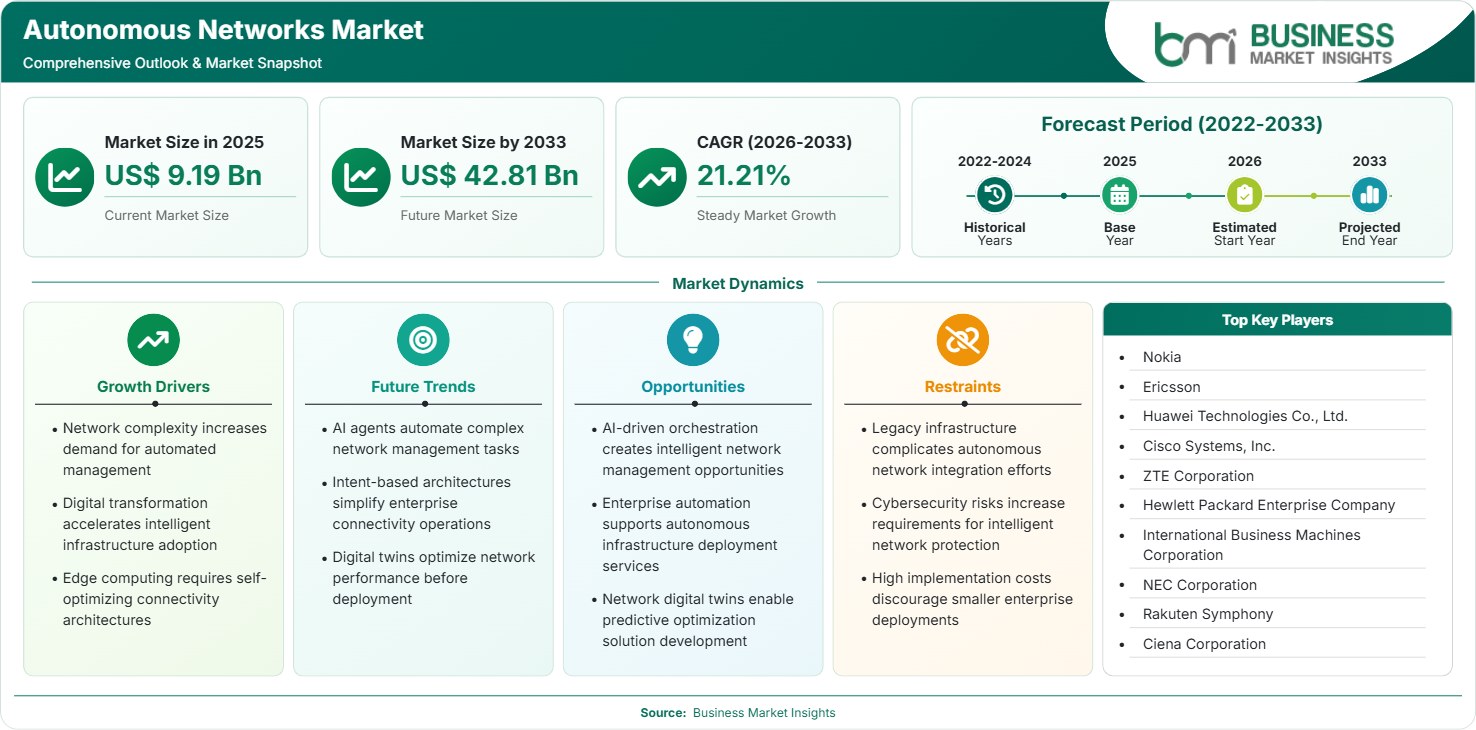
The Autonomous Networks Market size was valued at US$9.19 Billion in 2025 and is projected to reach US$42.81 Billion by 2033, growing at a CAGR of 21.21% during 2026–2033, driven by AI automation, 5G complexity, cloud adoption, resilience, and closed-loop operations.

Report Coverage
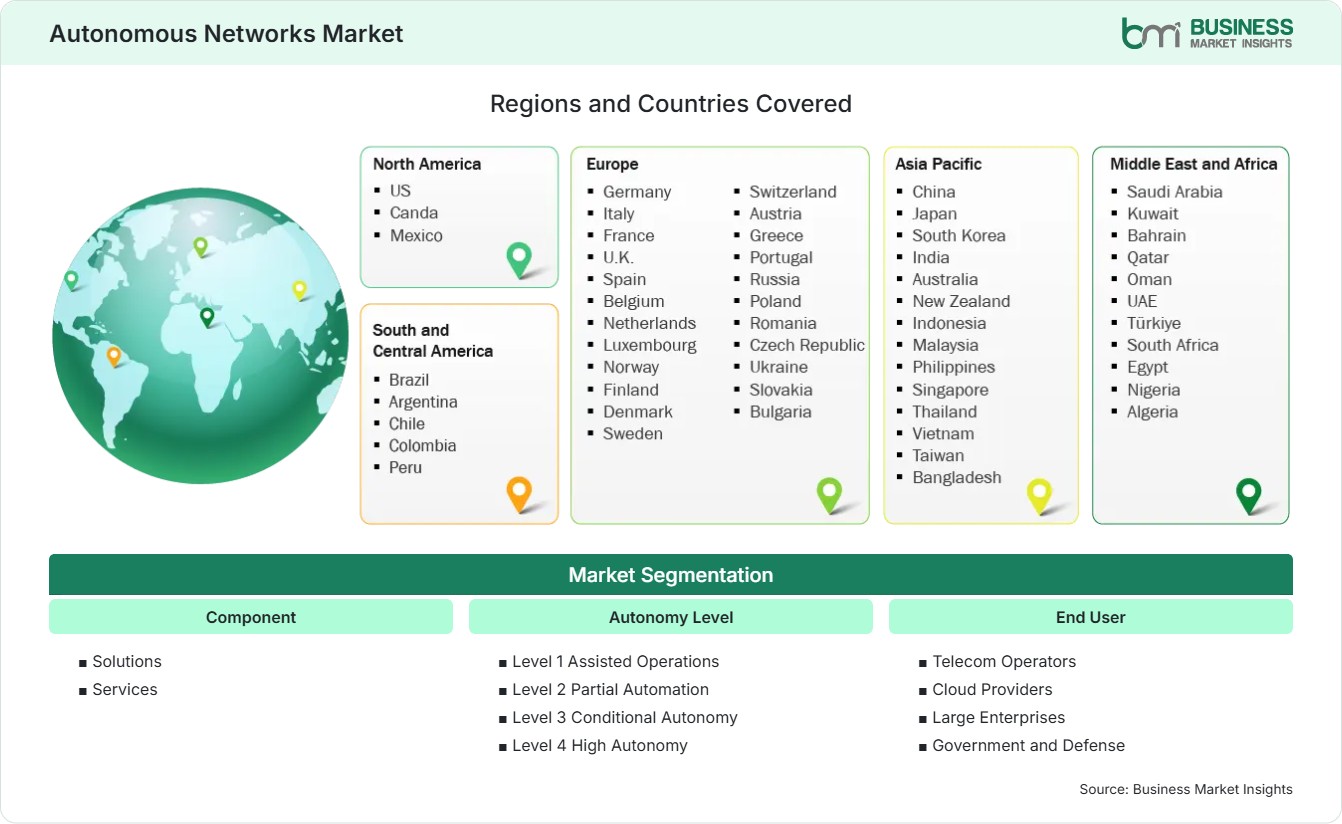
  • Component: Solutions, Services
  • Autonomy Level: Level 1 Assisted Operations, Level 2 Partial Automation, Level 3 Conditional Autonomy, Level 4 High Autonomy
  • End User: Telecom Operators, Cloud Providers, Large Enterprises, Government and Defense
US$ 9.19 Bn Market size in 2025
US$ 42.81 Bn Market Size by 2033
21.21% CAGR, 2026 - 2033
2026-2033 Forecast Period

AI Overview

Autonomous Networks Market Summary

  • North America Region: North America holds a 35%–38% Autonomous Networks Market share in 2025 and grows at a 19%–21% CAGR, supported by hyperscale cloud investment, AI workloads, 5G modernization, enterprise automation, and resilient infrastructure. The U.S. remains the primary contributor, with advanced telecom automation and AI infrastructure supporting an 18%–20% CAGR through 2033.
  • Fastest Growing Region: Asia Pacific holds a 27%–30% share in 2025 and expands at a 23%–26% CAGR, supported by 5G deployment, cloud adoption, AI investment, digital transformation, dense network infrastructure, and government-backed connectivity programs.
  • Leading Segment: Solutions account for a 58%–62% share in 2025 and advance at a 20%–22% CAGR, supported by orchestration, intent-based networking, AI assurance, digital twins, analytics, and closed-loop automation.
  • High Growth Segment: Level 4 High Autonomy represents a 22%–26% share in 2025 and advances at a 24%–27% CAGR, driven by agentic AI, autonomous decision-making, predictive assurance, digital twins, and cross-domain orchestration.
  • Key Market Opportunity: Agentic AI enables networks to move from task automation toward goal-driven operations, creating opportunities in autonomous assurance, multi-agent orchestration, digital twins, energy optimization, and service management.
  • Major Market Players: Nokia, Ericsson, Huawei Technologies Co., Ltd., Cisco Systems, Inc., ZTE Corporation, Hewlett Packard Enterprise Company, International Business Machines Corporation, NEC Corporation, Rakuten Symphony, and Ciena Corporation.
Strategic Insights

Autonomous Networks Market: Strategic Insights

Autonomous Networks Market Strategic Framework
FREE PDF
Request your free sample
Request free sample
Stakeholder View

Key Takeaways

  • The ecosystem is moving toward integrated platforms connecting telemetry, orchestration, AI agents, assurance, cybersecurity, and cloud infrastructure rather than isolated automation tools.
  • Closed-loop assurance, fault remediation, energy optimization, service orchestration, and capacity management provide substantial opportunities as organizations progress toward higher autonomy.
  • Agentic AI is shifting network software from predefined workflow execution toward intent interpretation, contextual reasoning, dynamic decision-making, and controlled action.
  • Asia Pacific offers strong expansion potential because 5G deployment, cloud modernization, AI investment, and digital transformation are progressing simultaneously across major markets.
  • Investment is increasingly converging networking, observability, AI, and automation. The integration of Juniper Networks into Hewlett Packard Enterprise illustrates this broader technology convergence.
  • Interoperability remains critical because autonomous systems must coordinate multi-vendor infrastructure, heterogeneous data, AI models, and existing operational systems.
Geographic Outlook

Autonomous Networks Market Regional Highlights

North America Autonomous Networks Market

North America accounts for a 35%–38% share in 2025 and expands at a 19%–21% CAGR through 2033. The region benefits from cloud infrastructure, AI workloads, telecom modernization, enterprise automation, and sophisticated network operations. The U.S. represents the largest contributor. Investment is concentrated in autonomous assurance, data-center networking, private connectivity, and AI-ready infrastructure, creating demand for integrated software and services across telecommunications, cloud, and enterprise environments.

  • AI infrastructure investment is increasing demand for programmable networks capable of dynamic capacity allocation, anomaly detection, and workload-aware optimization.
  • Telecom operators are prioritizing automation as 5G, edge computing, virtualization, and multi-vendor environments increase operational complexity.
  • Cloud providers are expanding network intelligence across data centers and distributed computing environments, supporting autonomous provisioning and predictive assurance.
  • Enterprise adoption is broadening through AIOps, software-defined networking, and security automation across distributed infrastructure.

US Autonomous Networks Market

The U.S. represents 72%–76% of North American demand in 2025 and grows at an 18%–20% CAGR through 2033. Hyperscale cloud investment, enterprise networking, telecom modernization, and AI infrastructure deployment support adoption. Service providers increasingly connect telemetry with AI assurance and orchestration, while enterprises automate campus, branch, data-center, and hybrid-cloud operations. Federal modernization also supports resilient infrastructure requirements.

  • Hyperscale AI infrastructure is creating demand for high-capacity networking with automated monitoring, optimization, and remediation.
  • U.S. telecom operators are expanding intent-based networking and AI assurance to manage complex 5G and enterprise connectivity requirements.
  • Enterprise vendors are integrating multi-agent AI for troubleshooting, configuration-drift detection, and controlled remediation.

Europe Autonomous Networks Market

The Europe region accounts for 25% - 28% in 2025 and is expanding at a 20% - 22% CAGR through 2033. The dominant markets in Europe include Germany, the UK, France, and Nordic countries, whereas Spain and Italy present higher growth potential. Efficiency, energy management, reliability, and automation are the key focus areas for operators. Cybersecurity, sustainability, data governance, and cross-border network complexity reinforce demand for controlled autonomy across critical infrastructure.

  • Germany and the United Kingdom show strong demand for automated infrastructure management, AI operations, and resilient digital services.
  • France and Nordic markets are advancing network intelligence through 5G modernization, cloud-native architecture, and energy optimization.
  • Spain offers high-growth potential through telecom transformation and participation in international autonomous-network initiatives.
  • European operators increasingly require auditability, rollback mechanisms, transparent AI governance, and interoperability.

Asia Pacific Autonomous Networks Market

Asia-Pacific is projected to hold a 27%-30% market share in 2025 and will experience the highest regional growth rate, at a CAGR of 23%-26%, until 2033. The key regions driving this market's development include China, Japan, South Korea, India, and Singapore, with significant growth potential in Southeast Asia. There are ample opportunities for automation owing to large-scale 5G networks, AI spending, cloud deployments, and digital infrastructure.

  • China benefits from large-scale operator investment, domestic technology development, and AI-enabled network programs.
  • Japan combines advanced mobile infrastructure with software-led modernization and AI-powered RIC deployment.
  • India offers high-growth potential through telecom digitization, 5G expansion, cloud adoption, and strong software capabilities.
  • Southeast Asian operators are adopting automation to manage network growth while controlling operating complexity and energy consumption.

Rest of World Autonomous Networks Market

South and Central America benefit from 5G, cloud computing, and telecommunications, whereas the Middle East and Africa prioritize resilience and digitalization. The Rest of World has an 8%-11% share in 2025 and an 18%-21% CAGR to 2033. Brazil, Saudi Arabia, and the UAE offer the best prospects, with robust technological investments in the Gulf region.

  • Brazil is advancing telecom modernization and cloud adoption, supporting automated assurance, optimization, and operational analytics.
  • Gulf markets are investing in digital infrastructure, AI, smart cities, and cloud platforms, supporting autonomous network applications.
  • Saudi Arabia and the United Arab Emirates combine connectivity expansion with AI investment and large technology programs.
  • African operators can use automation to improve efficiency across heterogeneous infrastructure without proportionate workforce expansion.
Global Market Geography
FREE PDF
Request your free sample
Request free sample
Segment Analysis

Autonomous Networks Market Segmentation

Component

The solutions accounted for 58% to 62% of the market in 2025 and are projected to grow at a 20% - 22% CAGR until 2033. The services will also expand to include integration, customization, migration, governance, and management for multi-vendor deployment environments, broadening the Autonomous Networks Market scope.

  • Solutions: Platforms integrate orchestration, assurance, AI analytics, digital twins, intent management, and automation engines for coordinated closed-loop operations.
  • Services: Consulting, integration, deployment, managed services, and training support architecture modernization, interoperability, governance, and operational transformation.

Autonomy Level

Autonomy adoption remains concentrated in lower and intermediate maturity stages, while Level 4 is developing fastest. Adoption depends on AI maturity, data quality, orchestration readiness, governance, and emerging Autonomous Networks Market trends.

  • Level 1 Assisted Operations: Human-led operations use monitoring, analytics, and recommendations, establishing data and workflow foundations for higher automation.
  • Level 2 Partial Automation: Repetitive provisioning, monitoring, and remediation become automated while human approval remains important for operational control.
  • Level 3 Conditional Autonomy: AI systems execute defined operations within controlled domains while humans manage exceptions and higher-risk decisions.
  • Level 4 High Autonomy: Networks interpret intent, reason over context, and execute closed-loop actions across domains using advanced AI and governance.

End User

Telecom operators are the largest end users, but more cloud providers and enterprises are also embracing the solution. The need for AI, network complexity, resilience, manpower, and changes in market adoption trends influence demand.

  • Telecom Operators: Operators deploy autonomy across RAN, transport, core, and service operations to improve efficiency, remediation, optimization, and customer experience.
  • Cloud Providers: Cloud operators require automated infrastructure coordination, observability, capacity management, and low-latency optimization for distributed AI workloads.
  • Large Enterprises: Enterprises apply autonomous capabilities across hybrid networks, campuses, branches, data centers, and security environments.
  • Government and Defense: Government and defense networks prioritize resilient, secure, auditable automation across complex and mission-critical infrastructure.
Market Forces

Autonomous Networks Market Dynamics

Key Market Drivers

AI agents are shifting networks toward closed-loop operations

The impact of AI agents on the Autonomous Networks Market growth lies in shifting the process from workflow-driven to context-based reasoning and action execution. The advanced autonomy paradigm relies heavily on intent-based design, closed-loop management, and AI-assisted decision-making. Multi-agent architectures are now being leveraged for drift detection, anomaly detection, troubleshooting, and corrective action. This further cements the trend of platforms that integrate telemetry, orchestration, analytics, and governance. Increasing network complexity of 5G, cloud, edge, and multi-vendor networks facilitates the adoption, as manual orchestration becomes increasingly difficult. The journey starts with fault management, service assurance, power optimization, and change management.

Network complexity is increasing the economic value of automation

Today’s networks span physical infrastructure, virtualization, cloud services, edge nodes, software-defined components, and multiple vendors, creating many dependencies for the operations team to track at once. The use of automation enables the correlation of information across topology, telemetry, configuration, and services, reducing fragmentation in troubleshooting. The value of commercial usage will be highest when automation affects availability, mean time to repair, usage, energy consumption, or service consistency. With the increase in software-defined infrastructure, there is greater demand for systems integration rather than for separate automation components.

AI workloads are redefining network performance requirements

AI Workloads Need High Throughput, Consistent Latency, Distributed Processing, and Constant Infrastructure Optimization. All these needs are resulting in a shift from connectivity-focused networks to intelligent infrastructure that can adapt to workload conditions. There is a need for predictive assurance, traffic engineering, dynamic resource allocation, and AI-based operations. In addition to telecom operators, cloud operators and enterprises are now significant buyers, thus increasing the addressable market size. As a result, vendors are combining networking, observability, AI, and automation into integrated platforms that detect workload changes, correlate infrastructure states, and execute controlled actions.

Key Market Opportunities

Agentic orchestration creates a new software value layer

According to the Autonomous Networks Market Forecasts, there are emerging opportunitithat coordinatesare designed to manage specialized agents in the network ecosystem. While conventional automation relies on static processes, agentic systems possess knowledge of their own objectives, contextual information, the coordination of competencies, and the execution of activities in line with policies. There are business prospects in agent coordination, policy engines, assessment methodologies, observability, security governance, and domain knowledge. Companies capable of connecting their agents to OSS, BSS, controllers, and network capabilities have an opportunity to adopt the software-and-services business model. Companies can develop their own agents for assurance, optimization, capacity, or configuration and integrate them into autonomous operations systems.

Energy optimization provides measurable deployment economics

Network energy management is a promising investment area, as applying AI-driven optimization will enable linking operational decisions to measurable resource usage. Autonomous systems can detect underutilized resources, predict traffic flows, and manage power-saving operations while ensuring that all service conditions are met. AI-powered RIC solutions demonstrate that optimization can be a practical starting point for introducing autonomy. This applies not only to RAN sleeping capabilities, workload management, cooling optimization, data center networking, and capacity management, but also to sustainability requirements, as they reinforce the business case for automation.

Digital twins can accelerate safer autonomy deployment

With digital twins, it is possible to validate autonomous decisions before deploying them into production. The integration of network topologies, configurations, telemetry data, and policies with simulated environments enables validation of failure conditions, optimization, and agent behavior. These opportunities may include simulation programs, real-time synchronization, model validation, and governance functions. Digital twins can also be used for educational purposes, rehearsals, capacity planning, and technology transfers. In most cases, the benefits of digital twins arise when performance must be guaranteed before more decision-making power is handed over to artificial intelligence. Simulation will become an important part of the process as autonomy is broadened from the task level to the cross-domain level.

Market Restraints and Challenges

Fragmented architectures complicate cross-domain autonomy

Factor: Diverse infrastructure, proprietary interfaces, different data models, and operational systems might pose obstacles to the creation of a reliable end-to-end context for autonomous agents. Impact: Operators would require considerable cross-domain integration to make decisions; therefore, it would take them longer to deploy and would incur higher transformation costs. Large operators have systems created across different technological generations. Open APIs, open architecture, standardized data models, and reusable components for automation might reduce friction, but they would still be implemented differently. Therefore, early deployments would be conducted in bounded domains where data quality and operational processes are established.

Trust, governance, and cybersecurity constrain autonomous decisions

Factor: Autonomous systems have the capacity to take important configuration and remediation actions using advanced AI models; hence, issues related to explainability, data integrity, model behavior, security, and accountability are raised. Impact: Human decision gates may be maintained by operators even when systems are capable of taking independent actions, because operators have the autonomy to hold off until they are comfortable with such actions. Enterprises and government institutions face additional data sovereignty and cybersecurity challenges. The vendors require audited actions, confidence scoring, policy control mechanisms, rollbacks, access control, and model evaluations.

Company Analysis

Competitive Landscape

Autonomous Networks Market analysis indicates competition among telecom equipment suppliers, networking vendors, cloud infrastructure providers, and software specialists. Competitive differentiation increasingly centers on AI orchestration, observability, intent management, digital twins, multi-agent capabilities, and integration.

Company Name

Overview

Products and Services relevant to this market

Nokia

Communications technology provider developing autonomous operations across major network domains.

Autonomous Networks Suite, agent libraries, SMO, AI-driven network automation and assurance.

Ericsson

Telecom technology company advancing AI-enabled, intent-driven network architectures.

Autonomous operations, AI assurance, digital twins, intent management, and closed-loop automation.

Huawei Technologies Co., Ltd.

ICT provider developing autonomous network technologies across telecom and enterprise environments.

Autonomous Driving Network, intelligent agents, digital twins, orchestration, and AI assurance.

Cisco Systems, Inc.

Networking provider extending AI and multi-agent capabilities across infrastructure.

Crosswork Network Automation, AI operations, assurance, telemetry, orchestration, and remediation.

ZTE Corporation

ICT vendor developing AI-native autonomous platforms for network operations.

Intelligent automation, telecom large models, agents, digital twins, and optimization.

Hewlett Packard Enterprise Company

Enterprise technology provider combining networking, AIOps, and self-driving operations.

HPE Aruba Networking Central, HPE Juniper Networking Mist, AIOps, and observability.

International Business Machines Corporation

Enterprise technology provider applying AI and automation to infrastructure operations.

AIOps, automation, hybrid-cloud management, observability, and infrastructure orchestration.

NEC Corporation

Japanese technology company developing AI-enabled autonomous network operations.

Agentic AI operations, 5G automation, lifecycle management, and orchestration.

Rakuten Symphony

Software-led provider focused on cloud-native, Open RAN, and network automation.

Symworld, RIC, OSS automation, AI optimization, and Open RAN orchestration.

Ciena Corporation

Networking and optical technology provider advancing intelligent network operations.

Blue Planet automation, AI frameworks, optical networking, assurance, and orchestration.

Trust & Transparency

Research Methodology

The market analysis combines proprietary research with secondary data from government agencies, company disclosures, regulatory filings, industry databases and expert interviews. Market estimates are validated through data triangulation, cross-market benchmarking and analyst review.

View Full Research Methodology

Questions Answered

Frequently Asked Questions

How can buyers evaluate an Autonomous Networks Market Report?

Buyers should examine methodology, base year, segmentation, regional definitions, vendor coverage, assumptions, and forecast methodology. A robust report should distinguish sourced observations from analyst modeling.

What role do standards play in autonomous network adoption?

Standards establish common maturity definitions, architectures, interfaces, evaluation methods, and effectiveness indicators, helping operators structure progression toward higher autonomy while supporting multi-vendor collaboration.

Which network domains are likely to adopt autonomy first?

Fault management, service assurance, RAN optimization, energy management, configuration validation, and capacity planning are practical starting points because they generate structured telemetry and measurable outcomes.

How does agentic AI differ from conventional network automation?

Conventional automation generally follows predefined workflows. Agentic AI can interpret goals, reason over context, coordinate specialized capabilities, and dynamically select actions within defined policies.

What infrastructure foundation is required before deploying high-autonomy networks?

A reliable foundation requires comprehensive telemetry, consistent data models, programmable interfaces, observability, policy controls, and rollback mechanisms. Organizations also need measurable operational objectives before granting AI systems greater execution authority.

Access the Full Autonomous Networks Market Report

Get segment-level forecasts, regional estimates, competitive benchmarking, company profiles and downloadable Excel datasets.

Access the full Autonomous Networks Market Report
350 pages PDF & Excel | 2026-09-28
Similar Research

Related Market Reports