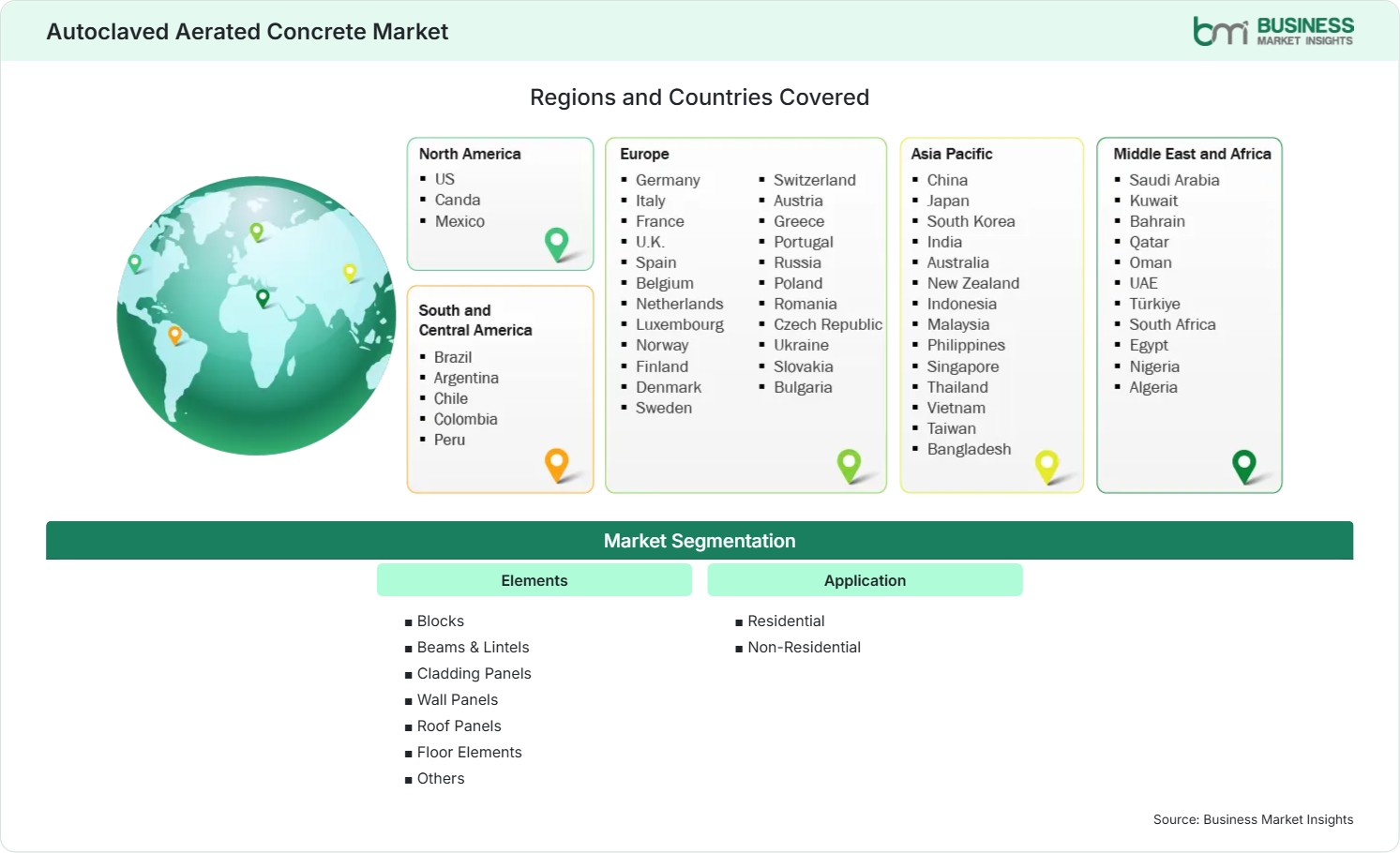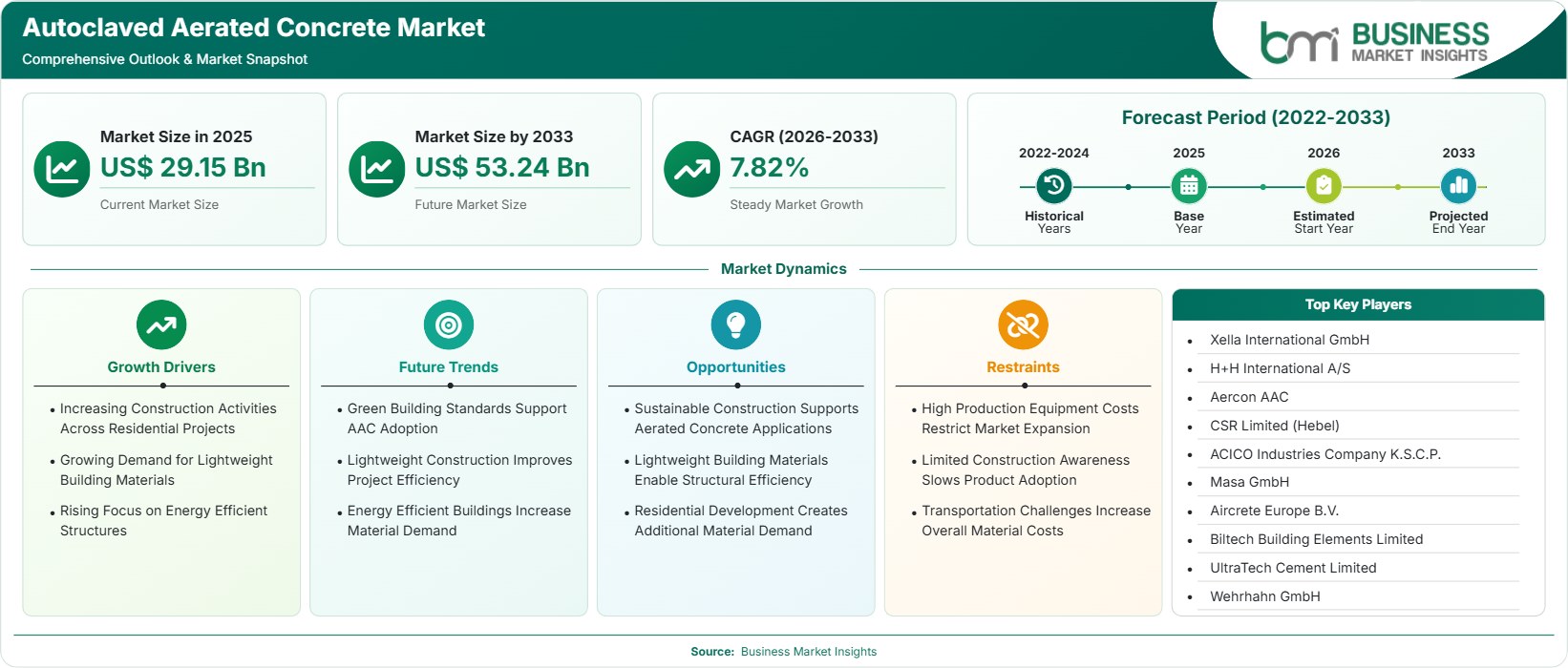
Autoclaved Aerated Concrete Market Regional Highlights
North America Autoclaved Aerated Concrete Market
North America accounted for approximately 22%–25% of global revenue in 2025 and is projected to expand at a 6.8%–7.3% CAGR through 2033. Regional demand is supported by stringent building efficiency requirements, growing adoption of modular construction, and increasing awareness of fire-resistant materials. The Autoclaved Aerated Concrete Market share in the region benefits from commercial renovation activity and institutional construction projects. Manufacturers continue expanding educational efforts among architects and contractors to accelerate adoption across residential and non-residential applications.
- Energy-efficient building codes encourage adoption of insulated wall systems providing long-term operational savings and reduced carbon footprints.
- Rising labor costs support interest in prefabricated construction materials that shorten project schedules and reduce installation complexity.
- Schools, healthcare facilities, and government buildings increasingly specify lightweight masonry solutions with enhanced fire performance.
- Product awareness programs and industry training initiatives continue expanding acceptance among contractors and design professionals.
US Autoclaved Aerated Concrete Market
The United States represents around 72%–76% of North American demand and is forecast to grow at 6.9%–7.4% CAGR through the assessment period. Construction modernization, sustainable housing initiatives, and increasing resilience requirements support usage across diverse projects. The market benefits from greater interest in energy-efficient envelopes and reduced lifecycle costs. Adoption remains strongest in institutional, commercial, and custom residential developments where thermal performance and installation efficiency deliver measurable advantages.
- Developers increasingly consider lifecycle energy savings when selecting wall and structural systems for new developments.
- Prefabricated construction practices accelerate material acceptance in industrial and large-scale residential projects nationwide.
- State-level sustainability initiatives encourage investment in efficient building materials aligned with emissions-reduction goals.
- Increasing wildfire and fire-safety concerns strengthen demand for non-combustible construction solutions.
Europe Autoclaved Aerated Concrete Market
Europe held approximately 27%–30% market share in 2025 and is expected to grow at a 7.0%–7.6% CAGR of the Autoclaved Aerated Concrete Market through 2033. The region maintains a mature manufacturing base and strong regulatory emphasis on sustainable buildings. Germany remains the leading market with growth around 6.8%–7.2%, while Poland and Eastern European countries exhibit faster expansion of 7.8%–8.5%. Energy renovation programs, stringent insulation standards, and circular-economy objectives continue supporting industry development across residential and commercial sectors.
- Building renovation initiatives focused on efficiency upgrades strengthen replacement demand for advanced wall materials.
- Germany remains a significant production and consumption hub supported by established manufacturing capabilities.
- Central and Eastern Europe benefit from housing demand and infrastructure modernization investment.
- Sustainability frameworks encourage lower-energy construction practices throughout the region.
- Industrialized construction methods increase acceptance of factory-manufactured building elements.
Asia Pacific Autoclaved Aerated Concrete Market
Asia Pacific accounted for 38%–42% of global revenue in 2025 and is expected to register the fastest growth at 8.8%–9.4% CAGR. China remains the leading regional market, while India demonstrates expansion exceeding 9.0%–9.8% CAGR. Rapid urbanization, government housing programs, and infrastructure spending support sustained demand. The region benefits from increasing manufacturing investments and rising awareness of energy-efficient construction. Strong project pipelines and industrial development further accelerate adoption across multiple end-use categories.
- Smart-city initiatives and affordable housing schemes create substantial demand for lightweight construction materials.
- India experiences rapid growth due to infrastructure investments and expanding urban residential development.
- China continues benefiting from industrialized building methods and large-scale construction activity.
- Manufacturing capacity additions improve regional supply availability and cost competitiveness.
- Sustainability objectives encourage use of thermally efficient and resource-conscious construction products.
Rest of World Autoclaved Aerated Concrete Market
The rest of world had an 8%–11% market share in 2025 and is estimated to witness growth at a 7.6%–8.3% CAGR till 2033. Demand in the Middle East is driven by substantial infrastructure development projects and urbanization, whereas demand in South and Central America is aided by residential construction. Saudi Arabia is the dominant adopter within the region, and the UAE shows promising potential. Brazil is a major Latin American country. Growing awareness about energy-efficient building practices bodes well for future performance.
- Gulf countries promote sustainable construction within large urban development and tourism projects.
- Saudi Arabia benefits from diversified infrastructure programs and major construction investments.
- Brazil experiences increasing usage in residential and mid-rise commercial developments.
- Industrialization of construction methods improves acceptance across emerging economies.
- Growing focus on operational energy efficiency strengthens product positioning against conventional masonry.