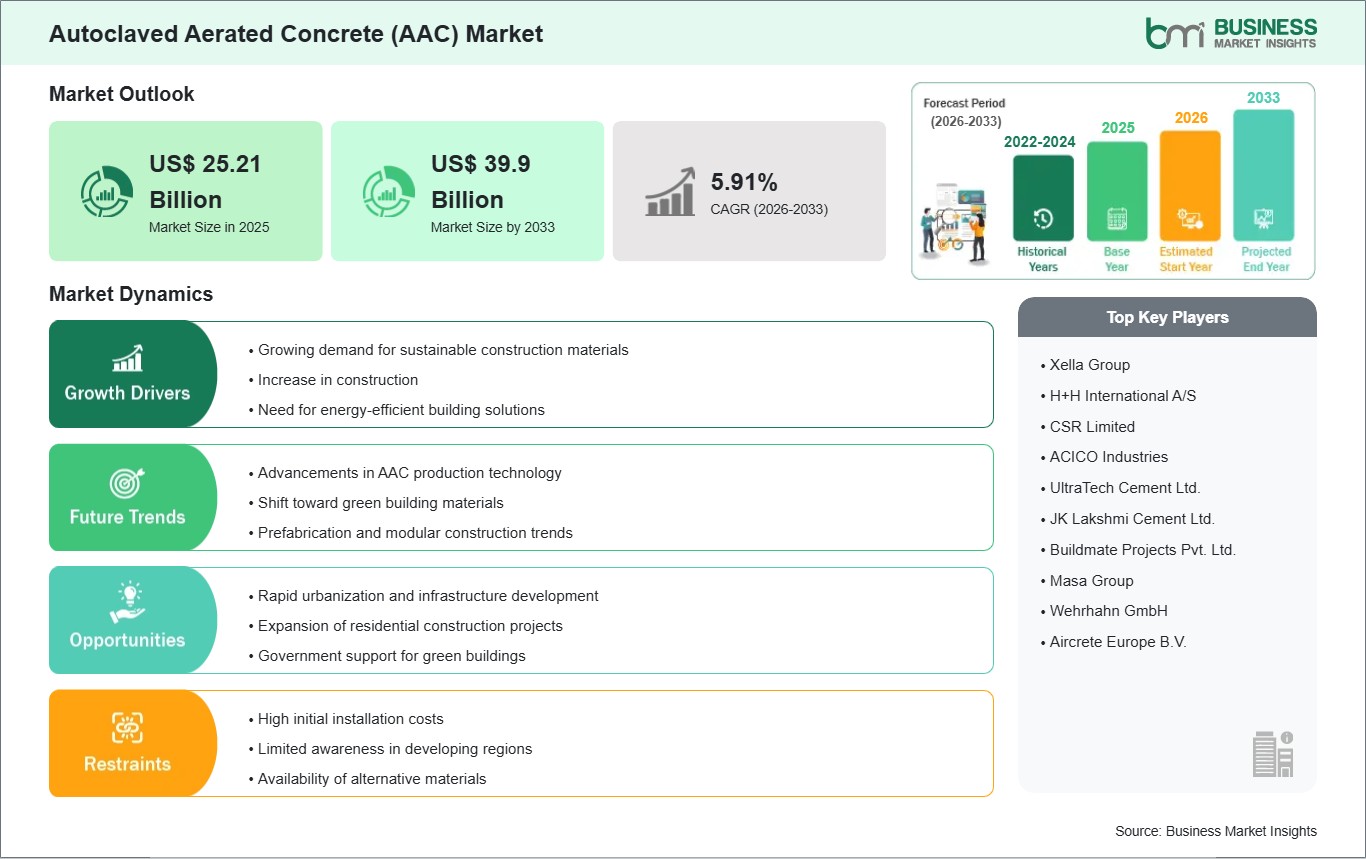
The Autoclaved Aerated Concrete (AAC) Market size is expected to reach US$ 39.9 Billion by 2033 from US$ 25.21 Billion in 2025. The market is estimated to record a CAGR of 5.91% from 2026 to 2033.
The global autoclaved aerated concrete (AAC) market is defined by the increasing demand for lightweight, energy-efficient, and sustainable construction materials. AAC is a precast foam concrete building material that offers excellent thermal insulation, fire resistance, and ease of installation. Its lightweight nature reduces structural load, making it highly suitable for modern construction practices focused on efficiency and sustainability.
The market is witnessing significant growth driven by rapid urbanization, infrastructure development, and the growing emphasis on green building standards. Governments and regulatory bodies across regions are promoting eco-friendly construction materials to reduce carbon emissions and improve energy efficiency in buildings. AAC aligns well with these objectives due to its lower environmental impact compared to traditional construction materials such as clay bricks and conventional concrete.
Competitive dynamics in the AAC market are centered on production efficiency, product quality, and regional expansion. Manufacturers are investing in advanced manufacturing technologies to improve product consistency and reduce costs. Additionally, companies are focusing on expanding their distribution networks and establishing new production facilities in emerging markets to meet rising demand. Strategic collaborations and innovations in product design are further shaping the competitive landscape.

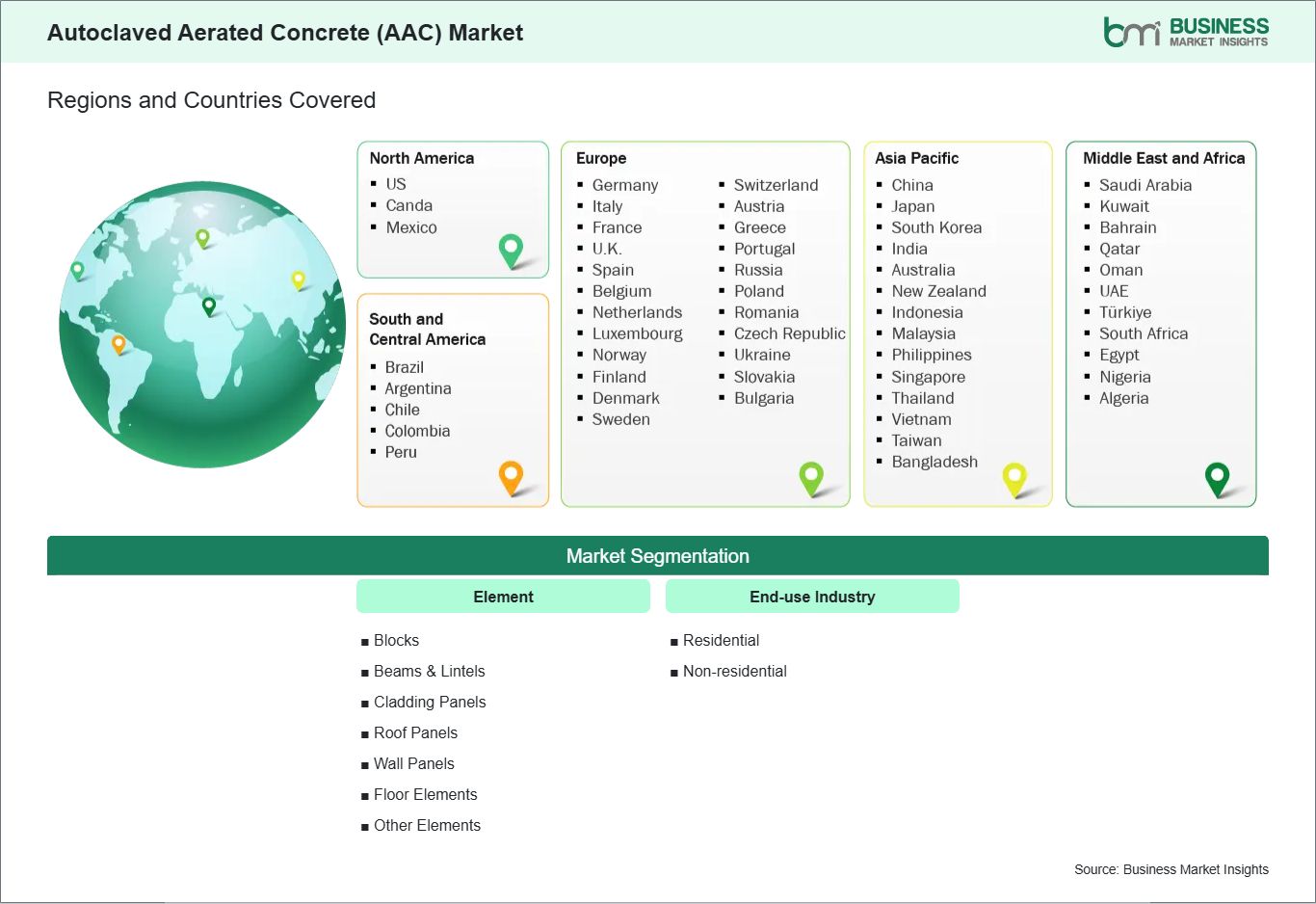
Key segments that contributed to the derivation of the autoclaved aerated concrete (AAC) market analysis are element and end-use industry.
An increasing focus on sustainable building practices will continue to contribute to the growth of the autoclaved aerated concrete (AAC) cement market. Because AAC is made of natural raw materials like sand, lime, cement, and aluminum powder, the production of AAC requires much less energy than traditional building materials like clay bricks and concrete blocks. When considering the total life cycle of construction materials, AAC is an ecologically responsible option that complements global sustainability goals.
By far, the most substantial benefit of AAC is its exceptional thermal insulation, which means that buildings constructed using AAC consume less energy for heating and cooling, directly supporting green building programs while reducing carbon footprints. Additionally, the light weight of AAC allows for easy handling and transport, ultimately reducing labor costs and the amount of time needed for construction, with the added benefit of versatility and use in residential, commercial, and industrial projects, providing cost-effectiveness and performance at all levels.
With the ongoing advancements in technology associated with AAC production, manufacturers will produce AAC products with increasingly better quality, resulting in high-strength products with excellent durability that can be used in a variety of applications. With developments in eco-friendly construction by governments and organisations around the globe, there will be a growing market for AAC in the future due to the combined benefit of sustainability, efficiency and low-cost solutions.
The AAC (autoclaved aerated concrete) market is experiencing strong growth potential due to rapid urbanization and infrastructure development in emerging economies. The increasing population densities and movement towards cities are bringing greater demand for residential housing, commercial properties, and civic infrastructure. The light weight of AAC products makes them ideal for large-scale developments, allowing them to reduce the structural weight of a building while still making high-rise buildings possible. The speed of installation and construction time of AAC products provide developers with solutions that help them to be cost-effective as well. AAC products also provide fire resistance, sound insulation, and durability, which support safety and comfort levels associated with modern-day cities. Many governments in Asia, Africa, and Latin America continue to invest heavily in low-cost housing projects and smart city initiatives, which support continued increased demand for AAC products.
The growing appeal of prefabricated and modular construction techniques also continues to enhance the demand for AAC; the components of AAC are a perfect match for use in factory-built systems. Infrastructure projects, including schools, hospitals, and transportation hubs, frequently call for AAC due to its performance and sustainability characteristics. As urbanization increases, the need for building materials that are efficient, safe, and environmentally friendly will only increase. This creates a critical place for AAC in meeting the challenges faced by rapidly growing urban areas, supporting continued long-term growth.

The Autoclaved Aerated Concrete (AAC) Market demonstrates steady growth, with size and share analysis highlighting evolving trends and competitive dynamics among key players. The report examines subsegments categorized within element and end-use industry, offering insights into their contribution to overall market performance.
By element, the blocks subsegment dominated the market in 2025, driven by their widespread use in wall construction and structural applications.
Based on end-use industry, the residential subsegment dominated the market in 2025, driven by increasing demand for affordable housing and urban development projects.
| Report Attribute | Details |
|---|---|
| Market size in 2025 | US$ 25.21 Billion |
| Market Size by 2033 | US$ 39.9 Billion |
| Global CAGR (2026 - 2033) | 5.91% |
| Historical Data | 2022-2024 |
| Forecast period | 2026-2033 |
| Segments Covered | By Element
|
|
Regions and Countries Covered
| |
| North America | US, Canada, Mexico |
| Europe | Belgium, Austria, Finland, Denmark, Greece, Poland, Romania, Russia, Ukraine, Czech Republic, Slovakia, Bulgaria, Italy, Luxembourg, Germany, Switzerland, France, Netherlands, Norway, Portugal, Spain, Sweden, United Kingdom |
| Asia-Pacific | Australia, China, India, Japan, South Korea, Indonesia, Malaysia, Philippines, Singapore, Thailand, Vietnam, Bangladesh, New Zealand, Taiwan |
| South and Central America | Brazil, Argentina, Peru, Chile, Colombia |
| Middle East and Africa | Bahrain, Kuwait, Oman, Qatar, Saudi Arabia, United Arab Emirates, Turkiye, South Africa, Egypt, Algeria, Nigeria |
| Market leaders and key company profiles |
|
The "Autoclaved Aerated Concrete (AAC) Market Size and Forecast (2022 - 2033)" report provides a detailed analysis of the market covering below areas:
The geographical scope of the Autoclaved Aerated Concrete (AAC) Market report is divided into North America, Asia Pacific, Europe, Middle East & Africa, and South & Central America. North America held the largest share in 2025.
The adoption and growth of AAC materials vary across regions, influenced by construction practices, regulatory frameworks, and economic development. In North America, the market is driven by increasing adoption of sustainable construction materials and energy-efficient building solutions. The region is witnessing growing awareness of AAC benefits, particularly in residential construction.
In Europe, stringent environmental regulations and strong emphasis on green building standards are driving the demand for AAC materials. Countries such as Germany, the UK, and France are leading in the adoption of advanced construction technologies and sustainable materials.
Asia Pacific is the dominant and fastest-growing region, supported by rapid urbanization, population growth, and large-scale infrastructure development. Countries such as China and India are experiencing high demand for cost-effective and efficient construction materials, making AAC a preferred choice.
The Middle East & Africa and South & Central America are witnessing gradual growth, driven by infrastructure development and increasing investments in construction projects. Across all regions, government initiatives and evolving construction trends are playing a crucial role in shaping market dynamics.

The Autoclaved Aerated Concrete (AAC) Market is evaluated by gathering qualitative and quantitative data post primary and secondary research, which includes important corporate publications, association data, and databases. A few of the key developments in the autoclaved aerated concrete (AAC) market are:
The Autoclaved Aerated Concrete (AAC) Market is valued at US$ 25.21 Billion in 2025, it is projected to reach US$ 39.9 Billion by 2033.
As per our report Autoclaved Aerated Concrete (AAC) Market, the market size is valued at US$ 25.21 Billion in 2025, projecting it to reach US$ 39.9 Billion by 2033. This translates to a CAGR of approximately 5.91% during the forecast period.
The Autoclaved Aerated Concrete (AAC) Market report typically cover these key segments-
The historic period, base year, and forecast period can vary slightly depending on the specific market research report. However, for the Autoclaved Aerated Concrete (AAC) Market report:
The Autoclaved Aerated Concrete (AAC) Market is populated by several key players, each contributing to its growth and innovation. Some of the major players include:
The Autoclaved Aerated Concrete (AAC) Market report is valuable for diverse stakeholders, including:
Essentially, anyone involved in or considering involvement in the Autoclaved Aerated Concrete (AAC) Market value chain can benefit from the information contained in a comprehensive market report.
Please tell us your area of interest
(Market Segments/ Regions and Countries/ Companies)