
Athleisure Market Outlook: Size, Share, Trends, Growth Analysis, Competitive Landscape & Forecast, 2026-2033

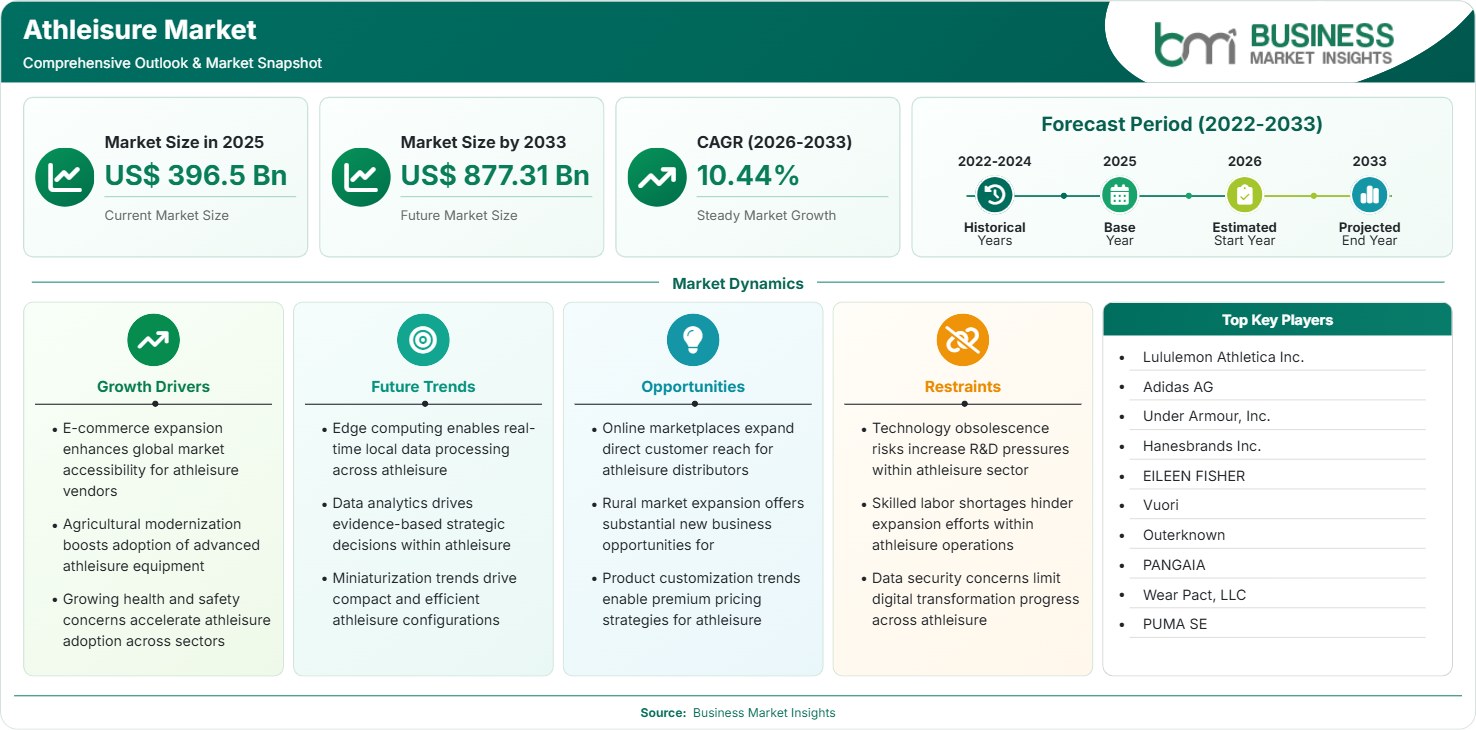
The Athleisure Market size was valued at US$ 396.5 Billion in 2025 and is projected to reach US$ 877.31 Billion by 2033, growing at a CAGR of 10.44% during 2026–2033, driven by wellness adoption, versatile apparel demand, premiumization, digital retail, and sustainable material innovation.

Report Coverage
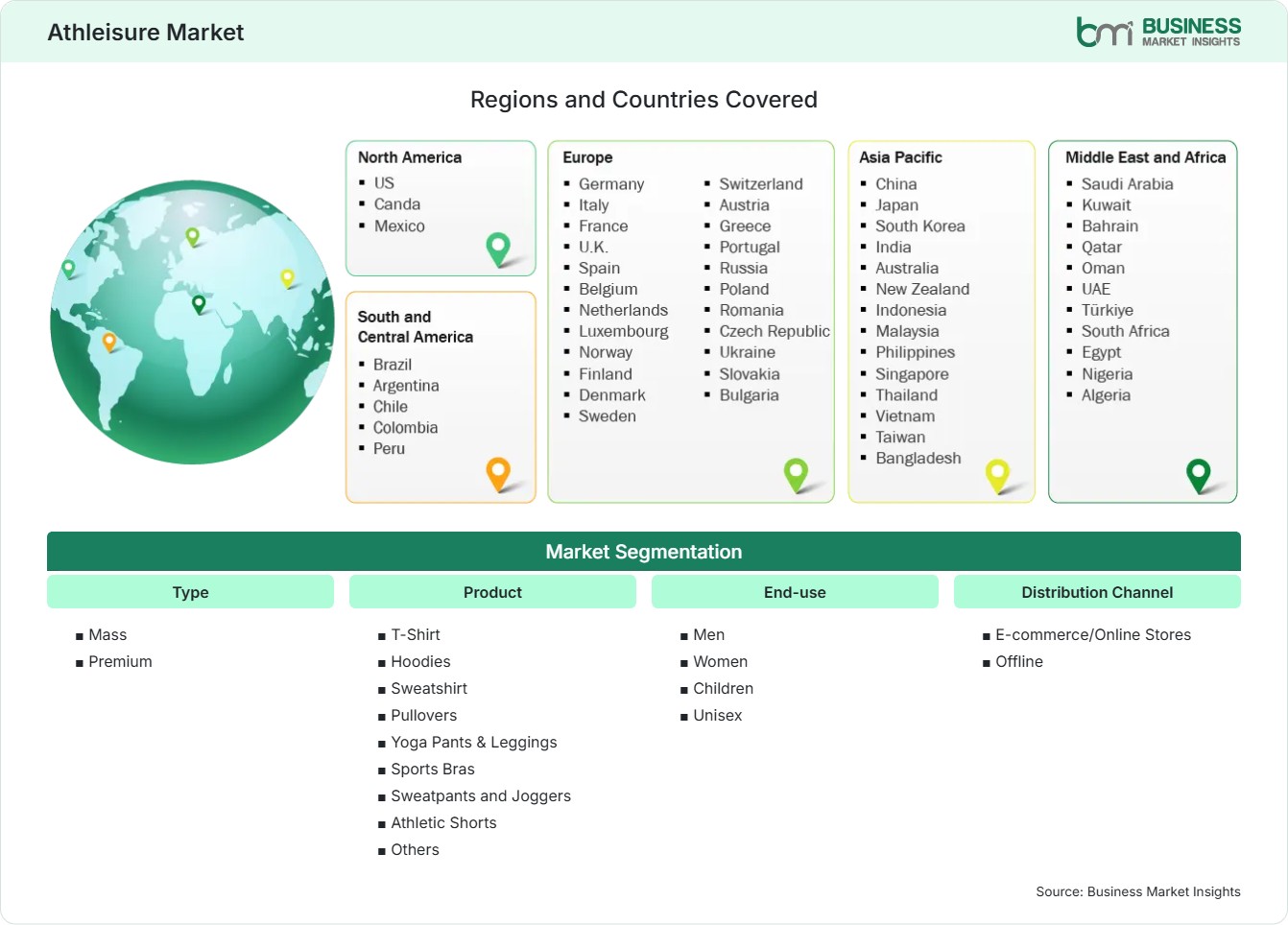
  • Type: Mass, Premium
  • Product: T-Shirt, Hoodies, Sweatshirt, Pullovers, Yoga Pants & Leggings, Sports Bras, Sweatpants and Joggers, Athletic Shorts, Others
  • End-use: Men, Women, Children, Unisex
  • Distribution Channel: E-commerce/Online Stores, Offline
US$ 396.5 Bn Market size in 2025
US$ 877.31 Bn Market Size by 2033
10.44% CAGR, 2026 - 2033
2026-2033 Forecast Period

01 AI Overview

Athleisure Market Summary

  • North America Region: North America · 35%–38% share (2025) · 9.2%–10.0% CAGR (2026–2033) · Premium brand loyalty, active lifestyles, omnichannel retail, and direct-to-consumer models support demand while innovation in fabrics and inclusive sizing creates opportunities. The US remains the regional anchor, with 9.0%–9.8% CAGR through 2033, supported by wellness participation, casual workplace dressing, and strong e-commerce penetration.
  • Fastest Growing Region: Asia Pacific · 24%–27% share (2025) · 12.5%–13.5% CAGR (2026–2033) · Rising fitness participation, expanding middle-class consumption, localized brand development, digital commerce, and urban wellness culture create opportunities across China, India, Japan, and Southeast Asia.
  • Leading Segment: Mass · 61%–64% share (2025) · 10.0%–10.7% CAGR (2026–2033) · Broad affordability, high-volume basics, private-label expansion, promotional flexibility, and omnichannel availability support adoption among value-conscious consumers seeking everyday performance apparel.
  • High Growth Segment: E-commerce/Online Stores · 31%–34% share (2025) · 13.5%–14.5% CAGR (2026–2033) · Mobile shopping, social commerce, personalized recommendations, wider assortment, rapid delivery, and digital-first brands are accelerating online apparel discovery and repeat purchases.
  • Key Market Opportunity: Product innovation combining performance, comfort, circular materials, and lifestyle aesthetics can expand premium pricing, improve retention, and unlock demand among younger consumers seeking versatile wardrobe solutions.
  • Major Market Players: Lululemon Athletica Inc., Adidas AG, Under Armour, Inc., Hanesbrands Inc., EILEEN FISHER, Vuori, Outerknown, PANGAIA, Wear Pact, LLC, and PUMA SE.
02 Strategic Insights

Athleisure Market: Strategic Insights

Athleisure Market Strategic Framework
FREE PDF
Request your free sample
Request free sample
03 Stakeholder View

Key Takeaways

  • Market structure insight: The value chain is increasingly organized around brand-owned design, specialized textile suppliers, contract manufacturing, digital merchandising, and omnichannel fulfillment, making supply-chain responsiveness a strategic differentiator rather than merely an operating function.
  • Growth opportunity insight: Yoga pants and leggings, sports bras, sweatpants and joggers, and versatile unisex collections offer attractive upside because they address overlapping fitness, leisure, travel, and casual-work use cases.
  • Innovation trend: Material development is moving toward recycled fibers, bio-based inputs, improved stretch recovery, thermoregulation, odor control, and digitally enabled personalization, raising the importance of textile R&D and product-level differentiation.
  • Regional opportunity: Asia Pacific provides the strongest expansion case, with a 24%–27% 2025 share and 12.5%–13.5% CAGR through 2033, supported by urban wellness adoption and accelerating digital commerce.
  • Investment / M&A trend: Capital is increasingly attracted to premium activewear, digitally native brands, and sustainable-material platforms, while established companies are prioritizing international expansion, women's categories, and direct consumer relationships.
  • Strategic insight: Competitive advantage increasingly depends on balancing premium positioning with accessible price points, because consumers can compare brands instantly across social platforms, marketplaces, and direct retail channels.
04 Geographic Outlook

Athleisure Market Regional Highlights

North America Athleisure Market

North America holds a 35%–38% Athleisure Market share in 2025 and is projected to grow at a 9.2%–10.0% CAGR through 2033. The region benefits from mature fitness culture, established premium brands, strong direct-to-consumer infrastructure, and widespread casualization. The United States remains the dominant contributor, while Canada supports premium demand through established technical apparel brands. Product innovation increasingly centers on versatile silhouettes, fabric performance, inclusive sizing, and sustainability. Retailers are integrating stores, mobile applications, loyalty programs, and social commerce to improve customer retention and capture cross-category spending.

  • Premium activewear remains resilient as consumers prioritize comfort, fabric performance, and long-term wardrobe versatility across fitness and everyday use cases.
  • Direct-to-consumer brands are expanding through community events, ambassador programs, personalized digital merchandising, and selective physical stores that reinforce brand identity.
  • Sustainability initiatives increasingly focus on recycled fibers, responsible sourcing, durability, repairability, and improved product lifecycle transparency.
  • Men's and unisex collections provide incremental expansion opportunities as established women's activewear brands diversify assortments and broaden customer acquisition.
  • E-commerce continues reshaping discovery, with social content and creator-led recommendations influencing product consideration before consumers visit brand-owned or marketplace channels.

US Athleisure Market

The US represents approximately 29%–32% of 2025 regional demand and is projected to expand at 9.0%–9.8% CAGR through the Athleisure Market Forecasts. The country's scale is supported by high brand awareness, established sportswear infrastructure, broad e-commerce adoption, and strong participation in fitness and recreational activities. Demand is increasingly polarized between affordable mass products and premium technical apparel. Leading brands are investing in women's, men's, and unisex assortments, while retailers emphasize loyalty ecosystems, community activation, and seamless online-to-store experiences to sustain repeat purchasing.

  • Casual workplace adoption continues supporting versatile apparel demand, particularly products that transition from commuting to exercise and social settings.
  • Premium brands are broadening men's assortments and footwear-adjacent apparel to diversify revenue beyond established women's categories.
  • Digital-native labels compete through social storytelling, community engagement, rapid product testing, and selective physical expansion.
  • Promotional intensity remains a strategic consideration as consumers compare premium products with increasingly capable mass-market alternatives.

Europe Athleisure Market

Europe accounts for a 24%–27% Athleisure Market share in 2025 and is forecast to expand at 9.5%–10.4% CAGR through 2033. Germany and the United Kingdom are leading contributors, supported by strong sportswear consumption and developed digital retail. Spain and Italy represent high-growth opportunities at 10.5%–11.5% CAGR, benefiting from fashion influence and wellness adoption. Sustainability regulation, textile traceability, and circularity expectations are reshaping sourcing decisions. Brands combining performance, minimalist design, and responsible materials are positioned to gain relevance across urban consumers seeking multifunctional wardrobes.

  • Germany benefits from established sports participation, technical apparel demand, and strong purchasing power across premium and mass categories.
  • The United Kingdom provides a strong digital retail environment where activewear brands can scale through social discovery and direct-to-consumer channels.
  • Spain and Italy offer high-growth potential as fitness culture increasingly intersects with fashion-conscious consumption and tourism-driven retail activity.
  • European sustainability requirements are encouraging investment in traceable materials, recycled inputs, durable design, and circular business models.
  • Localized collections and collaborations allow international brands to adapt global performance propositions to distinctive European fashion preferences.

Asia Pacific Athleisure Market

Asia Pacific represents a 24%–27% Athleisure Market share in 2025 and is projected to grow at 12.5%–13.5% CAGR through 2033. China and Japan are leading contributors, while India, Indonesia, and Vietnam offer high-growth potential at 13.5%–15.0% CAGR. Urbanization, rising disposable incomes, fitness participation, and mobile commerce are accelerating adoption. The region also supports local brand innovation, enabling consumers to combine international performance standards with culturally relevant designs, pricing, and digital engagement strategies.

  • China is benefiting from rising participation in running, climbing, marathon events, racket sports, and fitness activities, strengthening demand for premium performance apparel.
  • India offers substantial whitespace as younger consumers increasingly adopt fitness-oriented lifestyles and discover brands through mobile-first commerce.
  • Japan's mature consumer base favors high-quality technical fabrics, minimalist styling, durability, and products suitable for commuting and leisure.
  • Southeast Asian growth is supported by expanding urban populations, rising incomes, social commerce, and climate-responsive lightweight apparel.
  • Local brands are intensifying competition through regional cultural relevance, competitive pricing, rapid design cycles, and marketplace distribution.

Rest of World Athleisure Market

South and Central America account for approximately 7%–9% of 2025 Athleisure Market demand, with Brazil and Mexico leading regional consumption. Brazil is projected at 10.5%–11.5% CAGR through 2033, supported by fitness culture and expanding digital retail. Premiumization remains concentrated in major urban centers, while affordable products dominate broader adoption.

Middle East and Africa contribute approximately 5%–7% share in 2025, with the United Arab Emirates and Saudi Arabia leading premium demand. Saudi Arabia offers 11.5%–12.5% CAGR potential through 2033 as wellness investment, retail modernization, and youth-oriented consumption expand.

  • Brazil's established fitness culture and large consumer base support demand for leggings, sports bras, shorts, and versatile everyday apparel.
  • Mexico benefits from proximity to North American supply networks and expanding modern retail, supporting faster brand availability and product diversification.
  • Gulf markets favor premium technical apparel as wellness destinations, luxury retail, and affluent younger consumers increase category visibility.
  • Saudi Arabia's lifestyle transformation is encouraging investment in fitness facilities, sporting events, retail infrastructure, and consumer-facing wellness ecosystems.
  • African opportunities remain concentrated in urban markets where mobile commerce and affordable performance-inspired apparel can overcome limited formal retail coverage.
Global Market Geography
FREE PDF
Request your free sample
Request free sample
05 Segment Analysis

Athleisure Market Segmentation

Type

Type segmentation is led by Mass products, representing a 61%–64% Athleisure Market share in 2025 and expanding at a 10.0%–10.7% CAGR between 2026–2034. Premium remains strategically important as affluent consumers prioritize technical fabrics, brand credibility, durability, and design-led versatility. Price polarization encourages brands to differentiate through fabric innovation, collaborations, and tiered collections while retaining accessible entry products.

  • Mass: Broad affordability and extensive distribution support high-volume basics, while private labels and promotional pricing expand adoption among consumers seeking functional apparel for everyday activities.
  • Premium: Technical fabrics, superior construction, distinctive design, and brand communities justify higher prices, with premiumization supported by affluent consumers seeking performance and lifestyle versatility.

Product

Product segmentation reflects strong demand for versatile apparel capable of serving exercise and non-sport occasions. Yoga pants and leggings remain a leading category because of comfort and styling flexibility, while hoodies, sweatshirts, joggers, and sports bras benefit from everyday use. The Athleisure Market scope increasingly includes multifunctional silhouettes, gender-neutral designs, and material innovation.

  • T-Shirt: Lightweight layering, breathable fabrics, and easy styling support year-round demand, while technical blends improve moisture management and expand usage beyond traditional workouts.
  • Hoodies, Sweatshirt, and Pullovers: Comfort-led dressing and casualization sustain demand, with fleece innovation, lightweight insulation, and oversized silhouettes broadening seasonal and lifestyle applications.
  • Yoga Pants & Leggings: Stretch recovery, body contouring, opacity, and moisture control make these products highly versatile for yoga, training, travel, commuting, and casual wardrobes.
  • Sports Bras: Consumers increasingly seek support, comfort, adjustability, and attractive styling, encouraging innovation in fit engineering and materials across low-, medium-, and high-impact activities.
  • Sweatpants and Joggers: Relaxed silhouettes combine comfort and mobility, supporting demand for commuting, travel, home use, and casual social settings while premium fabrics elevate perceived value.
  • Athletic Shorts: Running, training, outdoor recreation, and leisure applications drive demand for lightweight construction, secure storage, ventilation, and quick-drying performance fabrics.

End-use

End-use segmentation is shaped by expanding participation across genders and age groups, with women representing a major demand base and unisex apparel gaining visibility. Product development increasingly emphasizes inclusive fit, adaptable styling, and category crossover. Athleisure Market trends favor collections that serve multiple activities and occasions, reducing wardrobe specialization and encouraging higher purchase frequency.

  • Men: Growing interest in training, running, commuting, and casual performance apparel supports demand for technical tops, joggers, shorts, and versatile layering products.
  • Women: Strong adoption across yoga, fitness, running, and lifestyle dressing sustains demand for leggings, sports bras, tops, and coordinated sets with fashion-led styling.
  • Children: Rising parental interest in comfort, durability, and active lifestyles supports functional apparel designed for school, recreation, sports participation, and everyday movement.
  • Unisex: Gender-neutral silhouettes expand addressable audiences and simplify assortment planning, while relaxed fits and minimalist aesthetics appeal to consumers seeking flexible wardrobe choices.

Distribution Channel

Distribution is evolving toward integrated physical and digital ecosystems, with e-commerce gaining share through convenience, broad assortments, personalized recommendations, and social discovery. Offline stores remain important for fit, fabric evaluation, and brand experience. The Athleisure Market share increasingly reflects omnichannel behavior, where consumers research digitally, test products physically, and purchase through whichever channel offers the strongest combination of convenience and value.

  • E-commerce/Online Stores: Mobile shopping, social commerce, personalization, and digital-first brands accelerate online adoption, while improved sizing tools and seamless returns reduce barriers to apparel purchases.
  • Offline: Brand stores, department stores, specialty retailers, and outlets remain important for tactile product evaluation, fitting, experiential merchandising, and immediate purchase fulfillment.
06 Market Forces

Athleisure Market Dynamics

Key Market Drivers

Active Lifestyle Integration and Casualization

Active lifestyle adoption is converting performance apparel into everyday wardrobe essentials, supporting Athleisure Market growth across commuting, travel, social occasions, and hybrid work. As per the McKinsey 2025 study on sporting goods, physical activity is becoming increasingly significant to the consumers as part of their identity and hence has resulted in increased demand for clothing that can convey a message about good health other than just performing its functional purpose. In terms of the business, this will translate into the expanded use cases for leggings, joggers, tech shirts, and even layers of clothing. The manufacturers have started designing products that are made to move but also look fashionable for everyday use.

Fabric Innovation and Performance-Led Product Differentiation

Material Engineering Has Become a Key Competitive Lever Because Consumers Are Seeking Comfort, Durability, Stretch Recovery, Breathability, Moisture Management, and Environmental Sustainability All at Once. Athleisure Market trends are shifting toward proprietary fabrics and distinct construction designs, and not merely logos. This is because of the new innovations in recycled polyester, biodegradable fibres, elastane blends, thermoregulation, deodorization, and insulation. Additionally, research indicates that there is great potential in the development of sensor textiles that will have the ability to track motion and physiological data. This path of innovation allows for high-end pricing, provided that performance advantages are communicated effectively. Companies that manage to innovate in performance and aesthetics at the same time increase their customers' loyalty and lessen product comparisons.

Omnichannel Expansion and Direct Consumer Relationships

The expansion of direct-to-consumer commerce is reshaping assortment planning, customer acquisition, and inventory management. The digital channel allows for first-party consumer data about behavior that will help launch the product, size the products, replenish products and promote products. Physical store remains vital because the purchase of apparel requires consumers to feel and test the clothing. Hence, leading organizations are developing an integrated system, which includes the website, mobile app, loyalty program, community event, and physical store. Adidas has demonstrated that revenue from the Adidas brand has increased by 13% in 2025 currency neutral terms, with apparel up 15%.

Key Market Opportunities

Asia Pacific Localization and Digital-First Expansion

Asia Pacific offers an attractive investment pathway because fitness participation, urbanization, disposable income, and mobile commerce are developing simultaneously. The Chinese market sees increasing consumer interest in running, mountaineering, marathon, and emerging racket sports while India and Southeast Asia provide a large young consumer base that buys through the Internet. This could be capitalized on through localized sizing, climate-appropriate fabrics, and locally-relevant partnerships. It is recommended that international players strike the right balance between high-end positioning and affordable entry-level products, whereas local players can leverage their culture and product agility to compete.

Sustainable Materials and Circular Product Models

Increased attention on the effects of textiles provides an opportunity for material innovation, tracing services, and brands that can show lifecycle improvement. Potential investment areas range from recycled fibers to fiber-to-fiber recycling, repairs, resale, improved construction, and reduced-invasive dyeing. Regulations in Europe are of special interest since traceability and circularity demands may affect the choices even outside Europe. Companies using measurable environmental factors in the products’ design might benefit in terms of differentiation as well as avoid potential expenses on compliance. The most successful business cases will be able to combine sustainability with durability and product efficiency in order to make customers believe that the environmental factor is just one component of the product’s function.

Smart Apparel and Personalized Performance Products

The Athleisure Market Trends indicate that Connected textiles represent a longer-term opportunity in which apparel can serve as an interface for fitness tracking, rehabilitation, and personalized training. Research done in 2025 showed the development of a prototype for sportswear made possible through AI that makes use of strain sensing in the clothing combined with deep learning to determine the type of exercise being done, reportedly with a 92.3% accuracy rate in testing. Challenges in commercializing the product include washability, the battery, the robustness include issues of the durability of the sensors, privacy issues regarding the data, and the cost, but the future looks promising. These investments must be directed toward cooperation in the industries of fashion, textile technology, sensor technology, and health technology.

Market Restraints and Challenges

Input Cost Volatility and Supply Chain Exposure

Factor: Factors affecting production costs include prices of synthetic fibers, elastane, energy costs, freight costs, and changes in tariffs.

Impact: Increased costs could put pressure on gross margin margins or lead to an increase in prices at the retail level, resulting in reduced demand. The problem is made even more complex by the fact that most clothing brands utilize geographic diversity for their manufacturing process while trying to be efficient, compliant, and resilient. Companies that have varied sources of supply, effective demand forecasting, flexibility in production processes, and good supplier relationships are better positioned to cope with disruptions in their operations. But small brands don’t necessarily have the ability to take cost increases due to their purchasing power.

Premium Price Polarization and Brand Substitution

Factor: Credible choices for consumers are becoming available through mass merchandisers, private brands, digitally native brands, and sportswear brands.

Impact: Premium brands need to be able to differentiate based on performance in terms of fabric, fit, longevity, styling, or community value to substantiate their price premium. Where such differentiation is increasingly harder to perceive, consumers may choose to trade down without compromising functionally on the bargain. Such an environment tends to encourage promotional marketing, lower sell-through at full price, and higher customer acquisition costs. In order for brands to compete effectively, they need to ensure that there is a well-defined product architecture at different price points.

07 Company Analysis

Competitive Landscape

The Athleisure Market analysis indicates a fragmented competitive structure spanning premium specialists, diversified sportswear manufacturers, sustainable apparel companies, and digital-native brands. Competitive advantage increasingly depends on proprietary materials, category breadth, brand communities, international distribution, and omnichannel execution.

Company Name

Overview

Products and Services relevant to this market

Lululemon Athletica Inc.

Canadian premium athletic apparel company with a strong direct-to-consumer model and community-led brand positioning across women's and men's categories.

Yoga apparel, leggings, sports bras, tops, shorts, joggers, outerwear, men's activewear, accessories, and omnichannel retail services.

Adidas AG

German sportswear leader combining performance innovation with lifestyle and Originals positioning across footwear and apparel categories.

Sportswear, training apparel, running clothing, hoodies, T-shirts, sweatpants, leggings, sports bras, and digitally enabled retail.

Under Armour, Inc.

US performance apparel specialist focused on technical products designed for training, running, team sports, and active lifestyles.

Performance tops, leggings, shorts, sports bras, hoodies, sweatpants, compression apparel, footwear, and accessories.

Hanesbrands Inc.

US apparel company with broad distribution and established basics expertise, serving consumers through accessible and value-oriented product portfolios.

Activewear basics, T-shirts, sweatshirts, hoodies, sports apparel, underwear, socks, and mass-market apparel distribution.

EILEEN FISHER

US apparel brand emphasizing minimalist design, premium materials, responsible sourcing, and circularity initiatives.

Women's comfortable apparel, relaxed tops, pants, layers, active-inspired basics, sustainable materials, resale, and circular product programs.

Vuori

US premium performance apparel brand positioned around versatile products combining technical functionality with contemporary lifestyle styling.

Performance joggers, leggings, shorts, T-shirts, hoodies, sweatshirts, sports bras, men's activewear, and direct-to-consumer retail.

Outerknown

US sustainable lifestyle apparel company emphasizing responsible materials, ethical production, and relaxed designs for active everyday living.

Sustainable tops, sweatshirts, joggers, shorts, performance-inspired casualwear, outerwear, and responsibly sourced lifestyle apparel.

PANGAIA

UK materials-focused lifestyle brand known for science-led textiles, sustainability, and contemporary casual silhouettes.

Plant-based and recycled apparel, T-shirts, hoodies, sweatpants, active-inspired basics, innovative fibers, and sustainable material applications.

Wear Pact, LLC

US sustainable basics company focused on organic materials, ethical production, and accessible everyday apparel.

Organic cotton T-shirts, leggings, sweatshirts, joggers, underwear, loungewear, and sustainability-oriented apparel collections.

PUMA SE

German sportswear company combining athletic performance with fashion-led lifestyle products and broad international distribution.

Training apparel, running clothing, T-shirts, hoodies, sweatpants, shorts, sports bras, lifestyle collections, footwear, and accessories.

10 Trust & Transparency

Research Methodology

The market analysis combines proprietary research with secondary data from government agencies, company disclosures, regulatory filings, industry databases and expert interviews. Market estimates are validated through data triangulation, cross-market benchmarking and analyst review.

View Full Research Methodology

11 Questions Answered

Frequently Asked Questions

How can smaller brands compete with established companies?

The Athleisure Market Report highlights that Smaller brands can focus on specific communities, differentiated materials, localized designs, and digital-first customer acquisition. Narrower assortments can enable faster testing and stronger inventory discipline, while selective physical experiences can build trust without replicating the fixed-cost structure of large retail networks.

Which product attributes most influence premium positioning?

Premium positioning increasingly depends on measurable performance, fabric handfeel, fit consistency, durability, construction quality, and distinctive design. Consumers are more likely to accept higher prices when technical benefits are visible in everyday use rather than limited to specialized athletic applications.

What role do communities play in brand growth?

Community programs can reduce reliance on paid advertising by creating recurring engagement around fitness events, local clubs, ambassadors, and educational experiences. This approach strengthens loyalty and can generate organic discovery while giving brands direct insight into consumer preferences and emerging activities.

Why are unisex collections gaining strategic importance?

Unisex products can broaden addressable audiences while simplifying assortment planning and reducing design duplication. Relaxed silhouettes, neutral styling, and adaptable sizing appeal to consumers who prioritize versatility and increasingly view clothing through lifestyle rather than traditional gender-category boundaries.

How sustainability changing product development?

Sustainability is moving from a marketing attribute toward a product-development requirement. Brands increasingly evaluate recycled or bio-based inputs, durability, repairability, traceability, and end-of-life pathways. This creates opportunities for material suppliers and circular business models while increasing sourcing complexity and compliance requirements.

Access the Full Athleisure Market Report

Get segment-level forecasts, regional estimates, competitive benchmarking, company profiles and downloadable Excel datasets.

Access the full Athleisure Market Report
350 pages PDF & Excel | 2026-08-17