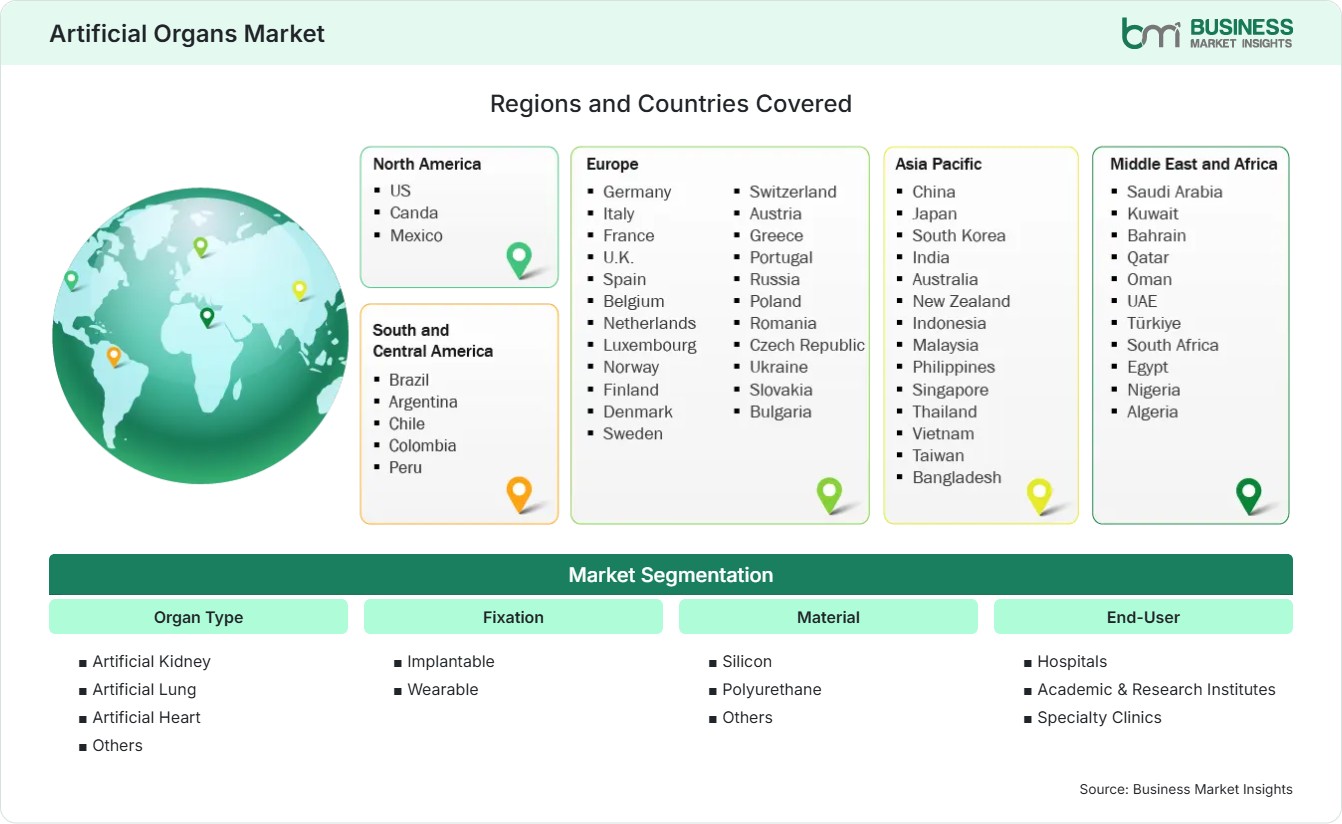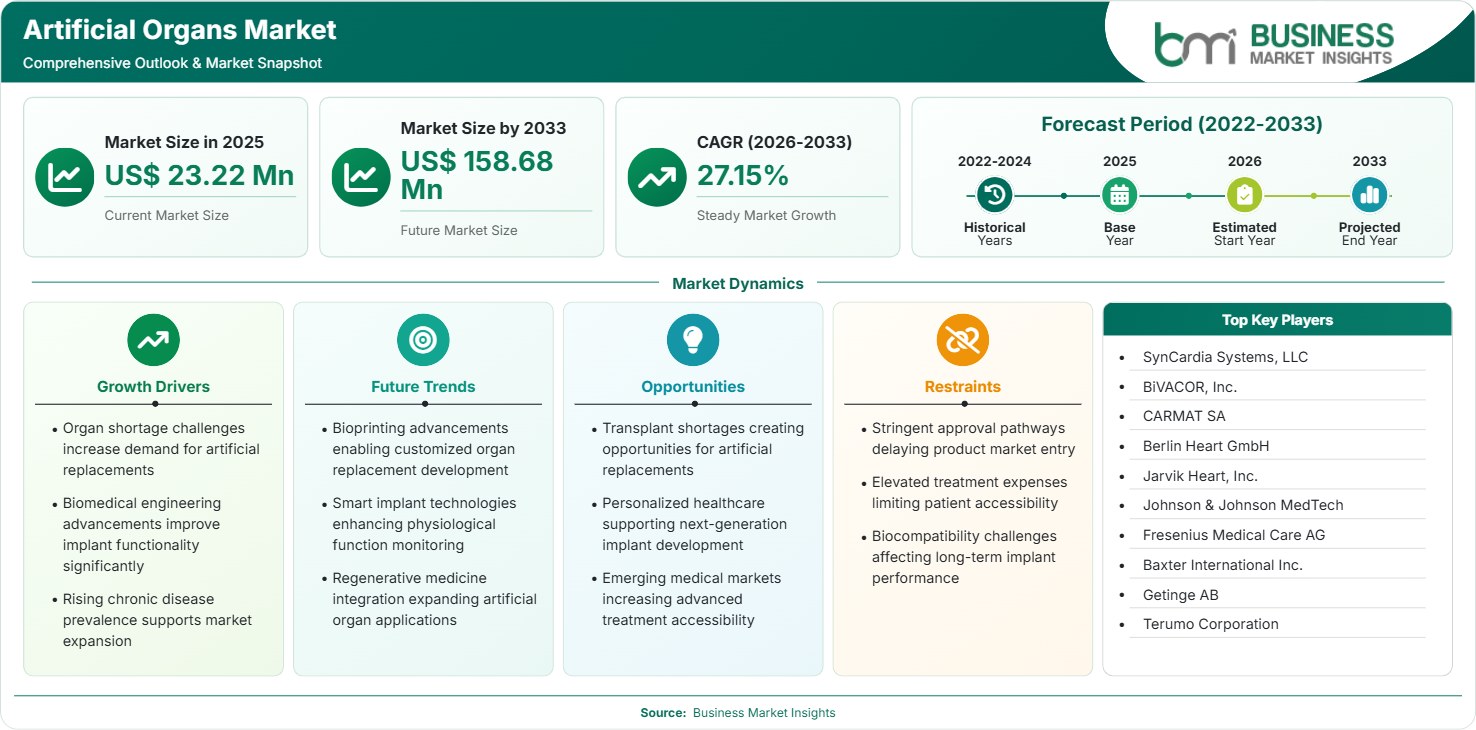
Artificial Organs Market Regional Highlights
North America Artificial Organs Market
North America accounts for 52%–56% of 2025 demand, with a 26%–28% CAGR from 2026–2033. The region combines high procedure intensity, mature cardiovascular infrastructure, established dialysis networks, and extensive clinical research. Artificial Organs Market share remains concentrated in the United States because major transplant centers and specialized hospitals provide access to complex technologies.
- Advanced cardiac centers promote the use of ventricular assist devices, temporary heart pumps, and total artificial-heart technologies, while their highly developed intensive-care facilities allow for complex extracorporeal support.
- U.S. clinical development is important since FDA approvals, post-approval studies, and early feasibility programs can generate the kind of evidence that in turn supports future discussions on international commercialization and reimbursement.
- Canada provides its contribution via its specialized cardiovascular and transplant centers, but since its smaller number of procedures, the regional commercial focus is still largely inclined towards the U.S. healthcare systems and procurement networks.
- Venture financing and strategic acquisitions are increasingly linking device innovation with transplantation technologies, organ preservation, biomaterials, and manufacturing capabilities, as well as digital monitoring.
US Artificial Organs Market
The United States Artificial Organs Market represents 82%–86% of North American demand in 2025, with a 26%–28% CAGR through 2033. Its position reflects concentrated transplant expertise, advanced cardiac hospitals, dialysis infrastructure, and a deep medical-device innovation ecosystem. The FDA continues to shape commercialization through premarket review and post-approval evidence requirements.
- The commercial value of temporary mechanical circulatory support is shown by Johnson & Johnson MedTech's Impella platform, since the development of clinical guidelines is leading to an increased use of this treatment based on evidence.
- The development of renal replacement technology is aided by the existing dialysis infrastructure and by increasing interest in home treatment, which in turn provides a significant route for portable and wearable kidney-supporting technologies.
- The development of artificial hearts is advancing via early feasibility studies, and BiVACOR is carrying out a study approved by the FDA of its total artificial heart as a bridge-to-transplant option.
Europe Artificial Organs Market
Europe holds a 21%–24% share in 2025, with a 27%–29% CAGR during 2026–2033. Germany, France, the United Kingdom, and Italy form important clinical and manufacturing hubs. France is particularly relevant to total artificial-heart development through CARMAT's Aeson program, while Germany maintains strong ventricular-assist expertise. Artificial Organs Market share is supported by established hospital networks, specialist cardiac centers, and coordinated medical research.
- Germany combines its specialist skills in cardiac surgery with an existing ventricular-assist system, and Berlin Heart says that the EXCOR Adult is used around the world for short-term, medium-term, and long-term circulatory support.
- France is still a major center for the development of artificial hearts, and CARMAT reached the milestone of its 100th Aeson implant in February 2025, following an increase in the number of implants from 2024.
- The United Kingdom has a good pathway for transplantation technology, especially via the use of machine perfusion, and in August 2026, NICE approved routine NHS access to ex-situ liver machine perfusion.
- Italy is still important in the uptake of cardiovascular devices via specialist hospitals and transplant networks, and general demand in Europe is aided by the fact that populations are aging and chronic diseases are being managed.
Asia Pacific Artificial Organs Market
Asia Pacific represents 15%–18% of 2025 demand, expanding at a 29%–32% CAGR during 2026–2033. Japan, China, South Korea, India, and Australia are the principal demand centers, while India and China provide substantial long-term manufacturing and healthcare expansion potential. Artificial Organs Market growth is supported by increasing chronic disease burden, greater access to tertiary hospitals, medical tourism, specialist training, and domestic device production.
- Japan's sophisticated cardiovascular medicine is combined with its advanced manufacturing capabilities, which is why the country is relevant to the fields of high-complexity implants, extracorporeal systems, biomaterials, and the production of precision medical devices.
- China achieves scale by means of a large network of hospitals and a growing domestic medical-device ecosystem, which in turn provides opportunities for local production and cheaper organ-support technologies.
- The fact that India has a growing demand for renal care, together with an expanding tertiary-care infrastructure and increasing domestic production of medical devices, has created a favorable route for cost-engineered kidney and extracorporeal technologies.
- Australia provides assistance via its advanced transplant centers and through clinical research; BiVACOR carried out its first implantation of a total artificial heart in Australia in 2024, the patient then having a transplant in March 2025.
Rest of World Artificial Organs Market
South and Central America account for a smaller portion of global demand, with Brazil, Mexico, Argentina, and Colombia providing the principal clinical markets. Adoption is concentrated in major urban hospitals where specialist cardiovascular and renal services are available. Artificial Organs Market share remains constrained by affordability, reimbursement variability, and uneven specialist coverage.
- Brazil has the biggest healthcare network in South America, with the main opportunities being located near major cardiac centres, dialysis providers, and hospitals that are capable of carrying out transplants.
- The Gulf states are putting their money into advanced hospitals and into specialist medical treatment, which in turn creates a demand for sophisticated mechanical circulatory support, extracorporeal systems, and transplantation technologies.
- Israel has a robust ecosystem for medical technology and a solid foundation for clinical research, which enables the development and uptake of sophisticated implantable and wearable technologies.
- Although affordability and the availability of specialists still act as major obstacles to the wider use of advanced artificial organs, South Africa functions as a healthcare centre for the region.