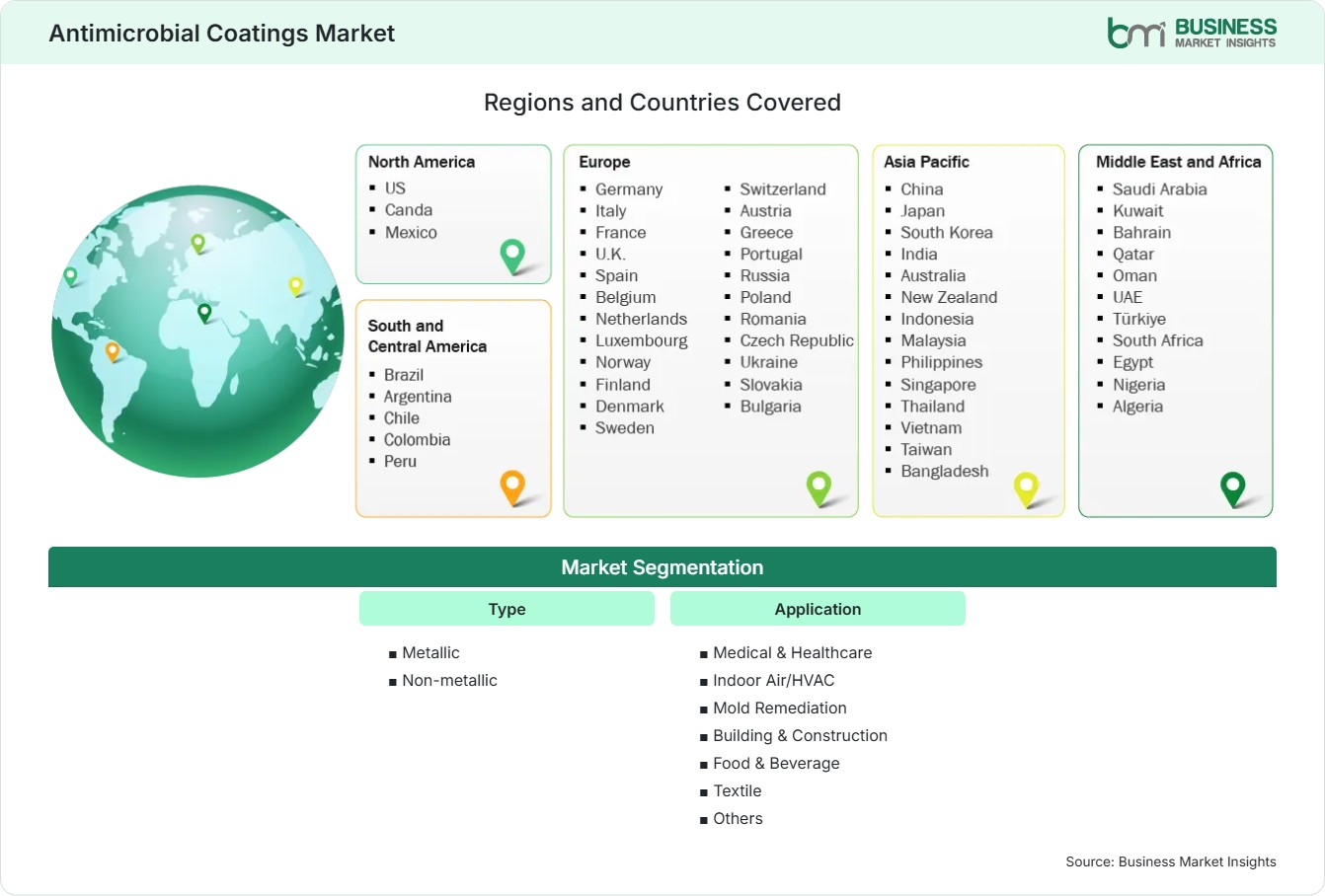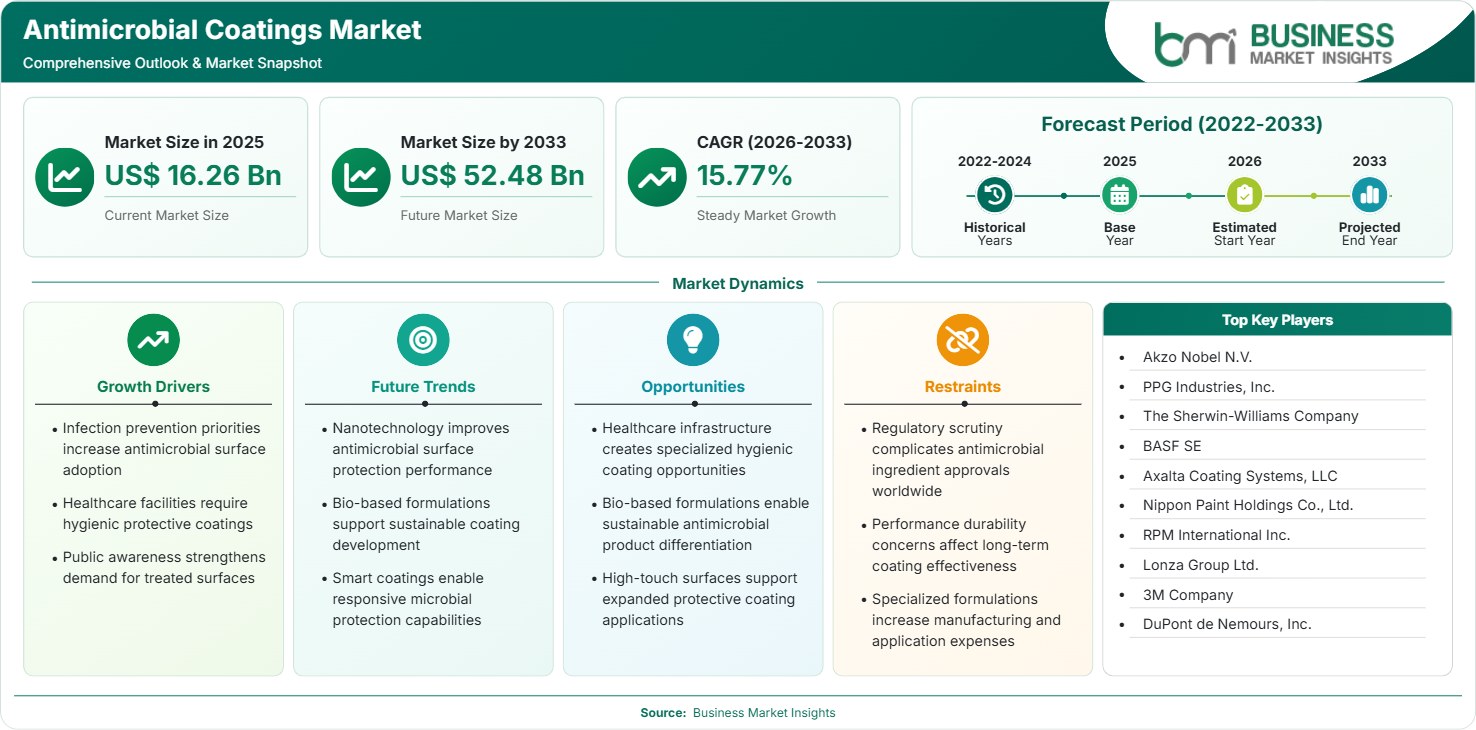
Antimicrobial Coatings Market Regional Highlights
North America Antimicrobial Coatings Market
North America holds 34%–37% market share in 2025 and is anticipated to record 14.8%–15.4% CAGR in the forecast period 2026-2033. End-use demands include healthcare facilities, commercial buildings, HVAC products, food processing facilities, and institutional renovations. Consumers now judge antimicrobial properties alongside durability, cleanability, and compliance. The region has advantages due to the presence of coating companies, well-developed powder coating technology, and sound specification practices. The US Antimicrobial Coatings Market remains the leading domestic market, while Canada and Mexico offer additional potential in healthcare, food manufacturing, industrial equipment, and building renovations.
- Healthcare procurement favors coatings capable of maintaining surface performance under frequent cleaning cycles and intensive institutional use.
- HVAC modernization is expanding opportunities for protected coils, grilles, vents, housings, and air-handling components.
- Construction refurbishment supports antimicrobial powder coatings for doors, partitions, fixtures, railings, and high-contact architectural surfaces.
- Food-processing investment creates demand for durable, cleanable coatings that support hygiene-focused facility design.
US Antimicrobial Coatings Market
The US represents approximately 74%–78% of the North American share in 2025 and is expected to grow at a 15.1%–15.7% CAGR of the Antimicrobial Coatings Market during 2026–2033. Hospital construction, healthcare equipment refurbishment, institutional buildings, food processing, and commercial HVAC modernization provide the principal demand base. The suppliers have to separate the surface protection claims from those involving human protection against pathogenic microorganisms. For this reason, EPA-treated article regulations and customer demands affect product formulation, labeling, testing, and marketing. PPG, Sherwin-Williams, Axalta, and other suppliers possess wide-ranging capabilities in antimicrobial powder coating.
- US demand is supported by renovation spending where antimicrobial functionality can be incorporated without replacing complete equipment or surface systems.
- Healthcare and institutional buyers increasingly prioritize durable coatings compatible with repeated cleaning, disinfecting, abrasion, and chemical exposure.
- Commercial HVAC and building retrofits create opportunities for coatings that combine microbial control with corrosion protection and longer maintenance intervals.
Europe Antimicrobial Coatings Market
Europe accounts for 27% - 30% in 2025 and is predicted to grow at a CAGR of 14.5% - 15.2% from 2026 to 2033. The key areas of demand include Germany, the United Kingdom, France, Italy, and Spain. Germany is projected to lead the market, and Poland shows good growth at approximately 15.5%-16.2% CAGR. The sustainability needs include low VOC powder coatings, energy-efficient curing, durable film formation, and a long maintenance cycle.
- Germany benefits from advanced industrial manufacturing, healthcare infrastructure, and strong demand for engineered powder-coating systems.
- France and the UK provide opportunities in healthcare, public buildings, hospitality, transportation, and indoor environmental applications.
- Sustainability objectives encourage suppliers to combine antimicrobial performance with lower solvent use, efficient curing, and extended coating life.
- European specifiers increasingly demand documented performance and transparent environmental and regulatory information before approving functional coatings.
Asia Pacific Antimicrobial Coatings Market
Asia Pacific region has a market share of 23%-26% in 2025 and will grow at the fastest pace among all regions with a CAGR of 17.1%-17.9%. China continues to lead the market, while India is forecast to experience the highest growth rate, at 18.4%-19.2% CAGR, driven by healthcare developments, manufacturing investments, infrastructure development, and food processing. Japan and South Korea provide formulation expertise and high-end applications. Increasing production of medical devices, appliances, HVAC systems, and architectural products widens opportunities for coated surfaces.
- China combines large manufacturing capacity with extensive healthcare, construction, appliance, transportation, and food-processing applications.
- India offers substantial greenfield and retrofit opportunities as hospitals, commercial buildings, manufacturing plants, and food facilities expand.
- Japan supports premium antimicrobial technologies where performance validation, durability, precision manufacturing, and product quality strongly influence procurement.
- Southeast Asian markets provide additional growth through urbanization, hospitality construction, electronics manufacturing, healthcare investment, and food exports.
Rest of World Antimicrobial Coatings Market
Rest of World constitutes 10%–13% in 2025 and is forecasted to register 16.0%–16.8% CAGR through 2026–2033. South and Central America have advantages in food processing, healthcare infrastructure, and industrial renovation, with Brazil as the dominant player. The Middle East and Africa have demand for healthcare, hospitality, infrastructure, HVAC, and food applications, while the UAE and Saudi Arabia are relatively more promising options for premium projects.
South American purchasers are seeking long-lasting coating solutions with a focus on hygiene for the food and healthcare industries. Middle Eastern demand will be strengthened by major commercial projects, hospitals, airports, hotels, and buildings that require mechanical ventilation systems.
- Brazil provides the largest addressable Antimicrobial Coatings Market in South America through food production, healthcare, industrial facilities, and construction.
- Mexico and Chile offer opportunities linked to manufacturing, food exports, healthcare infrastructure, and commercial construction.
- Saudi Arabia and the UAE support premium applications through healthcare campuses, hospitality developments, airports, and large-scale commercial projects.
- Africa remains a developing opportunity where healthcare capacity, food processing, and urban infrastructure gradually expand demand for functional surface protection.