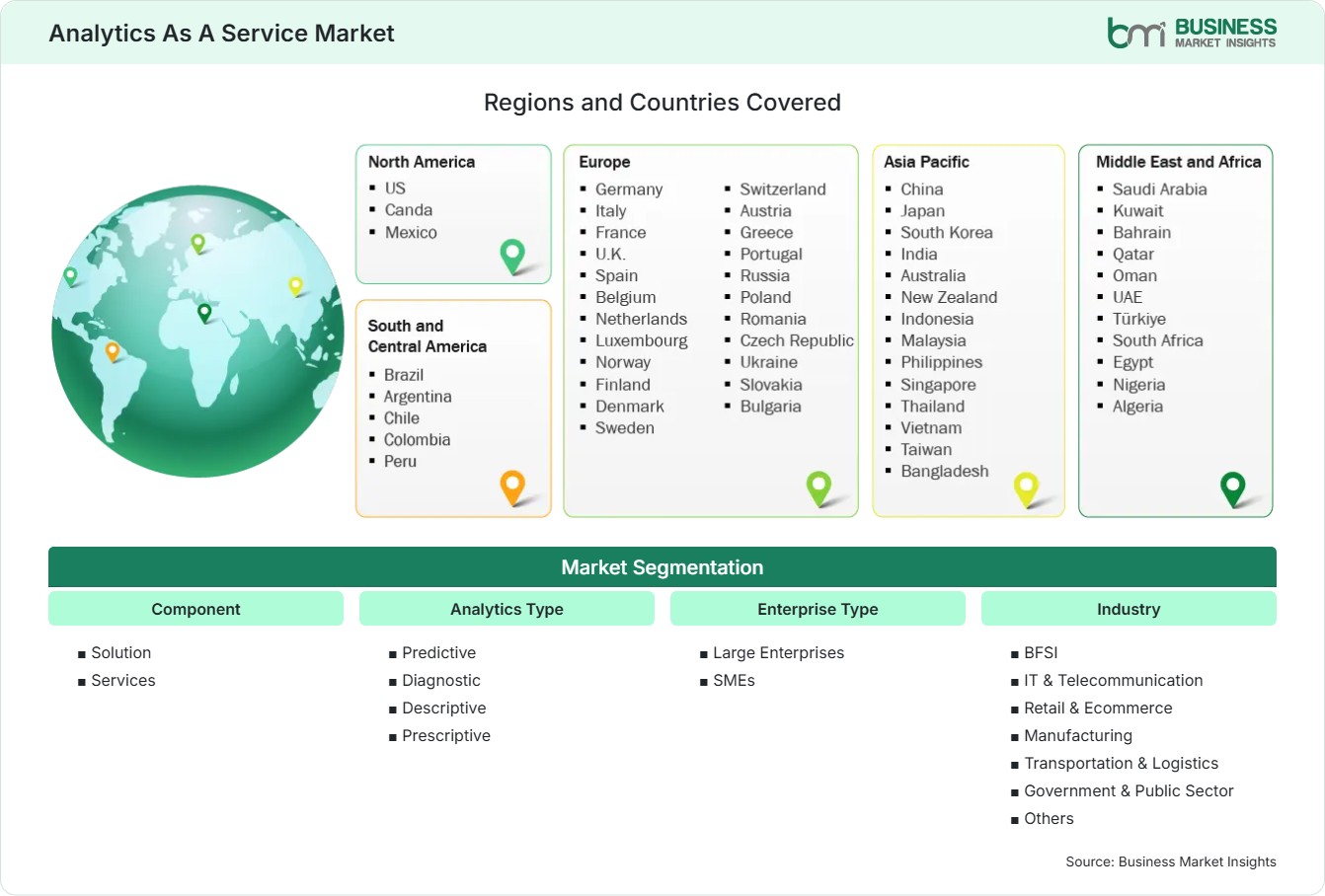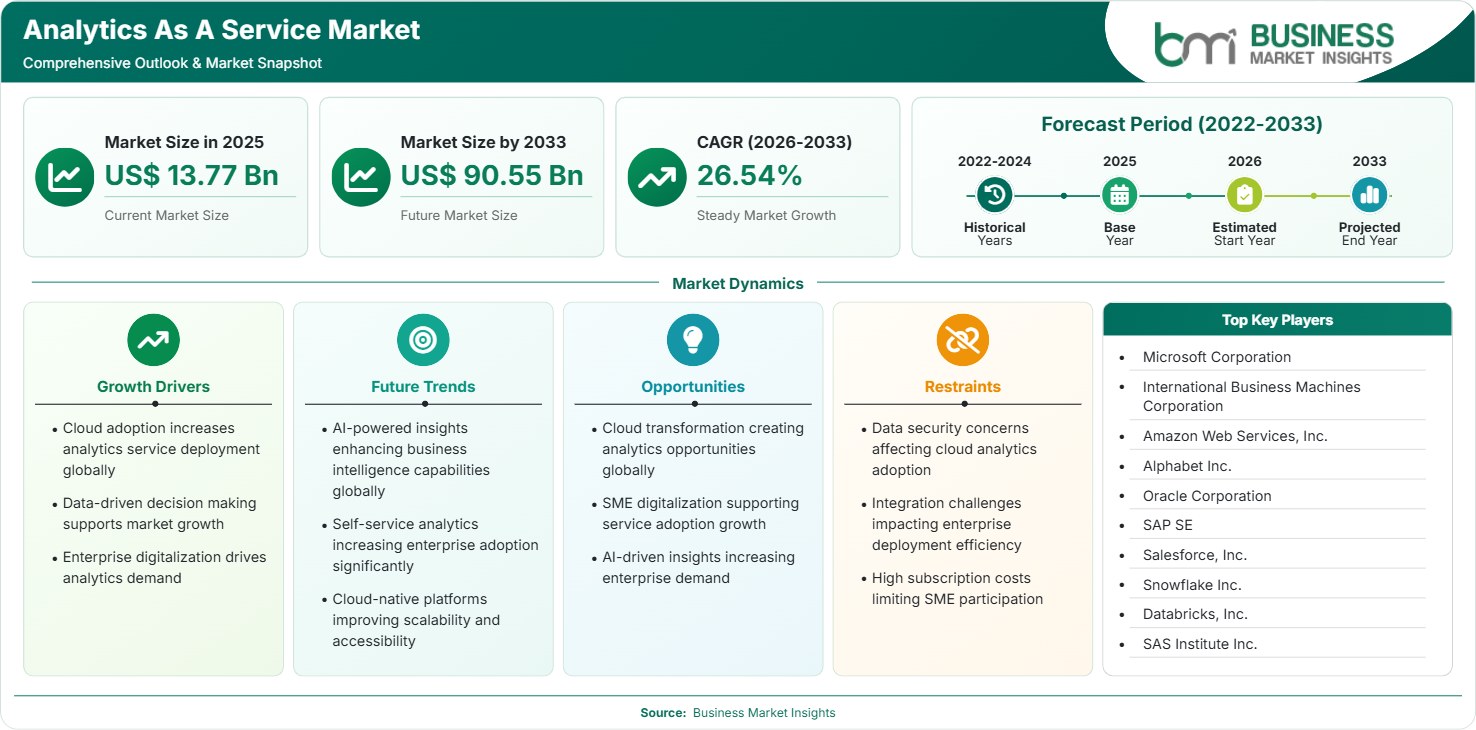
Analytics As A Service Market Regional Highlights
North America Analytics As A Service Market
North America holds a 24%–27% Analytics As A Service Market share in 2025 and is projected to expand at a 24%–27% CAGR through 2033. The region benefits from mature cloud ecosystems, high enterprise software spending, sophisticated data teams, AI investment, and widespread adoption of subscription-based technology services.
- The growing demand for managed analytics is due to cloud-native enterprise architectures, since such architectures allow organizations to scale their computing and storage capabilities without the need to maintain a large on-premise infrastructure or a specialized team for platform operations.
- Financial institutions are currently extending their use of real-time fraud analytics, customer intelligence, risk modeling, and regulatory reporting, which in turn creates a continuous need for scalable services capable of integrating both structured and unstructured data.
- Technology companies are now incorporating analytics directly into their applications so that customers can access features such as recommendations, forecasting, anomaly detection, and performance intelligence without having to use separate analytical environments.
- As businesses look for greater control over sensitive information, model outputs, access permissions, lineage, and compliance in their ever more widely distributed cloud environments, data governance is now becoming a requirement in procurement.
US Analytics As A Service Market
The US represents approximately 82%–86% of the North American Analytics As A Service Market demand and maintains a 25%–28% CAGR through 2033. Strong cloud infrastructure, advanced AI development, extensive enterprise software adoption, and large technology budgets support continued expansion.
- As the volume of transactions and the number of digital channels grow, banking and insurance companies are making greater use of predictive risk analysis, fraud detection, customer segmentation, and automated compliance analytics.
- To improve the accuracy of their forecasts, offer more personalized engagement, and at the same time reduce the complexity of their analytical infrastructure, retailers are combining data on customers, inventory, pricing, marketing, and the supply chain.
- Technology companies are speeding up the adoption of embedded analytics and AI assistants so that operational users can query corporate information using conversational interfaces even if they don't have specialized knowledge of statistics or programming.
Europe Analytics As A Service Market
Europe accounts for approximately 20%–23% Analytics As A Service Market share in 2025 and is expected to expand at a 23%–26% CAGR through 2033. Germany, the United Kingdom, France, and the Netherlands form major demand centers, while Poland and Spain offer high-growth opportunities.
- As manufacturers implement predictive maintenance, production optimization, quality monitoring, and supply-chain intelligence in their ever-more connected factories, Germany sees a benefit from the demand for industrial analytics.
- The United Kingdom is still one of the leading markets for analytics since financial services, retail, telecommunications, and government organizations are continuing to invest in AI-enabled decision systems and in cloud modernization.
- France is promoting wider adoption by carrying out digitization in the public sector, modernizing its financial services, introducing industrial automation, and having businesses increase their investment in secure artificial intelligence and data platforms.
- The Netherlands and Spain offer attractive opportunities for growth through logistics optimization, e-commerce analytics, smart infrastructure, telecommunications, and the expansion of cloud-based enterprise applications.
Asia Pacific Analytics As A Service Market
Asia Pacific represents approximately 27%–30% Analytics As A Service Market share in 2025 and is forecast to expand at a 29%–32% CAGR, making it the fastest-growing regional market. China, Japan, India, South Korea, Singapore, and Australia are major demand centers, while India, Southeast Asia, and selected emerging economies offer faster expansion.
- India is seeing a strong level of adoption as banks, retailers, technology companies, manufacturers, and government organizations combine cloud migration with the use of AI for making operational decisions and for gaining customer intelligence.
- China is still making investments in industrial analytics, e-commerce intelligence, logistics optimization, financial technology, and in large-scale data platforms that support ever-more automated commercial and manufacturing ecosystems.
- Both Japan and South Korea are advancing their use of analytics through initiatives in advanced manufacturing, in the telecommunications sector, in semiconductor ecosystems, in mobility applications, in robotics, and as part of enterprise modernization programs that require real-time operational intelligence.
- The economies of the Southeast Asian region are experiencing rapid development since the growing use of digital payments, e-commerce, logistics platforms, cloud services, and small and medium-sized enterprises that are enabled by digital technology is increasing the demand for accessible analytical capabilities.
Rest of World Analytics As A Service Market
South and Central America collectively represent approximately 7%–10% Analytics As A Service Market share in 2025 and are expanding at a 24%–28% CAGR. Brazil and Mexico lead regional demand, supported by financial technology, telecommunications, retail modernization, logistics, and cloud adoption.
- In Brazil, there is an increasing use of analytics in the sectors of financial services, retail, agriculture, telecommunications, and logistics, since large datasets offer opportunities for predictive planning and for gaining customer intelligence.
- As part of its efforts to carry out national digital transformation, Gulf economies are bringing analytics into such areas as smart infrastructure, government platforms, energy operations, and financial services, thus accelerating investment in enterprise technology.
- South Africa serves as a technological center for the regions in the fields of financial services and telecommunications analytics, and there is increasing demand for fraud detection, customer intelligence, and operational optimization.
- Because of manufacturing, logistics, retail, and nearshoring activities, Mexico is seeing greater demand for supply-chain visibility, production analytics, workforce intelligence, and predictive maintenance.