
AI-Powered Emotion Analytics Market Outlook: Size, Share, Trends, Growth Analysis, Competitive Landscape & Forecast, 2026-2033

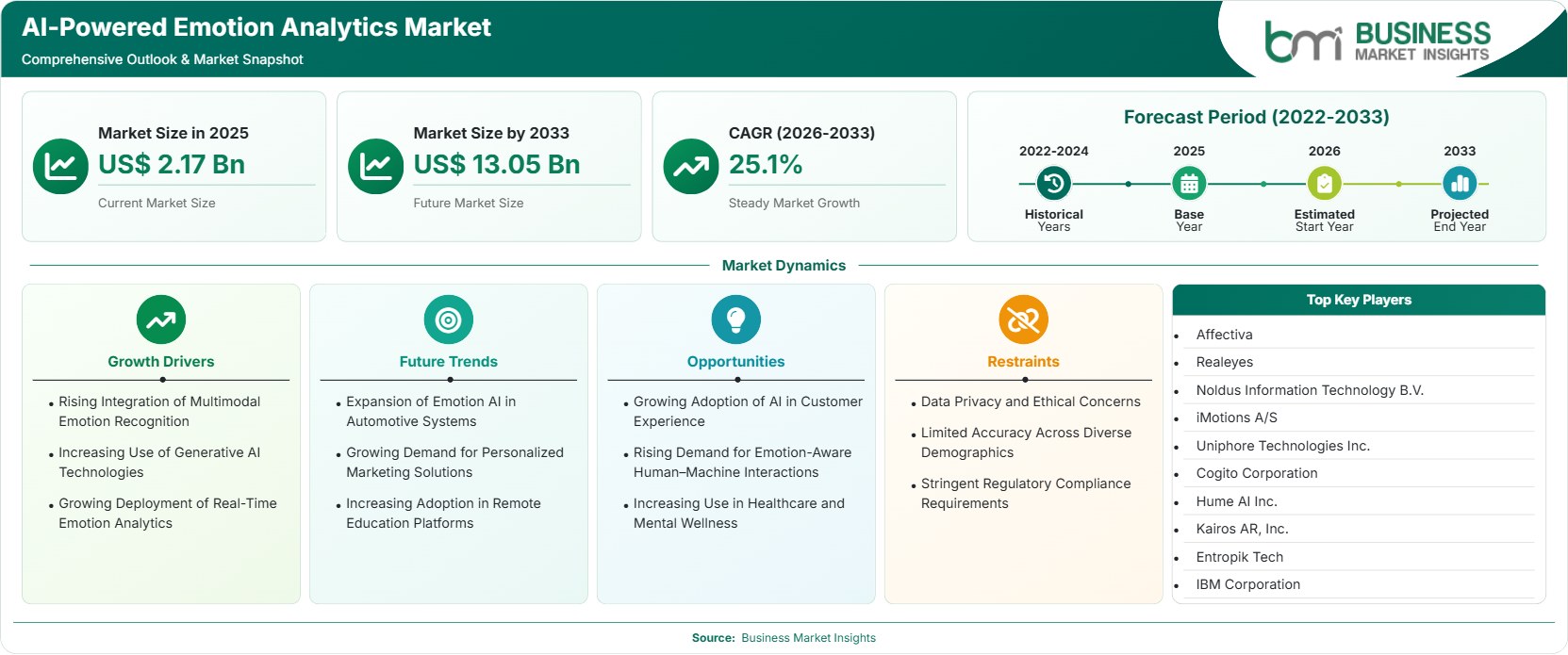
The AI-Powered Emotion Analytics Market size was valued at USD 2.17 Billion in 2025 and is projected to reach USD 13.05 Billion by 2033, growing at a CAGR of 25.1% during 2026–2033. Market expansion is driven by rising integration of multimodal emotion recognition, increasing adoption of generative AI technologies, and growing deployment of real-time emotion analytics across enterprise applications. Expanding AI-driven customer experience platforms, emotion-aware human-machine interactions, and healthcare analytics present significant growth opportunities.

Report Coverage
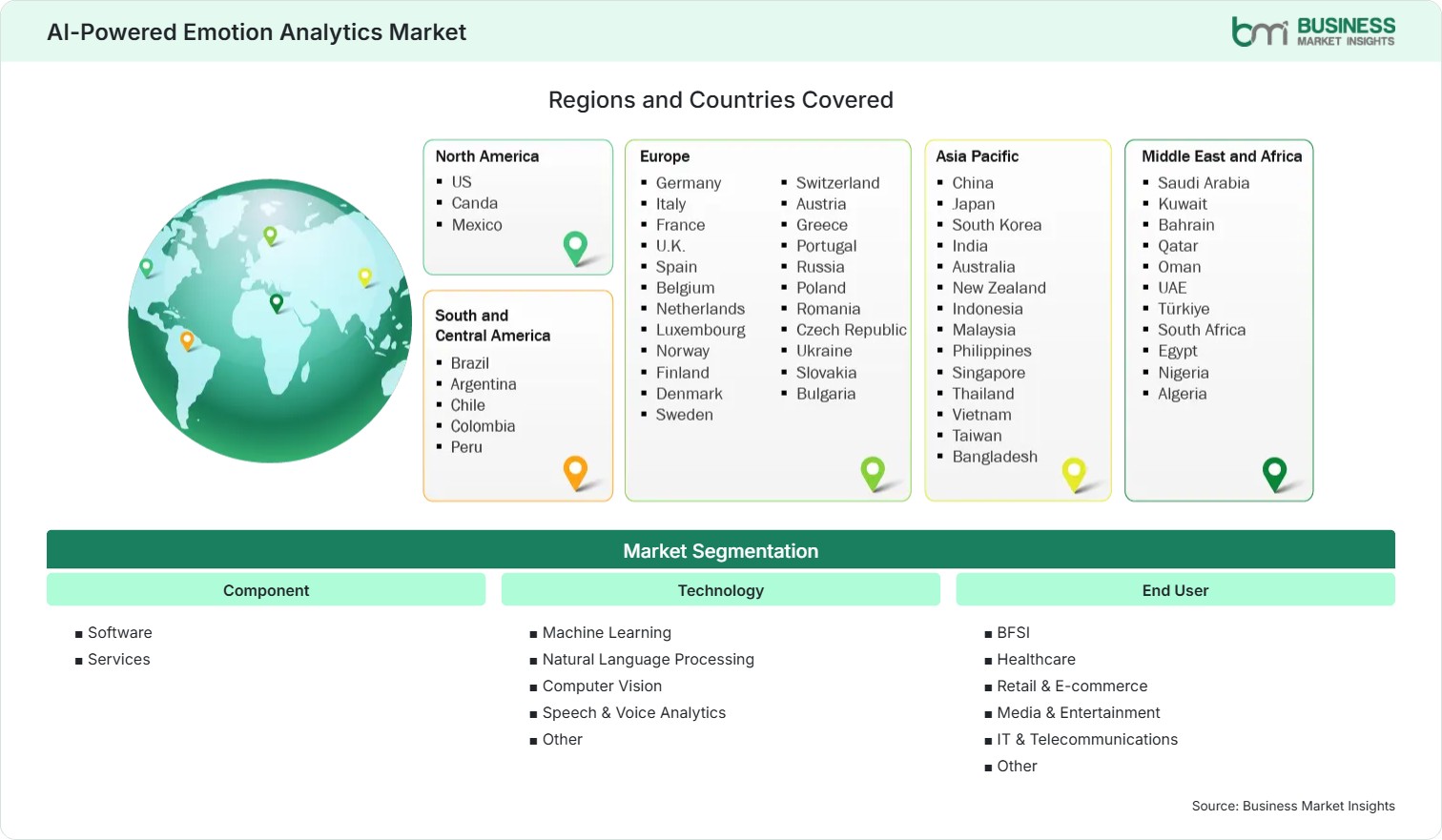
  • Component: Software, Services
  • Technology: Machine Learning, Natural Language Processing, Computer Vision, Speech & Voice Analytics, Other
  • End User: BFSI, Healthcare, Retail & E-commerce, Media & Entertainment, IT & Telecommunications, Other
US$ 2.17 Bn Market size in 2025
US$ 13.05 Bn Market Size by 2033
25.1% CAGR, 2026 - 2033
2026-2033 Forecast Period

AI Overview

AI-Powered Emotion Analytics Market Summary

  • North America Region: North America holds 37%–40% market share in 2025 and is projected to grow at a CAGR of 24.2%–24.9% during 2026–2033. Strong AI innovation ecosystems, widespread enterprise AI adoption, and increasing investments in customer experience technologies continue driving regional growth. The U.S. market remains the dominant contributor with a projected 24.5%–25.2% CAGR, supported by rapid deployment of AI-powered analytics platforms across healthcare, finance, and retail sectors.
  • Fastest Growing Region: Asia Pacific accounts for 24%–27% AI-powered emotion analytics market share in 2025 and is expected to register the fastest CAGR of 27.2%–28.1% through 2033. Accelerating digital transformation, AI investments, expanding cloud infrastructure, and growing adoption of intelligent customer engagement solutions continue strengthening regional demand.
  • Leading Segment: Software represents 66%–69% market share in 2025 and is projected to expand at a CAGR of 24.8%–25.6%. Increasing enterprise demand for scalable AI platforms, real-time behavioral analytics, and cloud-native emotion recognition solutions supports segment leadership.
  • High Growth Segment: Healthcare accounts for 16%–19% market share in 2025 and is anticipated to register a CAGR of 27.5%–28.4% through the forecast period. Growing adoption of AI-enabled mental wellness platforms, patient monitoring solutions, and telehealth services continues accelerating implementation across healthcare systems.
  • Key Market Opportunity: Advancements in multimodal AI, emotionally intelligent virtual assistants, digital therapeutics, personalized customer engagement, and privacy-preserving AI models are creating substantial opportunities for technology providers and enterprise software developers.
  • Major Market Players: Smart Eye AB (Affectiva), Realeyes, Noldus Information Technology B.V., iMotions A/S, Uniphore Technologies Inc., Cogito Corporation, Hume AI Inc., Kairos AR, Inc., Entropik Tech, and IBM Corporation.
Strategic Insights

AI-Powered Emotion Analytics Market: Strategic Insights

AI-Powered Emotion Analytics Market Strategic Framework
FREE PDF
Request your free sample
Request free sample
Stakeholder View

Key Takeaways

  • The industry ecosystem is rapidly evolving through collaborations among AI software developers, cloud service providers, behavioural science specialists, and enterprise platform vendors to deliver scalable, privacy-aware emotion recognition solutions across multiple industries.
  • The strongest commercial opportunities are emerging in customer experience management, healthcare diagnostics, contact centers, and intelligent virtual assistants where real-time emotional insights improve personalization, operational efficiency, and decision-making.
  • Innovation is increasingly focused on multimodal AI models that combine facial expression recognition, speech analytics, natural language processing, physiological signal analysis, and computer vision to enhance emotion detection accuracy across diverse environments.
  • Asia Pacific represents the most attractive long-term investment destination owing to accelerating AI adoption, expanding digital infrastructure, supportive government initiatives, and rising enterprise investments in intelligent customer engagement technologies.
  • Strategic acquisitions, venture capital funding, and partnerships between AI startups and enterprise technology companies continue accelerating commercialization of emotion analytics platforms while strengthening cloud-based deployment capabilities and global AI-Powered Emotion Analytics market reach.
  • Responsible AI development, explainable machine learning, and privacy-preserving analytics are becoming major competitive differentiators as organizations seek regulatory compliance and greater user trust in AI-powered emotional intelligence solutions.
Geographic Outlook

AI-Powered Emotion Analytics Market Regional Highlights

North America AI-Powered Emotion Analytics Market

North America accounted for approximately 37%–40% of global revenue in 2025 and is projected to grow at a CAGR of 24.2%–24.9% through 2033. The AI-Powered Emotion Analytics Market share remains the highest globally due to advanced AI ecosystems, strong cloud infrastructure, widespread enterprise digitization, and significant investments in responsible artificial intelligence. High adoption across healthcare, financial services, retail, and customer experience platforms continues supporting regional leadership.

  • Strong investment in generative AI, cloud computing, and enterprise analytics platforms continues accelerating deployment of emotion recognition technologies across commercial and public-sector organizations.
  • Mature digital infrastructure enables organizations to integrate multimodal emotion analytics into contact centers, virtual assistants, and customer engagement platforms with greater operational efficiency.
  • Healthcare providers increasingly adopt AI-powered emotional assessment solutions for behavioral health monitoring, telemedicine, and patient engagement initiatives.
  • Expanding regulatory focus on ethical AI and data governance encourages vendors to strengthen transparency, explainability, and privacy protection within emotion analytics platforms.
  • Continuous research collaborations between technology companies and academic institutions support innovation in multimodal artificial intelligence and human-centered computing.

US AI-Powered Emotion Analytics Market

The United States represented approximately 30%–33% of global revenue in 2025 and is expected to register a CAGR of 24.5%–25.2% during the forecast period. The country continues leading commercialization of AI-powered emotion recognition through strong venture capital investments, enterprise software innovation, and broad adoption across customer experience, healthcare, financial services, and media industries.

  • Growing deployment of AI-enabled customer experience platforms enhances personalized engagement across banking, retail, telecommunications, and hospitality industries.
  • Increasing investment in healthcare AI supports wider adoption of emotion analytics for behavioral health, patient monitoring, and digital therapeutics.
  • Technology companies continue advancing multimodal foundation models capable of improving contextual understanding and real-time emotional intelligence.
  • Strong cloud infrastructure and enterprise AI ecosystems accelerate large-scale implementation of software-based emotion analytics solutions.

Europe AI-Powered Emotion Analytics Market

Europe accounted for approximately 27%–30% of global market revenue in 2025 and is projected to grow at a CAGR of 23.6%–24.4% through 2033. The region benefits from increasing AI adoption, strong regulatory oversight, and growing investments in trustworthy artificial intelligence. Germany leads regional demand, while the Netherlands is expected to register the fastest growth with a CAGR of 25.5%–26.3%.

  • Organizations increasingly prioritize explainable AI and ethical emotion recognition technologies aligned with evolving European regulatory frameworks.
  • Financial institutions and healthcare providers continue expanding AI-powered behavioral analytics to improve customer engagement and clinical decision support.
  • Growing enterprise investments in intelligent automation strengthen adoption across manufacturing, telecommunications, and public administration.
  • Collaboration between research institutions and AI companies continues advancing multimodal machine learning technologies for commercial applications.
  • Demand for privacy-preserving AI architectures supports innovation in secure cloud and edge-based emotion analytics platforms.

Asia Pacific AI-Powered Emotion Analytics Market

Asia Pacific accounted for approximately 24%–27% of global revenue in 2025 and is projected to record the fastest AI-Powered Emotion Analytics Market growth with a CAGR of 27.2%–28.1% during 2026–2033. China remains the largest regional market, while India is expected to achieve the highest growth at a CAGR of 28.4%–29.3%, supported by accelerating AI investments, digital transformation initiatives, and expanding enterprise cloud adoption.

  • Rapid digitalization across financial services, healthcare, retail, and education continues increasing demand for AI-enabled emotional intelligence platforms.
  • Government-supported artificial intelligence initiatives encourage innovation, commercialization, and broader enterprise deployment across regional economies.
  • Expanding startup ecosystems and venture capital investments accelerate development of advanced multimodal AI solutions.
  • Rising adoption of conversational AI and intelligent virtual assistants strengthens demand for speech, facial expression, and sentiment analysis technologies.
  • Increasing cloud infrastructure investments improve scalability and accessibility of AI-powered emotion analytics across enterprises.

Rest of World AI-Powered Emotion Analytics Market

Rest of World represented approximately 6%–8% of global market revenue in 2025 and is expected to expand at a CAGR of 25.0%–25.8% through 2033.

South & Central America continue benefiting from expanding digital transformation programs, with Brazil projected to register a CAGR of 25.6%–26.4% during the forecast period.

The Middle East & Africa are witnessing increasing investments in AI innovation, smart city initiatives, and digital government programs. The United Arab Emirates is expected to achieve the fastest regional growth with a CAGR of 26.5%–27.3%.

  • Digital economy initiatives continue encouraging adoption of intelligent customer engagement and analytics platforms across public and private sectors.
  • Financial institutions increasingly deploy AI-powered behavioral analytics to strengthen customer service and fraud prevention capabilities.
  • Healthcare modernization programs support implementation of AI-assisted patient engagement and behavioral monitoring technologies.
  • Growing cloud adoption and regional AI investment initiatives improve market accessibility for global technology vendors.
  • Expanding partnerships between governments and AI solution providers continue accelerating enterprise adoption across emerging economies.
Global Market Geography
FREE PDF
Request your free sample
Request free sample
Segment Analysis

AI-Powered Emotion Analytics Market Segmentation

Component

The Component segment represents the core structure of the market, with software platforms accounting for the majority of industry revenue due to increasing enterprise adoption of AI-driven analytics solutions. This segment contributed approximately 66%–69% market share in 2025 and is projected to expand at a CAGR of 24.8%–25.6% during 2026–2033. Continuous innovation in cloud-native AI platforms, multimodal analytics, and enterprise integration capabilities is expanding the AI-Powered Emotion Analytics Market scope across customer experience, healthcare, and workforce intelligence applications.

  • Software: Software dominates the market as organizations increasingly deploy scalable AI platforms capable of analyzing facial expressions, speech, text, and behavioral signals for real-time emotional intelligence across enterprise environments.
  • Services: Services are witnessing strong demand as enterprises require consulting, deployment, integration, customization, training, and managed support to maximize the effectiveness of emotion analytics implementations.

Technology

Technology remains the most innovation-driven segment as vendors continues integrating multiple artificial intelligence models to improve recognition accuracy, contextual understanding, and real-time processing capabilities. The segment accounted for approximately 52%–55% market share in 2025 and is anticipated to register a CAGR of 25.4%–26.2% throughout the forecast period. Continuous advancements in foundation models, multimodal AI, and edge computing continue strengthening enterprise adoption.

  • Machine Learning: Machine learning algorithms provide predictive capabilities that continuously improve emotion recognition accuracy through adaptive model training, behavioral pattern analysis, and large-scale enterprise data processing.
  • Natural Language Processing (NLP): NLP enables contextual interpretation of written and spoken language, allowing organizations to analyze customer sentiment, conversational intent, and emotional context across digital communication channels.
  • Computer Vision: Computer vision technologies analyze facial expressions, eye movement, head positioning, and micro-expressions to deliver accurate visual emotion recognition for enterprise, healthcare, and research applications.
  • Speech & Voice Analytics: Speech analytics evaluates tone, pitch, cadence, pauses, and vocal characteristics to identify emotional states during customer interactions, healthcare consultations, and virtual assistant communications.

End User

The End User segment continues expanding as organizations increasingly integrate emotionally intelligent AI into customer engagement, operational analytics, healthcare delivery, and enterprise decision-making. This segment represented approximately 46%–49% market share in 2025 and is projected to grow at a CAGR of 25.0%–25.8% through 2033. Rising enterprise AI adoption and increasing investments in digital transformation continue supporting AI-Powered Emotion Analytics Market trends across multiple industry verticals.

  • BFSI: Financial institutions utilize emotion analytics to improve customer engagement, optimize contact center performance, strengthen fraud detection, and personalize digital banking experiences using behavioral insights.
  • Healthcare: Healthcare providers increasingly deploy emotion analytics for behavioral health assessment, patient engagement, telemedicine, digital therapeutics, and early identification of mental wellness indicators.
  • Retail & E-commerce: Retailers employ emotion recognition technologies to personalize shopping experiences, optimize marketing campaigns, improve customer satisfaction, and enhance conversion rates through behavioral analysis.
  • Media & Entertainment: Media organizations leverage emotion analytics to evaluate audience engagement, optimize content development, measure advertising effectiveness, and improve viewer experience across digital platforms.
  • IT & Telecommunications: Telecommunications companies integrate emotion analytics into customer support, conversational AI, intelligent virtual assistants, and workforce optimization solutions to improve service quality and operational efficiency.
Market Forces

AI-Powered Emotion Analytics Market Dynamics

Key Market Drivers

Rising Integration of Multimodal Emotion Recognition

Organizations are embracing multimodal emotion recognition technologies that include facial expression detection, speech analytics, natural language processing, physiologic signals, and behavior data to boost their context awareness and decision-making. The accuracy of emotion recognition is higher when using multimodal input compared to single-input solutions for customer service, health care, education, automotive and enterprise collaboration applications. Advances in foundation model architectures and edge computing capabilities facilitate real-time emotion recognition and minimize latency. Based on industry developments in enterprise artificial intelligence applications, organizations seek integrated analytics technologies that can provide valuable insights.

Increasing Use of Generative AI Technologies

Rapid proliferation of generative AI is reshaping emotion analytics by allowing for much more natural dialogue and reasoning based on emotions as customers engage in interactions. Emotion recognition systems powered by large language models allow enterprises to tailor their digital interactions, automate customer support processes, and enhance their conversational AI capabilities. Companies are now looking at ways to leverage AI copilots, intelligent virtual assistants, and automated engagement solutions that can discern both the textual meaning and emotional context behind the interaction.

Growing Deployment of Real-Time Emotion Analytics

motional analysis in real time is gaining prominence as an integral part of any enterprise looking to derive behavior insights in real time from live customer engagement, employee communication, and medical consultation. The advancements in cloud-first architecture, edge computing, and efficient AI inference engines help organizations analyze the multi-sensory data with low latency. The AI-Powered Emotion Analytics Market growth is further fueled by the growing demand for proactive customer services, intelligent contact centers, adaptive learning platforms, and clinical real-time monitoring systems.

Key Market Opportunities

Growing Adoption of AI in Customer Experience

Organizations worldwide are investing heavily in AI-powered customer experience platforms that deliver personalized interactions based on behavioral and emotional insights. Emotion analytics enables businesses to understand customer satisfaction, predict purchasing intent, and optimize engagement strategies across digital and physical channels. Integration with CRM platforms, conversational AI, and marketing automation systems creates opportunities for technology vendors to expand enterprise deployments while improving customer retention and operational efficiency.

Rising Demand for Emotion-Aware Human–Machine Interactions

The development of emotionally intelligent virtual assistants, collaborative robots, digital avatars, and intelligent automotive interfaces is creating substantial opportunities for emotion analytics providers. Human-machine interaction technologies increasingly require contextual understanding of user emotions to improve communication, safety, accessibility, and personalization. As AI systems become more interactive across consumer and enterprise applications, demand for accurate emotion recognition capabilities is expected to accelerate significantly over the forecast period.

Increasing Use in Healthcare and Mental Wellness

Healthcare represents one of the fastest-growing application areas as emotion analytics supports behavioral health assessments, patient engagement, digital therapeutics, telemedicine, and remote monitoring solutions. The strong outlook reflected in AI-Powered Emotion Analytics Market Forecasts is reinforced by increasing investments in AI-assisted mental wellness platforms and clinical decision support systems. Growing awareness of mental health, expanding telehealth adoption, and continuous improvements in multimodal AI algorithms are expected to create sustained long-term growth opportunities.

Market Restraints and Challenges

Data Privacy and Ethical Concerns

Factor: Analytics systems for emotions work with sensitive biometric data including facial expression, voice and behavior, all of which have been subject to increasingly strict data privacy rules, ethical AI standards and user consent requirements around the world. Impact: Adherence to new regulatory standards leads to higher implementation complexity and increased costs and regulatory requirements for tech vendors. Companies will need to focus on secure data handling, explainability of AI, privacy-preserving machine learning and transparency of consent practices.

Limited Accuracy Across Diverse Demographics

Factor: The effectiveness of emotion recognition algorithms could vary among diverse cultures, languages, age ranges, ethnicities, and environments due to training data constraints. Impact: Such discrepancies in recognition accuracy could undermine corporate trust, make adoption difficult in regulated industries, and necessitate regular updates to maintain consistent results. Vendors are accordingly making efforts to gather diverse datasets, eliminate bias in recognition software, and develop adaptable AI algorithms.

Company Analysis

Competitive Landscape

AI-Powered Emotion Analytics Market analysis indicates that companies are prioritizing explainable AI, privacy-preserving analytics, and scalable cloud-native platforms to strengthen their competitive positioning across customer experience, healthcare, financial services, and enterprise intelligence applications.

Company Name

Overview

Products and Services Relevant to this Market

Smart Eye AB (Affectiva)

Global AI company specializing in human insight technologies through automotive and enterprise emotion recognition solutions.

Facial emotion recognition software, in-cabin sensing, behavioral analytics, multimodal AI platforms.

Realeyes

AI software company focused on attention measurement and emotion analytics for media and advertising industries.

Emotion recognition platform, audience analytics, advertising effectiveness measurement, facial analysis software.

Noldus Information Technology B.V.

Leading provider of behavioral research and human observation software for scientific and commercial applications.

Behavioral analysis software, facial coding solutions, observational research platforms, emotion analytics tools.

iMotions A/S

Developer of multimodal biometric research software integrating emotion recognition and physiological analytics.

Biometric analytics, facial expression analysis, eye tracking, emotion AI research software.

Uniphore Technologies Inc.

Enterprise AI company delivering conversational automation and emotion-aware customer engagement solutions.

Conversational AI, speech analytics, emotion detection, intelligent virtual assistants, contact center software.

Cogito Corporation

AI-driven behavioral analytics company specializing in real-time conversational guidance for enterprises.

Real-time voice analytics, behavioral intelligence, customer experience optimization, conversational AI.

Hume AI Inc.

Artificial intelligence company developing empathic AI models capable of understanding emotional expression.

Empathic AI models, emotion recognition APIs, multimodal language models, developer AI platforms.

Kairos AR, Inc.

AI technology provider focused on facial recognition and emotional intelligence software solutions.

Facial analytics, identity verification, emotion recognition APIs, computer vision solutions.

Entropik Tech

Enterprise AI company providing consumer neuroscience and emotion analytics platforms for customer research.

Emotion AI platform, user experience testing, facial coding, voice analytics, market research solutions.

IBM Corporation

Global technology leader delivering enterprise AI, cloud computing, and advanced analytics platforms.

Watson AI, NLP solutions, AI analytics, enterprise cloud, machine learning platforms.

Industry Activity

Recent Developments

July 2026

Smart Eye AB (Affectiva) announced a new metric in its cloud-based Emotion AI offering. This metric, bolstered by Smart Eye’s advanced automotive safety-grade eye tracking technology, represents a significant leap in viewer attention measurement for brands, advertisers, entertainment companies.

June 2026

IBM Corporation launched IBM watsonx.ai v2.4 to help clients build and scale AI with more model choice, stronger governance, modernized runtimes and greater flexibility across hybrid environments

November 2025

Uniphore Technologies Inc. introduced advanced generative AI enhancements for its enterprise conversational automation platform, integrating real-time emotion intelligence to improve customer service, agent assistance, and contact center productivity.

March 2025

Hume AI Inc. revolutionizing mental health care by integrating empathic AI into therapeutic practice. By harnessing Hume’s advanced technologies, hpy enables therapists to deliver more personalized and effective care while preserving the essential human connection that underpins successful therapy.

Trust & Transparency

Research Methodology

The market analysis combines proprietary research with secondary data from government agencies, company disclosures, regulatory filings, industry databases and expert interviews. Market estimates are validated through data triangulation, cross-market benchmarking and analyst review.

View Full Research Methodology

Questions Answered

Frequently Asked Questions

What does an AI-Powered Emotion Analytics Market Report include?

A comprehensive market report provides market sizing, forecasts, competitive benchmarking, regional analysis, technology assessment, segmentation, regulatory developments, emerging trends, and strategic recommendations for industry participants.

What are the most promising future opportunities?

Significant opportunities are emerging in AI-driven customer experience, emotion-aware human-machine interactions, digital therapeutics, behavioural healthcare, intelligent virtual assistants, and privacy-preserving multimodal AI technologies.

Which component holds the largest market share?

Software represents the largest component segment because organizations increasingly prefer scalable cloud-native AI platforms capable of delivering real-time multimodal emotion recognition and enterprise analytics across multiple business functions.

Which region leads the AI-Powered Emotion Analytics Market?

North America dominates the market due to its advanced AI ecosystem, strong cloud infrastructure, significant enterprise technology investments, and early adoption of emotion analytics across healthcare, BFSI, retail, and customer experience applications.

What is driving the Market?

Key growth drivers include increasing adoption of multimodal emotion recognition, rapid deployment of generative AI technologies, expanding enterprise AI investments, and growing demand for real-time emotional intelligence across customer experience, healthcare, and financial services.

Access the Full AI-Powered Emotion Analytics Market Report

Get segment-level forecasts, regional estimates, competitive benchmarking, company profiles and downloadable Excel datasets.

Access the full AI-Powered Emotion Analytics Market Report
350 pages PDF & Excel | 2026-07-29