
4D Imaging Radar Market Outlook: Size, Share, Trends, Growth Analysis, Competitive Landscape & Forecast, 2026-2033

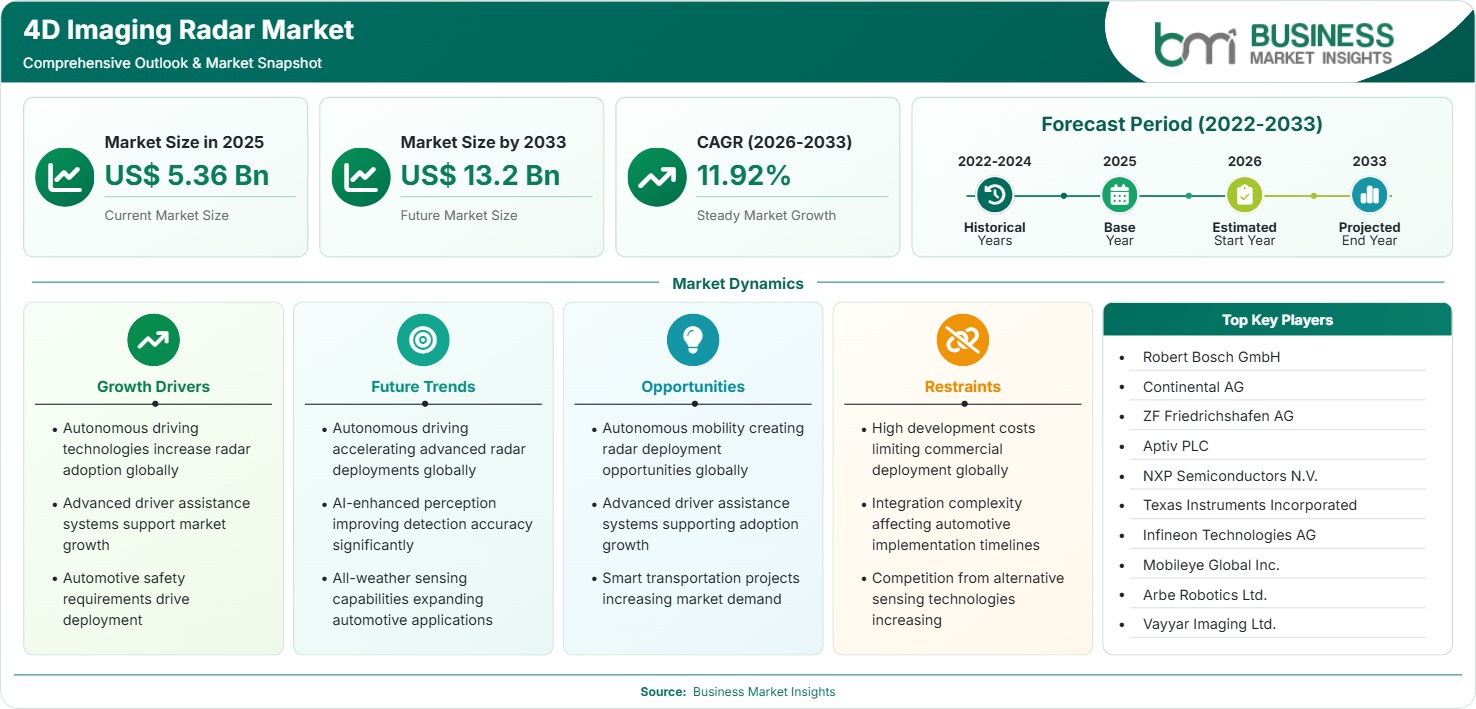
The 4D Imaging Radar Market size was valued at US$ 5.36 Billion in 2025 and is projected to reach US$ 13.2 Billion by 2033, growing at a CAGR of 11.92% during 2026–2033, supported by ADAS adoption, higher radar resolution, centralized vehicle computing, regulatory safety requirements, and demand for reliable all-weather perception.

Report Coverage
  • Radar Architecture: MIMO, DBF, FMCW, Doppler Radar, Synthetic Aperture Radar
  • Component: Radar SoC/RFIC, Antenna-in-Package, Transceivers, Software, Embedded Systems
  • Imaging Capability: 2D Radar, 3D Radar, 4D Imaging Radar
  • Deployment Mode: OEM-Installed, Aftermarket, Integrated into Perception Stacks
  • Range: Short-Range, Mid-Range, Long-Range
US$ 5.36 Bn Market size in 2025
US$ 13.2 Bn Market Size by 2033
11.92% CAGR, 2026 - 2033
2026-2033 Forecast Period

AI Overview

4D Imaging Radar Market Summary

  • North America Region: North America holds a 27%–31% 4D Imaging Radar Market share in 2025, growing at a 10.8%–12.2% CAGR, supported by mandatory AEB, premium ADAS adoption, software-defined vehicles, autonomous driving investment, and strong radar semiconductor capabilities. The US market is expanding at an estimated 10.9%–12.3% CAGR as automakers accelerate Level 2+ sensing deployments and comply with NHTSA safety requirements.
  • Fastest Growing Region: Asia Pacific accounts for a 29%–33% share in 2025 and is expanding at a 13.0%–14.8% CAGR, driven by Chinese ADAS penetration, EV production, semiconductor localization, intelligent vehicle policies, high-volume radar manufacturing, and rising demand for cost-efficient imaging sensors.
  • Leading Segment: 4D Imaging Radar within Imaging Capability represents a 48%–53% share in 2025 and advances at a 12.5%–14.0% CAGR, reflecting demand for elevation data, velocity measurement, dense point clouds, superior object separation, and all-weather perception.
  • High Growth Segment: Radar SoC/RFIC within Components holds a 24%–28% share in 2025 and grows at a 13.5%–15.0% CAGR, driven by higher channel counts, integrated processing, smaller sensor footprints, lower system costs, and centralized electronic architectures.
  • Key Market Opportunity: The strongest opportunity lies in scalable 4D platforms that combine RF, signal processing, AI perception, and software interfaces, enabling automakers to deploy one architecture across multiple vehicle classes.
  • Major Market Players: Robert Bosch GmbH, Continental AG, ZF Friedrichshafen AG, Aptiv PLC, NXP Semiconductors N.V., Texas Instruments Incorporated, Infineon Technologies AG, Mobileye Global Inc., Arbe Robotics Ltd., and Vayyar Imaging Ltd.
Strategic Insights

4D Imaging Radar Market: Strategic Insights

4D Imaging Radar Market Strategic Framework
FREE PDF
Request your free sample
Request free sample
Stakeholder View

Key Takeaways

  • The value chain is moving toward integrated radar platforms in which semiconductor suppliers, Tier 1 manufacturers, perception-software developers, and OEMs jointly optimize sensing, processing, networking, and functional-safety requirements.
  • Long-range and multi-range imaging radar offers the strongest upside because autonomous driving functions require reliable detection beyond conventional short-range sensing while maintaining performance across weather and lighting conditions.
  • Radar development is progressing toward 8Tx8R and higher channel architectures, antenna-in-package integration, centralized processing, software-defined calibration, and AI-assisted interpretation of high-density radar point clouds.
  • Asia Pacific provides the most attractive volume opportunity as Chinese EV manufacturers, Japanese suppliers, South Korean electronics companies, and Indian automotive producers increase ADAS content while local semiconductor ecosystems mature.
  • Strategic investment is concentrating on radar semiconductor IP, perception software, antenna technology, and production-qualified platforms rather than standalone sensor hardware, raising the importance of ecosystem partnerships.
  • Cost per sensing function is becoming as important as maximum range. Platforms capable of replacing multiple conventional sensors can improve vehicle packaging, wiring complexity, processing efficiency, and total system economics.
Geographic Outlook

4D Imaging Radar Market Regional Highlights

North America 4D Imaging Radar Market

North America represents a 27%–31% 4D Imaging Radar Market share in 2025 and is projected to expand at a 10.8%–12.2% CAGR through 2033. The region benefits from advanced vehicle electronics, strong semiconductor expertise, autonomous-driving programs, and regulatory pressure for improved collision avoidance. US automakers are increasing radar content across premium and mainstream platforms, while technology suppliers are developing centralized architectures that support software-defined vehicles. Canada contributes through automotive engineering and component manufacturing. Mexico provides additional manufacturing capacity as global OEMs diversify vehicle and electronics production across North American supply chains.

  • Advanced emergency braking regulation supports broader radar installation, while high-resolution sensing improves pedestrian, cyclist, and vehicle detection across highway and urban driving scenarios.
  • US premium vehicle programs are moving toward richer radar data streams that support hands-free and automated driving while reducing dependence on camera-only perception.
  • Semiconductor suppliers benefit from demand for integrated radar processors, 76–81 GHz transceivers, and scalable architectures compatible with multiple vehicle platforms.
  • Mexico offers manufacturing advantages for radar modules as automakers expand regional production and seek shorter supply chains for electronically intensive vehicles.

US 4D Imaging Radar Market

The US represents 22%-25% of the global 4D Imaging Radar Market in 2025 and is expected to grow at a 10.9%-12.3% CAGR through 2033. This growth will be driven by increasing adoption of ADAS, autonomous driving testing, advanced electronic systems on high-end vehicles, and regulations. The NHTSA-issued AEB regulation mandates that all new passenger cars and light trucks have an AEB system installed by September 2029, making it a solid sensor content play.

  • Automakers are prioritizing radar architectures that provide reliable detection during darkness and adverse weather, improving the performance envelope of automated emergency braking and highway assistance.
  • Silicon Valley and wider US technology clusters support AI-based radar perception, sensor fusion, embedded computing, and autonomous-driving validation programs.
  • Vehicle manufacturers increasingly seek production-ready radar systems that can scale from mainstream ADAS to higher levels of automated driving without major architecture changes.

Europe 4D Imaging Radar Market

Europe currently accounts for 24%–28% market share in the 4D Imaging Radar Market, growing at a CAGR of 10.5%–12.0%. Germany continues to be the top market due to the presence of OEMs, Tier 1, radar engineering, and semiconductor design. Technologies in France and the UK help, and Spain and Italy contribute to vehicle production. The EU's General Safety Regulation has increased ADAS adoption in new cars, boosting demand for reliable sensor and radar technologies.

  • Germany remains the primary European development center, with suppliers investing in long-range radar, centralized processing, functional safety, and scalable ADAS architectures.
  • France and the UK provide opportunities in automotive software, sensing algorithms, testing, and autonomous mobility programs, supporting demand for advanced perception hardware.
  • Spain and Italy benefit from established vehicle assembly and component networks, creating opportunities for localized radar module manufacturing and integration.
  • European safety regulation continues to raise the minimum technology content of new vehicles, supporting sustained demand for radar-based collision avoidance and driver assistance.

Asia Pacific 4D Imaging Radar Market

Asia Pacific represents a 29%–33% 4D Imaging Radar Market share in 2025 and is forecast to achieve the fastest 13.0%–14.8% CAGR through 2033. China leads regional deployment because of EV manufacturing scale, domestic ADAS development, and rapid adoption of intelligent vehicle functions. Japan and South Korea provide mature automotive electronics ecosystems, while India is becoming a relevant manufacturing and engineering location. IMF projections continue to show strong growth momentum in India and China, supporting vehicle production and technology investment.

  • China is the largest volume opportunity as domestic EV brands integrate higher levels of ADAS while semiconductor and sensor suppliers localize components.
  • Japan combines mature automotive engineering with demand for compact, reliable sensing platforms suitable for high-volume passenger vehicles and advanced safety functions.
  • South Korea offers strong electronics and semiconductor capabilities, supporting radar IC development, embedded computing, AI processing, and sensor integration.
  • India is gaining importance as vehicle production, engineering services, and domestic technology investment expand, creating a longer-term opportunity for cost-optimized radar systems.

Rest of World 4D Imaging Radar Market

Rest of World represents a 17%–21% 4D Imaging Radar Market share in 2025 and is projected to grow at a 9.5%–11.2% CAGR. South and Central America are supported by rising vehicle safety awareness, the import of ADAS technologies, and expanding automotive distribution. Brazil remains the principal regional market, while Mexico is closely integrated with North American production. In the Middle East and Africa, the UAE, Saudi Arabia, and South Africa provide opportunities through smart mobility, premium vehicle adoption, intelligent infrastructure, and autonomous transport initiatives.

  • Brazil offers the strongest South American opportunity because of its vehicle fleet size, manufacturing base, and increasing penetration of electronically enabled safety systems.
  • Gulf markets are attractive for high-end ADAS because premium vehicles, smart-city projects, and autonomous mobility programs create demand for high-performance sensing.
  • South Africa provides an entry point into Sub-Saharan applications, although adoption remains sensitive to vehicle affordability and infrastructure investment.
  • Saudi Arabia and the UAE can accelerate deployment through government-backed smart mobility initiatives, autonomous transportation pilots, and technologically advanced vehicle fleets.
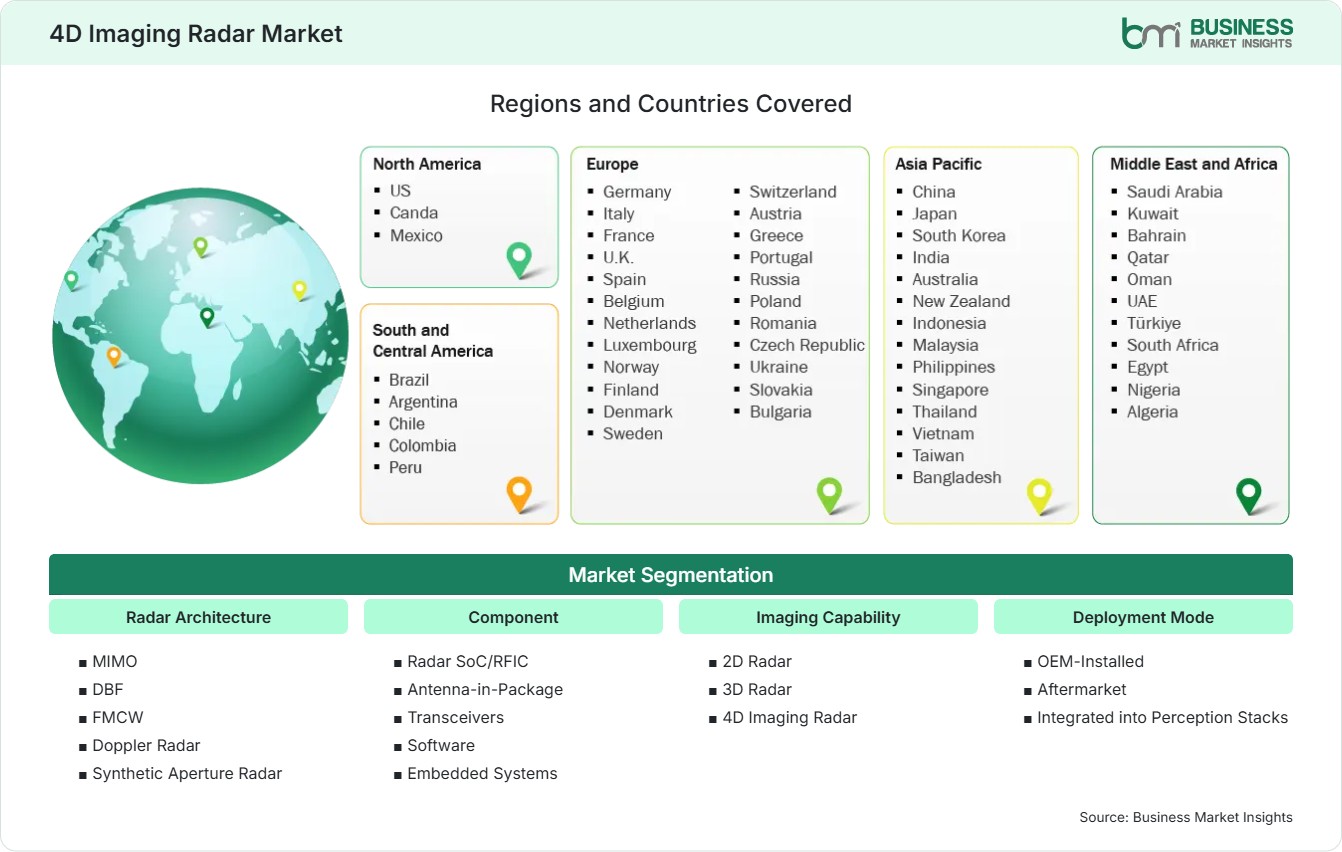
Global Market Geography
FREE PDF
Request your free sample
Request free sample
Segment Analysis

4D Imaging Radar Market Segmentation

Radar Architecture

Radar Architecture accounts for 31%–35% of the market share in 2025 and is anticipated to record a CAGR of 10.8%–12.4%. The selection of architecture now hinges on factors such as angular resolution, processing and power requirements, scalability, and vehicle packaging. MIMO remains the prevailing architecture, although DBF and FMCW architectures are used in high-resolution scenarios. The scope of the 4D Imaging Radar Market thus covers both radar fundamentals and advanced architectures.

  • MIMO: MIMO remains widely adopted because multiple transmit and receive paths create virtual channels that improve angular resolution without requiring proportionally larger physical arrays.
  • DBF: Digital beamforming enables flexible spatial processing and multiple simultaneous beams, supporting advanced object separation and adaptive sensing across complex traffic environments.
  • FMCW: FMCW provides simultaneous range and velocity information, making it fundamental to automotive perception and increasingly important for software-defined radar processing.
  • Doppler Radar: Doppler-based sensing improves velocity estimation and complements range information, supporting collision prediction, object tracking, and vulnerable-road-user detection.
  • Synthetic Aperture Radar: Synthetic aperture techniques can improve spatial resolution in specialized applications, although processing complexity limits broad automotive deployment compared with MIMO-based architectures.

Component

Component holds a market share of 29%-33% in the 4D Imaging Radar Market in 2025 and is projected to grow at a CAGR of 12.5%-14.2%. The integration of radio frequency, processing, memory, and interface components into modules is simplifying module design. Performance in radar systems increasingly depends on the SoC and RFIC, and antenna-in-package is minimizing the signal path length.

  • Radar SoC/RFIC: Integrated radar silicon combines RF transmission, reception, processing, calibration, and interfaces, reducing component count while enabling higher channel density and scalable performance.
  • Antenna-in-Package: Antenna-in-package integration reduces board area and signal losses while supporting compact high-frequency modules suited to increasingly constrained vehicle architectures.
  • Transceivers: Advanced transceivers are moving toward higher transmitter and receiver counts, enabling richer virtual channels, greater angular resolution, and longer-range imaging performance.
  • Software: Radar software increasingly handles calibration, object tracking, classification, sensor fusion, and perception refinement, turning raw radar measurements into actionable vehicle intelligence.
  • Embedded Systems: Embedded computing provides real-time signal processing and safety-critical execution, with architectures increasingly designed for centralized vehicle computers and zonal electronic systems.

Imaging Capability

Imaging Capability is led by 4D Imaging Radar, representing a 48%–53% share in 2025 with a 12.5%–14.0% CAGR. Adoption is being driven by the need for elevation information, velocity measurement, dense object representation, and greater robustness than conventional radar. The transition from 2D to 3D and 4D sensing is closely tied to higher levels of ADAS automation.

  • 2D Radar: 2D radar remains relevant for cost-sensitive applications where range and azimuth information provide sufficient performance for basic detection and collision warning functions.
  • 3D Radar: 3D radar adds elevation measurement, improving object localization and helping systems distinguish overhead structures, road geometry, and vertically separated targets.
  • 4D Imaging Radar: 4D imaging combines range, azimuth, elevation, and velocity to produce richer environmental models for advanced ADAS, automated driving, and all-weather perception.

Deployment Mode

In the Deployment Mode, 4D Imaging Radar Market share of 22%-26%, while the CAGR forecast is 11.5%-13.2 %. OEM Integration is the main focus because it requires coordinating functional safety, vehicle networking, calibration, and software validation during car development. The importance of aftermarket and perception stack integration remains significant.

  • OEM-Installed: Factory-installed systems offer optimized sensor positioning, vehicle-specific calibration, functional safety validation, and direct integration with braking and vehicle-control systems.
  • Aftermarket: Aftermarket radar provides opportunities in commercial fleets, retrofit safety systems, robotics, and specialized mobility applications where vehicle replacement cycles are slower.
  • Integrated into Perception Stacks: Integration into perception stacks allows radar outputs to be combined with camera and other sensor data, improving object tracking and decision-making.

Range

The range segmentation is led by long-range systems, which account for 34%-38% of the market in 2025 and are growing at a CAGR of 12.8%-14.4%. The higher-range sensing will enable automated vehicles with adaptive cruise control, forward collision warning, and detection of fast-approaching objects. The mid-range systems will remain significant for urban ADAS, and short-range radar will continue to see high volumes in parking and blind-spot applications.

  • Short-Range (up to ~30 m): Short-range systems serve parking, blind-spot, side-impact, and near-field applications where wide coverage and compact packaging matter more than maximum detection distance.
  • Mid-Range (30–100 m): Mid-range radar supports urban ADAS, lane-change assistance, cross-traffic detection, and forward sensing where balanced range and resolution are required.
  • Long-Range (>100 m): Long-range systems are increasingly prioritized for highway automation because early object detection provides additional reaction time and improves trajectory planning at higher speeds.

Frequency Band

Adoption of Frequency Band is prevalent in 76–81 GHz systems and holds 52%–56% of the 4D Imaging Radar Market share in 2025, with a 12.7%–14.1% CAGR. Higher-frequency automotive radars benefit from greater available bandwidth and smaller antennas. Regulatory compliance, semiconductor availability, and OEMs' design expertise support the development of 76–81 GHz technology.

  • 24 GHz: 24 GHz remains relevant for selected legacy and short-range applications, although new high-resolution automotive development increasingly favors higher-frequency architectures.
  • 60 GHz: 60 GHz supports compact sensing, particularly in cabin monitoring and selected industrial applications requiring short-range multidimensional detection.
  • 76–77 GHz: The band remains established in automotive radar because of mature components, established regulatory pathways, and widespread deployment across forward and corner sensing.
  • 77–81 GHz: This band provides broader bandwidth and supports higher-resolution radar designs, making it central to imaging radar and long-range ADAS development.
  • >81 GHz: Higher-frequency approaches can support future high-resolution applications, although cost, propagation characteristics, regulatory considerations, and ecosystem maturity influence commercial adoption.
Market Forces

4D Imaging Radar Market Dynamics

Key Market Drivers

Higher ADAS Content and Mandatory Vehicle Safety Functions

Regulatory requirements are strengthening the addressable base for advanced radar. While the EU mandates that new cars integrate various ADAS functions, such as automatic braking and lane-keeping features, the US rule on AEB applies to new passenger cars and light trucks from September 2029. Regulations push for more sensors and incentivize car manufacturers to invest in higher-resolution radar systems rather than bare-minimum detection capabilities. In this case, the 4D Imaging Radar Market growth is increasingly influenced by regulations and hardware requirements rather than consumer behavior. High-resolution radar systems can detect pedestrians, perform object segmentation, and operate effectively in dark or adverse weather conditions.

Demand for High-Resolution All-Weather Perception

Cameras excel at classification but may be hampered by issues such as darkness, glare, rain, fog, and visibility. On the other hand, the strength of radar lies in its ability to measure both range and speed directly, with imaging technologies also providing elevation information. This is why radar is becoming indispensable in redundancy perception for levels 2+ and above in automation. Aptiv's Gen 8 system, for instance, uses radar technology and machine learning to enhance sensing for driving and parking. As a result, there is a shift in the 4D Imaging Radar Market trends towards higher channel numbers, denser point clouds, broader fields of view, and more accurate separation of close-proximity objects.

Centralized Vehicle Computing and Radar Silicon Integration

Vehicle electronic architectures are moving from distributed processing toward centralized and zonal computing. This transition changes radar design because raw or partially processed sensor data can be transmitted to a central compute platform rather than requiring every radar module to contain extensive processing hardware. The Infineon 8Tx8R CTRX8188F enables a centralized architecture and allows detection of vehicles and vulnerable road users from a distance. The NXP third-generation TEF8388 enables 8T8R configurations and scalable radar architecture. This development drives the 4D Imaging Radar Market growth by reducing component duplication, enabling software scalability, and promoting a common radar architecture across different vehicle programs.

Key Market Opportunities

Scalable Multi-Range Radar Platforms

Radar systems that perform short-, medium-, and long-range tasks using a single piece of hardware are in demand now more than ever to reduce wiring, mounting points, calibration, and ECUs. An example of such multi-range radar technology is Vayyar's automotive solution, which performs short- to long-range detection on a single chip and provides coverage up to 300 meters. This design enables suppliers to develop platforms tailored to the car's price and level of autonomy. Increasingly popular in the 4D Imaging Radar Market Forecasts are scalable architectures because OEMs can reuse validated hardware across multiple models while adjusting software functions, processing levels, and sensor counts.

Radar Perception Software and AI-Based Object Classification

Software is becoming an ever-growing value chain as raw radar signals evolve into increasingly valuable assets. Machine learning algorithms can perform object classification, track improvement, reduce noise, and merge radar and camera data. The new generation of radars from Aptiv highlights the growing trend of using radar data in combination with machine-learning techniques. Vendors who provide high-quality hardware and reusable perception software can earn repeated development and licensing revenue while reducing OEM integration times. However, the most profitable segment is portable software that works on different radar chips and vehicle platforms. This can save OEMs from having to rewrite all their software when changing sensor generations.

Expansion into Autonomous Commercial Mobility

Commercial trucks, robotaxi, autonomous shuttle, cargo delivery, and smart-infrastructure use cases generate demand in addition to that created by ADAS in passenger cars. The ability to operate for longer hours under changing conditions makes the applications valuable, given the need for reliable sensing and tracking of objects. Since the technology performs well in darkness and in poor weather, it is appropriate for fleets operating in conditions where daylight is unavailable. Long-distance sensing devices may help increase detection margins for vehicles with longer stopping distances due to size. It will be possible for suppliers to target fleets using a combined safety platform comprising radar, cameras, edge computing, and connectivity.

Market Restraints and Challenges

High Development and Validation Costs

Factor: Imaging radar requires radio-frequency components qualified for use in automobiles, and complex antenna designs, processing algorithms, functional safety validation, electromagnetic compatibility, and extended OEM qualification periods. Higher channel counts raise the bar for development efforts and may require novel cooling and computational approaches. Impact: Smaller suppliers face many obstacles to winning production business, as they must pay for engineering, testing, tooling, and customer support before generating any substantial revenue. This is one of the factors that pushes semiconductor vendors to work together with Tier 1 suppliers and OEMs, thereby consolidating the market among firms with an existing automotive track record.

Sensor Interference, Integration Complexity, and Cost Pressure

Factor: The higher the density of radars, the greater is the potential for mutual interference between the sensors, as well as the need to incorporate the radars with cameras, processors, the car's network, and other sensors. Impact: OEMs must balance resolution against power dissipation, processing, thermal management, sensor placement, and material costs. In addition, radar vendors have to compete not only on maximum range and number of channels but also on operational stability across varying temperatures, vehicle variants, driving conditions, and electromagnetic environments. This is especially true for the mass-market cars, where any increase in the number of sensors affects the vehicle's economics.

Company Analysis

Competitive Landscape

The competitive structure reflects a combination of semiconductor expertise, automotive Tier 1 integration, radar IP, perception software, and production scale. 4D Imaging Radar Market analysis indicates that suppliers with integrated hardware-software portfolios have an advantage because OEMs increasingly seek validated solutions rather than individual components.

Company Name

Overview

Products and Services relevant to this market

Robert Bosch GmbH

Major automotive technology supplier with extensive radar engineering, manufacturing scale, and OEM relationships across global vehicle programs.

Automotive radar sensors, ADAS platforms, radar processing, sensing software, and integrated vehicle safety technologies.

Continental AG

Global automotive supplier with extensive radar production experience and high-performance imaging radar development for automated driving.

Front and corner radar, long-range imaging radar, ADAS sensing, radar software, and perception technologies.

ZF Friedrichshafen AG

Automotive technology group developing integrated chassis, safety, sensing, and automated-driving solutions for passenger and commercial vehicles.

Radar sensors, ADAS systems, automated-driving platforms, sensor fusion, and vehicle control technologies.

Aptiv PLC

Automotive technology company combining radar hardware, antenna technology, software, and machine learning for advanced ADAS.

Gen 8 radar systems, radar perception, ADAS software, sensing architectures, and vehicle connectivity.

NXP Semiconductors N.V.

Semiconductor supplier providing scalable radar transceivers and processors for advanced automotive perception systems.

TEF8388 radar transceiver, S32R processors, RF-CMOS radar platforms, development tools, and automotive networking.

Texas Instruments Incorporated

Semiconductor company with broad automotive radar and edge-processing capabilities supporting integrated sensing architectures.

mmWave radar sensors, radar processors, automotive MCUs, signal processing, and development platforms.

Infineon Technologies AG

Automotive semiconductor supplier developing high-channel-count radar transceivers and centralized sensing architectures.

RASIC radar MMICs, 8Tx8R transceivers, AURIX processing, radar development platforms, and automotive semiconductor solutions.

Mobileye Global Inc.

ADAS and automated-driving technology company developing imaging radar for higher-level highway automation.

Imaging radar, EyeQ compute platforms, perception software, sensor fusion, and automated-driving systems.

Arbe Robotics Ltd.

Radar technology specialist focused on high-resolution imaging radar chipsets for automotive and other mobility applications.

4D imaging radar chipset, perception technology, radar reference platforms, and high-resolution sensing solutions.

Vayyar Imaging Ltd.

Radar sensing specialist developing multifunctional automotive radar platforms for ADAS and cabin monitoring.

60 GHz and 79 GHz radar-on-chip platforms, XRR technology, in-cabin monitoring, ADAS and ARAS solutions.

Trust & Transparency

Research Methodology

The market analysis combines proprietary research with secondary data from government agencies, company disclosures, regulatory filings, industry databases and expert interviews. Market estimates are validated through data triangulation, cross-market benchmarking and analyst review.

View Full Research Methodology

Questions Answered

Frequently Asked Questions

Why is a 4D Imaging Radar Market Report relevant to automotive technology planning?

A 4D Imaging Radar Report can help technology teams compare radar architectures, semiconductor strategies, regional adoption patterns, supplier capabilities, regulatory drivers, and emerging applications before committing to long vehicle-development cycles.

What should buyers evaluate when selecting an imaging radar platform?

Buyers should assess detection range, angular resolution, channel architecture, interference management, functional safety, software support, thermal performance, calibration requirements, scalability, and the supplier's automotive production experience.

Which frequency range is becoming most important for automotive imaging radar?

The 76–81 GHz range is becoming the central platform for high-resolution automotive radar because it supports compact antennas, broad bandwidth, mature components, and established vehicle integration practices.

How does 4D imaging radar differ from conventional automotive radar?

4D systems add elevation and richer spatial information to range, azimuth, and velocity measurements. This produces denser environmental representations and can improve object separation, tracking, and perception redundancy in advanced driving applications.

What factors will influence the adoption of 4D imaging radar in mass-market vehicles?

Cost, functional-safety qualification, sensor integration, semiconductor availability, and measurable ADAS benefits will determine adoption. Platforms that combine several sensing functions within compact hardware should gain an advantage as OEMs seek lower system complexity.

Access the Full 4D Imaging Radar Market Report

Get segment-level forecasts, regional estimates, competitive benchmarking, company profiles and downloadable Excel datasets.

Access the full 4D Imaging Radar Market Report
350 pages PDF & Excel | 2026-10-22
Similar Research

Related Market Reports