
Water Heater Market Outlook: Size, Share, Trends, Growth Analysis, Competitive Landscape & Forecast, 2026-2033

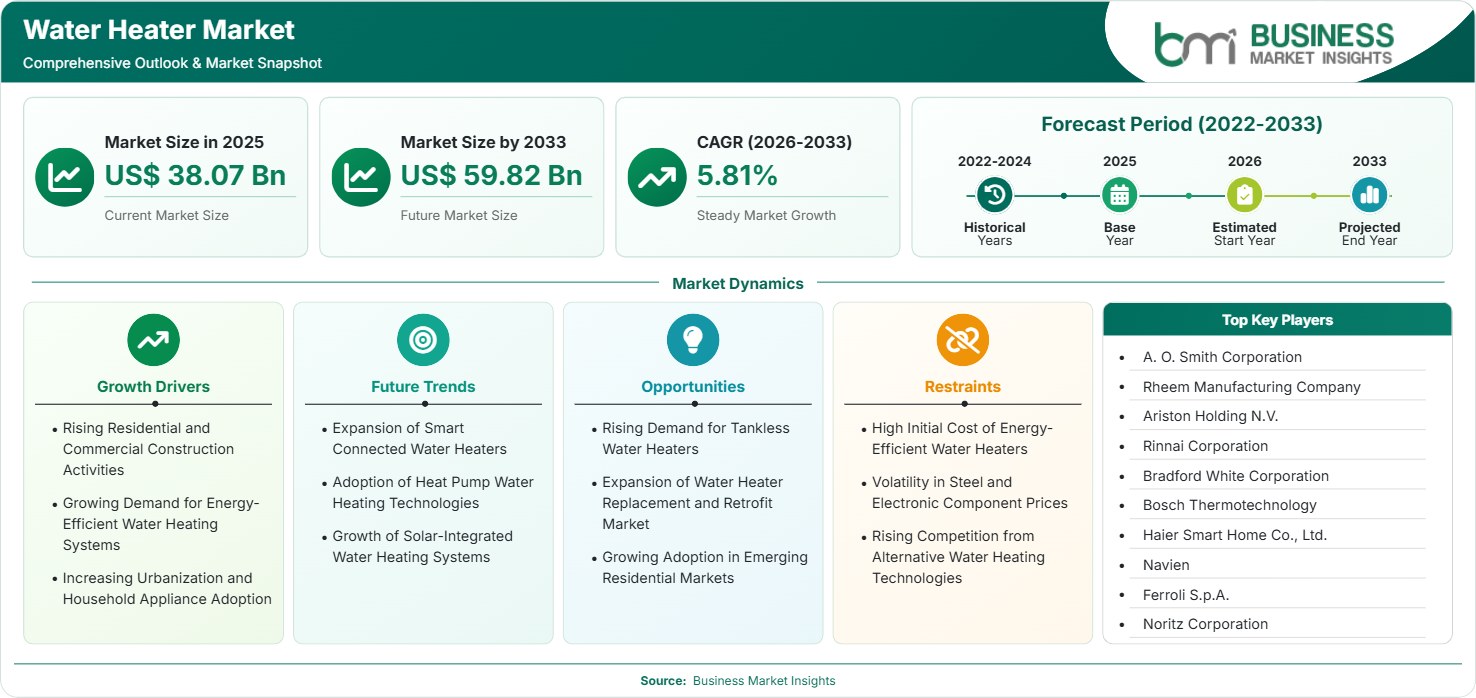
The Water Heater Market size was valued at US$ 38.07 Billion in 2025 and is projected to reach US$ 59.82 Billion by 2033, growing at a CAGR of 5.81% during 2026–2033. Rising urbanization, increasing demand for energy-efficient water heating systems, growth in residential construction activities, and expanding adoption of smart home appliances are supporting market growth globally.

Report Coverage
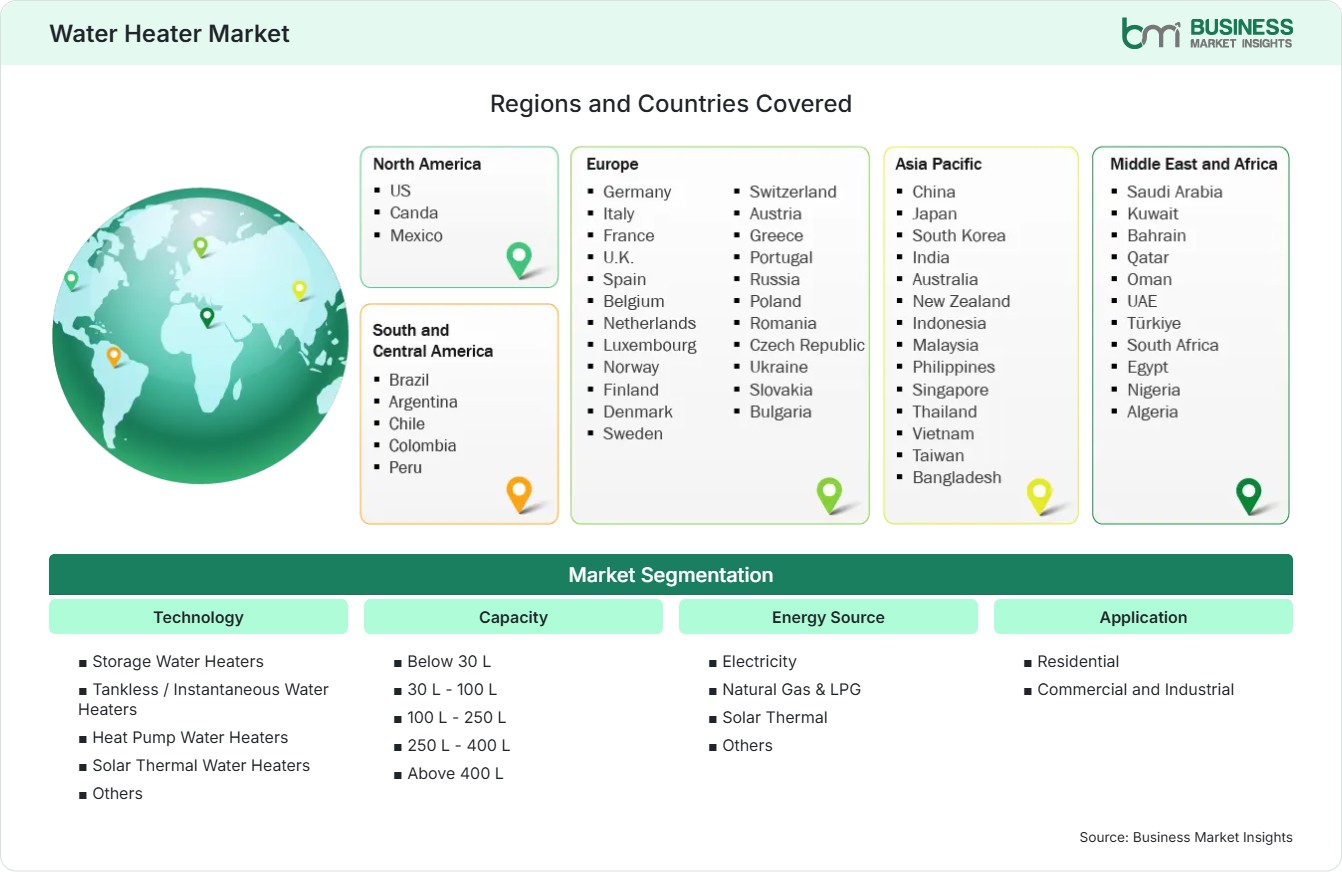
  • Technology: Storage Water Heaters, Tankless / Instantaneous Water Heaters, Heat Pump Water Heaters, Solar Thermal Water Heaters, Others
  • Capacity: Below 30 L, 30 L - 100 L, 100 L - 250 L, 250 L - 400 L, Above 400 L
  • Energy Source: Electricity, Natural Gas & LPG, Solar Thermal, Others
  • Application: Residential , Commercial and Industrial
US$ 38.07 Bn Market size in 2025
US$ 59.82 Bn Market Size by 2033
5.81% CAGR, 2026 - 2033
2026-2033 Forecast Period

01 AI Overview

Water Heater Market Summary

  • North America Region: North America holds a water heater market share of 34%–37% in 2025, growing with a CAGR of 5.2%–5.8% during 2026–2033. High replacement demand, growing adoption of tankless water heaters, increasing energy efficiency regulations, and rising investments in smart residential infrastructure continue supporting regional leadership. The U.S. market is expected to register a CAGR of 5.3%–5.9%.
  • Fastest Growing Region: Asia Pacific accounts for 28%–31% share in 2025 and is projected to grow at a CAGR of 6.8%–7.4% through 2033. Rapid urbanization, increasing construction activities, rising middle-class income levels, and growing adoption of modern household appliances continue supporting regional expansion.
  • Leading Segment: Storage (Tank) Water Heaters represent 49%–52% share in 2025 and are expected to grow at a CAGR of 5.3%–5.9% through 2033. Broad residential usage, lower upfront costs, widespread availability, and strong replacement demand continue supporting segment dominance.
  • High Growth Segment: Heat Pump Water Heaters account for 12%–15% share in 2025 and are forecast to grow at a CAGR of 8.8%–9.5% during 2026–2033. Increasing emphasis on energy efficiency, government incentive programs, and sustainability targets are driving adoption.
  • Key Market Opportunity: Expansion of smart connected water heaters integrated with energy management systems and renewable energy solutions is creating significant growth opportunities.
  • Major Market Players: A. O. Smith Corporation, Rheem Manufacturing Company, Ariston Holding N.V., Rinnai Corporation, Bradford White Corporation, Bosch Thermotechnology, Haier Smart Home Co., Ltd., Navien, Ferroli S.p.A., Noritz Corporation.
02 Strategic Insights

Water Heater Market: Strategic Insights

Water Heater Market Strategic Framework
FREE PDF
Request your free sample
Request free sample
03 Stakeholder View

Key Takeaways

  • Storage water heaters continue dominating installations due to affordability, ease of installation, and broad residential adoption.
  • Heat pump water heaters are emerging as the fastest-growing technology segment because of superior energy efficiency.
  • Residential applications remain the largest demand contributor supported by urban housing development and replacement demand.
  • Asia Pacific presents significant long-term growth opportunities driven by urbanization and infrastructure expansion.
  • Smart water heating systems are becoming increasingly important as connected home ecosystems expand globally.
  • Sustainability regulations and energy-efficiency standards continue influencing technology development and product adoption.
04 Geographic Outlook

Water Heater Market Regional Highlights

North America Water Heater Market

North America accounts for 34%–37% Water Heater Market share in 2025 and is projected to grow at a CAGR of 5.2%–5.8% through 2033. Strong replacement demand, growing awareness regarding energy efficiency, increasing adoption of smart home technologies, and rising investments in sustainable building infrastructure continue supporting regional market growth.

  • Residential consumers are increasingly replacing aging systems with energy-efficient tankless and heat pump water heaters to reduce electricity consumption and operating expenses.
  • Building regulations encouraging energy conservation continue supporting adoption of advanced water heating technologies.
  • Smart connected water heaters are gaining popularity among homeowners seeking remote monitoring and energy management capabilities.
  • Commercial establishments are increasingly investing in high-efficiency systems to reduce utility costs and improve environmental performance.
  • Growing renovation and remodeling activities continue generating replacement demand across residential and commercial properties.
  • Utility rebate programs and incentive schemes are supporting wider adoption of advanced water heating systems.

US Water Heater Market

The United States contributes approximately 84%–88% of North American revenue and is expected to register a CAGR of 5.3%–5.9% through 2033. High household penetration, well-established replacement cycles, and increasing interest in sustainable home appliances continue supporting water heater market growth.

  • Consumers are increasingly investing in advanced water heaters that offer improved efficiency and lower lifetime operating costs.
  • Tankless water heater adoption continues rising due to space-saving benefits and on-demand hot water availability.
  • Smart home integration is supporting demand for digitally connected heating systems.
  • Commercial facilities continue upgrading aging equipment to comply with evolving efficiency standards.
  • Growing awareness regarding environmental sustainability is encouraging investment in renewable-energy-compatible systems.

Europe Water Heater Market

Europe represents 25%–28% of global revenue in 2025 and is anticipated to expand at a CAGR of 5.7%–6.3% through 2033. Strong environmental regulations, increasing emphasis on renewable energy integration, and high consumer awareness regarding energy conservation continue supporting regional growth. Germany remains the leading water heater market while Poland demonstrates stronger growth momentum.

  • Germany continues leading regional adoption through investments in energy-efficient building technologies and sustainable heating systems.
  • Poland is among the fastest-growing markets and is expected to register a CAGR of 6.8%–7.4% during the forecast period.
  • Government programs promoting energy-efficient appliances are supporting replacement demand.
  • Solar thermal and heat pump water heaters are gaining popularity due to sustainability objectives.
  • Building owners increasingly seek solutions that reduce energy costs and improve environmental performance.
  • Technological advancements continue driving modernization of residential and commercial heating infrastructure.

Asia Pacific Water Heater Market

Asia Pacific accounts for 28%–31% of global revenue in 2025 and is expected to achieve the fastest CAGR of 6.8%–7.4% through 2033. Rapid urbanization, increasing residential construction, improving living standards, and expanding access to modern appliances continue supporting strong regional growth.

  • China remains the largest regional water heater market due to extensive urban housing development and strong appliance manufacturing capabilities.
  • India is projected to achieve approximately 7.6%–8.2% CAGR, supported by growing housing demand and rising middle-class purchasing power.
  • Consumers are increasingly adopting modern water heating systems as access to quality residential infrastructure improves.
  • Commercial construction activities are creating demand for large-capacity water heating installations.
  • Government focus on energy efficiency is encouraging deployment of advanced heating technologies.

Rest of World Water Heater Market

Rest of World accounts for 8%–11% of global revenue in 2025 and is projected to expand at a CAGR of 5.9%–6.5% through 2033. Growing urban development, increasing infrastructure investment, and rising consumer awareness regarding energy-efficient appliances continue supporting market expansion.

  • Brazil continues generating demand through residential construction growth and modernization of household infrastructure.
  • The UAE is witnessing increasing adoption of advanced water heating systems across residential and hospitality developments.
  • Saudi Arabia is expected to achieve approximately 6.7%–7.3% CAGR through 2033, supported by infrastructure expansion and residential development projects.
  • Tourism and hospitality investments continue creating demand for large-scale commercial water heating systems.
  • Rising disposable incomes are supporting greater adoption of premium and energy-efficient appliances.
  • Increasing energy-efficiency awareness continues encouraging replacement and upgrade activities.
Global Market Geography
FREE PDF
Request your free sample
Request free sample
05 Segment Analysis

Water Heater Market Segmentation

Technology

The technology segment remains the foundation of product innovation and market differentiation within the global water heater industry. The segment accounts for approximately 49%-52% share in 2025 and is projected to grow at a CAGR of 5.8%-6.4% through 2033. The expanding Water Heater Market scope is supported by growing construction activities, increasing replacement demand, stricter energy-efficiency regulations, and continuous technological advancements in water heating solutions.

  • Storage (Tank) Water Heaters: Storage water heaters remain the dominant technology due to affordability, simple installation requirements, broad availability, and strong consumer familiarity. These systems continue to be widely adopted across residential and commercial applications.
  • Tankless / Instantaneous Water Heaters: Tankless systems are gaining significant traction because they provide on-demand hot water, reduce standby energy losses, occupy less space, and offer improved efficiency compared with conventional storage systems.
  • Heat Pump Water Heaters: Heat pump technologies represent one of the fastest-growing categories due to superior energy performance, lower operating costs, and increasing support from government sustainability programs.
  • Solar Thermal Water Heaters: Solar thermal systems continue witnessing adoption across regions prioritizing renewable energy integration, energy savings, and carbon emission reduction initiatives.
  • Others: Additional technologies include hybrid systems and specialized commercial and industrial water heating solutions designed for unique operating environments.

Capacity

Capacity requirements vary depending on household size, commercial demand patterns, industrial applications, and hot water consumption volumes. This segment accounts for approximately 34%-37% share in 2025 and is expected to register a CAGR of 5.9%-6.5% through 2033. Current Water Heater Market trends indicate growing demand for application-specific solutions tailored to efficiency and performance requirements.

  • Below 30 L: These systems are primarily utilized for compact residential spaces, small apartments, and point-of-use applications where space optimization is important.
  • 30 L - 100 L: This category represents the largest segment due to its suitability for standard residential households and everyday hot water consumption requirements.
  • 100 L - 250 L: Medium-capacity systems are commonly used in larger households, apartment complexes, educational institutions, and small commercial establishments.
  • 250 L - 400 L: These systems serve commercial operations including hotels, restaurants, and healthcare facilities requiring greater hot water availability.
  • Above 400 L: Large-capacity systems are increasingly utilized in industrial settings, hospitality projects, and large-scale commercial facilities with significant hot water demand.

Energy Source

Energy source selection significantly influences operating costs, environmental impact, efficiency levels, and long-term adoption trends. This segment accounts for approximately 38%-41% share in 2025 and is forecast to grow at a CAGR of 6.1%-6.7% through 2033.

  • Electricity: Electric water heaters continue dominating installations because of simple installation processes, widespread electricity access, and compatibility with residential infrastructure.
  • Natural Gas & LPG: Gas-based systems remain popular in regions with established gas distribution networks and lower operating costs relative to electricity.
  • Solar Thermal: Solar-powered systems continue expanding due to rising environmental awareness and increasing demand for renewable energy solutions.
  • Others: Additional energy sources include hybrid configurations and emerging alternative heating technologies focused on efficiency improvement.

Application

Application diversity continues supporting stable water heater market growth across residential, commercial, and industrial sectors. This segment accounts for approximately 56%-59% share in 2025 and is projected to expand at a CAGR of 6.0%-6.6% through 2033.

  • Residential: Residential applications remain the dominant segment due to growing housing development, appliance replacement demand, and increasing consumer awareness regarding energy-efficient technologies.
  • Single-Family Homes: Single-family housing continues generating strong demand for both conventional and advanced water heating solutions.
  • Multi-Family / Apartments: Urbanization and apartment construction projects continue supporting growth across this category.
  • Commercial: Commercial users increasingly invest in efficient systems to reduce operational expenses and ensure consistent hot water supply.
  • Hospitality: Hotels and resorts require large-scale water heating systems for guest comfort and operational efficiency.
  • Healthcare: Healthcare facilities depend on reliable hot water systems for sanitation, patient care, and operational requirements.
  • Education: Educational institutions require centralized water heating systems to support student and staff facilities.
  • Food Service: Restaurants and foodservice providers utilize high-capacity systems for cooking, cleaning, and sanitation activities.
  • Others: Additional commercial users include office complexes, retail centers, and institutional buildings.
  • Industrial: Industrial facilities utilize specialized water heating systems across manufacturing, processing, cleaning, and operational support functions.
06 Market Forces

Water Heater Market Dynamics

Key Market Drivers

Rising Residential and Commercial Construction Activities

Urbanization and infrastructure construction keep on fueling the demand for water heaters. There are increasing investments in the real estate sector in the form of residential buildings, apartments, hotels, schools, hospitals, and commercial buildings. Water heaters are an important element in contemporary building since they affect the comfort and sanitation in buildings. Water heaters play a very crucial role since they enhance efficiency in buildings. In the coming years, the demand for water heaters is expected to be sustained by the increasing demand from end users.

Growing Demand for Energy-Efficient Water Heating Systems

Both consumers and businesses have become more inclined to use energy-efficient appliances in an effort to minimize costs and enhance sustainability. It is important to note that water heating takes up a large share of energy consumption in households and organizations, which makes it quite profitable to achieve improvements. Modern technologies like heat pump water heaters, tankless heaters, and solar heaters can help save a considerable amount of energy in comparison to conventional technologies. Governments around the world have been actively developing laws and energy efficiency programs to boost the adoption of energy-efficient equipment.

Increasing Urbanization and Household Appliance Adoption

Urban population growth continues driving greater adoption of modern household appliances, including water heaters. Rising living standards, expanding middle-class populations, and improving access to residential infrastructure are encouraging consumers to invest in appliances that improve comfort and convenience. As urban households increasingly demand modern lifestyles, hot water availability is becoming a basic requirement rather than a premium feature. This trend is particularly evident across emerging economies where residential electrification and appliance ownership rates continue increasing. Improved consumer awareness regarding advanced technologies and product benefits is further supporting installation growth. As urbanization accelerates globally, demand for water heating systems is expected to remain strong across both developed and developing markets.

Key Market Opportunities

Rising Demand for Tankless Water Heaters

Tankless water heaters are gaining widespread popularity due to their ability to deliver hot water on demand while reducing standby energy losses. Consumers increasingly appreciate their compact design, longer operational lifespan, improved efficiency, and reduced energy consumption. These systems are particularly attractive in urban environments where space efficiency is important. Manufacturers continue introducing technologically advanced models with smart monitoring capabilities and enhanced flow performance. Growing consumer interest in energy-efficient home appliances is expected to support increased adoption across residential and light commercial applications. Tankless solutions represent one of the most significant growth opportunities within the water heater industry.

Expansion of Water Heater Replacement and Retrofit Market

A substantial installed base of aging water heaters across residential and commercial properties is creating significant replacement opportunities. Many existing systems fail to meet modern energy-efficiency standards and incur higher operating costs. Property owners are increasingly replacing older units with advanced technologies capable of delivering better performance and lower utility expenses. Retrofit projects are also benefiting from government energy-efficiency initiatives and sustainability programs. Manufacturers and installers are actively targeting replacement demand through incentive-based promotions and upgrade solutions. As aging infrastructure continues requiring modernization, the replacement market is expected to generate substantial revenue opportunities throughout the forecast period.

Growing Adoption in Emerging Residential Markets

Emerging markets represent one of the most attractive opportunities for future industry expansion. Rising disposable incomes, expanding housing developments, improving utility access, and increasing consumer awareness continue supporting appliance adoption. Consumers in developing regions are increasingly prioritizing comfort-oriented products that improve household living standards. In addition, government programs promoting housing and infrastructure development are expanding potential customer bases. Long-term Water Heater Market Forecasts remain favorable as manufacturers increase investments in localized production, distribution networks, and product affordability to address growing demand in emerging residential markets.

Market Restraints and Challenges

High Initial Cost of Energy-Efficient Water Heaters

Factor: Advanced technologies such as heat pump water heaters, solar thermal systems, and premium tankless products typically involve higher upfront costs compared with traditional storage water heaters. Additional installation expenses and infrastructure modifications can further increase total ownership costs. Impact: Higher purchase prices may discourage adoption among cost-sensitive consumers despite long-term energy savings benefits. Affordability concerns can slow market penetration, particularly in developing economies and among lower-income households. Manufacturers must continue improving cost efficiency and educating consumers regarding lifetime value benefits.

Volatility in Steel and Electronic Component Prices

Factor: Water heater manufacturing depends heavily on raw materials including steel, copper, insulation materials, electronic controls, sensors, and heating elements. Price volatility within global supply chains can significantly affect production costs and profitability. Supply disruptions and commodity market fluctuations also create procurement challenges for manufacturers. Impact: Rising material costs may increase product prices, compress profit margins, and delay purchasing decisions among consumers and commercial buyers. Companies must continuously optimize sourcing strategies, manufacturing efficiency, and supply chain management to mitigate cost-related risks while maintaining competitiveness.

07 Company Analysis

Competitive Landscape

The Water Heater Market analysis is characterized by strong competition among global manufacturers focused on energy efficiency, smart water heating technologies, sustainability-driven product innovation, and expansion across residential, commercial, and industrial applications. Market participants are investing in heat pump technologies, tankless systems, solar-compatible solutions, connected appliances, and advanced energy management platforms to strengthen their competitive positions. Increasing regulatory pressure on energy consumption and rising consumer demand for intelligent, environmentally friendly water heating systems continue driving innovation across the industry.

Company Name

Overview

Products and Services relevant to this market

A. O. Smith Corporation

Global manufacturer specializing in residential and commercial water heating solutions with a strong focus on efficiency and innovation.

Storage water heaters, tankless water heaters, heat pump water heaters, commercial water heating systems, and smart water heating solutions.

Rheem Manufacturing Company

Water heating and HVAC equipment manufacturer serving residential and commercial customers globally.

Electric water heaters, gas water heaters, tankless systems, heat pump water heaters, commercial heating solutions, and connected water heating technologies.

Ariston Holding N.V.

International thermal comfort company offering energy-efficient water and space heating technologies.

Water heaters, heat pump systems, solar thermal solutions, storage heaters, tankless products, and sustainable heating technologies.

Rinnai Corporation

Global manufacturer known for advanced tankless and gas-fired water heating technologies.

Tankless water heaters, gas water heaters, commercial heating systems, energy-efficient solutions, and smart comfort technologies.

Bradford White Corporation

Water heating company serving residential, commercial, and industrial applications.

Storage water heaters, gas water heaters, electric water heaters, tankless products, and commercial water heating equipment.

Bosch Thermotechnology

Heating technology provider focused on sustainable and energy-efficient water heating systems.

Heat pump water heaters, solar thermal systems, storage heaters, commercial heating technologies, and smart energy solutions.

Haier Smart Home Co., Ltd.

Consumer appliance manufacturer offering residential water heating and smart home solutions.

Electric water heaters, smart water heaters, residential heating products, connected appliance solutions, and energy-efficient systems.

Navien

Manufacturer specializing in high-efficiency tankless water heaters and heating technologies.

Tankless water heaters, condensing systems, commercial heating products, smart control solutions, and energy-saving technologies.

Ferroli S.p.A.

Heating equipment manufacturer serving residential and commercial thermal comfort markets.

Storage water heaters, solar thermal products, electric water heaters, commercial heating systems, and integrated thermal solutions.

Noritz Corporation

Water heating company focused on advanced tankless and energy-efficient technologies.

Tankless water heaters, residential heating systems, commercial water heating products, and energy-efficient thermal solutions.

10 Trust & Transparency

Research Methodology

The market analysis combines proprietary research with secondary data from government agencies, company disclosures, regulatory filings, industry databases and expert interviews. Market estimates are validated through data triangulation, cross-market benchmarking and analyst review.

View Full Research Methodology

11 Questions Answered

Frequently Asked Questions

How are smart technologies influencing the water heater industry?

Manufacturers are increasingly integrating Wi-Fi connectivity, remote monitoring, intelligent temperature controls, predictive maintenance features, and energy management capabilities to improve user convenience and efficiency.

What does this Water Heater Market Report cover?

This report covers technology analysis, capacity segmentation, energy source evaluation, application trends, regional opportunities, competitive landscape assessment, market dynamics, and growth prospects through 2033.

Why are heat pump water heaters the fastest-growing technology segment?

Heat pump water heaters offer significant energy savings, lower operating costs, reduced environmental impact, and increasing eligibility for government incentives and efficiency programs.

Which technology segment dominates the market?

Storage (tank) water heaters remain the leading technology segment due to affordability, widespread consumer familiarity, broad installation suitability, and strong replacement demand across residential applications.

What is driving growth in the water heater market?

Rising residential and commercial construction activities, growing demand for energy-efficient water heating systems, increasing urbanization, and expanding adoption of modern household appliances are major factors supporting market growth.

Access the Full Water Heater Market Report

Get segment-level forecasts, regional estimates, competitive benchmarking, company profiles and downloadable Excel datasets.

Access the full Water Heater Market Report
350 pages PDF & Excel | 2026-08-12