
Virtual Sensors Market Outlook: Size, Share, Trends, Growth Analysis, Competitive Landscape & Forecast, 2026–2033

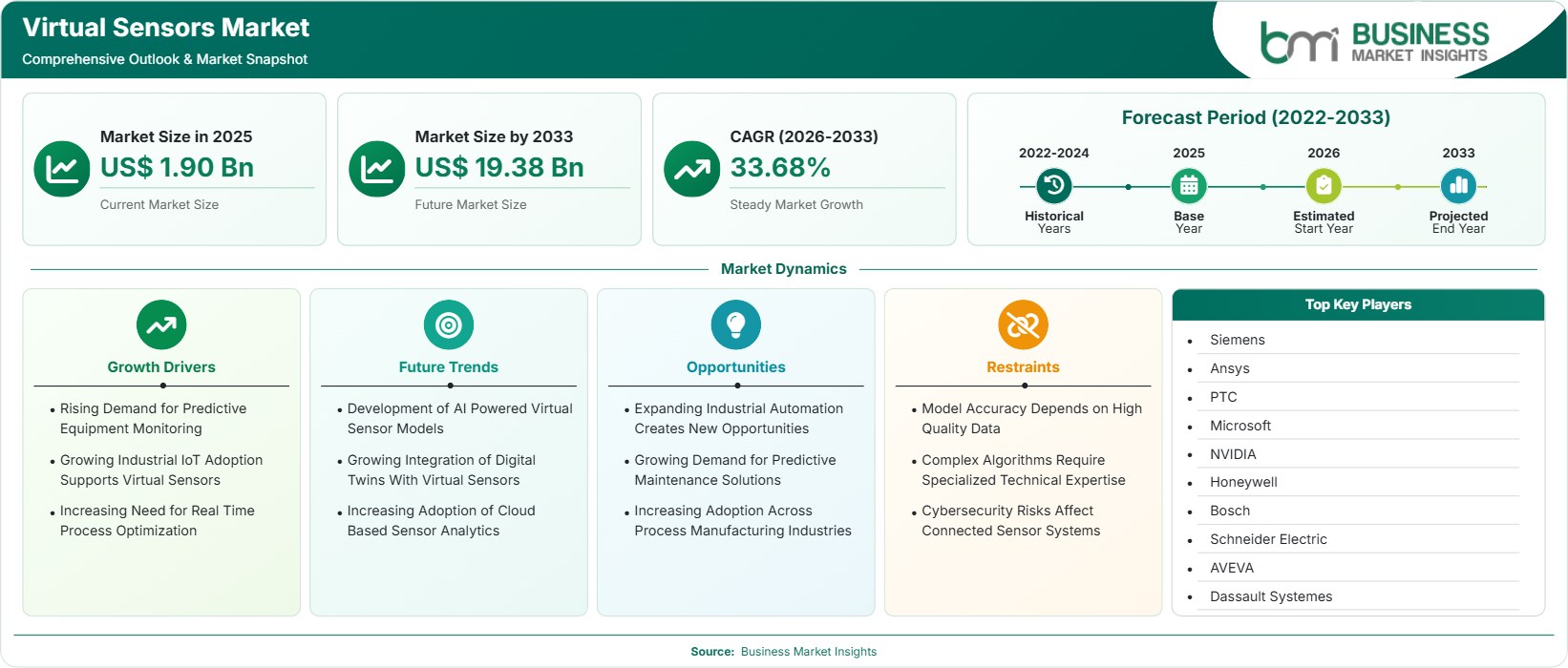
The Virtual Sensors Market size was valued at US$ 1.90 billion in 2025 and is projected to reach US$ 19.38 billion by 2033, growing at a CAGR of 33.68% during 2026–2033, driven by predictive monitoring, industrial IoT, process optimization, automation, and digital twin adoption.

Report Coverage
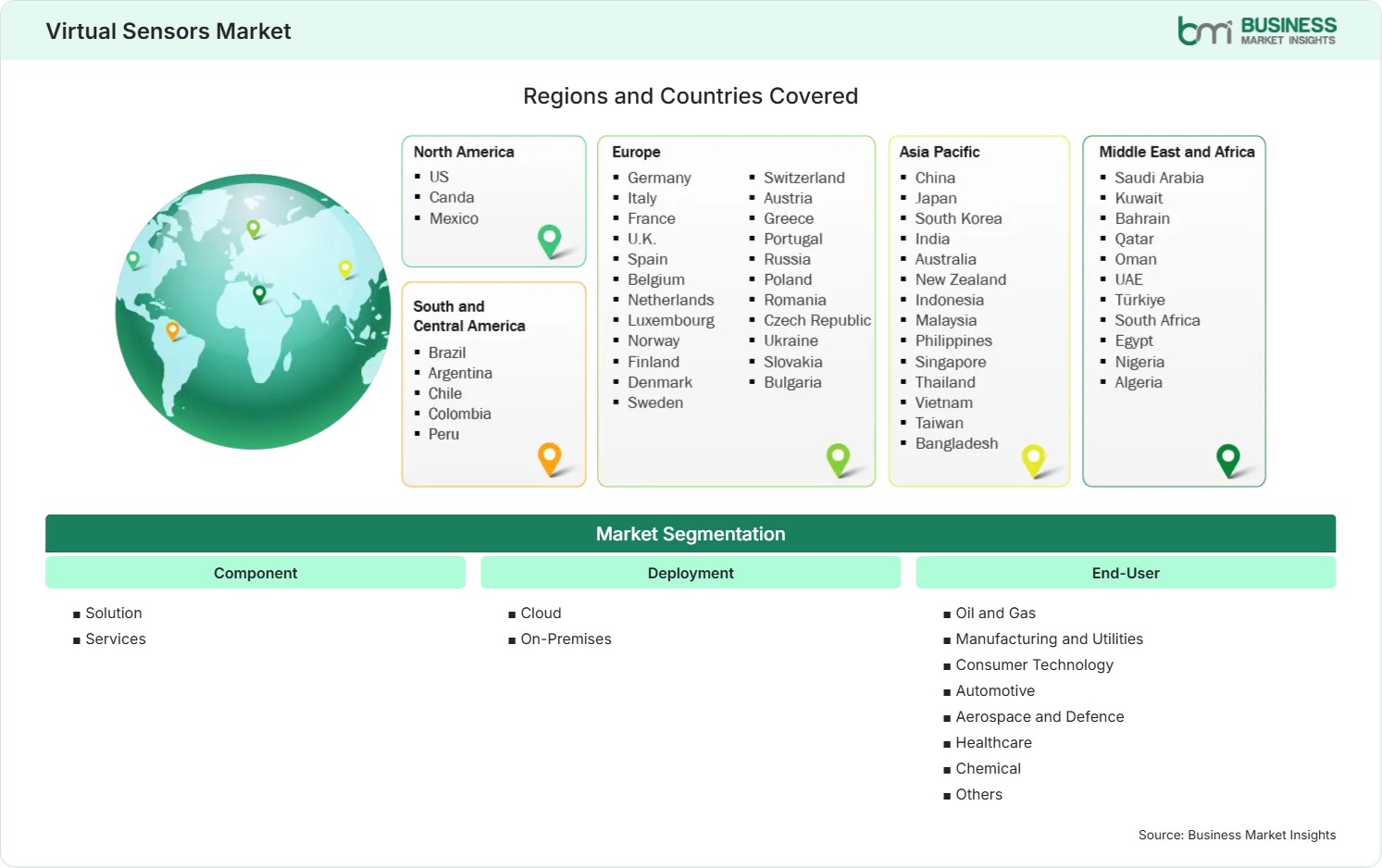
  • Component: Solution, Services
  • Deployment: Cloud, On-Premises
  • End-User: Oil and Gas, Manufacturing and Utilities, Consumer Technology, Automotive, Aerospace and Defence, Healthcare, Chemical, Others
US$ 1.90 Bn Market size in 2025
US$ 19.38 Bn Market Size by 2033
33.68% CAGR, 2026 - 2033
2026-2033 Forecast Period

01 AI Overview

Virtual Sensors Market Summary

  • North America Region: North America holds a 36%–39% share in 2025, growing with a 31%–33% CAGR through 2033, influenced by industrial AI adoption, advanced manufacturing, cloud infrastructure, digital twins, and predictive asset management. The U.S. market benefits from strong industrial software adoption and connected factory investment, supporting a 30%–32% CAGR through 2033.
  • Fastest Growing Region: Asia Pacific holds a 22%–25% share in 2025, growing with a 36%–39% CAGR through 2033, supported by manufacturing digitization, expanding IIoT deployments, automation investment, smart factories, and process optimization initiatives.
  • Leading Segment: Solution holds a 58%–62% share in 2025, growing with a 31%–33% CAGR through 2033, supported by simulation capabilities, predictive analytics, digital twins, model-based monitoring, and integration with industrial data environments.
  • High Growth Segment: Cloud deployment holds a 64%–68% Virtual Sensors Market share in 2025, growing with a 36%–39% CAGR through 2033, supported by scalable computing, remote accessibility, centralized model management, rapid deployment, and integration with connected industrial platforms.
  • Key Market Opportunity: Integration of virtual sensing with digital twins, predictive maintenance, industrial AI, edge computing, and process simulation creates opportunities to estimate difficult-to-measure variables and optimize assets without additional physical instrumentation.
  • Major Market Players: Siemens, Ansys, PTC, Microsoft, NVIDIA, Honeywell, Robert Bosch GmbH, Schneider Electric, AVEVA, and Dassault Systemes.
02 Strategic Insights

Virtual Sensors Market: Strategic Insights

Virtual Sensors Market Strategic Framework
FREE PDF
Request your free sample
Request free sample
03 Stakeholder View

Key Takeaways

  • Industrial software providers, automation vendors, simulation specialists, and cloud platforms are converging around connected architectures that link physical assets with models, telemetry, analytics, and operational workflows.
  • Predictive maintenance and process optimization offer strong commercial potential because virtual measurements can extend asset visibility where additional instrumentation is impractical, expensive, or technically difficult.
  • Product development is shifting toward hybrid models that combine physics-based simulation, machine learning, real-time telemetry, and digital twins to improve model responsiveness and operational relevance.
  • Asia Pacific provides an attractive expansion case as manufacturers modernize production infrastructure, deploy industrial IoT technologies, and increase automation across large and diverse industrial ecosystems.
  • Strategic partnerships are becoming more important as customers seek integrated solutions spanning simulation, cloud computing, automation, data management, digital twins, and AI rather than isolated sensing applications.
  • Long-term differentiation will depend on model reliability, interoperability, deployment flexibility, domain-specific algorithms, explainability, and the ability to translate inferred measurements into actionable industrial decisions.
04 Geographic Outlook

Virtual Sensors Market Regional Highlights

North America Virtual Sensors Market

North America holds a 36%–39% share in 2025 and is projected to expand at a 31%–33% CAGR through 2033. Mature industrial software ecosystems, advanced automation, cloud infrastructure, and established predictive maintenance programs support adoption across manufacturing, energy, transportation, and process industries.

  • Manufacturers are integrating inferred measurements into asset monitoring workflows to improve equipment visibility while limiting additional instrumentation across complex production environments.
  • Industrial enterprises are combining digital twins with operational telemetry to evaluate equipment behavior, identify emerging deviations, and support maintenance planning without interrupting production.
  • Cloud and edge computing investments are improving access to industrial analytics, allowing virtual measurement models to operate closer to equipment while retaining centralized governance.
  • Demand is expanding across aerospace, automotive, energy, and advanced manufacturing where difficult-to-measure parameters can influence safety, quality, throughput, and asset performance.

US Virtual Sensors Market

The United States represents approximately 72%–76% of North American demand in 2025 and is projected to grow at a 30%–32% CAGR through 2033. Industrial automation, advanced manufacturing, cloud adoption, and AI investment provide a strong foundation for deployment.

  • Industrial organizations increasingly use simulation and machine learning to supplement physical instrumentation, particularly where equipment access, installation costs, or measurement constraints limit conventional sensing.
  • Manufacturing modernization is encouraging integration between operational technology, cloud platforms, digital twins, and predictive analytics, creating broader deployment opportunities across production and maintenance functions.
  • Energy and infrastructure operators are exploring model-based monitoring to improve asset visibility, anticipate abnormal conditions, and support more efficient maintenance planning.

Europe Virtual Sensors Market

Europe accounts for approximately 25%–28% of 2025 demand and is expected to expand at a 32%–34% CAGR through 2033. Germany leads regional adoption, while the United Kingdom and France provide strong technology and industrial opportunities.

  • Germany benefits from advanced manufacturing, engineering expertise, automation investment, and strong demand for digital production technologies supporting model-based asset management.
  • The United Kingdom offers opportunities through industrial digitization, aerospace engineering, energy modernization, and increasing use of cloud-based analytics for operational optimization.
  • France is developing adoption across aerospace, automotive, energy, and process industries where simulation and digital engineering are already embedded within production workflows.
  • Italy and the Netherlands provide additional opportunities through industrial automation, connected manufacturing, engineering software adoption, and modernization of production assets.

Asia Pacific Virtual Sensors Market

Asia Pacific represents approximately 22%–25% of 2025 demand and is projected to grow at a 36%–39% CAGR through 2033. China leads regional scale, while India and Southeast Asia offer particularly strong expansion opportunities.

  • China is accelerating smart manufacturing, industrial automation, and digital factory initiatives, increasing demand for software-defined measurement and model-based process monitoring.
  • India is expanding industrial digitalization across automotive, manufacturing, energy, and engineering sectors, creating opportunities for cloud-enabled industrial analytics and predictive applications.
  • Japan combines sophisticated manufacturing capabilities with strong engineering and automation expertise, supporting advanced applications involving digital twins and model-based equipment monitoring.
  • South Korea and Southeast Asian economies are increasing investments in smart factories, electronics manufacturing, industrial connectivity, and automation, supporting wider adoption.

Rest of World Virtual Sensors Market

Rest of World accounts for approximately 10%–13% of 2025 demand and is expected to grow at a 30%–33% CAGR through 2033. South America and Middle Eastern markets are building industrial digital capabilities.

Brazil and Mexico provide opportunities through manufacturing, energy, and industrial modernization, while Gulf economies are investing in connected infrastructure, automation, and digitally managed industrial assets.

  • Brazil offers potential across energy, mining, manufacturing, and process industries where remote monitoring can improve visibility across geographically distributed equipment.
  • Mexico benefits from industrial automation and advanced manufacturing investments linked to automotive, electronics, and cross-border production ecosystems.
  • Saudi Arabia and the United Arab Emirates are developing digital industrial infrastructure, supporting applications in energy, utilities, manufacturing, and large-scale facilities.
  • South Africa provides opportunities across mining, energy, manufacturing, and infrastructure where model-based monitoring can complement conventional instrumentation and maintenance practices.
Global Market Geography
FREE PDF
Request your free sample
Request free sample
05 Segment Analysis

Virtual Sensors Market Segmentation

Component

Solution represents the leading component, holding a 58%–62% Virtual Sensors Market share in 2025 and expanding at a 31%–33% CAGR through 2033. Virtual sensing platforms increasingly combine simulation, analytics, machine learning, and industrial data connectivity.

  • Solution: Software solutions provide model creation, virtual measurement, analytics, visualization, integration, and monitoring capabilities that help organizations infer difficult-to-measure variables from available operational information.
  • Services: Services support model development, deployment, integration, validation, customization, training, and ongoing optimization, particularly for industrial users with specialized process requirements.

Deployment

Cloud represents the leading deployment category, holding a 64%–68% share in 2025 and expanding at a 36%–39% CAGR through 2033. Cloud environments simplify computational scaling, model management, collaboration, and integration across distributed industrial operations.

  • Cloud: Cloud deployment provides scalable computing, centralized model administration, remote access, rapid updates, and integration with industrial data platforms across geographically dispersed facilities.
  • On-Premises: On-premises deployment remains relevant where operational data sensitivity, latency requirements, legacy infrastructure, or internal governance policies favor local processing and direct technology control.

End-User

Manufacturing and utilities represent a leading end-user category within the Virtual Sensors Market because complex assets generate continuous operational data and require reliable performance monitoring. Broader adoption is supported by process optimization, predictive maintenance, automation, and digital engineering requirements across industrial sectors.

  • Oil and Gas: Operators use virtual measurements to estimate process variables, monitor equipment conditions, improve production visibility, and support maintenance where additional instrumentation is difficult.
  • Manufacturing and Utilities: Industrial facilities apply model-based sensing to optimize production, monitor equipment, improve quality, and manage distributed assets across connected operations.
  • Consumer Technology: Technology manufacturers can use virtual measurements for production monitoring, equipment optimization, quality assurance, and connected factory applications requiring rapid operational feedback.
  • Automotive: Automotive organizations apply virtual sensing across manufacturing, vehicle development, testing, simulation, and predictive applications where software-based measurements complement physical sensors.
  • Aerospace and Defence: Aerospace and defense programs use simulation-based sensing for engineering validation, structural monitoring, testing, and complex asset analysis where physical instrumentation can be constrained.
  • Healthcare: Healthcare applications include equipment monitoring, facility optimization, and model-based operational analysis where continuous measurement can support asset reliability and efficient resource utilization.
  • Chemical: Chemical producers use inferred process variables to optimize operations, monitor equipment, improve safety, and strengthen control across complex production environments.
06 Market Forces

Virtual Sensors Market Dynamics

Key Market Drivers

Rising Demand for Predictive Equipment Monitoring

The predictive monitoring of equipment is growing beyond the traditional method of sensor-based networks because of the efforts by the industries to gain early insight into the health status of their assets. Virtual sensing may be used alongside physical sensing by predicting values that are hard to obtain on an ongoing basis. Such technology is useful for condition-based maintenance, detection of any anomalies, and performance of equipment without having to use more hardware at every measuring point. Furthermore, integration with the digital twin will make it possible for businesses to correlate their observation to simulated operational conditions. Consequently, the Virtual Sensors market growth will depend on the requirement to change from reactive maintenance to proactive asset management.

Growing Industrial IoT Adoption Supports Virtual Sensors

IoT systems offer the necessary telemetry infrastructure to enable software measurement approaches. Machines, controllers, gateways, and edge devices produce operating data that can then be integrated with engineering models and machine learning. With greater connectivity in industrial networks, organizations will have access to larger sets of data to estimate unknown variables. This enhances the applicability of virtual sensing in manufacturing, utilities, energy, and process domains. The Virtual Sensors Market forecast will be increasingly driven by industrial connectivity, increased availability of data, and virtual measurements integration into the overall automation/analytics framework.

Increasing Need for Real Time Process Optimization

Manufacturers are looking for ways to make quicker decisions when operations become more automated and variable. Virtual sensors will be able to give an estimated value of the conditions of the process between measurement points, enabling the control system and operators to react according to different levels of load, equipment conditions, and other variables in the process. When coupled with edge analytics, these models will enable real-time optimization without the need to depend on full centralization. The Virtual Sensors Market trend is towards flexible software that uses available signals from the operation process.

Key Market Opportunities

Expanding Industrial Automation Creates New Opportunities

The growing trend of industrial automation will contribute to a more conducive ecosystem for software-defined sensing, as the automation of equipment involves a constant need for information for decision-making related to manufacturing and maintenance. Virtual sensors could be combined with traditional sensors in robots, assembly lines, utilities, and process equipment. Companies could add value to their products by combining the use of virtual sensors with automation controllers, digital twins, edge computing platforms, and enterprise-level analytics, thus making it possible for them to offer bundled solutions instead of software alone. Usage would also be more when there is an upgrade of old machinery by the manufacturers, and the need to see without having to replace too much hardware.

Growing Demand for Predictive Maintenance Solutions

There is the possibility of using predictive maintenance for a commercial approach because businesses are able to link up the inferred measurements with maintenance plans and the performance of assets. Modeling can give estimations on internal or hard-to-measure factors and detect anomalies before the traditional factors show any problems. It is possible for the providers to enhance their services by integrating their services with computerized maintenance management systems, enterprise asset management, and remote monitoring systems. The use cases will arise where there are significant effects from the downtime of machines, and additional sensing is not economically feasible.

Increasing Adoption Across Process Manufacturing Industries

Process manufacturing offers many possibilities due to the fact that processes tend to be interconnected, have complicated physical relations, and are variables that are hard to measure directly. With virtual sensing, it is possible to estimate process conditions using the existing measurements and perform optimization and control tasks. Chemical companies, refineries, utilities, food processing, and industrial materials companies are able to utilize these possibilities along with simulation and digital twin environments. Domain vendors can distinguish themselves with the help of application-specific algorithms instead of just plain analytics. Entering the process industry brings many opportunities for extended service engagements.

Market Restraints and Challenges

Model Accuracy Depends on High Quality Data

Factor: virtual models require representative, consistent, and sufficiently granular operational data to produce dependable estimates across changing conditions. Impact: incomplete telemetry, sensor drift, inconsistent operating states, or poorly governed datasets can reduce model reliability and limit confidence in inferred measurements. Organizations may therefore require extensive data preparation, calibration, validation, and monitoring before deployment. Performance can also deteriorate when equipment configuration changes or production conditions move outside the model's original training range. Maintaining data quality becomes an ongoing operational requirement rather than a one-time implementation task, increasing management effort for industrial users.

Complex Algorithms Require Specialized Technical Expertise

Factor: effective virtual sensing can require knowledge spanning physics-based modeling, machine learning, industrial processes, data engineering, and control systems. Impact: organizations without specialized personnel may face longer implementation cycles, greater dependence on external providers, and difficulty validating model outputs. Technical complexity can also complicate integration with existing operational technology and maintenance systems. Vendors can reduce this barrier through reusable models, low-code configuration, automated calibration, domain templates, and managed services. Nevertheless, advanced applications still require engineering oversight because incorrect assumptions about equipment behavior can produce unreliable measurements and inappropriate operational decisions.

07 Company Analysis

Competitive Landscape

The Virtual Sensors Market analysis indicates competition across industrial automation, engineering simulation, cloud computing, industrial IoT, digital twins, and enterprise software. Leading providers are expanding model-based capabilities while integrating simulation, AI, telemetry, and operational analytics.

Company Name

Overview

Products and Services relevant to this market

Siemens

Industrial technology provider combining automation, engineering software, simulation, and digital twin capabilities across asset-intensive industries.

Simcenter, Siemens Xcelerator, Industrial Edge, digital twins, simulation, industrial AI, automation, and virtual sensing technologies.

Ansys

Engineering simulation specialist providing tools for modeling complex physical systems and sensor behavior across industrial applications.

Ansys simulation software, AVxcelerate Sensors, digital engineering, multiphysics simulation, sensor modeling, and validation solutions.

PTC

Industrial software provider focused on connected operations, IoT, product lifecycle management, and digital transformation.

ThingWorx, Kepware, industrial IoT, connected asset management, predictive analytics, and digital twin capabilities.

Microsoft

Cloud technology provider supporting connected industrial environments through IoT, AI, analytics, and digital twin infrastructure.

Azure Digital Twins, Azure IoT, cloud analytics, AI services, industrial data platforms, and simulation integrations.

NVIDIA

Accelerated computing and AI provider developing technologies for simulation, digital twins, robotics, and industrial physical AI.

NVIDIA Omniverse, simulation platforms, physical AI, digital twins, accelerated computing, and virtual sensor simulation.

Honeywell

Industrial technology company providing automation, monitoring, analytics, and asset-performance solutions across process and infrastructure markets.

Honeywell Forge, predictive maintenance, industrial analytics, remote monitoring, asset performance, and connected operations solutions.

Robert Bosch GmbH

Technology and engineering company with capabilities spanning industrial automation, connected products, sensors, software, and AI-enabled systems.

Industrial IoT, connected manufacturing, AI analytics, automation technologies, digital engineering, and sensor-related solutions.

Schneider Electric

Energy management and industrial automation provider integrating digital platforms with operational intelligence and simulation capabilities.

EcoStruxure, ETAP, digital twins, industrial automation, asset analytics, energy optimization, and connected infrastructure solutions.

AVEVA

Industrial software provider specializing in engineering, operations, simulation, asset performance, and connected industrial environments.

AVEVA Dynamic Simulation, industrial software, digital twins, process simulation, asset performance, and operational analytics.

Dassault Systemes

Engineering software provider focused on simulation, digital twins, virtual product development, and industrial lifecycle management.

3DEXPERIENCE, SIMULIA, DELMIA, digital twins, multiphysics simulation, virtual engineering, and industrial analytics.


10 Trust & Transparency

Research Methodology

The market analysis combines proprietary research with secondary data from government agencies, company disclosures, regulatory filings, industry databases and expert interviews. Market estimates are validated through data triangulation, cross-market benchmarking and analyst review.

View Full Research Methodology

11 Questions Answered

Frequently Asked Questions

What does the Virtual Sensors Market report indicate about future competition?

The report indicates that competition will increasingly center on model accuracy, industrial domain expertise, interoperability, AI capabilities, cloud scalability, and digital twin integration. Providers capable of converting operational data into reliable measurements and actionable insights should gain stronger positioning across industrial applications.

Why are industrial IoT deployments creating new opportunities for virtual sensors?

Industrial IoT systems provide the connected data streams required by virtual sensing models. As machines, controllers, and equipment become increasingly connected, organizations can use existing telemetry to infer additional variables and strengthen monitoring without installing physical sensors at every measurement location.

How are digital twin technologies influencing virtual sensing adoption?

Digital twins provide a structured environment for combining physical measurements, engineering models, simulations, and operational data. Virtual sensors can enrich these environments by supplying estimated variables that are difficult to measure directly, improving model completeness and supporting more detailed asset and process analysis.

Which applications present the strongest opportunity in the market?

Predictive equipment monitoring, process optimization, manufacturing analytics, digital twins, and asset performance management represent strong opportunities. These applications benefit from software-based measurements that can supplement physical sensors and provide additional information for maintenance, engineering, production, and operational decision-making.

What factors are improving Virtual Sensors Market return on investment?

Predictive maintenance, improved asset visibility, reduced instrumentation requirements, process optimization, and broader industrial IoT adoption are improving return on investment. Virtual sensing allows organizations to derive additional operational information from existing data, helping extend monitoring coverage while limiting the need for new physical hardware.

Access the Full Virtual Sensors Market Report

Get segment-level forecasts, regional estimates, competitive benchmarking, company profiles and downloadable Excel datasets.

Access the full Virtual Sensors Market Report
350 pages PDF & Excel | 2026-08-24