Market Summary
Executive Summary and Global Market Analysis
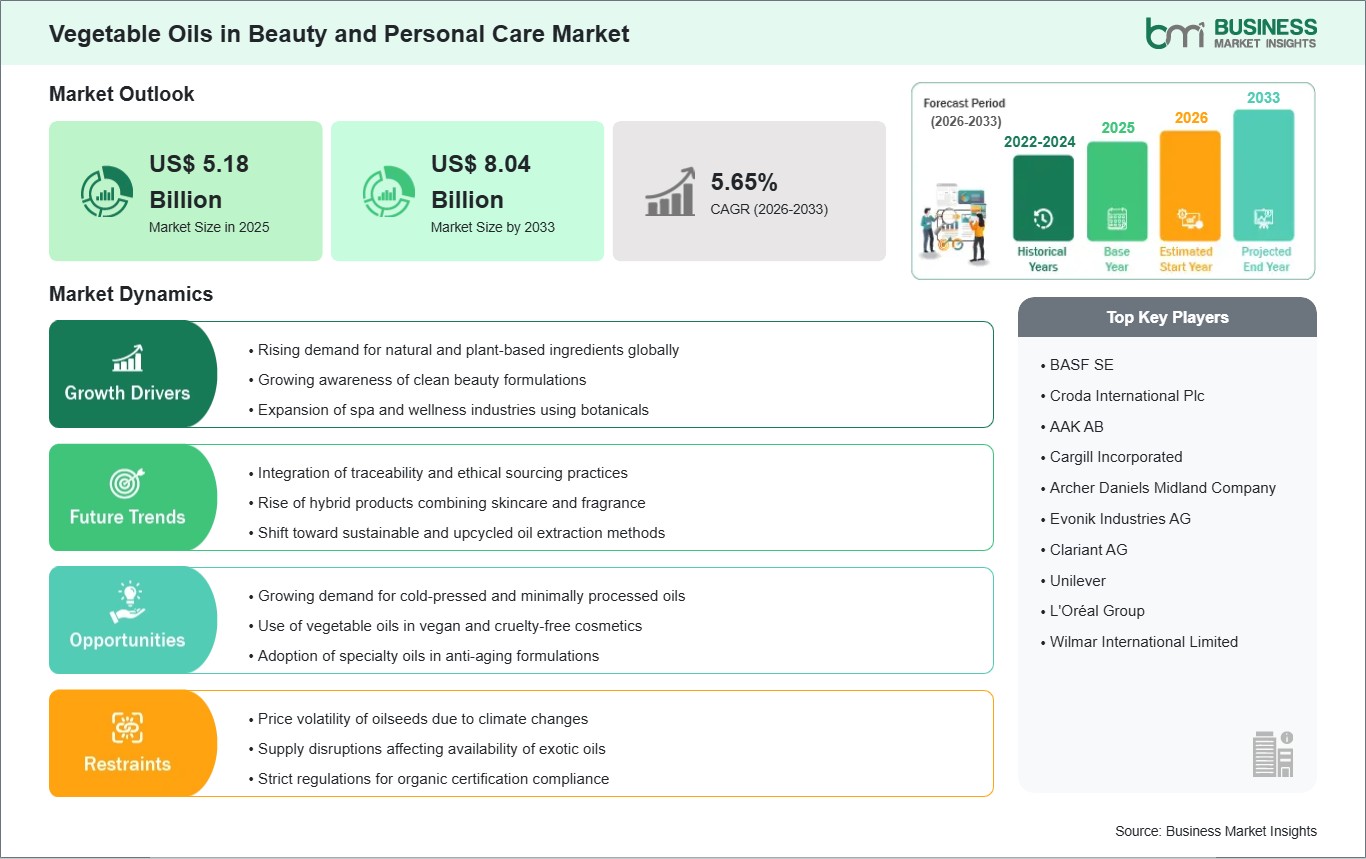
The global vegetable oils in beauty and personal care market is characterized by a robust growth trajectory, driven by the indispensable role of plant-derived lipids in modern cosmetic chemistry. As consumers move toward holistic wellness and clean beauty, vegetable oils have become the cornerstone for replacing synthetic emollients. In 2025, conventional oils like coconut and olive remain the volume leaders due to their cost-efficiency and established supply chains. However, the organic and specialty oil segments are seeing rapid value growth as brands cater to the luxury and prestige markets. Skincare remains the primary application for these materials, valued for their ability to deliver deep hydration and anti-aging benefits through natural fatty acid profiles.
Additionally, technological improvements in extraction methods, such as supercritical CO2 and cold-pressing, are further improving the quality and shelf life of these types of oils. The market is also being driven by a strong sustainability and ethical focus, with many companies implementing “farm-to-face” traceability schemes to ensure sustainability. Despite some challenges in the market regarding raw material cost fluctuations and supply chain volatility, the long-term prognosis for this market is good. The increasing use of vegetable oils in color cosmetics and the expanding fragrance and aromatherapy market offer new avenues for growth. In conclusion, the growth in this market, in terms of high-performing, sustainable, and ethical botanical ingredients, ensures its relevance in the beauty economy.
Segment Analysis
Vegetable Oils in Beauty and Personal Care Market Segmentation
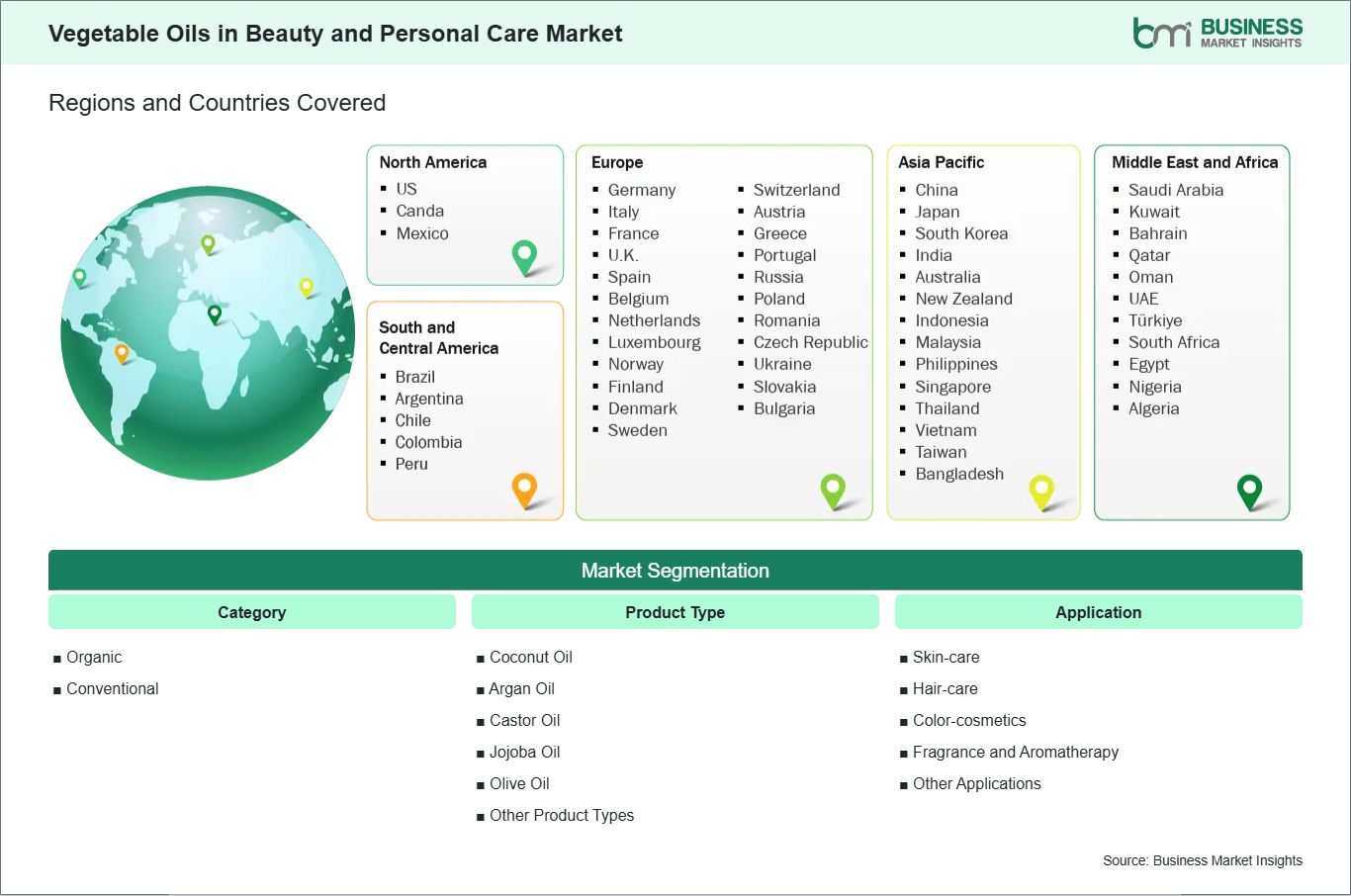
Key segments that contributed to the derivation of the Vegetable Oils in Beauty and Personal Care market analysis are category, product type, and application.
- By category, the vegetable oils in beauty and personal care market is segmented into Organic and Conventional. The Conventional segment dominated the market in 2025.
- By product type, the vegetable oils in beauty and personal care market is segmented into Coconut Oil, Argan Oil, Castor Oil, Jojoba Oil, Olive Oil, and Other product types. The Coconut Oil segment dominated the market in 2025.
- By application, the vegetable oils in beauty and personal care market is segmented into Skin-care, Hair-care, Color-cosmetics, Fragrance and Aromatherapy, and Other Applications. The Skin-care segment dominated the market in 2025.
Market Forces
Vegetable Oils in Beauty and Personal Care Market Drivers and Opportunities
Surging Consumer Demand for Natural and Plant-Based Ingredients
The beauty industry is experiencing a fundamental shift as consumers increasingly scrutinize ingredient labels and move away from synthetic or petroleum-derived chemicals. Vegetable oils have emerged as the primary alternative to mineral oils and silicones, offering a bio-compatible solution for skin and hair nourishment. These oils are rich in essential fatty acids, vitamins, and phytosterols that closely mimic the natural sebum produced by human skin. This biological affinity ensures better absorption and efficacy, making plant-based oils highly desirable for individuals seeking "clean" and non-toxic personal care routines. The transparency movement in beauty has empowered users to choose recognizable, earth-derived ingredients over complex synthetic esters.
Furthermore, the influence of wellness-centric lifestyles has elevated the status of vegetable oils from simple kitchen staples to high-performance active ingredients. In regions like Asia-Pacific and North America, the growth of the middle class and increased disposable income have led to a preference for premium botanical formulations. Brands are responding by incorporating various nutrient-dense oils into everything from cleansing balms to lip treatments. This broad-spectrum adoption is supported by extensive dermatological research highlighting the anti-inflammatory and barrier-repairing properties of these oils. As the industry prioritizes long-term skin health over temporary aesthetic fixes, the reliance on sustainable, plant-derived lipids continues to act as the strongest catalyst for market expansion.
Growing Demand for Cold-Pressed and Minimally Processed Virgin Oils
Innovation in extraction technology has opened up a significant opportunity for the commercialization of cold-pressed and virgin vegetable oils within the prestige beauty segment. Unlike traditional solvent extraction, which involves high heat and chemical processing that can degrade sensitive nutrients, cold-pressing preserves the inherent antioxidants and volatile aromatic compounds of the oil. Consumers are increasingly willing to pay a premium for these high-purity oils because they offer superior therapeutic benefits and a more authentic sensory experience. This trend is particularly evident in the rise of facial oils and concentrated hair serums where the quality of the base lipid directly determines the product's market value.
Beyond performance, the demand for cold-pressed oils is closely tied to the broader environmental and ethical sourcing movement. These extraction methods are generally perceived as eco-friendlier and raw, aligning with the values of the modern conscious consumer. Manufacturers are seizing this opportunity by partnering with local cooperatives to source unique oils such as prickly pear, moringa, and baobab. By marketing the unique fatty acid profiles and the heritage of these oils, brands can differentiate themselves in a crowded marketplace. As the "skin-minimalism" trend gains traction, where consumers use fewer but higher-quality products, the market for potent, minimally processed vegetable oils is poised to capture a larger share of the luxury personal care category.
Size and Share Analysis
Vegetable Oils in Beauty and Personal Care Market Size and Share Analysis
The global Vegetable Oils in Beauty and Personal Care market is experiencing steady growth, with market size and share analysis reflecting evolving treatment preferences and competitive dynamics among key players. The report evaluates important subsegments categorized within category, product type, and application highlighting their respective contributions to overall market performance.
By category, the Conventional subsegment dominated the market in 2025 due to its cost-effectiveness and widespread availability across mass-market supply chains. Established extraction methods and large-scale agricultural production allow manufacturers to maintain competitive pricing for high-volume beauty products like body lotions and shampoos.
By product type, the Coconut Oil subsegment dominated the market in 2025 because of its exceptional multi-functional properties and high lauric acid content. Its ability to serve as a natural emollient, antimicrobial agent, and hair repair treatment makes it a staple ingredient in both premium and economy formulations.
By application, the Skin-care subsegment dominated the market in 2025 due to the rising consumer shift toward plant-based lipid replenishment and "clean beauty" standards. Vegetable oils are essential in facial serums and moisturizers for their ability to deliver concentrated fatty acids and antioxidants that support skin barrier health.
Report Coverage
Vegetable Oils in Beauty and Personal Care Market Report Coverage and Deliverables
The "Vegetable Oils in Beauty and Personal Care Market Size and Forecast (2022 - 2033)" report provides a detailed analysis of the market covering below areas:
- Vegetable Oils in Beauty and Personal Care market size and forecast at the regional and country levels for segments covered under the scope
- Vegetable Oils in Beauty and Personal Care market trends, as well as drivers, restraints, and opportunities
- Vegetable Oils in Beauty and Personal Care market analysis covering key trends, regional framework, major players, regulations, and recent developments
- Industry landscape and competition analysis covering market concentration, heat map analysis, prominent players, and recent developments for the Vegetable Oils in Beauty and Personal Care market
- Detailed company profiles, including SWOT analysis
Geographic Insights
Vegetable Oils in Beauty and Personal Care Market Geographic Insights
The geographical scope of the Vegetable Oils in Beauty and Personal Care market report is divided into: North America, Asia Pacific, Europe, Middle East & Africa, and South & Central America. North America held the largest share in 2025.
North America maintains a dominant position in the global vegetable oils in beauty and personal care market, supported by a highly sophisticated consumer base and a mature personal care manufacturing sector. The region’s leadership is anchored by the United States, which serves as a global hub for clean beauty innovation and premium skincare brands. High levels of disposable income allow consumers to prioritize organic and specialty vegetable oils over cheaper synthetic alternatives. Furthermore, the presence of stringent regulatory frameworks and a strong emphasis on ingredient transparency have pushed North American manufacturers to be at the forefront of developing sustainable and ethically sourced oil blends that meet the highest safety standards.
The dominance of North America is also fueled by the rapid growth of the indie beauty movement, where smaller, niche brands focus heavily on botanical ingredients and artisanal oils like jojoba and argan. These brands have successfully used social media and digital marketing to educate consumers on the specific benefits of various oil profiles, driving regional demand. Additionally, the well-established distribution networks and the rise of specialty beauty retailers have made high-quality vegetable oil-based products more accessible to a broad demographic. As the region continues to lead in technological advancements for oil stabilization and formulation, North America is expected to remain the primary driver of market value, setting global trends for natural and high-performance beauty solutions.
Industry Activity
Recent Developments
The Vegetable Oils in Beauty and Personal Care market is evaluated by gathering qualitative and quantitative data post primary and secondary research, which includes important corporate publications, association data, and databases. A few of the key developments in the Vegetable Oils in Beauty and Personal Care market are:
- In May 2024, Ashland, announced the launch of new additives under its Transformed Vegetable Oil (TVO) platform at NYSCC Suppliers’ Day, including soybean-derived ingredients for use in sun care, skin care, and hair care formulations.
- In October 2024, Clean Food Group, announced a strategic partnership with THG LABS to develop sustainable oils for cosmetics using food waste fermentation technology, targeting environmentally friendly alternatives to conventional vegetable oils.
- In August 2024, L'Oréal, announced the launch of a new line of organic cosmetic oils sourced from sustainable farming practices, aimed at meeting rising demand for natural and plant-based beauty products.
Trust & Transparency
Research Methodology
The market analysis combines proprietary research with secondary data from government agencies, company disclosures, regulatory filings, industry databases and expert interviews. Market estimates are validated through data triangulation, cross-market benchmarking and analyst
review.
View Full Research Methodology
Key Sources Referred:
American Oil Chemists’ Society (AOCS)International Olive Council (IOC)Roundtable on Sustainable Palm Oil (RSPO)Global Shea Alliance (GSA)European Federation for Cosmetic Ingredients (EFfCI)Cosmetic, Toiletry and Perfumery Association (CTPA)Personal Care Products Council (PCPC, USA)Indian Cosmetic Manufacturers Association (ICMA)Company WebsitesCompany Annual ReportsCompany Investor Presentations