
Underwater Marine IOT Market Outlook: Size, Share, Trends, Growth Analysis, Competitive Landscape & Forecast, 2026-2033

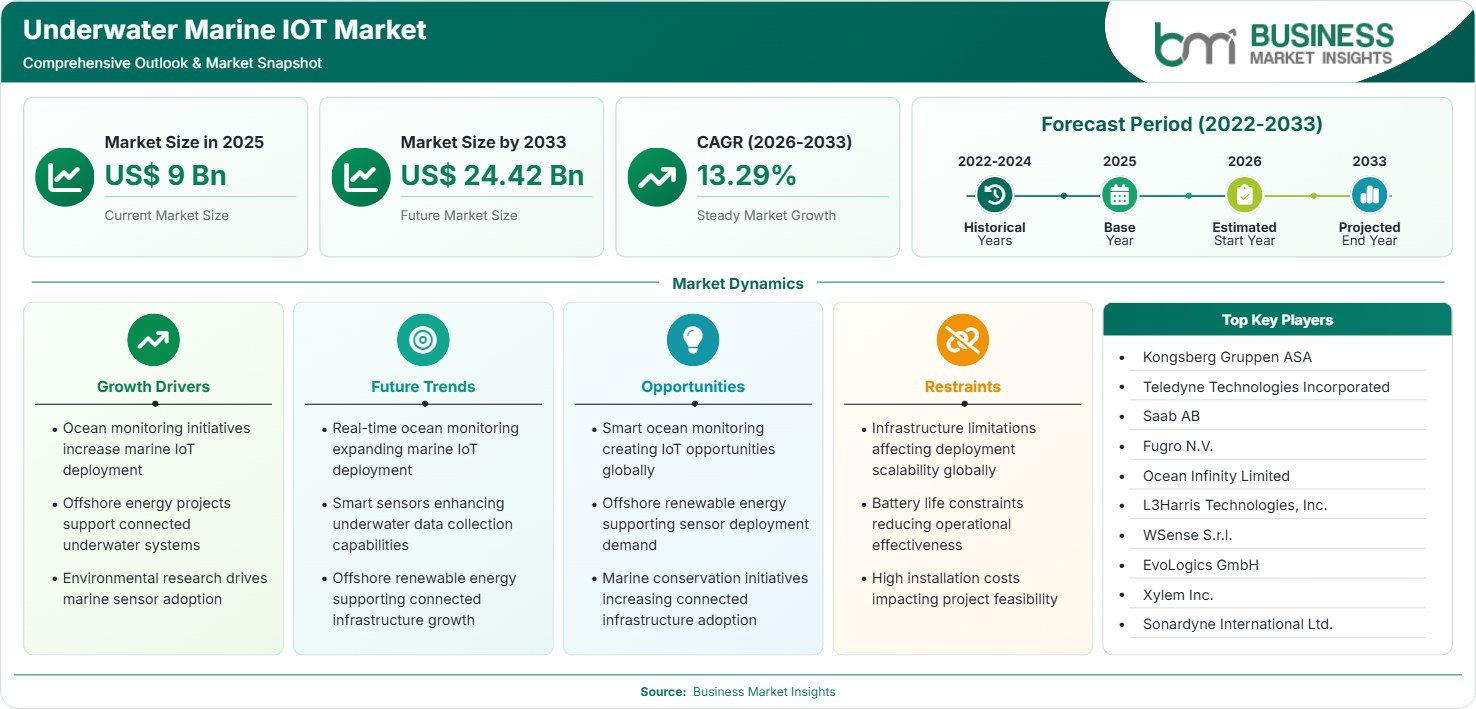
The Underwater Marine IoT Market size was valued at US$ 9 Billion in 2025 and is projected to reach US$ 24.42 Billion by 2033, growing at a CAGR of 13.29% during 2026–2033, driven by autonomous systems, subsea monitoring, offshore digitalization, advanced sensing, defense modernization, and remote operations.

Report Coverage
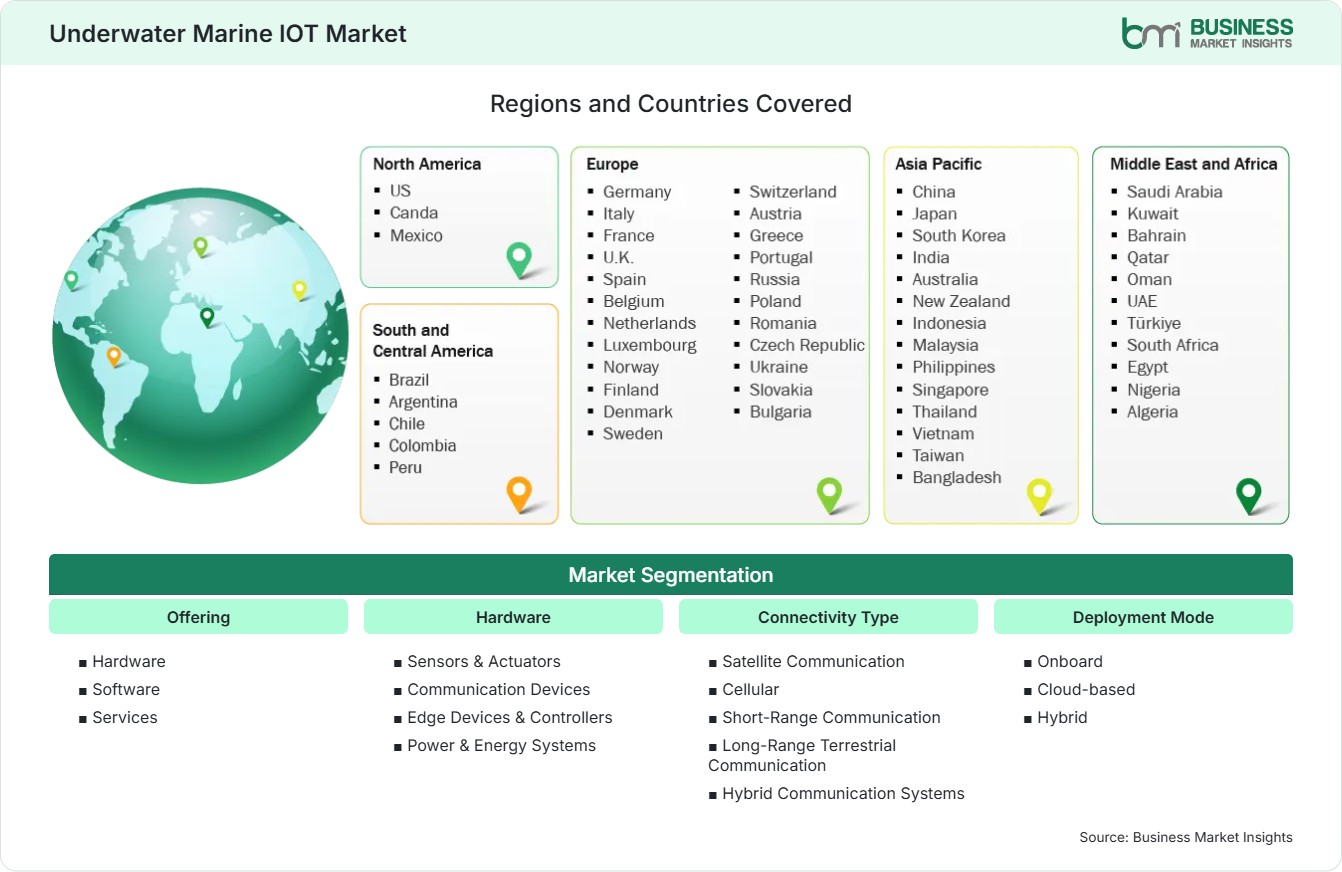
  • Offering: Hardware, Software, Services
  • Hardware: Sensors & Actuators, Communication Devices, Edge Devices & Controllers, Power & Energy Systems
  • Connectivity Type: Satellite Communication, Cellular , Short-Range Communication, Long-Range Terrestrial Communication, Hybrid Communication Systems
  • Deployment Mode: Onboard, Cloud-based, Hybrid
  • Technology: AI & ML, Big Data & Analytics, Edge & Fog Computing, Digital Twins, Blockchain, Others
US$ 9 Bn Market size in 2025
US$ 24.42 Bn Market Size by 2033
13.29% CAGR, 2026 - 2033
2026-2033 Forecast Period

AI Overview

Underwater Marine IOT Market Summary

  • North America Region: holds a 24%–27% Underwater Marine IoT Market share in 2025, growing at 11%–13%, supported by offshore energy monitoring, naval modernization, autonomous vehicles, resilient communications, subsea infrastructure protection, and expanding edge analytics adoption across fleets. The U.S. holds 70%–74% of North America, with 11%–13% CAGR, supported by naval autonomy and offshore monitoring.
  • Fastest Growing Region: holds a 29%–32% share in 2025, growing at 14%–16%, driven by offshore infrastructure, aquaculture digitization, coastal surveillance, subsea cables, ocean science programs, and expanding autonomous vehicle deployments across Asia today.
  • Leading Segment: Sensors & Actuators holds a 32%–35% share in 2025, growing at 11%–13%, supported by dense environmental sensing, asset monitoring, predictive maintenance, navigation, autonomous operations, and regulatory data requirements globally.
  • High Growth Segment: Software holds a 20%–24% share in 2025, growing at 15%–17%, driven by analytics platforms, digital twins, AI-enabled autonomy, fleet optimization, remote operations, and recurring subscription models across maritime operators globally.
  • Key Market Opportunity: Opportunity centers on integrated underwater data ecosystems linking sensors, acoustic networks, edge intelligence, autonomous platforms, and cloud analytics for offshore energy, defense, environmental monitoring, aquaculture, and infrastructure management worldwide.
  • Major Market Players: Kongsberg Gruppen ASA, Teledyne Technologies Incorporated, Saab AB, Fugro N.V., Ocean Infinity Limited, L3Harris Technologies, Inc., WSense S.r.l., EvoLogics GmbH, Xylem Inc., and Sonardyne International Ltd.
Strategic Insights

Underwater Marine IOT Market: Strategic Insights

Underwater Marine IOT Market Strategic Framework
FREE PDF
Request your free sample
Request free sample
Stakeholder View

Key Takeaways

  • Value creation is moving from individual sensing hardware toward integrated ecosystems combining sensors, communications, edge computing, analytics, autonomous vehicles, cloud platforms, and remote operations.
  • Software, edge intelligence, digital twins, autonomous underwater vehicles, and environmental monitoring offer expanding monetization opportunities because operators increasingly require continuous data rather than periodic inspection.
  • Acoustic communications are being combined with higher-performance onboard processing, modular payloads, machine learning, and autonomous navigation to overcome underwater bandwidth and latency constraints.
  • Asia Pacific presents a strong investment case through offshore infrastructure expansion, aquaculture modernization, subsea cable deployment, maritime security requirements, and growing ocean-science activity.
  • Strategic capital is increasingly directed toward specialized underwater communication and monitoring companies. Fincantieri’s 2025 investment in WSense demonstrates industrial interest in acquiring or partnering for specialized subsea capabilities.
Geographic Outlook

Underwater Marine IOT Market Regional Highlights

North America Underwater Marine IoT Market

North America accounted for 24%–27% in 2025 and is projected to grow at 11%–13% through 2033. Demand is concentrated in U.S. defense, offshore energy, autonomous vehicles, subsea infrastructure inspection, and oceanographic monitoring. High-value projects favor integrated sensing and secure communications.

  • Defense programs are increasing demand for autonomous underwater platforms, acoustic sensing, persistent surveillance, and seabed intelligence across complex operating environments.
  • Offshore operators are deploying connected monitoring systems to improve inspection frequency, asset integrity, predictive maintenance, and environmental reporting while reducing vessel intervention requirements.
  • Edge processing is gaining importance because underwater bandwidth remains constrained, encouraging local classification, anomaly detection, compression, and autonomous decision support.
  • U.S. procurement increasingly emphasizes interoperability, modularity, cyber resilience, and autonomous mission execution, creating opportunities for integrated hardware and software suppliers.

US Underwater Marine IoT Market

The U.S. Underwater Marine IoT Market accounted for 70%–74% of North America in 2025 and is projected to grow at 11%–13%. Defense modernization, subsea infrastructure protection, offshore energy, scientific missions, and autonomous maritime systems support adoption, while federal procurement favors secure, interoperable technologies.

  • Naval programs are accelerating requirements for autonomous underwater vehicles, acoustic communications, seabed mapping, mine detection, and persistent intelligence collection.
  • Commercial offshore operators increasingly combine ROVs, AUVs, sensors, and analytics platforms for inspection and infrastructure monitoring.
  • Research institutions and government agencies continue deploying connected ocean sensors to improve environmental observation and marine data availability.

Europe Underwater Marine IoT Market

Europe had 31%–34% share in 2025 and is estimated to increase by 11%–13%. The major technology hubs are Norway, the United Kingdom, Germany, France, Italy, and the Netherlands, while Norway and the Netherlands are notable for their use of subsea technology.

  • Norway benefits from offshore energy expertise, subsea engineering, autonomous vessels, ocean observation, and established underwater robotics capabilities.
  • The United Kingdom is strengthening autonomous underwater capabilities across defense, offshore infrastructure, and marine research applications.
  • Germany and France provide demand through industrial automation, defense electronics, research institutions, and maritime technology development.
  • Italy is emerging through underwater-domain programs and industrial partnerships focused on monitoring, communications, and maritime infrastructure.

Asia Pacific Underwater Marine IoT Market

Asia Pacific accounted for 29%–32% in 2025 and is projected to grow at 14%–16%, making it the fastest-growing region. China, Japan, South Korea, India, Singapore, and Australia contribute through offshore projects, aquaculture, defense, ports, and ocean research.

  • China combines extensive maritime infrastructure, naval modernization, offshore development, and large-scale technology manufacturing to support connected underwater systems.
  • Japan and South Korea emphasize advanced sensors, autonomous platforms, shipbuilding technology, subsea inspection, and marine robotics.
  • India is expanding maritime surveillance, offshore infrastructure, ocean observation, and indigenous underwater technology capabilities.
  • Australia provides opportunities through offshore energy, seabed mapping, defense modernization, marine science, and remote operations.

Rest of World Underwater Marine IoT Market

South and Central America Underwater Marine IoT Market is expected to be 5%–7% of global demand in 2025, with Brazil being the key country for development in offshore energy, subsea inspection, and marine infrastructure.

The Middle East & Africa combined contributed around 4%-6%, with Saudi Arabia, the UAE, and South Africa leveraging their strengths in offshore infrastructure, maritime security, environmental surveillance, and marine resource management. The regional CAGR stands around 8% - 10%

  • Brazil benefits from deepwater oil and gas activity requiring persistent subsea inspection, environmental monitoring, and robotic data acquisition.
  • Saudi Arabia is developing maritime and offshore infrastructure, creating demand for connected monitoring, autonomous systems, and seabed intelligence.
  • The United Arab Emirates offers opportunities through ports, logistics, offshore assets, and maritime security applications.
  • South Africa provides demand from marine research, coastal surveillance, offshore resources, and infrastructure inspection.
Global Market Geography
FREE PDF
Request your free sample
Request free sample
Segment Analysis

Underwater Marine IOT Market Segmentation

Offering

Hardware accounted for 38%–41% in 2025, with software and services holding the remaining share. Software is expected to grow at 15%–17% through 2033 due to the increasing use of analytics, remote operations, digital twins, and recurring platforms. The scope of the Underwater Marine IoT Market is increasingly shifting from devices to an integrated lifecycle service.

  • Hardware: Provides the physical sensing, communication, processing, and energy infrastructure required for subsea data collection, with ruggedization, reliability, and modularity determining procurement decisions.
  • Software: Connects sensor streams with analytics, visualization, digital twins, AI models, and operational workflows, supporting recurring revenues and increasingly autonomous decision-making.
  • Services: Covers installation, integration, monitoring, maintenance, data management, inspection, and technical support, enabling operators to deploy complex systems without building complete internal capabilities.

Hardware

The Sensors & Actuators accounted for 32%–35% in 2025 and are anticipated to grow by 11%–13% till 2033. Communication Devices, Edge Controllers, and Power Systems are the complementary products for sensors. The Underwater Marine IoT Market share indicates the continuous investment in data acquisition.

  • Sensors & Actuators: Measure pressure, temperature, salinity, dissolved oxygen, motion, acoustics, corrosion, structural conditions, and other parameters for monitoring and automation.
  • Communication Devices: Enable acoustic, optical, radio-frequency, satellite-linked, and hybrid data transfer between submerged assets, surface gateways, vessels, and control centers.
  • Edge Devices & Controllers: Process data locally, reducing bandwidth requirements and enabling real-time alerts, autonomous decisions, sensor fusion, and mission-specific control.
  • Power & Energy Systems: Support long-duration deployments through batteries, energy harvesting, tidal systems, and optimized power management for submerged equipment.

Connectivity Type

Hybrid communication networks are becoming increasingly significant, as no single communication method can ensure uninterrupted, broadband coverage underwater. Acoustic communication will remain essential underwater, whereas satellite and cellular communication will be used to link surface gateways. Underwater Marine IoT Market trends increasingly emphasize seamless multi-network architectures.

  • Satellite Communication: Connects vessels, buoys, offshore platforms, and surface gateways with remote operations centers where terrestrial coverage is unavailable.
  • Cellular (4G & 5G): Supports high-throughput connectivity around ports, coastlines, vessels, and nearshore infrastructure where terrestrial networks are accessible.
  • Short-Range Communication: Enables local communication among sensors, vehicles, gateways, and equipment during inspection, docking, testing, and controlled deployment activities.
  • Long-Range Terrestrial Communication: Connects coastal infrastructure and surface systems over extended distances using terrestrial networks where coverage and bandwidth permit.
  • Hybrid Communication Systems: Combine acoustic, satellite, cellular, optical, and terrestrial technologies to maintain resilient communication across changing underwater and surface environments.

Deployment Mode

The use of hybrid deployments has gained importance since the need for local computation for latency-critical processes and cloud computing for fleet-level analytics has emerged. Onboard computation remains vital for autonomous operations, whereas cloud computation provides centralized visibility.

  • Onboard: Keeps sensing, processing, control, and mission-critical analytics directly on vessels, AUVs, ROVs, and underwater platforms.
  • Cloud-based: Centralizes data storage, visualization, analytics, fleet management, and collaborative monitoring across geographically distributed assets.
  • Hybrid: Combines local edge intelligence with cloud analytics, balancing latency, bandwidth limitations, cybersecurity, and enterprise-level data accessibility.

Technology

AI and ML, together with edge computing, are emerging as critical components of intelligent subaquatic activities, as interconnected assets produce streams that require immediate interpretation. Software-controlled autonomy is expected to see robust technological growth, while digital twins continue to link physical assets to operational models.

  • AI & ML: Classify sensor signals, detect anomalies, optimize routes, identify equipment degradation, and support autonomous decision-making.
  • Big Data & Analytics: Integrates historical and real-time marine datasets to identify patterns, improve maintenance planning, and support operational optimization.
  • Edge & Fog Computing: Processes information closer to underwater assets, reducing latency and communication requirements during constrained connectivity conditions.
  • Digital Twins: Create continuously updated virtual representations of vessels, subsea infrastructure, equipment, and environmental conditions for simulation and predictive maintenance.
  • Blockchain: Supports traceability, secure data exchange, asset records, and selected multi-party transactions where trusted information sharing is required.
Market Forces

Underwater Marine IOT Market Dynamics

Key Market Drivers

Expansion of Autonomous Underwater Operations

Autonomous underwater vehicles require increasing levels of connectivity across sensors, navigation, acoustic communication, edge processing, and constant data links. Kongsberg and Saab are developing autonomous sub-sea platforms, and Teledyne has developed autonomous underwater vehicles for the NATO members. These deployments increase demand for interoperable sensing and communication layers. The Underwater Marine IoT Market growth is therefore tied to autonomy because every autonomous mission requires reliable machine-readable environmental and equipment data. Another change in the market is the growing popularity of modular payloads. With this, a single aircraft can perform various functions, such as surveying, inspecting, mapping, and monitoring.

Growing Need for Continuous Subsea Monitoring

Submarine energy structures, cables, pipelines, ports, and other marine infrastructure require more frequent inspections to detect signs of corrosion, degradation, leakage, and seabed movement earlier. Sensors make such inspections less dependent on regular manual inspections, providing continuous information about an asset's condition. The long-term contracts between Fugro and Petrobras demonstrate commercial interest in robotically assisted subsea inspection and monitoring using remotely operated vessels. The shift in the market towards integrated hardware, communications, and analysis is shown in this example. Besides the cost savings for intervention and data collection, it also helps with compliance.

Maritime Digitalization and Interoperability

Regulations in the international maritime industry are becoming more digital, interoperable, data-centric, and autonomous. The IMO adopted a maritime digitalization strategy in March 2026, while the MASS Code became operative in July 2026. While both sets of regulations primarily address surface maritime operations, they help improve the ecosystem surrounding connected ships, remote control stations, autonomous systems, and data architecture. Consequently, there is an increased need for reliable underwater sensing and communication technology that can serve as input to other maritime digital platforms. Standardization helps lower integration costs between the supplier and user of equipment. The Underwater Marine IoT Market is boosted by standardization, as it enables the exchange of structured information.

Key Market Opportunities

Integrated Offshore Digital Twins

Digital twins have the potential to integrate subsea sensor data, images from inspection operations, acoustic data, maintenance history, vessel data, and environmental data, thus creating continuously evolving models of their assets. These applications include not only visualization but also predictive maintenance, scenario simulation, inspection prioritization, and asset life cycle management. Offshore oil and gas organizations have scattered infrastructures. The Underwater Marine IoT Market Forecasts indicate a trend towards software architectures that transform raw data into decisions. Vendors capable of integrating hardware-neutral data platforms with digital-twin environments can capture recurring software and analytics revenue. Adoption should increase as edge computing reduces the amount of information that must be transmitted from constrained underwater environments to centralized cloud platforms.

Persistent Ocean Intelligence Networks

Networked infrastructure of sensors, autonomous ships, surface gateways, and cloud-based analytics can deliver persistent ocean intelligence in place of episodic ocean surveys. Applications of such technology range from environmental monitoring to subsea cable inspection, wind power plant inspection, aquaculture management, coastal surveillance, and marine research. The business case is based on offering services in which customers pay for access to data or analytics results rather than just buying hardware. Power-efficient sensors and energy harvesting could extend operational time, while autonomous vehicles would allow a return to specific locations if an anomaly is detected. This system could also reduce the number of ships required for periodic inspections. Companies that offer interoperable solutions could serve multiple customer types using a single infrastructure.

Defense and Critical Infrastructure Protection

Underwater critical infrastructure protection is creating demand for persistent sensing, autonomous patrol, seabed mapping, acoustic monitoring, and secure data networks. Subsea cables, pipelines, offshore facilities, ports, and naval assets require systems capable of detecting unusual activity without continuous human presence. Some recent developments in this area include the following: Saab is developing an unmanned underwater vehicle for Sweden, and L3Harris is developing an autonomous underwater system for submarines. Such systems will involve sensors, communication technology, navigation, and other capabilities. Commercial vendors can use such architecture for other purposes, such as infrastructure inspection or environmental monitoring. This is a business opportunity that goes well beyond the military.

Market Restraints and Challenges

Underwater Connectivity and Bandwidth Constraints

Factor: Seawater drastically reduces the effectiveness of radio-frequency communication systems, leading many underwater devices to use acoustic communication systems, which have low bandwidth, high latency, and inconsistent propagation characteristics. Impact: The users will have to process data locally, compress it, and prioritize data transmissions. This will increase system complexity and make it difficult for applications that require real-time, high-definition video or sensors. Optical communications can offer higher bandwidth over shorter ranges, but they require ideal conditions. Hybrid systems help alleviate the issue but add new complexities of their own. Therefore, this challenge impacts equipment design, mission planning, energy usage, and overall cost. Firms that can develop acoustic efficiency, edge processing, and networking capabilities do not need consistent high-speed underwater connections to overcome this limitation.

Harsh Marine Conditions and Lifecycle Costs

Factor: The underwater system is prone to pressure, corrosion, biofouling, temperature variations, mechanical wear and tear, and restricted access for servicing. Impact: Stronger components and certain types of housing mean higher initial costs, while maintaining underwater devices may require vessels, remotely operated vehicles, divers, or recovery operations. Biofouling may decrease sensor accuracy and communication channel effectiveness over time. Lifecycle economics, rather than simply purchase costs, become increasingly important for operators because equipment failure may lead to excessive costs related to the boat and downtime. Modular design, remote diagnostics, predictive maintenance, and long-lasting power systems can help alleviate this issue somewhat. Nonetheless, reliability under harsh conditions is a core constraint to the deployment of connected underwater systems.

Company Analysis

Competitive Landscape

Competitive differentiation increasingly depends on integrated autonomy, sensing, communications, analytics, and subsea services rather than individual devices. Underwater Marine IoT Market analysis shows that established maritime technology companies compete alongside specialist robotics and communications firms, with partnerships increasingly used to combine domain expertise and software capabilities.

Company Name

Overview

Products and Services relevant to this market

Kongsberg Gruppen ASA

Norwegian technology group with extensive capabilities in maritime, subsea, autonomy, sensing, and navigation across commercial and defense markets.

HUGIN AUVs, subsea sensors, acoustic systems, autonomy platforms, sonar, navigation, and integrated underwater intelligence solutions.

Teledyne Technologies Incorporated

U.S.-based technology company with deep capabilities in marine instrumentation, imaging, sensing, acoustic communications, and autonomous underwater systems.

Teledyne Marine sensors, Benthos acoustic modems, AUVs, gliders, imaging systems, profiling instruments, and underwater communications.

Saab AB

Swedish defense and technology company active in underwater systems, autonomous platforms, sensors, command systems, and maritime security.

Autonomous Ocean Core, underwater vehicles, sensors, subsea systems, autonomy, surveillance, and maritime command technologies.

Fugro N.V.

Dutch geodata and offshore services company providing remote inspection, surveying, monitoring, and subsea asset-integrity services.

ROV services, subsea inspection, remote operations, marine surveying, geodata, asset monitoring, and autonomous technologies.

Ocean Infinity Limited

UK-headquartered marine technology company focused on robotic vessels, remote operations, subsea data acquisition, and offshore automation.

Armada robotic vessels, underwater robotics, autonomous survey systems, remote operations, subsea inspection, and marine data services.

L3Harris Technologies, Inc.

U.S. aerospace and defense technology company with established capabilities in autonomous underwater vehicles and undersea missions.

Iver AUVs, launch and recovery systems, underwater sensors, autonomy, communications, navigation, and mission systems.

WSense S.r.l.

Italian deep-tech company specializing in underwater monitoring, communications, and connected marine infrastructure.

Underwater communication networks, environmental monitoring, structural monitoring, subsea IoT, and sensor integration.

EvoLogics GmbH

German technology specialist developing underwater communication, positioning, robotics, and intelligent marine systems.

Acoustic modems, underwater communication, positioning, robotics, autonomous systems, and marine networking technologies.

Xylem Inc.

Global water technology company with instrumentation and monitoring capabilities applicable to marine environmental measurement and water-quality applications.

Water-quality sensors, environmental monitoring, analytics, measurement systems, and connected water-management technologies.

Sonardyne International Ltd.

UK specialist in underwater acoustic technology, positioning, navigation, sensing, and communications for subsea operations.

Acoustic modems, USBL systems, positioning, navigation, subsea communications, sensors, and underwater monitoring equipment.

Trust & Transparency

Research Methodology

The market analysis combines proprietary research with secondary data from government agencies, company disclosures, regulatory filings, industry databases and expert interviews. Market estimates are validated through data triangulation, cross-market benchmarking and analyst review.

View Full Research Methodology

Questions Answered

Frequently Asked Questions

Which factors determine the commercial value of connected underwater systems?

Commercial value depends on deployment duration, data quality, communication reliability, maintenance requirements, vessel-day savings, asset criticality, regulatory needs, and the ability to convert sensor information into actionable operational decisions.

What role do digital twins play in subsea asset management?

Digital twins combine sensor readings, inspection information, maintenance records, and environmental data into dynamic asset models. Operators can use these models to identify degradation, prioritize inspections, optimize maintenance, and evaluate operational scenarios.

Why are hybrid communication architectures gaining adoption?

Hybrid architectures allow systems to select communication methods based on depth, distance, bandwidth, and mission requirements. Acoustic links support underwater connectivity, while cellular, satellite, optical, or terrestrial links can handle surface and gateway communications.

What technologies are most important for autonomous underwater operations?

According to the Underwater Marine IoT Market report, autonomous operations depend on navigation sensors, acoustic communications, inertial systems, edge computing, AI-enabled perception, energy management, and modular payloads. Together, these technologies allow vehicles to operate with limited surface intervention.

How does underwater IoT differ from conventional maritime IoT?

Underwater systems must operate where radio-frequency connectivity is restricted. They therefore rely more heavily on acoustic, optical, wired, and hybrid communications, while edge processing becomes essential for reducing transmitted data and latency.

Access the Full Underwater Marine IOT Market Report

Get segment-level forecasts, regional estimates, competitive benchmarking, company profiles and downloadable Excel datasets.

Access the full Underwater Marine IOT Market Report
350 pages PDF & Excel | 2026-10-22
Similar Research

Related Market Reports