Market Summary
Executive Summary and Global Market Analysis
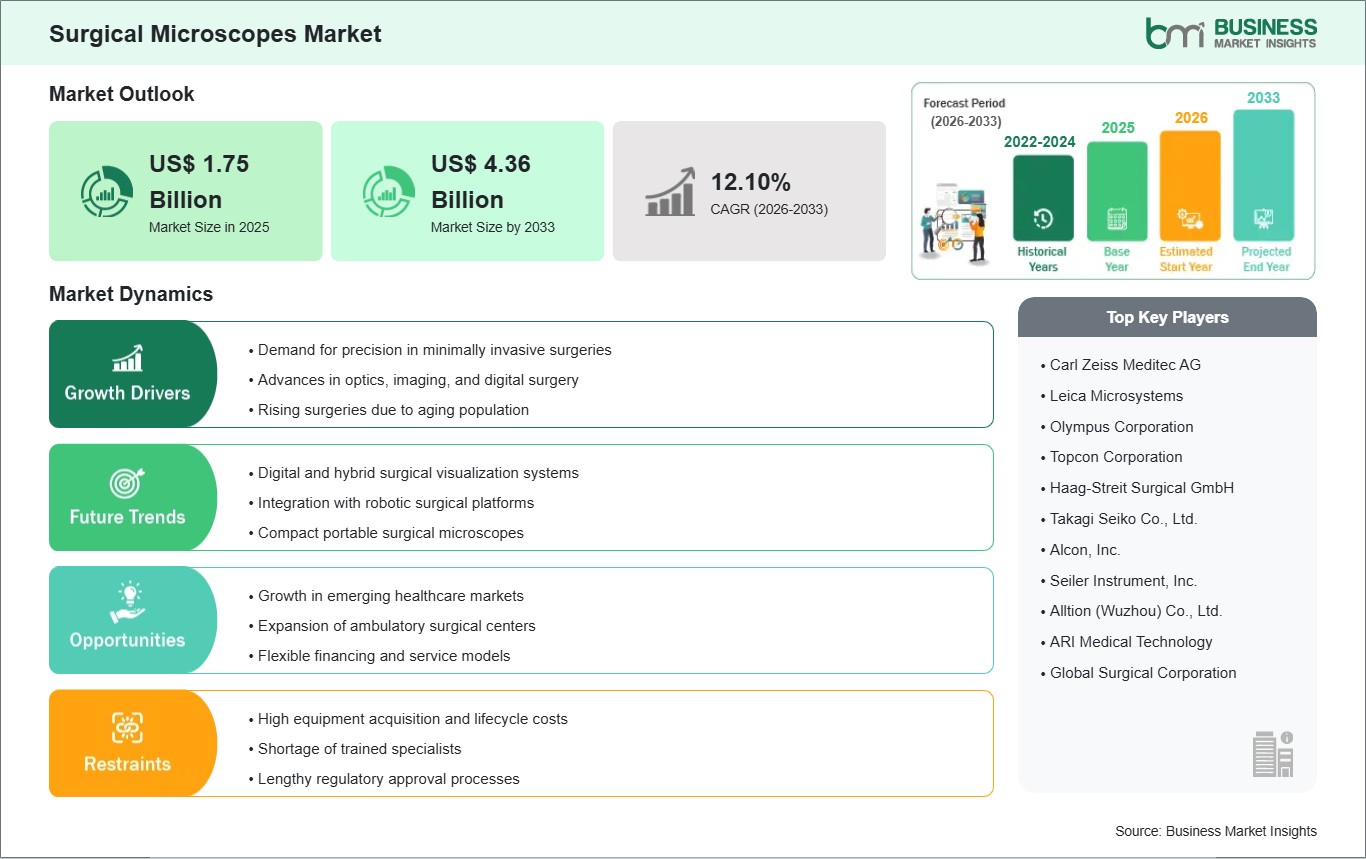
Surgical microscopes represent a critical advancement in surgical visualization, shifting from traditional loupes toward integrated, high-definition optical platforms. This market encompasses a sophisticated range of equipment, including casement-mounted, ceiling-mounted, and tabletop systems, essential for procedures that require extreme precision, such as neurosurgery, ophthalmology, and microvascular reconstruction. These systems deliver immense strategic value by providing surgeons with superior magnification, adjustable depth of field, and shadow-free illumination, which are vital for differentiating between healthy and diseased tissues. Market expansion is currently driven by the global surge in geriatric-related surgeries (such as cataracts and spinal decompression), the acceleration of digital surgery integration, and the increasing demand for fluorescence-guided interventions. Furthermore, the transition toward robotic-assisted and heads-up display (HUD) systems is significantly improving ergonomic comfort for surgeons and procedural accuracy.
However, several challenges can restrain market growth: high capital and maintenance expenditures remain a primary barrier, as premium systems with 4K or 3D capabilities can be prohibitively expensive for smaller clinics and hospitals in emerging economies. Technological complexity can also lead to a steep learning curve and a shortage of trained personnel capable of operating and maintaining these sensitive optical instruments. Additionally, the industry faces constraints due to space limitations in older operating theaters, where installing bulky ceiling-mounted or floor-standing units may require expensive structural renovations.
Despite these hurdles, the market holds immense opportunities in the universal push for outpatient surgery centers and the deployment of AI-driven surgical guidance. The expansion of medical tourism in developing nations and the development of hybrid digital-optical systems, which allow for real-time data overlays and remote collaboration, are expected to create significant opportunities for long-term market growth.
Segment Analysis
Surgical Microscopes Market Segmentation
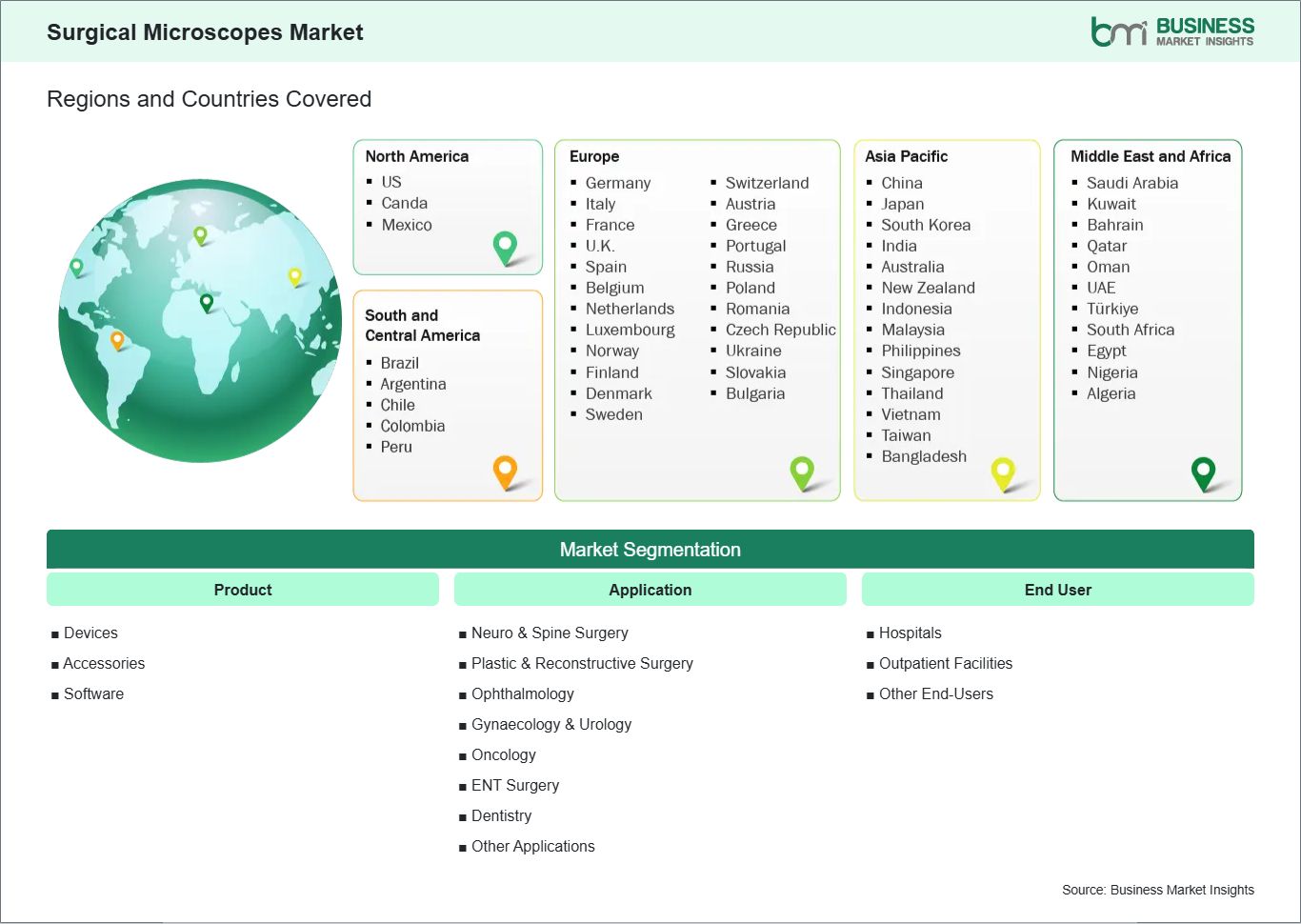
Key segments that contributed to the derivation of the Surgical Microscopes market analysis are product, application, and end user.
- By Product, the market is segmented into Devices, Accessories, and Software
- By Application, the market is divided into Neuro & Spine Surgery, Plastic & Reconstructive Surgery, Ophthalmology, Gynaecology & Urology, Oncology, ENT Surgery, Dentistry, and Others.
- By End User, the market is categorized into Hospitals, Outpatient Facilities, and Others.
Market Forces
Surgical Microscopes Market Drivers and Opportunities
Advancing Microsurgical Accuracy and Integrated Digital Workflows
The primary driver for the Surgical Microscopes Market is the accelerating global transition toward minimally invasive surgeries (MIS) and the rising volume of complex procedures necessitated by an aging population. As surgical techniques evolve, there is an intensifying demand for advanced visualization tools that enable surgeons to navigate delicate anatomical structures with unparalleled precision, resulting in smaller incisions, reduced patient trauma, and faster recovery times. This momentum is further propelled by the systemic adoption of "Smart OR" (Operating Room) technologies, where surgical microscopes act as integrated nodes within a larger digital ecosystem, coordinating real-time imaging with surgical navigation systems. The surging prevalence of chronic age-related conditions, such as cataracts, spinal stenosis, and neurological disorders, acts as a consistent catalyst for market expansion, particularly in developed regions with mature healthcare infrastructures.
Furthermore, the continuous focus on physician ergonomics and the reduction of surgical fatigue has driven the development of robotic-assisted visualization systems, ensuring that high-precision tools remain a foundational requirement for modern tertiary care institutions and specialized surgical centers worldwide.
AI-Enhanced Real-Time Analytics and Augmented Reality Integration
A significant high-value opportunity lies in the convergence of Surgical Microscopes with Artificial Intelligence (AI) and Augmented Reality (AR). By embedding AI-driven image analysis directly into the surgeon's field of view, next-generation microscopes can provide real-time tissue differentiation, identifying critical blood vessels or tumor margins that are invisible to the naked eye. There is also a major growth frontier in the adoption of Fluorescence Image-Guided Surgery (FIGS), which offers a lucrative opportunity for manufacturers to integrate multi-spectral imaging modules that highlight specific pathologies during oncology and vascular procedures.
Furthermore, the expansion of Ambulatory Surgery Centers (ASCs) and Outpatient Facilities presents a significant opportunity for the development of compact, caster-mounted, and cost-effective microscope solutions tailored for high-volume, "same-day" procedures like cataract or dental surgeries. Beyond traditional hospital settings, the rise of Tele-Robotic Surgery and Remote Mentoring platforms presents a frontier for cloud-connected microscopes that allow world-class specialists to guide procedures from across the globe. Manufacturers who focus on modular software-defined architectures and those pioneering integrated Optical Coherence Tomography (OCT) for real-time sub-surface visualization are positioned to lead the most innovative and high-margin segments of the 2026 surgical landscape.
Size and Share Analysis
Surgical Microscopes Market Size and Share Analysis
The Surgical Microscopes market demonstrates steady growth, with size and share analysis revealing evolving trends and competitive positioning among key players. The report further examines subsegments categorized within product, application, and end user, offering insights into their contribution to overall market performance.
Based on product, Devices subsegment holds a significant market presence, serving as the industry benchmark for core surgical visualization. Devices, particularly on-caster and ceiling-mounted systems, are indispensable for the Hospital sector, where they provide the primary high-magnification and illumination required for intricate microsurgery. A notable trend is the surge in the Software subsegment, which is registering a higher CAGR as hospitals invest in "Microscope-to-Digital" upgrade kits. These software solutions are becoming essential for Neuro & Spine Surgery, enabling real-time fluorescence image-guided surgery (FIGS) and AI-powered tissue differentiation.
Report Coverage
Surgical Microscopes Market Report Coverage and Deliverables
The "Surgical Microscopes Market Size and Forecast (2022 - 2033)" report provides a detailed analysis of the market covering below areas:
- Surgical Microscopes market size and forecast at global, regional, and country levels for all the key market segments covered under the scope
- Surgical Microscopes market trends, as well as market dynamics such as drivers, restraints, and key opportunities
- Surgical Microscopes market analysis covering key market trends, global and regional framework, major players, regulations, and recent market developments
- Industry landscape and competition analysis covering market concentration, heat map analysis, prominent players, and recent developments for the Surgical Microscopes market
- Detailed company profiles, including SWOT analysis
Geographic Insights
Surgical Microscopes Market Geographic Insights
The geographical scope of the Surgical Microscopes market report is divided into five regions: North America, Asia Pacific, Europe, Middle East & Africa, and South & Central America.
The Asia-Pacific Surgical Microscopes Market is segmented into China, Japan, South Korea, India, Australia, and the Rest of Asia. This region is the fastest-growing market globally, propelled by significant government-led healthcare modernization and the rising demand for minimally invasive procedures. China and India are at the forefront, utilizing vast capital investments to equip new multi-specialty facilities with advanced digital visualization tools. Japan remains a critical center for high-end optical research, focusing on ultra-precise imaging for neurosurgery and spinal interventions.
Growth is further bolstered by a significant shift toward 3D and 4K digital exoscopes among surgeons looking to improve ergonomics and surgical precision. The integration of AI-driven image enhancement and fluorescence-guided visualization, alongside the rising need for high-definition optics in outpatient surgery centers, solidifies Asia-Pacific as a critical hub for innovation and the future scaling of the Surgical Microscopes industry.
Industry Activity
Recent Developments
The Surgical Microscopes market is evaluated by gathering qualitative and quantitative data post primary and secondary research, which includes important corporate publications, association data, and databases. A few of the key developments in the Surgical Microscopes market are:
- In September 2025, Braun SE completed the acquisition of True Digital Surgery (TDS), a company specializing in digital robotic-assisted 3D surgical microscopy. This strategic move enhances B. Braun’s Aesculap AEOS® system used in neurosurgery, spine, and ENT procedures, combining TDS’s innovative technologies with B. Braun’s global reach. The acquisition is expected to accelerate technological advancements and expand adoption of digital surgical microscopes, positively impacting the Surgical Microscopes Market.
- In April 2025, Leica Microsystems launched the Proveo 8x 3D digital ophthalmic microscope at ASCRS 2025, providing real-time 3D visualization, integrated OCT and phaco data, and flexible surgeon viewing options. The system enhances surgical precision, workflow efficiency, and ergonomics for ophthalmic procedures. The launch highlights the ongoing adoption of advanced digital and 3D visualization technologies in the surgical microscopes market.
Trust & Transparency
Research Methodology
The market analysis combines proprietary research with secondary data from government agencies, company disclosures, regulatory filings, industry databases and expert interviews. Market estimates are validated through data triangulation, cross-market benchmarking and analyst
review.
View Full Research Methodology
Key Sources Referred:
World Bank - Global Trade IndicatorsWorld Trade Organization (WTO)International Monetary Fund (IMF)International Trade Administration (ITA)Company WebsitesCompany Annual ReportsCompany Investor Presentations