Market Summary
Executive Summary and Global Market Analysis
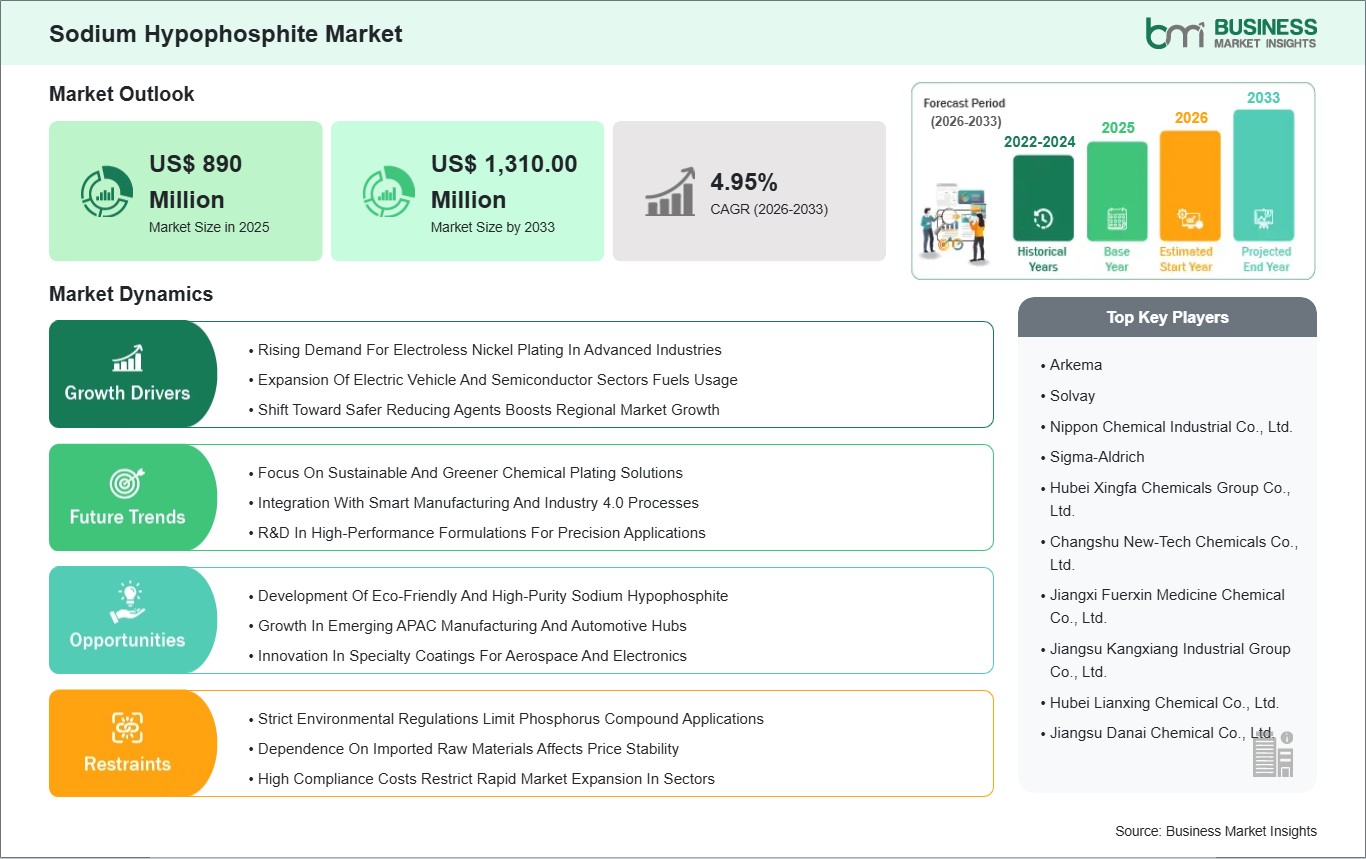
The North American sodium hypophosphite market exists as a highly specialized market because it connects to both advanced manufacturing and precision engineering industries. The compound serves as a vital reducing agent which enables electroless nickel plating to create uniform coatings that protect against corrosion and enhance resistance to wear. This includes aerospace components, automotive parts, electronic connectors, and industrial machinery. The region experiences market growth because manufacturers produce increasingly complex products which require dependable surface treatment methods. The electronics industry and semiconductor fabrication processes created a need for high-purity plating chemicals which now drive demand for these chemicals. The growing use of electric vehicles and renewable energy systems drives up the demand for coated components which in turn boosts the need for sodium hypophosphite. The main driver of this trend leads to safer chemical processes which have less environmental impact. North American industries are transitioning from using hazardous reducing agents which makes sodium hypophosphite a common choice because of its safer chemical characteristics. The market encounters several important limitations which restrict its progress. The environmental discharge and waste management of phosphorus-containing compounds face increased regulatory oversight from authorities. End-users must address operational difficulties which demand financial resources for building compliance systems and treatment technologies. The market experiences sensitivity to supply chain interruptions because imported raw materials determine both product availability and pricing consistency. These factors controll procurement approaches while they restrict fast growth potential for specific uses. The North American market exists through three fundamental forces which create demand for quality products and establish regulatory requirements and drive technological progress.
Segment Analysis
Sodium Hypophosphite Market Segmentation
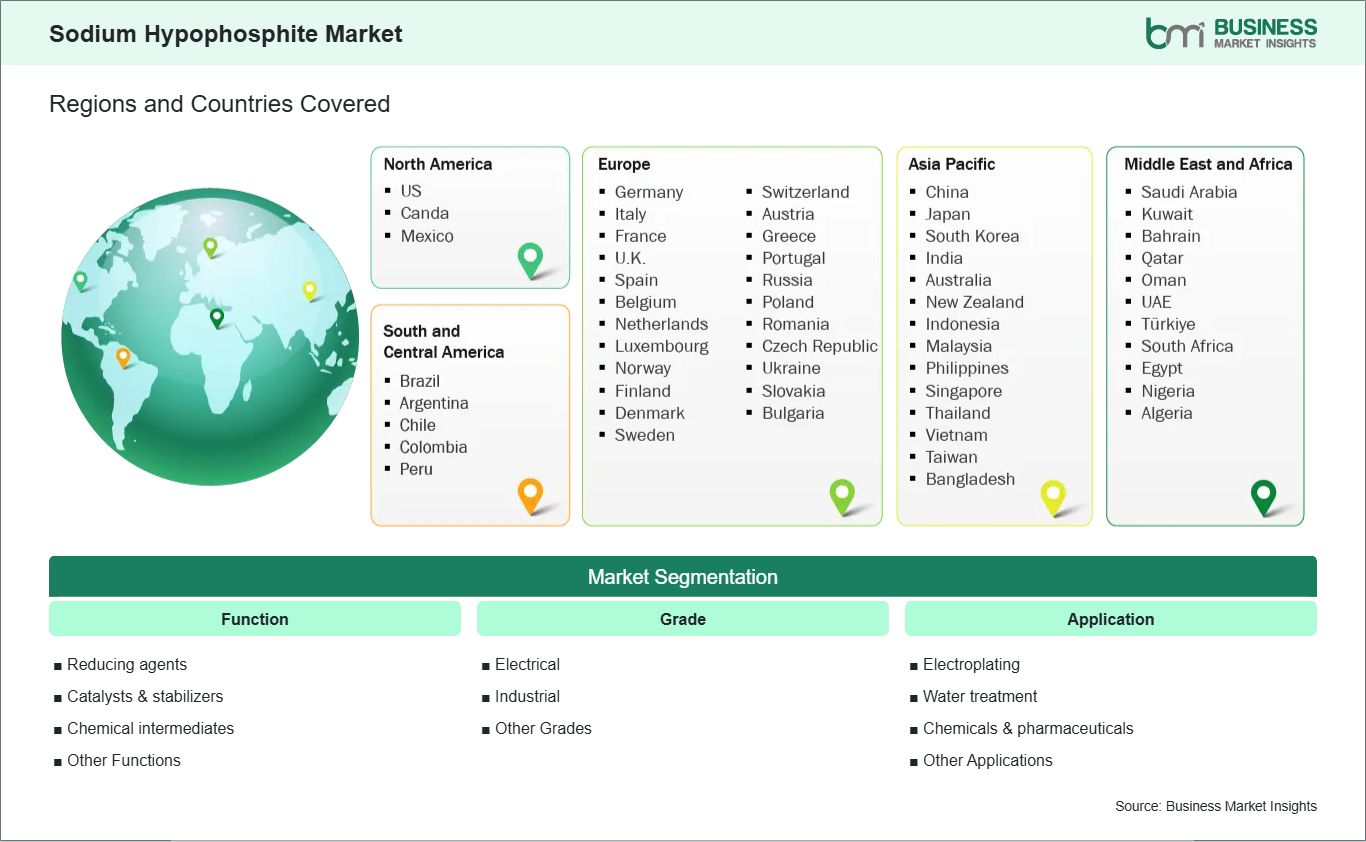
Key segments that contributed to the derivation of the sodium hypophosphite market analysis are function, grade and application.
- By function, the sodium hypophosphite market is segmented into reducing agents, catalysts & stabilizers, chemical intermediates, other functions. The reducing agents segment dominated the market in 2025.
- Based on grade, the sodium hypophosphite market is categorized into electrical, industrial, other grades. The electrical segment dominated the market in 2025.
- In terms of application, the sodium hypophosphite market is categorized into electroplating, water treatment, chemicals & pharmaceuticals, other applications. The electroplating segment dominated the market in 2025.
Market Forces
Sodium Hypophosphite Market Drivers and Opportunities
Rising Demand For Electroless Nickel Plating In Advanced Industries
The global sodium hypophosphite market exists because advanced industries use electroless nickel plating to produce surface coatings which meet their requirements for special component needs. The use of electrical current is not necessary for electroless nickel plating which provides uniform coverage to complex surfaces and has become essential for aerospace and automotive and shipbuilding and precision electronics industries. North American and European and Asia Pacific aerospace manufacturing centers need sodium hypophosphite because they require sodium hypophosphite to produce reliable reducing agents which protect their lightweight alloys through durable corrosion-resistant coatings. Automotive manufacturers in China and Japan and Germany now use plated components in their powertrain systems and fasteners because they want to achieve better durability while reducing product weight. The electronics assembly centers which operate throughout Southeast Asia and Taiwan now prefer electroless nickel deposits which sodium hypophosphite enables because these facilities need smaller and more complicated connectors and shield frames and semiconductor packaging. The increased automation and precision finishing capabilities which industrial economies now experience support this trend. The use of plated components in industrial machinery and tooling applications throughout Central and Eastern Europe and North America results in decreased maintenance expenses and lower equipment wear. The global demand for sodium hypophosphite as an essential substance exists because electroless nickel plating technology now finds applications in various industries which use it for their advanced material processing operations.
Development Of Eco‑Friendly And High‑Purity Sodium Hypophosphite
The global direction for sodium hypophosphite depends on two main factors, which are environmental sustainability and product performance because both manufacturers and end users now prefer chemical products that meet environmental standards while delivering pure and dependable results. Chemical manufacturers throughout Europe have developed new chemical formulas that produce less waste and create more environmentally friendly products because both strict government regulations and corporate environmental initiatives require them to adopt greener production methods. The research established high purity sodium hypophosphite grades, which provide dependable reducing capabilities through lower contaminant levels. This development fulfills essential requirements for medical device coatings and precision optics and aerospace component applications. The research conducted in North America and Asia Pacific demonstrates that electronics and automotive industries require both technical performance and environmental sustainability. The research results in sodium hypophosphite variants which enhance manufacturing processes through optimized production methods and additives. The advancements reduce total chemical requirements while decreasing the need for treatment of waste materials. Original equipment manufacturers (OEMs) now understand how plating chemicals affect their products throughout their entire lifecycle. The development of eco-friendly sodium hypophosphite and high purity sodium hypophosphite creates new market possibilities because businesses now make sustainability their main requirement for purchasing and manufacturing processes. The development of eco-friendly sodium hypophosphite and high-purity sodium hypophosphite continues to create new market opportunities while strengthening its position in advanced manufacturing systems.
Size and Share Analysis
Sodium Hypophosphite Market Size and Share Analysis
The sodium hypophosphite market demonstrates steady growth, with size and share analysis highlighting evolving trends and competitive dynamics among key players. The report examines subsegments categorized within function, grade and application, offering insights into their contribution to overall market performance.
By function, the reducing agents subsegment dominated the market in 2025, driven by its extensive use in electroless nickel plating processes, where sodium hypophosphite acts as a key reducing agent.
Based on grade, the electrical subsegment dominated the market in 2025, driven by rising demand for high-performance electroless plating in electronics and PCB manufacturing.
In terms of application, the electroplating subsegment dominated the market in 2025, driven by increasing adoption of electroless nickel plating across automotive, electronics, and industrial applications for corrosion resistance and uniform coating.
Report Coverage
Sodium Hypophosphite Market Report Coverage and Deliverables
The "Sodium Hypophosphite Market Size and Forecast (2022 - 2033)" report provides a detailed analysis of the market covering below areas:
- Sodium Hypophosphite Market size and forecast at global, regional, and country levels for all the key market segments covered under the scope
- Sodium Hypophosphite Market trends, as well as drivers, restraints, and opportunities
- Sodium Hypophosphite Market analysis covering key trends, global and regional framework, major players, regulations, and recent developments
- Industry landscape and competition analysis covering market concentration, heat map analysis, prominent players, and recent developments for the Sodium Hypophosphite Market
- Detailed company profiles, including SWOT analysis
Geographic Insights
Sodium Hypophosphite Market Geographic Insights
The geographical scope of the Sodium Hypophosphite Market report is divided into North America, Asia Pacific, Europe, Middle East & Africa, and South & Central America. North America held the largest share in 2025.
North America stands as the leading market for sodium hypophosphite because its advanced manufacturing industries and high-performance application sectors create strong demand for the chemical. The region uses electroless nickel plating for aerospace and defense and electronics and automotive applications which require precise and durable solutions. The existing regulatory framework supports the use of high-purity chemical formulations which meet environmental standards thus maintaining demand.
The Asia Pacific region develops at its fastest pace because industrialization grows and electronics manufacturing expands and automotive production increases in China Japan South Korea and India. The region increases its use of plating chemicals because it has affordable manufacturing and growing investments in semiconductor and electric vehicle supply chains. Europe maintains a stable market position because its automotive industrial machinery and specialty chemicals sectors create strong demand. The region moves toward cleaner production methods and better material usage because it values sustainability and environmental regulations.
The Middle East and Africa market currently functions as an emerging market because its primary demand comes from industrial maintenance activities and oilfield equipment protection needs and minimal manufacturing requirements. The region experiences growth because industries are gradually diversifying and infrastructure projects are being developed.
Brazil and Mexico drive the moderate growth potential of South and Central America because their automotive assembly and general manufacturing sectors create a demand for surface treatment chemicals. Economic volatility together with restricted technological adoption in certain areas will hinder market growth.
North America maintains its market leadership because it develops advanced technologies while Asia Pacific creates new business opportunities through volume increases. The market for specialized sodium hypophosphite formulations experiences constant demand from North America while the region maintains its technological dominance.
Industry Activity
Recent Developments
The Sodium Hypophosphite Market is evaluated by gathering qualitative and quantitative data post primary and secondary research, which includes important corporate publications, association data, and databases. A few of the key developments in the sodium hypophosphite market are:
- In September 2023, Solvay announced that it would showcase its complete range of advanced polymers and specialty chemicals—including its wet chemistry solutions for semiconductor and electronics manufacturing—at SEMICON Taiwan 2023, highlighting its commitment to supplying high‑performance materials globally. While not exclusively about sodium hypophosphite, this release underscores Solvay`s strategy in advanced chemical solutions that align with markets where sodium hypophosphite is deployed.
- In January 2023, Arkema finalized the divestment of its phosphorus derivatives business (including sodium hypophosphite production) by selling its subsidiary Febex to the Belgian specialty chemicals group Prayon, a move intended to support Febex`s growth under new ownership and sharpen Arkema`s portfolio focus.
Trust & Transparency
Research Methodology
The market analysis combines proprietary research with secondary data from government agencies, company disclosures, regulatory filings, industry databases and expert interviews. Market estimates are validated through data triangulation, cross-market benchmarking and analyst
review.
View Full Research Methodology
Key Sources Referred:
World Health Organization (WHO) Organisation for Economic Cooperation and Development (OECD) The World Bank Group Worldometer The Lancet International Bar Association International Trade Administration