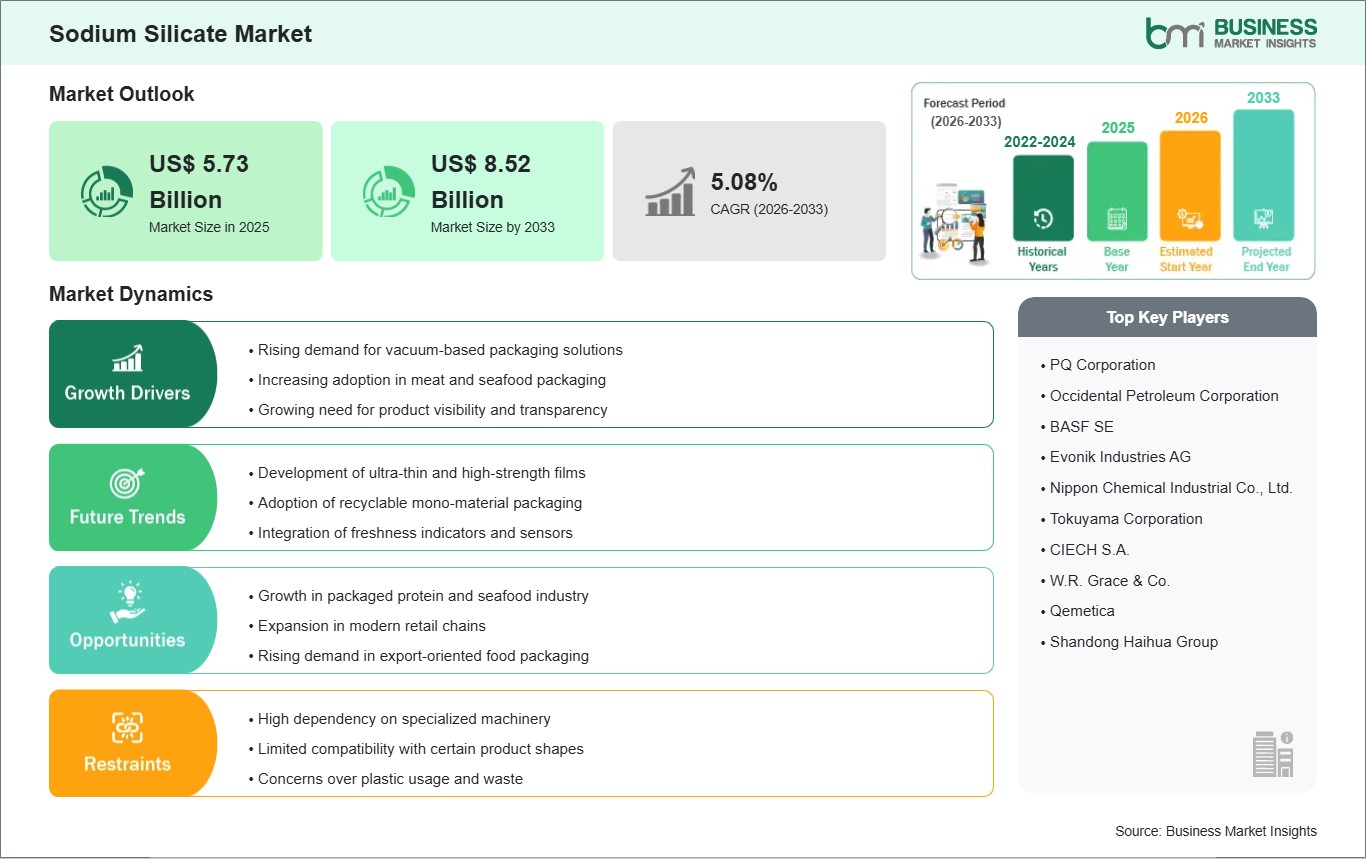
The Sodium Silicate Market size is expected to reach US$ 8.52 billion by 2033 from US$ 5.73 billion in 2025. The market is estimated to record a CAGR of 5.08% from 2026 to 2033.
The global sodium silicate market is witnessing a stable rate of growth due to its vast applicability in various industries like detergents, construction, water treatment, pulp and paper, and automotive. Sodium silicate, otherwise known as water glass, is highly prized for its adhesive, binding, and sealing properties, in addition to its chemical inertness and cost-effectiveness. One of the major factors for the growth of this market is its vast consumption in the detergent industry, where it acts as a builder, thus providing greater cleaning and water-softening properties. In this regard, another major factor for its growth is its consumption in construction activities, where it is utilized in cement mixtures, soil stabilization, and fire resistance. Environmental factors are also affecting the market in the following ways: the rising demand for sodium silicate in water treatment chemicals, particularly in the treatment of water to prevent corrosion and eliminate impurities.
Moreover, the rising demand for the product in green construction materials and green manufacturing processes is creating a positive impact on the market. Nevertheless, the market has experienced certain restraints, including the high-energy-intensive process of producing the product, as well as the product’s sensitivity to the availability of raw materials, including silica sand and soda ash. Moreover, the product has experienced stiff competition from other chemical agents in the market, particularly in the use of advanced polymers in certain applications. Despite the challenges affecting the market, the product has been very resilient due to its flexibility, low costs, and the rising need in environmentally driven applications.

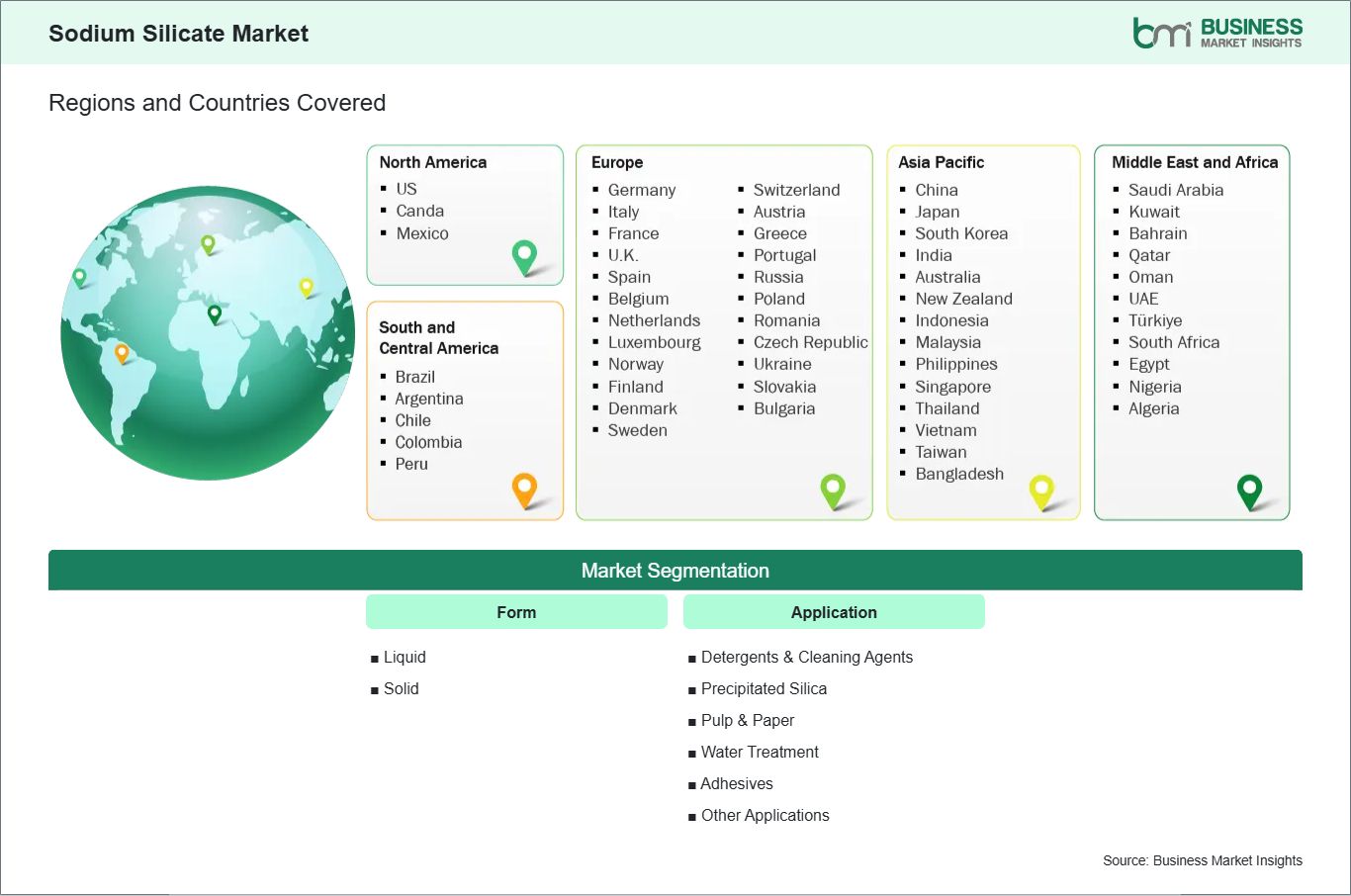
Key segments that contributed to the derivation of the sodium silicate market analysis are form and application.
The Western Europe sodium silicate market is growing steadily, and this is primarily because of the increased focus on product visibility and transparency, especially in packaging. Sodium silicate is used in the production of glass and the treatment of paperboard, and these are crucial for the production of transparent and high-quality packaging materials. In Germany, the Netherlands, and France, the need for transparent packaging formats is increasing significantly, especially for high-end food, beverage, and personal care products. It is estimated that over 45% of new packaging formats launched in Western Europe are featuring some form of transparent or semi-transparent material, which is indirectly boosting the consumption of sodium silicate.
In Germany, glass producers, especially those in the beverage and cosmetic industries, are increasingly using advanced sodium silicate compositions to ensure increased clarity and chemical resistance. Similarly, packaging companies in France are using sodium silicate as an additive in coated paper and board packaging to ensure sharper print and improved appearance, while maintaining recyclability. This is in line with the new EU directives, which are promoting the use of minimum packaging and recyclability, thus driving the market for multipurpose additives such as sodium silicate.
The Benelux market is also witnessing an increased trend in the use of shelf-ready packaging solutions, especially in the form of packaging that promotes the quality of the product through visibility. There is an increased trend among retailers to use packaging that allows consumers to look and check the quality of the product, especially organic and specialty foods. This is driving the market for sodium silicate, especially in packaging solutions that enhance the product's visibility, and is expected to maintain the growth rate in the region.
Another major factor that will contribute to the demand for sodium silicate in the packaged protein and seafood segment in Western Europe is the growth of this segment in this region. The packaged protein and seafood segment has been increasing in Spain, France, and the United Kingdom. The role of sodium silicate in this segment cannot be overstated, given that it has applications in cleaning agents, water treatment, and process aids that ensure hygiene in production.
The seafood production facilities in Spain’s coastal processing zones have increased capacity to meet both local and export requirements, and production output levels have increased by an estimated 6-8% annually. This trend is likely to continue, and the use of alkaline cleaning products containing sodium silicate is increasing to meet the requirements for removing protein residues and maintaining high levels of sanitation. Similarly, seafood production facilities catering to Northern European markets use water conditioning systems where sodium silicate is used to prevent corrosion and ensure a stable environment for production processes.
In France and the UK, the increasing trend towards ready-to-cook meat and seafood products is increasing the complexity of production processes, and there is a need for regular cleaning and wastewater disposal. Sodium silicate-based products are increasingly being used for these processes, especially because they are cost-effective and can be used with automation systems. Moreover, the increasing trend towards vacuum-sealed and portioned protein products is increasing the need for high levels of cleanliness and controlled production environments. As Western Europe's protein production and supply chains become increasingly sophisticated, the use of sodium silicate is expected to continue to grow for these supporting applications.

The sodium silicate market is experiencing steady growth, with market size and share analysis reflecting evolving treatment preferences and competitive dynamics among key players. The report evaluates important subsegments categorized within form and application highlighting their respective contributions to overall market performance.
By form, the liquid ght subsegment dominated the Sodium silicate market in 2025 because it is easier to handle, mix, and apply across industries like detergents, adhesives, and water treatment. Its solubility and versatility make it more cost-effective compared to solid forms, which require additional processing.
On a basis of application, the detergents & cleaning agents subsegment dominated the sodium silicate market in 2025 due to its role as a builder, stabilizer, and corrosion inhibitor. Rising hygiene awareness post-pandemic, coupled with growth in household and industrial cleaning products, drives this segment.
| Report Attribute | Details |
|---|---|
| Market size in 2025 | US$ 5.73 Billion |
| Market Size by 2033 | US$ 8.52 Billion |
| Global CAGR (2026 - 2033) | 5.08% |
| Historical Data | 2022-2024 |
| Forecast period | 2026-2033 |
| Segments Covered | By Form
|
|
Regions and Countries Covered
| |
| North America | US, Canada, Mexico |
| Europe | Belgium, Austria, Finland, Denmark, Greece, Poland, Romania, Russia, Ukraine, Czech Republic, Slovakia, Bulgaria, Italy, Luxembourg, Germany, Switzerland, France, Netherlands, Norway, Portugal, Spain, Sweden, United Kingdom |
| Asia-Pacific | Australia, China, India, Japan, South Korea, Indonesia, Malaysia, Philippines, Singapore, Thailand, Vietnam, Bangladesh, New Zealand, Taiwan |
| South and Central America | Brazil, Argentina, Peru, Chile, Colombia |
| Middle East and Africa | Bahrain, Kuwait, Oman, Qatar, Saudi Arabia, United Arab Emirates, Turkiye, South Africa, Egypt, Algeria, Nigeria |
| Market leaders and key company profiles |
|
The "Sodium silicate market Size And Forecast (2022 - 2033)" report provides a detailed analysis of the market covering below areas:
The geographical scope of the Sodium silicate market report is divided into five regions: North America, Asia Pacific, Europe, Middle East & Africa, and South & Central America. The Sodium silicate market in North America is expected to grow during the forecast period.
North America is the largest consumer of sodium silicate, and this is because the region offers a high demand for this product, coupled with a well-established industrial sector that is involved in its production. The country that is largely responsible for the high consumption rate is the United States, and this is because the country is a major consumer of this product, especially in the production of detergents, construction materials, and water treatment plants. The construction industry, which is highly developed, is also a major consumer of sodium silicate, especially for use in cement products such as sealing, binding, and fireproofing. The region is also highly developed, and this is why there is a high demand for sodium silicate, especially for use in water treatment plants, where it is used to prevent corrosion and for the stabilization of heavy metals. The country also contributes to the high consumption rate because of its pulp and paper industry, where the product is used for bleaching and de-inking.
The region is also highly developed, and this is why there is a high consumption rate, especially because of the availability of facilities that are involved in the production of this product. Overall, North America’s dominance is driven by industrial maturity, regulatory support, and continuous technological advancement in chemical processing and application development.

The sodium silicate market is evaluated by gathering qualitative and quantitative data post primary and secondary research, which includes important corporate publications, association data, and databases. A few of the key developments in the sodium silicate market are:
The Sodium Silicate Market is valued at US$ 5.73 Billion in 2025, it is projected to reach US$ 8.52 Billion by 2033.
As per our report Sodium Silicate Market, the market size is valued at US$ 5.73 Billion in 2025, projecting it to reach US$ 8.52 Billion by 2033. This translates to a CAGR of approximately 5.08% during the forecast period.
The Sodium Silicate Market report typically cover these key segments-
The historic period, base year, and forecast period can vary slightly depending on the specific market research report. However, for the Sodium Silicate Market report:
The Sodium Silicate Market is populated by several key players, each contributing to its growth and innovation. Some of the major players include:
The Sodium Silicate Market report is valuable for diverse stakeholders, including:
Essentially, anyone involved in or considering involvement in the Sodium Silicate Market value chain can benefit from the information contained in a comprehensive market report.
Please tell us your area of interest
(Market Segments/ Regions and Countries/ Companies)