Market Summary
Executive Summary and Global Market Analysis
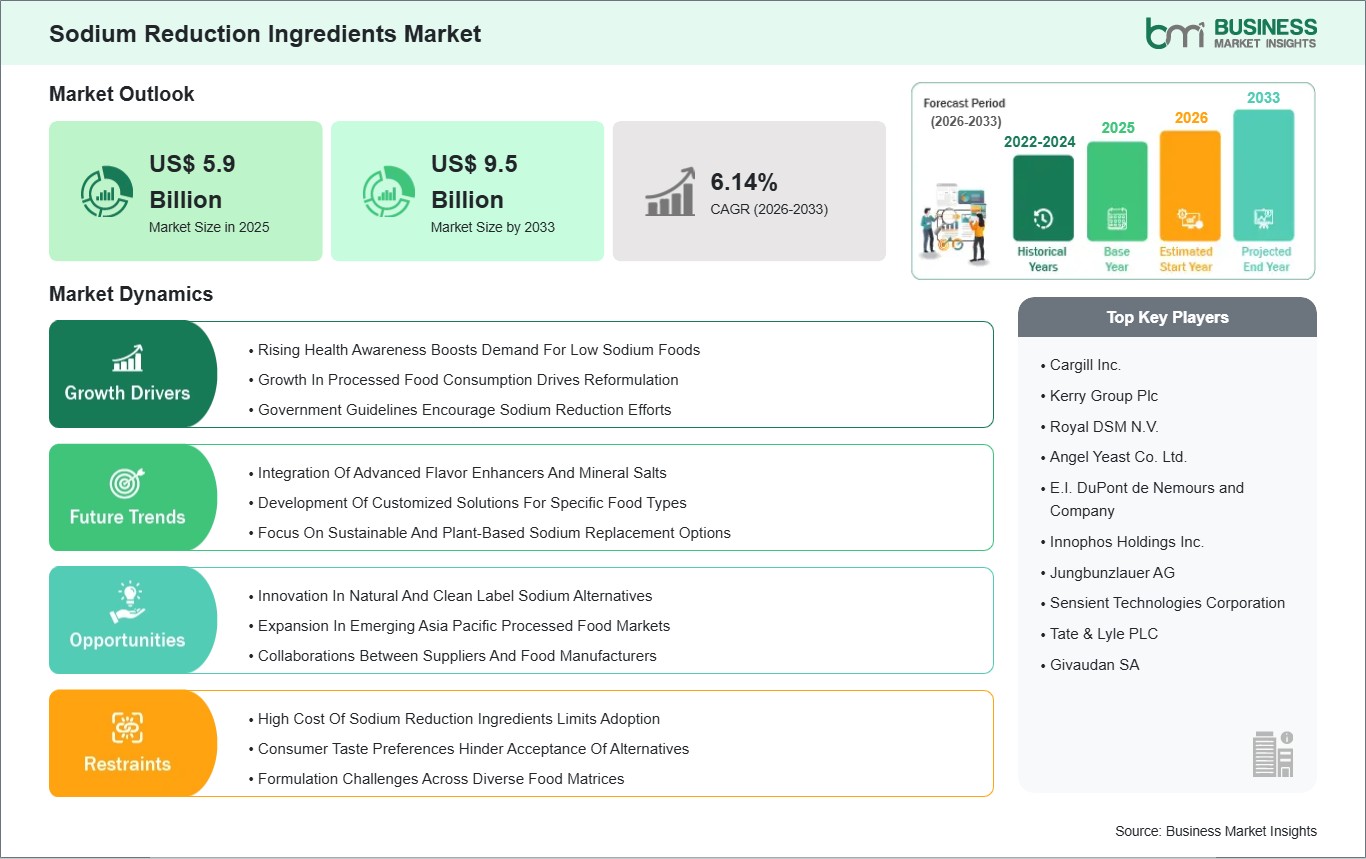
The global sodium reduction ingredients market has developed into a vital part of the food ingredients market because people want to eat healthier meals and because there are growing health problems that stem from high sodium intake. Sodium reduction ingredients include multiple products that replace salt taste through potassium chloride yeast extracts flavor enhancers mineral salts and new flavoring materials. Consumers worldwide now understand that excessive sodium consumption leads to hypertension and cardiovascular diseases which forces food companies to create healthier products that still taste good. The public health initiatives and government sodium reduction campaigns and nutritional labeling requirements drive this change in North America and Europe. Manufacturers use alternative salts and flavor systems to preserve the taste of their products while they work to reduce sodium content in snacks and bakery items and processed meats and sauces and ready meals. The development of taste enhancers and salt crystals with higher surface area and natural flavor boosters has provided formulators with new tools to create products that balance taste and healthy properties.
The market faces major limitations which prevent it from achieving its full potential despite the high demand which exists in the market. One primary challenge exists because customers find it difficult to perceive flavors from products which have had their sodium content reduced because flavor experts need to maintain existing taste profiles and sodium reduction needs to be achieved. The sodium reduction ingredients which some companies use cost more than standard sodium chloride which creates financial problems for manufacturers who operate in markets that prioritize cost efficiency. The need for specific solutions to handle different ingredient performances across various food matrices makes it difficult to develop products and expand manufacturing operations. Health-focused eating trends and regulatory support for sodium reduction methods drive worldwide innovation and sodium reduction method adoption in all food industry sectors.
Segment Analysis
Sodium Reduction Ingredients Market Segmentation
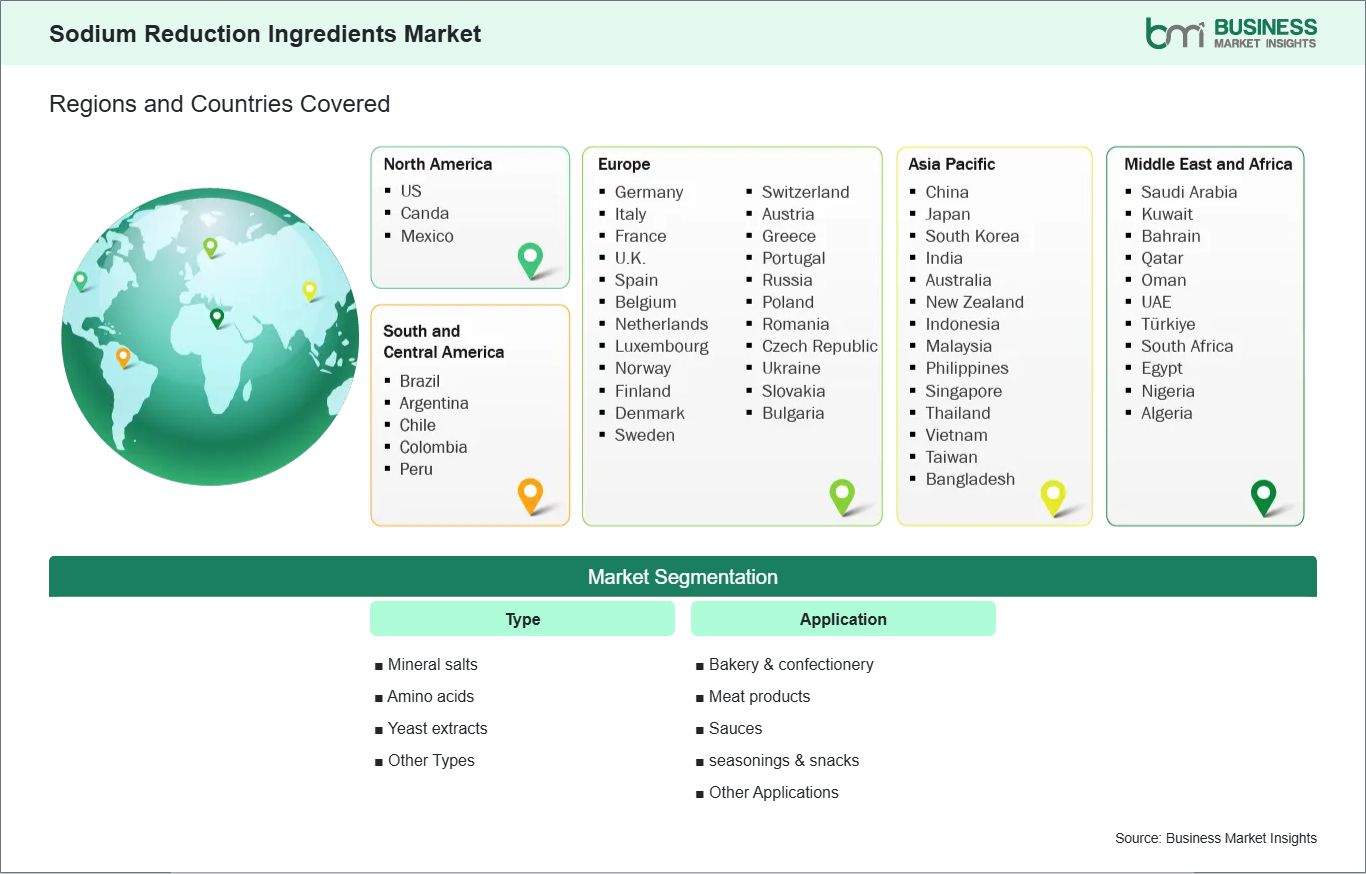
Key segments that contributed to the derivation of the sodium reduction ingredients market analysis are type and application.
- By type, the sodium reduction ingredients market is segmented into mineral salts, amino acids, yeast extracts, other types. The mineral salts segment dominated the market in 2025.
- Based on application, the sodium reduction ingredients market is categorized into bakery & confectionery, meat products, sauces, seasonings & snacks, other applications. The bakery & confectionery and meat products segments dominated the market in 2025.
Market Forces
Sodium Reduction Ingredients Market Drivers and Opportunities
Rising Health Awareness Boosts Demand For Low Sodium Foods
The sodium reduction ingredients market is experiencing its primary market development because people all over the world are becoming more conscious about health which leads them to understand that eating high sodium foods results in developing chronic diseases such as hypertension and heart disease and stroke. Health-conscious consumers in North America and Western Europe have developed low-sodium eating habits through public health campaigns and dietary guidelines which have existed for several decades, thus prompting food manufacturers to create new products that contain sodium-reducing ingredients. The trend extends beyond Western nations because urban populations in Japan and South Korea and Singapore now show increasing demand for transparent nutrition information and healthy food options while they choose to buy low-sodium products.
The growing health awareness of people has led to increased product development efforts which span all major processed food categories from baked goods to savory snacks and soups because brands seek to create tasty products that meet sodium reduction targets. Ingredient suppliers have been active in tailoring solutions that meet specific dietary expectations, such as potassium‑based salts, yeast extracts, and taste‑modifying blends that mimic saltiness without the associated health risks of traditional sodium chloride. The nutritional education programs in Latin America and the Middle East combined with rising media interest in wellness matters have begun to change how consumers shop, which has increased demand for low-sodium products in regular retail stores.
Innovation In Natural And Clean Label Sodium Alternatives
The global market now shows a dominant trend toward developing natural and clean label sodium reduction solutions because food manufacturers need to satisfy consumer demands for healthy products and transparent information. Recent developments in flavor science provide new ingredient platforms which combine plant-based ingredients and fermentation products and enzyme-modified carriers to produce salt-like flavors that contain very low sodium levels. Global consumers show strong interest in these innovations because they want products which deliver health benefits and use ingredients that they consider natural and unprocessed. European markets show high adoption of clean label trends which lead ingredient developers to use natural plant extracts and fermentation-based enhancers that meet local regulatory standards and customer preferences. North American brands now use clean label ingredients to show their sodium reduction efforts which helps build customer trust and product acceptance. The introduction of natural sodium alternatives which match local cooking methods has allowed Asia Pacific food manufacturers to develop traditional flavor profiles with better nutritional value.
Ingredient suppliers are investigating synergistic combinations which involve using bitter-blocking agents with mineral salts or umami-rich components to achieve better sodium reduction results without losing flavor. The food industry shifts towards wellness and ingredient transparency which creates worldwide market growth for new natural sodium replacement solutions that businesses must develop in order to succeed in established markets and developing markets.
Size and Share Analysis
Sodium Reduction Ingredients Market Size and Share Analysis
The sodium reduction ingredients market demonstrates steady growth, with size and share analysis highlighting evolving trends and competitive dynamics among key players. The report examines subsegments categorized within type and application, offering insights into their contribution to overall market performance.
By type, the mineral salts subsegment dominated the market in 2025, driven by their effectiveness in reducing sodium content while closely mimicking the taste of regular salt, making them easy to adopt across food products.
Based on application, the bakery & confectionery and meat products subsegments dominated the market in 2025, driven by the strong consumer demand for lower-sodium versions of everyday foods without compromising flavor and texture.
Report Coverage
Sodium Reduction Ingredients Market Report Coverage and Deliverables
The "Sodium Reduction Ingredients Market Size and Forecast (2022 - 2033)" report provides a detailed analysis of the market covering below areas:
- Sodium Reduction Ingredients Market size and forecast at global, regional, and country levels for all the key market segments covered under the scope
- Sodium Reduction Ingredients Market trends, as well as drivers, restraints, and opportunities
- Sodium Reduction Ingredients Market analysis covering key trends, global and regional framework, major players, regulations, and recent developments
- Industry landscape and competition analysis covering market concentration, heat map analysis, prominent players, and recent developments for the Sodium Reduction Ingredients Market
- Detailed company profiles, including SWOT analysis
Geographic Insights
Sodium Reduction Ingredients Market Geographic Insights
The geographical scope of the Sodium Reduction Ingredients Market report is divided into North America, Asia Pacific, Europe, Middle East & Africa, and South & Central America. North America held the largest share in 2025.
The Sodium Reduction Ingredients Market worldwide displays different regional patterns because health awareness and food industry structures and consumer tastes and regulatory requirements differ across different areas, with North America showing the strongest market presence. North American public health campaigns that promote sodium reduction succeeded because consumers in the region understand nutritional facts, which led to the widespread use of sodium reduction ingredients in processed foods and snacks and ready-to-eat meals. Food manufacturers in the United States and Canada are reformulating their products through the use of potassium-based salts and yeast extracts and flavor enhancers, which enable them to produce nutritious items that maintain their original taste, thanks to ingredient innovations and supplier relationships with food producers.
The Asia Pacific region faces growing need for sodium reduction solutions because of its fast urban development and rising middle-class population and its increasing demand for quick-to-use and packaged food products. The adoption of new technologies shows different rates across different markets because people in different regions have different food preferences, while their health regulatory systems are less strict than those in North America. Western European countries place special importance on public health protection through their regulatory systems, which European countries use to lower sodium levels in processed foods based on their government recommendations and industry targets. European customers who prefer clean labels and natural ingredients lead formulators to develop products that use plant-based enhancers and mineral-based alternatives.
The Middle East and Africa region demonstrates growing knowledge about diet-related health matters but shows slower progress in implementation because its food processing industry remains underdeveloped and its countries apply different nutritional regulations.
South and Central America shows moderate growth because processed food markets in Brazil and Mexico enable expansion while consumers become more health-conscious, although traditional flavor tastes and price sensitivity restrict market growth. Sodium reduction ingredient development throughout different regions depends on health trends, government regulations, and advances in food sector technology.
Industry Activity
Recent Developments
The Sodium Reduction Ingredients Market is evaluated by gathering qualitative and quantitative data post primary and secondary research, which includes important corporate publications, association data, and databases. A few of the key developments in the sodium reduction ingredients market are:
- In November 2023, PepsiCo, Inc. announced that it set ambitious new global sodium reduction and nutrition goals as part of its PepsiCo Positive (pep+) strategy, aiming to reduce sodium across its global convenient foods portfolio and incorporate more diverse ingredients to improve nutritional profiles. As part of this announcement, PepsiCo outlined targets to ensure a significant portion of its products meet lower sodium category targets by 2030 and to increase the use of nutritionally diverse ingredients in its offerings.
- In March 2025, SALT Minerals announced that it had gained the license to market and produce the sub4salt® product line, an innovative sodium reduction ingredient originally developed by Jungbunzlauer, expanding its portfolio of low‑sodium solutions for food applications. This product line allows food manufacturers to reduce sodium content by offering salt replacers in multiple grades suitable for baked goods, snacks, dairy, meats, and dressings while maintaining flavor functionality.
Trust & Transparency
Research Methodology
The market analysis combines proprietary research with secondary data from government agencies, company disclosures, regulatory filings, industry databases and expert interviews. Market estimates are validated through data triangulation, cross-market benchmarking and analyst
review.
View Full Research Methodology
Key Sources Referred:
World Health Organization (WHO) Organisation for Economic Cooperation and Development (OECD) The World Bank Group Worldometer The Lancet International Bar Association International Trade Administration