
Smokeless Tobacco Products Market Outlook: Size, Share, Trends, Growth Analysis, Competitive Landscape & Forecast, 2026-2033

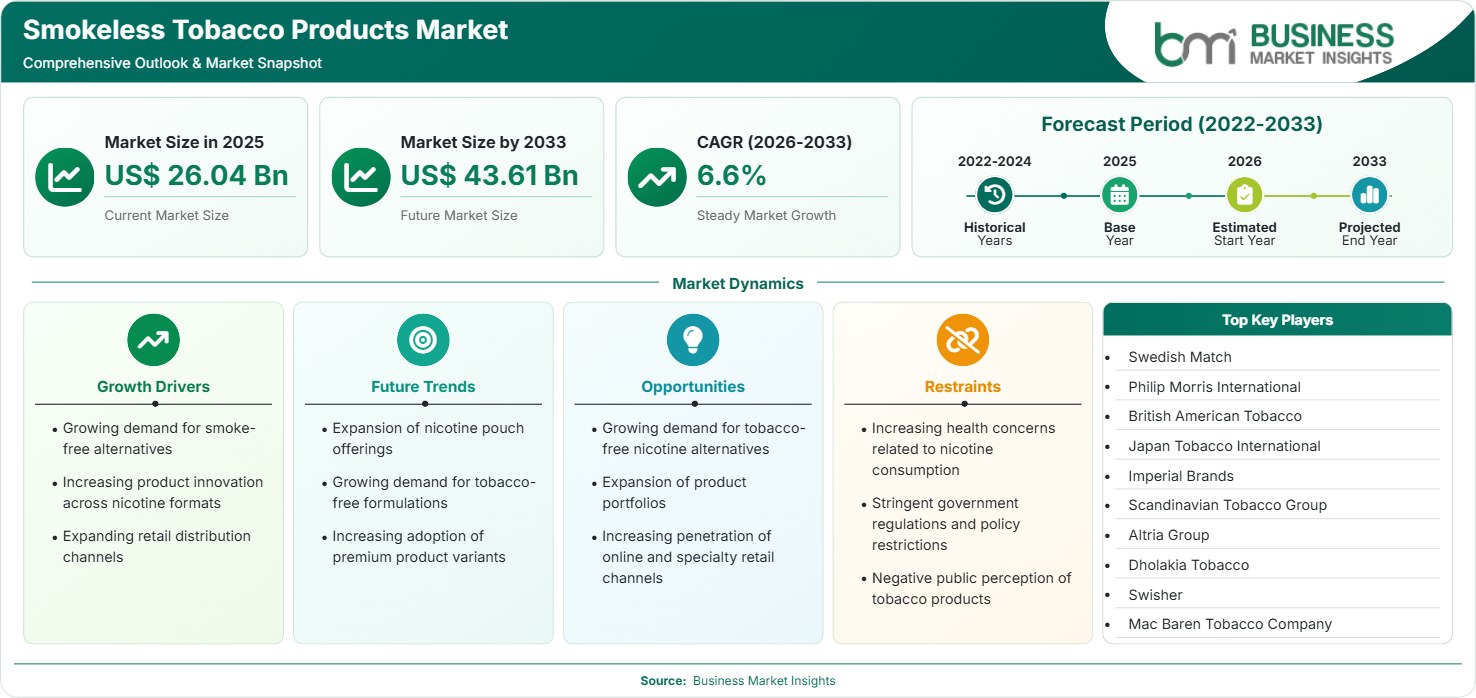
The Smokeless Tobacco Products Market size was valued at US$ 26.04 Billion in 2025 and is projected to reach US$ 43.61 Billion by 2033, growing at a CAGR of 6.6% from 2026 to 2033. Growth is supported by rising consumer preference for smoke-free formats, product innovation in nicotine delivery, premiumization of oral tobacco products, and wider availability through convenience retail and digital commerce channels.

Report Coverage
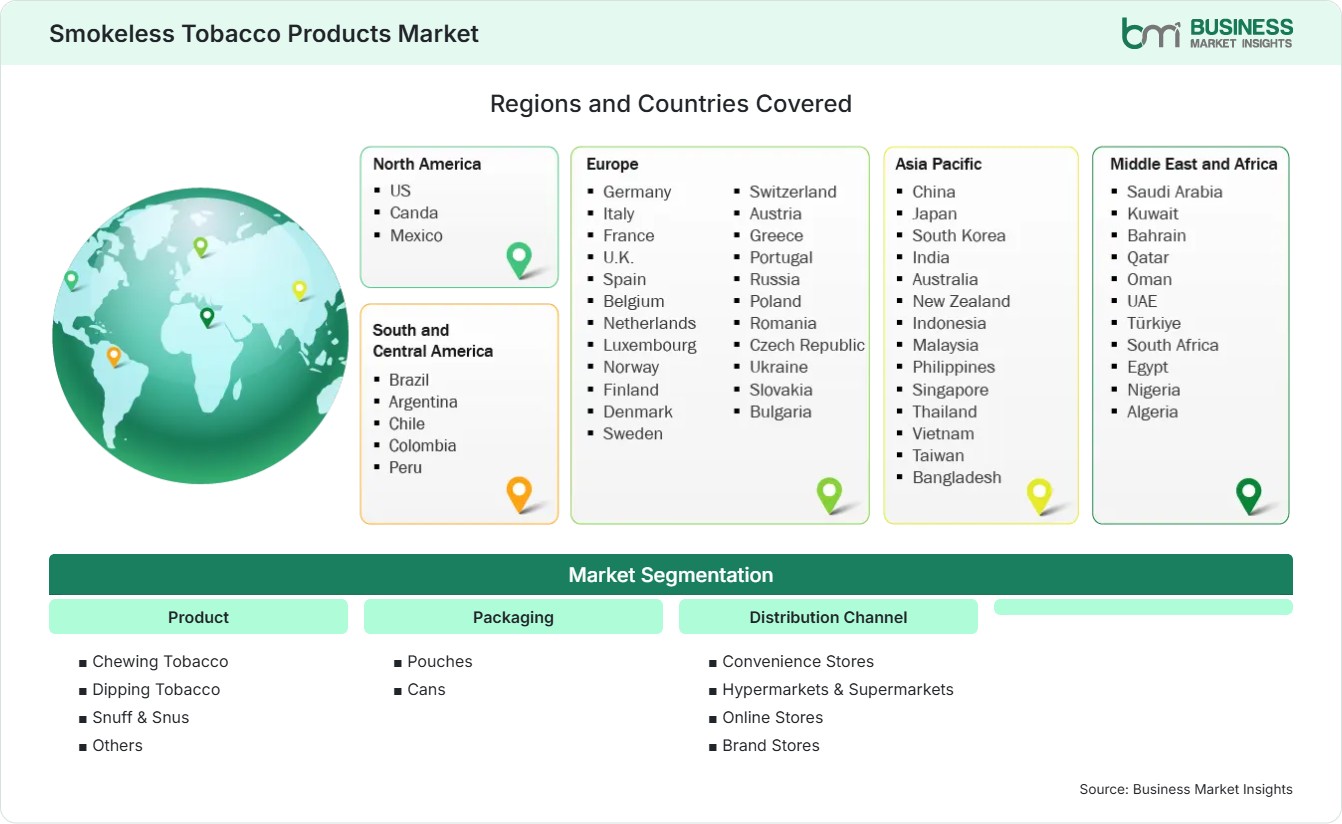
  • Product: Chewing Tobacco, Dipping Tobacco, Snuff & Snus, Others
  • Packaging: Pouches, Cans
  • Distribution Channel: Convenience Stores, Hypermarkets & Supermarkets, Online Stores, Brand Stores
US$ 26.04 Bn Market size in 2025
US$ 43.61 Bn Market Size by 2033
6.6% CAGR, 2026 - 2033
2026-2033 Forecast Period

AI Overview

Smokeless Tobacco Products Market Summary

  • North America Region: North America holds a market share of 38%–41% in 2025, expanding at a CAGR of 5.8%–6.4% during 2026–2033, supported by established smokeless tobacco consumption patterns, strong brand presence, product diversification, and advanced retail distribution. The US market maintains a CAGR of 5.9%–6.5% through 2033, driven by oral nicotine innovation, convenience store availability, and shifting adult consumer preferences toward smoke-free products.
  • Fastest Growing Region: Asia Pacific represents a market share of 24%–27% in 2025 and is projected to grow at a CAGR of 7.2%–8.0% during 2026–2033, driven by expanding urban populations, evolving tobacco consumption preferences, rising disposable incomes, and increasing availability of packaged smokeless tobacco products across emerging economies.
  • Leading Segment: Snuff & Snus holds a market share of 36%–39% in 2025 and is expected to register a CAGR of 6.8%–7.5% during 2026–2033, supported by established consumer acceptance, discreet usage formats, product innovation, and growing demand for smoke-free nicotine delivery options.
  • High Growth Segment: Online Stores represent the fastest-growing distribution channel with a market share of 10%–13% in 2025 and a CAGR of 8.0%–9.0% during 2026–2033, supported by digital purchasing convenience, expanding specialty platforms, improved product accessibility, and evolving consumer shopping behavior.
  • Key Market Opportunity: Manufacturers can capture emerging growth through tobacco-free nicotine alternatives, differentiated product portfolios, sustainable packaging solutions, and digital retail strategies that address changing consumer preferences and regulatory environments.
  • Major Market Players: Swedish Match, Philip Morris International, British American Tobacco, Japan Tobacco International, Imperial Brands, Scandinavian Tobacco Group, Altria Group, Dholakia Tobacco, Swisher, Mac Baren Tobacco Company.
Strategic Insights

Smokeless Tobacco Products Market: Strategic Insights

Smokeless Tobacco Products Market Strategic Framework
FREE PDF
Request your free sample
Request free sample
Stakeholder View

Key Takeaways

  • The market ecosystem is shifting toward diversified oral nicotine portfolios, where established tobacco companies are combining traditional smokeless products with newer nicotine delivery formats. Manufacturers are strengthening supply chains, research capabilities, and brand positioning to address changing consumer expectations while maintaining regulatory compliance.
  • Product innovation represents a major growth pathway as companies introduce improved pouch formats, enhanced flavors, discreet designs, and differentiated nicotine experiences. Snus, nicotine pouches, and modern oral formats are creating opportunities for portfolio expansion beyond conventional chewing tobacco and dipping products.
  • Packaging innovation is becoming a competitive factor as manufacturers prioritize convenience, portability, shelf visibility, and product preservation. Pouches are gaining attention due to their discreet usage characteristics and alignment with changing consumer preferences for compact and easy-to-carry products.
  • North America remains a strategically important market due to strong brand recognition, established consumer adoption, and extensive convenience retail networks. The region continues attracting investment from global tobacco companies expanding smoke-free product portfolios.
  • Competitive activity is increasing as major tobacco organizations pursue portfolio transformation through acquisitions, product launches, and investment in reduced-risk nicotine categories. Partnerships and technology development are supporting companies seeking long-term positioning in evolving nicotine markets.
  • Digital commerce is becoming an important channel opportunity as consumers increasingly explore specialty online retailers and direct purchasing platforms. Companies with strong digital engagement strategies can improve customer accessibility while developing targeted marketing approaches within regulatory boundaries.
Geographic Outlook

Smokeless Tobacco Products Market Regional Highlights

North America Smokeless Tobacco Products Market

North America accounted for a 38%–41% share of the Smokeless Tobacco Products Market in 2025 and is projected to grow at a CAGR of 5.8%–6.4% during 2026–2033. The region benefits from established consumer familiarity with oral tobacco formats, strong retail infrastructure, and extensive product availability through convenience stores. The US remains the dominant contributor, supported by established brands, premium product offerings, and increasing interest in smoke-free nicotine experiences.

  • The US continues leading regional demand due to strong consumer adoption of chewing tobacco, dipping tobacco, and modern oral nicotine formats supported by broad retail availability.
  • Convenience stores remain a significant distribution channel as consumers prioritize accessibility, immediate purchasing options, and established brand recognition across major retail networks.
  • Manufacturers are expanding product portfolios through pouch-based formats, improved packaging designs, and differentiated product offerings targeting evolving adult consumer preferences.
  • Regulatory scrutiny is influencing innovation strategies as companies invest in compliance-focused product development and alternative nicotine categories.

US Smokeless Tobacco Products Market

The US represented a 32%–35% share of the Smokeless Tobacco Products Market in 2025 and is expected to expand at a CAGR of 5.9%–6.5% from 2026–2033. The country remains a key revenue center due to strong brand loyalty, established smokeless tobacco consumption patterns, and widespread availability across convenience retailers. Increasing interest in smoke-free alternatives is encouraging manufacturers to develop innovative oral products.

  • The US market benefits from mature distribution networks covering convenience stores, specialty retailers, and digital channels supporting consumer access.
  • Product innovation is accelerating through new pouch formats, flavor variations, and improved user convenience features designed for discreet consumption.
  • Leading tobacco companies are increasing investment in reduced-risk product categories to diversify beyond traditional combustible tobacco offerings.

Europe Smokeless Tobacco Products Market

Europe held a 19%–22% share of the Smokeless Tobacco Products Market in 2025 and is forecast to grow at a CAGR of 6.3%–7.0% during 2026–2033. The region demonstrates strong adoption of snus and nicotine pouch products, particularly in Scandinavian countries. Sweden, Norway, and the United Kingdom represent important markets, with Sweden maintaining leadership due to historical acceptance of oral nicotine products.

  • Sweden remains a leading European market due to established snus consumption culture and consumer familiarity with smoke-free nicotine formats.
  • Norway demonstrates increasing demand for oral nicotine products as adult consumers seek alternatives to traditional smoking methods.
  • The United Kingdom is experiencing product expansion through nicotine pouch availability and increasing retail diversification.
  • European manufacturers are focusing on premium packaging and product differentiation to compete in evolving nicotine categories.

Asia Pacific Smokeless Tobacco Products Market

Asia Pacific represented a 24%–27% share of the Smokeless Tobacco Products Market in 2025 and is projected to achieve the fastest growth with a CAGR of 7.2%–8.0% during 2026–2033. The region benefits from large consumer populations, traditional oral tobacco usage in selected countries, rising urbanization, and expanding organized retail channels. India, Japan, and Southeast Asian markets are important contributors to regional development.

  • India remains a significant market due to longstanding consumption of smokeless tobacco products and extensive availability through local distribution networks.
  • Japan is experiencing increased attention toward alternative nicotine formats as consumers explore newer tobacco-related product categories.
  • Southeast Asian countries are seeing expanding retail penetration through convenience outlets and digital commerce platforms.
  • Regional manufacturers are adapting products to local preferences through varied formats, packaging approaches, and consumer-focused innovations.

Rest of World Smokeless Tobacco Products Market

Rest of World accounted for a 10%–13% of the Smokeless Tobacco Products Market share in 2025 and is expected to grow at a CAGR of 6.5%–7.3% during 2026–2033. Latin America, the Middle East, and Africa demonstrate varied consumption patterns influenced by cultural preferences, regulatory conditions, and retail development. Growing urbanization and improved distribution networks are supporting market expansion in selected countries.

  • Latin American markets are supported by traditional tobacco consumption patterns and increasing availability of packaged oral tobacco products.
  • Middle Eastern markets are experiencing gradual retail modernization, enabling wider access to branded smokeless tobacco products.
  • African markets show potential through expanding urban retail networks and growing consumer access to packaged nicotine products.
  • Manufacturers are developing region-specific strategies to address diverse regulatory environments and consumer preferences.
Global Market Geography
FREE PDF
Request your free sample
Request free sample
Segment Analysis

Smokeless Tobacco Products Market Segmentation

Product

The product segment represents the core structure of the Smokeless Tobacco Products Market, covering multiple oral tobacco formats designed for different consumer preferences and usage patterns. The segment accounted for the complete market revenue base in 2025 and is projected to expand at a CAGR of 6.6% during 2026–2033. Product innovation, improved packaging formats, and demand for discreet nicotine consumption continue shaping competitive strategies across chewing tobacco, dipping tobacco, snuff, and snus categories.

  • Chewing Tobacco: Chewing tobacco remains an established product category supported by long-term consumer familiarity and availability across traditional retail channels. Manufacturers continue improving packaging, flavors, and product consistency to maintain demand among existing adult consumers.
  • Dipping Tobacco: Dipping tobacco maintains strong adoption in North America due to established usage patterns and brand recognition. Product enhancements focused on convenience, portion control, and improved consumer experience support continued category relevance.
  • Snuff & Snus: Snuff and snus represent a major growth category due to discreet usage characteristics, reduced smoke exposure perception, and increasing acceptance of oral nicotine formats. Scandinavian markets continue influencing product innovation and category development.

Packaging

Packaging plays an increasingly important role in the Smokeless Tobacco Products Market growth as manufacturers focus on portability, convenience, product protection, and brand differentiation. The packaging segment is expected to maintain steady growth through 2033 as companies introduce improved designs aligned with consumer expectations and regulatory requirements. Pouches are gaining momentum due to their discreet format, while cans continue serving traditional product categories with strong consumer familiarity.

  • Pouches: Pouch packaging is gaining adoption due to compact design, convenience, controlled portions, and suitability for discreet consumption. Manufacturers are investing in improved materials and attractive designs to enhance product differentiation.
  • Cans: Can packaging remains widely used for traditional smokeless tobacco products due to durability, storage convenience, and established consumer acceptance. Brands continue utilizing cans for premium positioning and product preservation.

Distribution Channel

Distribution channels significantly influence accessibility and purchasing behavior within the Smokeless Tobacco Products Market. Convenience stores remain the dominant channel due to immediate availability and established consumer purchasing habits. However, online stores and specialty retailers are gaining importance as digital commerce expands and consumers seek broader product selection. Distribution strategies increasingly focus on balancing physical retail presence with digital accessibility.

  • Convenience Stores: Convenience stores represent a leading distribution channel due to high consumer accessibility, frequent purchasing patterns, and strong relationships with tobacco product suppliers.
  • Hypermarkets & Supermarkets: Hypermarkets and supermarkets support product visibility through organized retail networks, offering consumers convenient access alongside broader household shopping activities.
  • Online Stores: Online stores are expanding rapidly as consumers seek product convenience, wider selection, and easier access to specialized smokeless tobacco categories through digital platforms.
  • Brand Stores: Brand stores provide manufacturers with direct customer engagement opportunities, allowing stronger brand experiences, product education, and portfolio promotion within regulatory limits.
Market Forces

Smokeless Tobacco Products Market Dynamics

Key Market Drivers

Growing Demand for Smoke-Free Alternatives

Increased consumer inclination towards smokeless solutions is a major factor fueling market expansion, where adults with nicotine addiction preferences switch from the traditional cigarette to a product that is easier and discreet to consume. Forms like snus, tobacco pouches, and chewing tobacco have garnered popularity because of their easy carrying and odorlessness. The Smokeless Tobacco Products Market trends indicate that manufacturers are prioritizing alternative delivery formats to address changing preferences while maintaining compliance with regional regulations. Companies are expanding product portfolios with improved flavors, packaging, and user-friendly designs to strengthen adoption across mature and developing markets.

Increasing Product Innovation Across Nicotine Formats

Product innovation is accelerating as companies invest in new formulations, packaging improvements, and differentiated consumer experiences. Manufacturers are developing advanced pouch technologies, improved flavors, and high-quality packaging designs in order to compete in the highly segmented market for nicotine products. Innovation is being carried out with an aim of improving the convenience, consistency, and differentiating their products from others. Innovation is also contributing to portfolio development where companies are expanding into other segments apart from the conventional ones.

Expanding Retail Distribution Channels

Expansion of retail distribution channels is strengthening product accessibility across convenience stores, supermarkets, specialty retailers, and digital platforms. Improved availability allows manufacturers to reach broader consumer segments while increasing brand visibility. The convenience stores have continued to be critical owing to their purchase behavior; however, the online outlets have managed to create more opportunities in terms of product awareness and availability. The organizations have been putting efforts towards diversification of their distribution channels in order to enhance the effectiveness and efficiency of their market reach and meet the evolving shopping behaviors.

Key Market Opportunities

Growing Demand for Tobacco-Free Nicotine Alternatives

The increasing interest in tobacco-free nicotine alternatives creates significant opportunities for companies seeking portfolio diversification. As consumers search for products that offer smoke-free and more discreet ways of enjoying nicotine, it is prompting companies to create products that go beyond tobacco. Investing in other nicotine alternatives and innovations in their technology could be the key to gaining an advantage in this opportunity. Such an opportunity would be very much appropriate, considering that the strategy for most tobacco firms now revolves around creating nicotine ecosystems.

Expansion of Product Portfolios

Portfolio expansion provides companies with opportunities to address diverse consumer preferences across regional markets. Product variations, packaging, and premium brands are being launched by the companies to build loyalty and increase their penetration into the market. Increased product range gives companies the ability to compete in various markets without being dependent on one particular product range. Research, production facilities, and brand development are some of the areas that would be invested strategically for future opportunities.

Increasing Penetration of Online and Specialty Retail Channels

Digital commerce and specialty retail channels offer opportunities for manufacturers to improve accessibility and consumer engagement. The Internet provides a more expanded product discovery, efficient customer communication, and efficient distribution methods. The specialty retailers will ensure product availability and effective positioning. If buying behaviors continue to shift towards digitization, organizations that invest in compliance through online channels and partnerships with specialty retailers can enhance their competitive position. Smokeless Tobacco Products Market Forecasts show that the digital distribution will be relevant for consumers looking for

Market Restraints and Challenges

Increasing Health Concerns Related to Nicotine Consumption

Factor: Growing awareness of health risks associated with nicotine consumption is influencing consumer attitudes and creating demand uncertainty across traditional smokeless tobacco categories.

Impact: Manufacturers face challenges in maintaining consumer trust, addressing public health concerns, and investing in responsible product communication while adapting to changing market expectations. Nicotine risks are being highlighted by health organizations and regulating agencies, which may impact how the product is viewed and adopted by consumers. The companies have been doing this by increasing their level of transparency, adhering to compliance regulations, and also experimenting with new forms of nicotine.

Stringent Government Regulations and Policy Restrictions

Factor: Increasing regulatory oversight, taxation measures, packaging requirements, and marketing restrictions create operational challenges for smokeless tobacco manufacturers.

Impact: Companies may experience higher compliance costs, limited promotional activities, and slower product launches across regulated markets. Strict regulations on tobacco-related products continue to be enacted by governments around the world, affecting production, distribution, and market expansion. It is necessary to keep an eye on the changes in legislation and adjust the products in order not to get into trouble. Different legislations in various regions also pose additional challenges in terms of international expansion.

Company Analysis

Competitive Landscape

The Smokeless Tobacco Products Market analysis indicates a competitive environment dominated by global tobacco companies, regional manufacturers, and specialized nicotine product providers. Market participants compete through product innovation, brand strength, retail expansion, packaging improvements, and portfolio diversification. Leading companies are investing in smoke-free categories, premium product development, and digital engagement strategies to respond to changing consumer preferences. Strategic acquisitions, partnerships, and research initiatives are supporting long-term competitiveness as companies navigate evolving regulations and shifting nicotine consumption patterns.

Company Name

Overview

Products and Services relevant to this market

Swedish Match

Swedish Match is a leading oral nicotine and smokeless tobacco company with strong Scandinavian and international market presence.

Snus, nicotine pouches, chewing tobacco products, oral nicotine solutions, and smoke-free alternatives.

Philip Morris International

Philip Morris International is a global tobacco company expanding beyond traditional cigarettes into reduced-risk products.

Oral nicotine products, smoke-free nicotine solutions, tobacco alternatives, and consumer nicotine technologies.

British American Tobacco

British American Tobacco operates globally with a diversified portfolio across tobacco and nicotine categories.

Smokeless tobacco products, oral nicotine formats, nicotine pouches, and alternative nicotine solutions.

Japan Tobacco International

Japan Tobacco International provides tobacco products across global markets with expanding alternative product categories.

Smokeless tobacco products, nicotine products, and consumer-focused tobacco solutions.

Imperial Brands

Imperial Brands is a multinational tobacco company developing products across multiple nicotine categories.

Oral nicotine products, smokeless tobacco solutions, and alternative nicotine offerings.

Scandinavian Tobacco Group

Scandinavian Tobacco Group specializes in tobacco products with strong expertise in traditional and premium categories.

Fine-cut tobacco, smokeless products, tobacco-related consumer products, and specialty offerings.

Altria Group

Altria Group is a major US tobacco company with significant investment in smoke-free product categories.

Oral tobacco products, nicotine pouches, smokeless tobacco brands, and reduced-risk nicotine products.

Dholakia Tobacco

Dholakia Tobacco is an Indian tobacco manufacturer serving regional markets with traditional tobacco products.

Chewing tobacco products, regional tobacco formats, and packaged tobacco offerings.

Swisher

Swisher is a US-based tobacco company offering consumer tobacco products across multiple categories.

Smokeless tobacco products, tobacco alternatives, and consumer tobacco brands.

Mac Baren Tobacco Company

Mac Baren Tobacco Company is a tobacco manufacturer recognized for specialty tobacco products.

Tobacco products, specialty formats, and consumer tobacco solutions.

Industry Activity

Recent Developments

June 2026

Philip Morris International announced that the U.S. FDA issued Modified Risk Tobacco Product (MRTP) orders for 20 ZYN nicotine pouch products manufactured by Swedish Match USA, allowing authorized reduced-risk claims compared with cigarettes and strengthening ZYN’s regulatory position in the global nicotine pouch segment.

February 2026

British American Tobacco reported strong growth momentum for its modern oral nicotine category, highlighting that VELO Plus achieved significant U.S. growth and reached a leading market position as the company continued expanding its smokeless nicotine portfolio.

January 2026

Philip Morris International presented scientific evidence to the U.S. FDA’s Tobacco Products Scientific Advisory Committee in support of Modified Risk Tobacco Product authorization for ZYN nicotine pouches, advancing the company’s regulatory strategy for its smokeless nicotine portfolio.

June 2024

Altria Group’s subsidiary Helix Innovations submitted Premarket Tobacco Product Applications (PMTAs) to the U.S. FDA for its on! PLUS nicotine pouch products, including tobacco, mint, and wintergreen varieties with multiple nicotine strengths, supporting the company’s expansion in the oral nicotine pouch segment.

Trust & Transparency

Research Methodology

The market analysis combines proprietary research with secondary data from government agencies, company disclosures, regulatory filings, industry databases and expert interviews. Market estimates are validated through data triangulation, cross-market benchmarking and analyst review.

View Full Research Methodology

Questions Answered

Frequently Asked Questions

What does this Smokeless Tobacco Products Market Report provide?

This report provides insights into market size, segmentation, competitive strategies, regional trends, growth drivers, opportunities, and challenges influencing industry development.

Why are online channels gaining importance?

Online channels provide broader product access, convenience, specialty product availability, and improved consumer engagement opportunities within permitted regulatory frameworks.

How are companies responding to regulatory challenges?

Manufacturers are focusing on compliance, portfolio diversification, packaging improvements, and investment in alternative nicotine categories to adapt to changing regulatory environments.

Which product segment holds a major position in the Smokeless Tobacco Products Market?

Snuff and snus represent a leading product category due to established consumer acceptance, particularly in Scandinavian markets and other regions adopting oral nicotine formats.

What is driving demand for smokeless tobacco products?

Demand is influenced by consumer interest in smoke-free formats, product innovation, improved retail availability, and growing acceptance of discreet oral nicotine products.

Access the Full Smokeless Tobacco Products Market Report

Get segment-level forecasts, regional estimates, competitive benchmarking, company profiles and downloadable Excel datasets.

Access the full Smokeless Tobacco Products Market Report
350 pages PDF & Excel | 2026-07-29