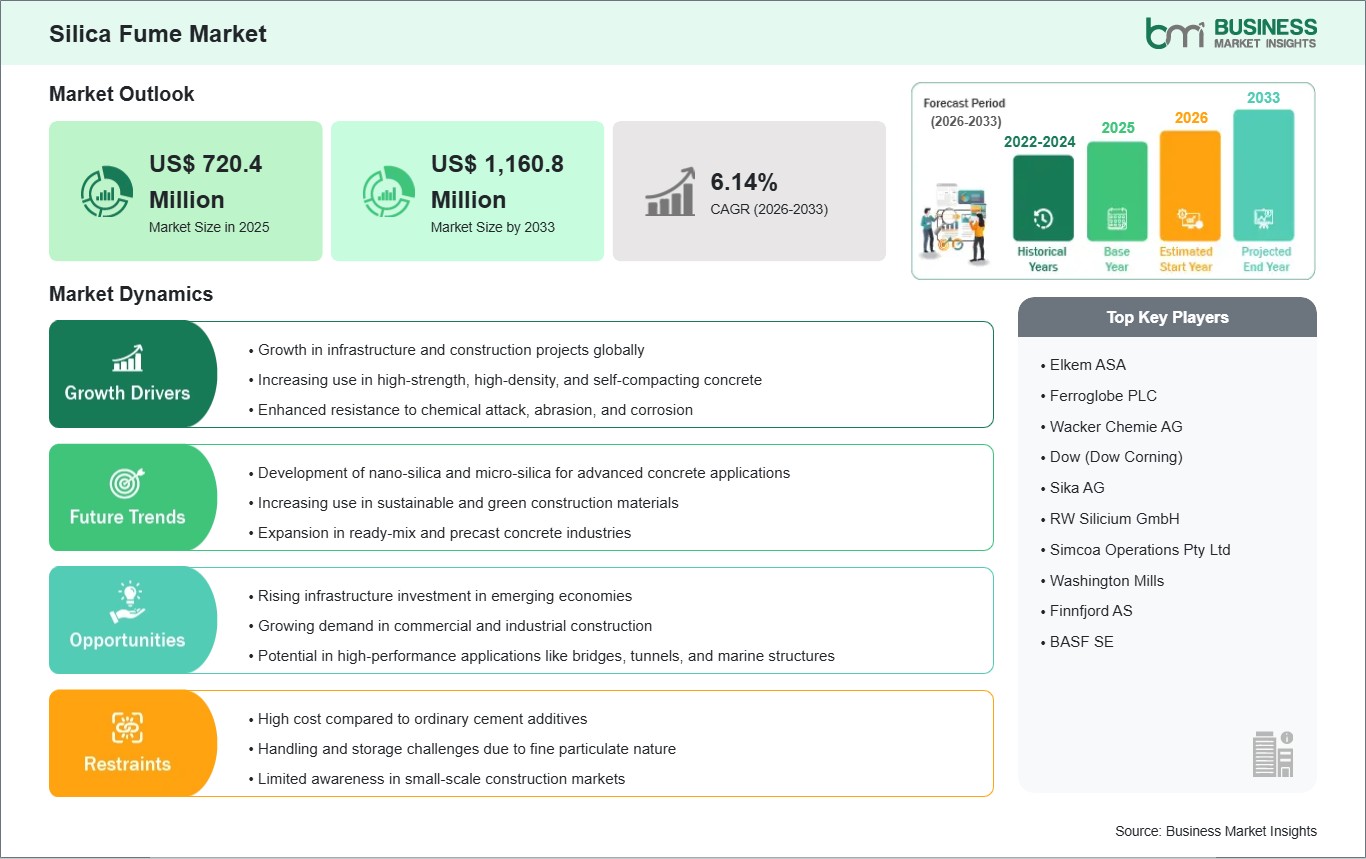
The Silica Fume Market size is expected to reach US$ 1,160.8 million by 2033 from US$ 720.4 million in 2025. The market is estimated to record a CAGR of 6.14% from 2026 to 2033.
The global silica fume market has become a crucial segment in the construction and industrial materials industry due to its ability to enhance concrete performance and durability. Silica fume, a byproduct of silicon and ferrosilicon alloy production, is widely used as a pozzolanic material in high-performance and ultra-high-performance concrete, where it improves compressive strength, reduces permeability, and enhances resistance to chemical attack. The market is primarily driven by the increasing demand for sustainable and long-lasting infrastructure, including bridges, highways, tunnels, and industrial plants, where long-term durability is critical. Additionally, the growth of urbanization and industrial development has expanded opportunities for silica fume applications in precast concrete, shotcrete, and refractory materials.
Environmental benefits, such as the ability to reduce cement usage and lower carbon emissions, further support market adoption. However, the market faces certain restraints, including the handling challenges associated with the ultrafine powder, which requires specialized equipment and safety precautions during transportation and incorporation. Furthermore, the availability of consistent-quality silica fume can be limited by production capacity, potentially impacting supply and project timelines, especially in regions with rapidly growing construction demand.

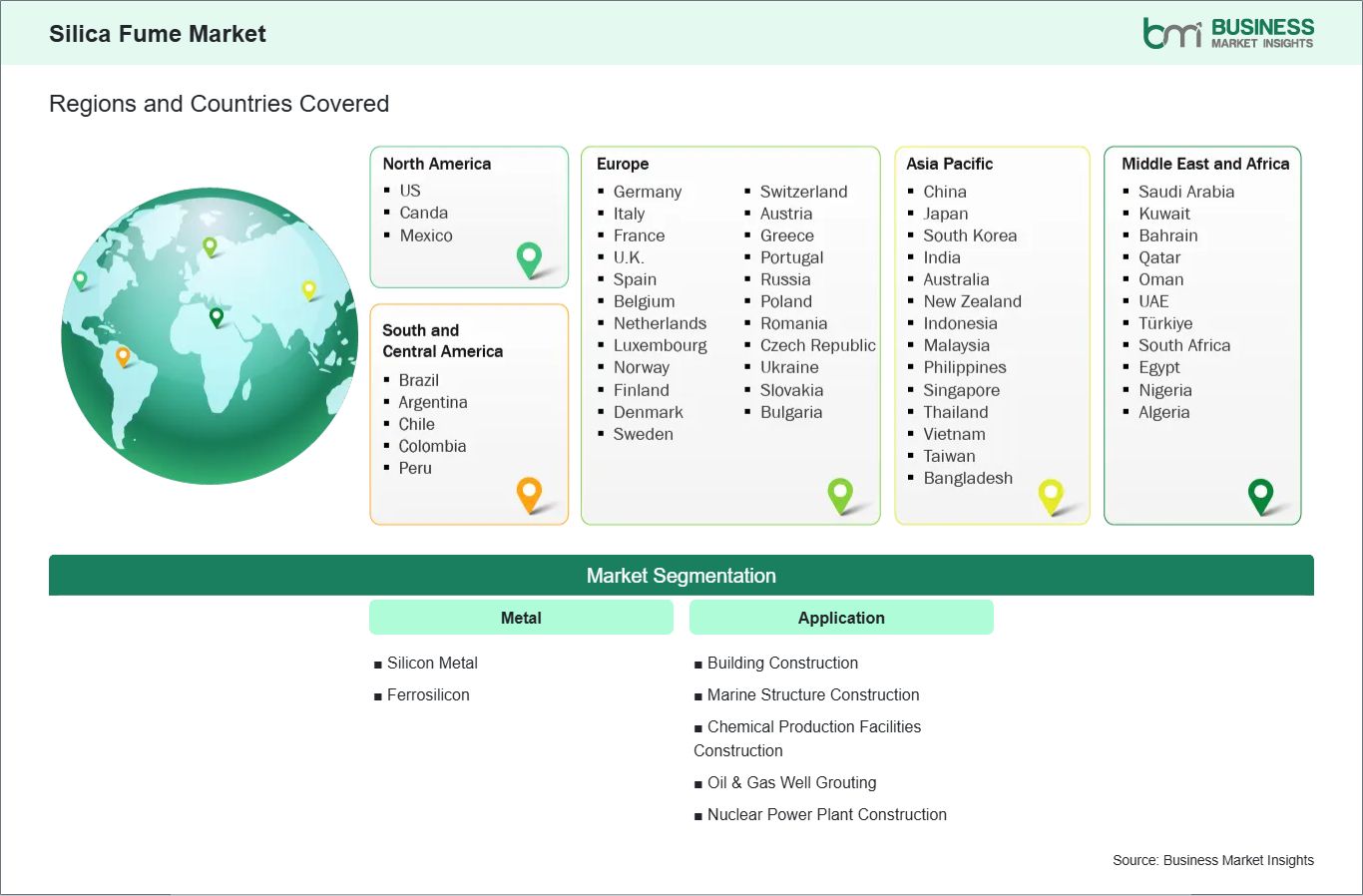
Key segments that contributed to the derivation of the silica fume market analysis are metal and application.
The Western Europe silica fume market is being driven by the region’s ongoing investment in infrastructure and large-scale construction projects. Countries such as Germany, France, and the United Kingdom are expanding transportation networks, including highways, railways, bridges, and tunnels, where silica fume is valued for its ability to enhance concrete strength, durability, and resistance to chemical attack. Its use in high-performance concrete allows engineers to achieve higher compressive and tensile strength, which is critical for long-span bridges, underground structures, and urban infrastructure projects.
Additionally, urban development projects in Western Europe are contributing to silica fume demand growth. Cities in this region, such as Paris, Frankfurt, and Amsterdam, are densely populated, and their infrastructure needs building materials with high bearing capacity, low permeability, and long life expectancy. Silica fume helps in building high-quality concrete with a superior microstructure, which is less porous, more resistant to environmental stresses, and hence a critical material in urban infrastructure development.
Finally, modernization of industrial, port, and water treatment infrastructure is another driver for silica fume demand growth in this region. High-quality, high-performance concrete with silica fume is critical in building structures with high integrity in harsh environments, and its use in sustainable building practices is a testament to its critical role in infrastructure development in this region.
The commercial and industrial construction sectors in Western Europe are further fueling silica fume adoption. Office buildings, shopping complexes, warehouses, and manufacturing plants require concrete with high durability, low shrinkage, and resistance to chemical exposure. Silica fume-enhanced concrete meets these requirements by improving mechanical strength, reducing water permeability, and ensuring long-term performance in heavily trafficked or exposed environments.
The industrial centers in Western Europe, such as the Ruhr area in Germany and northern Italy, are increasingly using silica fume in precast concrete parts, high-rise buildings, and heavy machinery foundations. This is due to its capability to increase workability and strength, thus enabling engineers to meet critical construction deadlines while achieving superior results. Moreover, silica fume is a key material in sustainable building, as it extends building life while limiting the requirement for frequent maintenance and replacement.
Additionally, there are growth prospects in urban growth and renovation activities in London, Madrid, and Lyon, where silica fume is used in high-rise floors, concrete facades, and building columns, where high strength and low permeability are critical. Combined with increased building longevity, resilience, and compliance with EU building standards, silica fume is a key material in commercial and industrial concrete applications, thus positioning Western Europe as a growth market for silica fume in building construction.

The silica fume market is experiencing steady growth, with market size and share analysis reflecting evolving treatment preferences and competitive dynamics among key players. The report evaluates important subsegments categorized within metal and application, highlighting their respective contributions to overall market performance.
By metal, the silicon subsegment dominated the Silica fume market in 2025 because it produced as a by-product of silicon metal production because it yields high-purity, ultra-fine particles ideal for cement and concrete applications. Ferrosilicon can produce silica fume too, but the lower purity and variable particle size make silicon-metal-derived fume the preferred feedstock for high-performance construction and industrial applications.
Based on application, the building construction subsegment dominated the silica fume market in 2025 because the silica fume significantly improves concrete strength, durability, and impermeability, which is critical for urban infrastructure, high-rise buildings, and bridges. Globally growing urbanization and demand for long-lasting, high-performance concrete drive this segment, making it the largest consumer of silica fume.
| Report Attribute | Details |
|---|---|
| Market size in 2025 | US$ 720.4 Million |
| Market Size by 2033 | US$ 1,160.8 Million |
| Global CAGR (2026 - 2033) | 6.14% |
| Historical Data | 2022-2024 |
| Forecast period | 2026-2033 |
| Segments Covered | By Metal
|
|
Regions and Countries Covered
| |
| North America | US, Canada, Mexico |
| Europe | Belgium, Austria, Finland, Denmark, Greece, Poland, Romania, Russia, Ukraine, Czech Republic, Slovakia, Bulgaria, Italy, Luxembourg, Germany, Switzerland, France, Netherlands, Norway, Portugal, Spain, Sweden, United Kingdom |
| Asia-Pacific | Australia, China, India, Japan, South Korea, Indonesia, Malaysia, Philippines, Singapore, Thailand, Vietnam, Bangladesh, New Zealand, Taiwan |
| South and Central America | Brazil, Argentina, Peru, Chile, Colombia |
| Middle East and Africa | Bahrain, Kuwait, Oman, Qatar, Saudi Arabia, United Arab Emirates, Turkiye, South Africa, Egypt, Algeria, Nigeria |
| Market leaders and key company profiles |
|
The "Silica fume market Size and Forecast (2022 - 2033)" report provides a detailed analysis of the market covering below areas:
The geographical scope of the Silica fume market report is divided into five regions: North America, Asia Pacific, Europe, Middle East & Africa, and South & Central America. The Silica fume market in North America is expected to grow during the forecast period.
North America dominates the silica fume market due to its mature construction industry, advanced infrastructure requirements, and stringent durability standards. The region has seen widespread adoption of high-performance and self-consolidating concrete in both commercial and civil infrastructure projects, which heavily rely on silica fume to meet performance specifications. North American construction firms are increasingly focused on sustainability and long-term maintenance reduction, using silica fume to enhance concrete lifespan and reduce repair costs.
Additionally, the region’s industrial sectors, such as oil and gas, power generation, and chemical processing, employ silica fume in refractory applications and high-strength cement formulations. The presence of established silica fume manufacturers, coupled with local production facilities, ensures consistent quality and supply, which is critical for large-scale construction projects. North America also leads in research and development efforts to optimize silica fume use, including innovative blending techniques and hybrid admixtures that improve workability and performance. Despite its dominance, the region faces challenges such as handling safety, higher cost compared to conventional materials, and strict regulatory compliance, which drive ongoing innovation in application techniques and material management.

The silica fume market is evaluated by gathering qualitative and quantitative data post primary and secondary research, which includes important corporate publications, association data, and databases. A few of the key developments in the silica fume market are:
The Silica Fume Market is valued at US$ 720.4 Million in 2025, it is projected to reach US$ 1,160.8 Million by 2033.
As per our report Silica Fume Market, the market size is valued at US$ 720.4 Million in 2025, projecting it to reach US$ 1,160.8 Million by 2033. This translates to a CAGR of approximately 6.14% during the forecast period.
The Silica Fume Market report typically cover these key segments-
The historic period, base year, and forecast period can vary slightly depending on the specific market research report. However, for the Silica Fume Market report:
The Silica Fume Market is populated by several key players, each contributing to its growth and innovation. Some of the major players include:
The Silica Fume Market report is valuable for diverse stakeholders, including:
Essentially, anyone involved in or considering involvement in the Silica Fume Market value chain can benefit from the information contained in a comprehensive market report.
Please tell us your area of interest
(Market Segments/ Regions and Countries/ Companies)