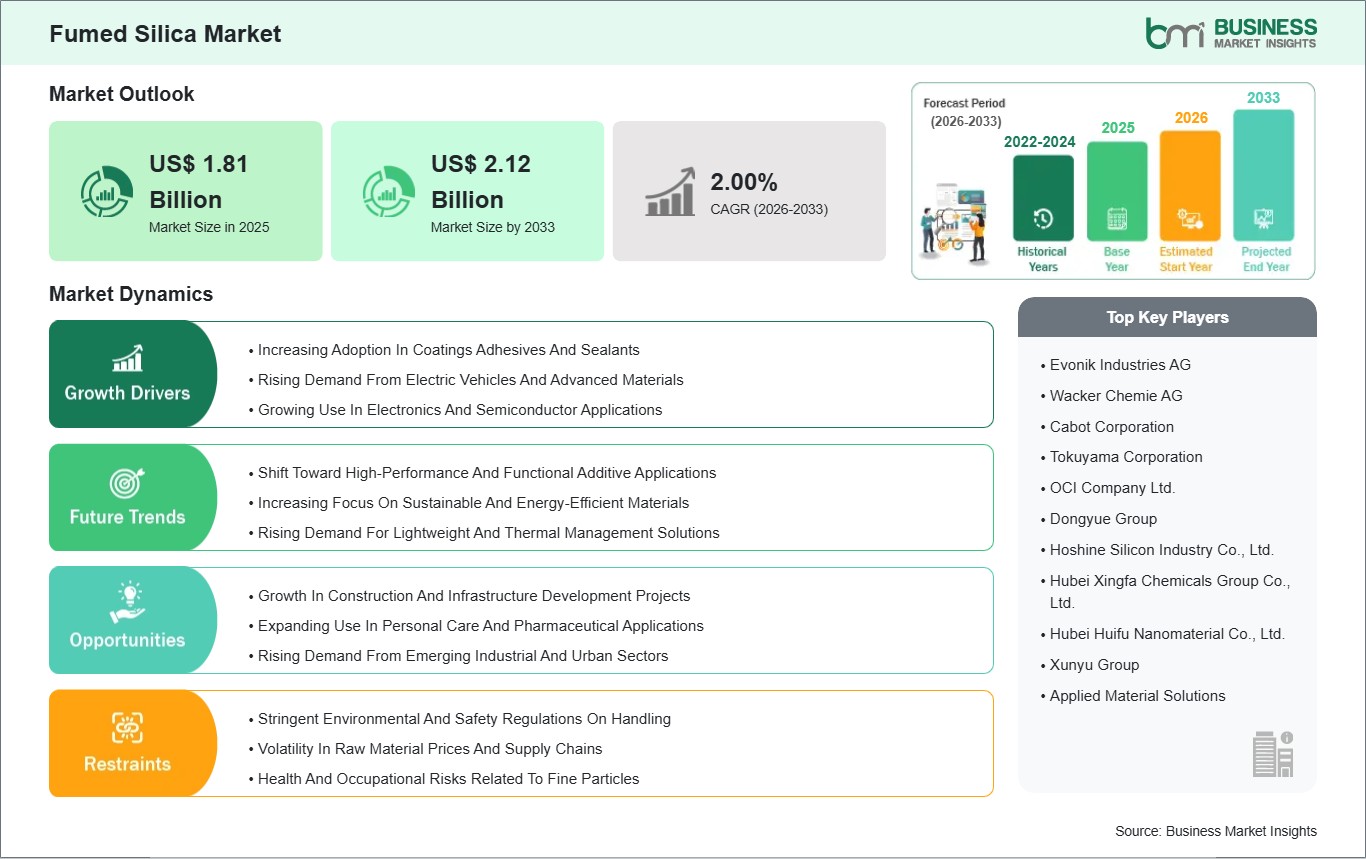
The Fumed Silica Market size is expected to reach US$ 2.12 Billion by 2033 from US$ 1.81 Billion in 2025. The market is estimated to record a CAGR of 2.00% from 2026 to 2033.
The global fumed silica market is one of the most important segments worldwide that produces and uses ultra-fine calcium silicon dioxide particles that are highly porous and possess a variety of unique physicochemical properties. Fumed silica is a versatile material that has been used extensively as an additive to improve the performance of products across many different types of industries, including paints and coatings, adhesives and sealants, silicone elastomers, personal care products, pharmaceutical products, and food processing.
The application of fumed silica in these industries has resulted in increased productivity of the products and improved properties. Fumed silica is an essential component of the formulation of those products because it improves the rheological (flow) properties, prevents the settling of solids, greatly increases the thickening ability of liquids and solids, and reinforces the strength of products that were formulated to be stable and consistent. The primary growth driver of the fumed silica market is the increasing demand for high-performance materials in construction, automotive, and electronic applications, where long-term reliability, precision and efficiency are critical; furthermore, the continued expansion of personal care and health care formulations will also continue to drive the growth of the fumed silica market due to its ability to improve texture and stability within products. Producing fumed silica is a highly energy-intensive process that requires unique infrastructure.
As a result, the manufacturing costs of fumed silica are higher than those of other products, which decreases entry into the market for smaller companies. Likewise, as a result of the fine particulate nature of fumed silica, handling and processing difficulties create the need for additional strict safety measures, which can add to overall operational difficulty. Because of regulations regarding airborne particles and both the environment and personal safety, regulations can also affect the fumed silica industry. Surface treatment technology advancements, as well as a broadening of fumed silica applications in high-value industries, are supporting the continued growth and relevance of the fumed silica market globally.

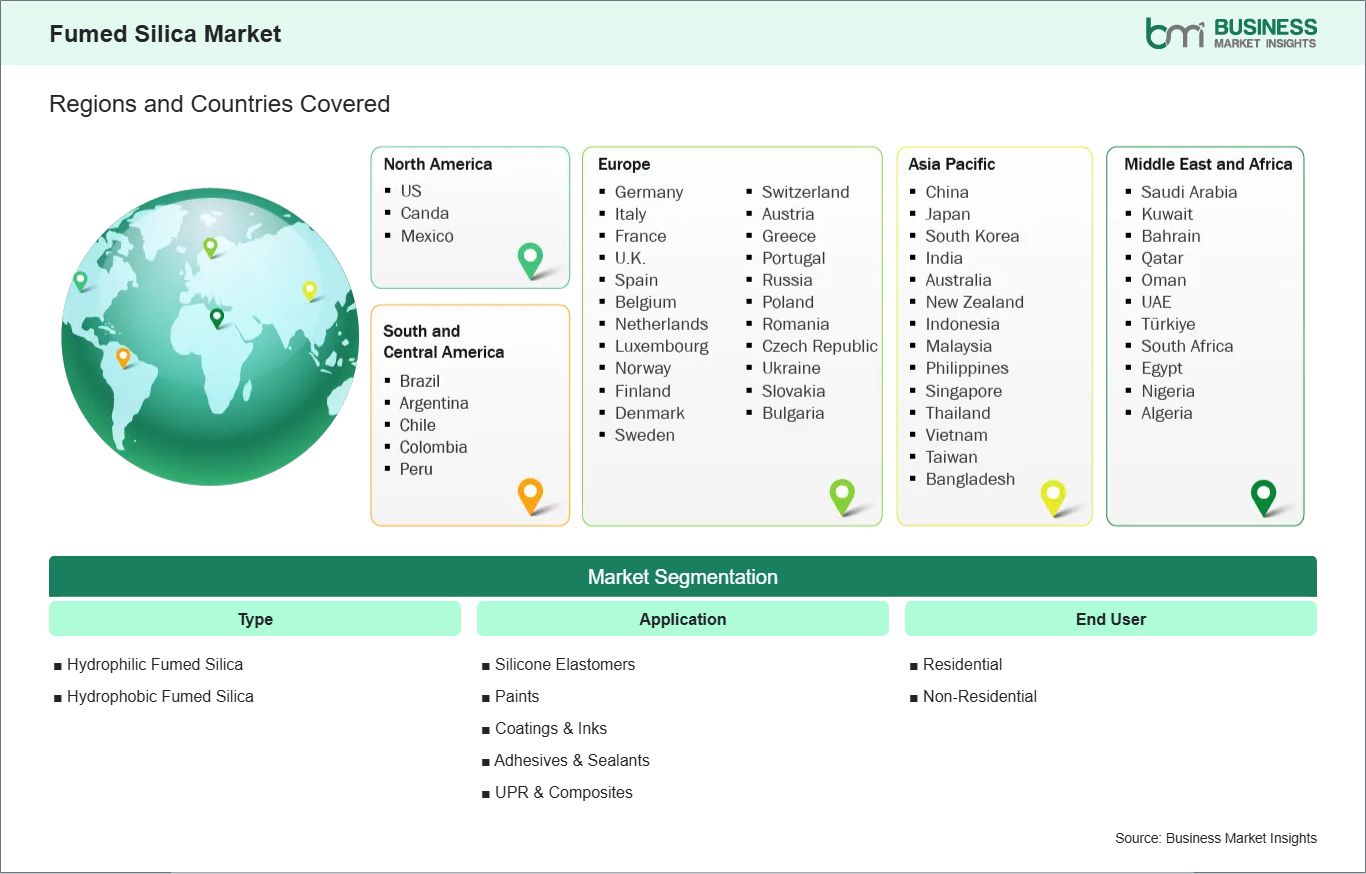
Key segments that contributed to the derivation of the fumed silica market analysis are type, application, and end‑use industry.
The global fumed silica market is experiencing strong growth due to its increasing use as a performance-enhancing additive in coatings, adhesives, and sealants. Fumed silica is valued for its ability to modify rheology, improve viscosity control, and prevent sagging or settling in liquid formulations. In coatings, it enables uniform film formation and enhances scratch resistance, while in adhesives and sealants, it improves bonding strength and stability across varying environmental conditions. Its ultra-fine particle structure allows it to create thixotropic behavior, which is particularly important in applications requiring precise application control, such as vertical coatings or gap-filling sealants.
In highly industrialized regions, fumed silica is widely used in high-performance coatings for automotive finishes, protective industrial layers, and specialty coatings that require durability and consistent surface quality. In regions with expanding manufacturing and packaging sectors, adhesives incorporating fumed silica are used in assembly processes, laminates, and flexible packaging, where controlled flow and strong adhesion are critical. Meanwhile, in regions with strong construction chemical markets, sealants enhanced with fumed silica are applied in glazing, insulation joints, and waterproofing systems to improve long-term stability.
Ongoing innovation is expanding the role of fumed silica in formulation chemistry. Surface-treated variants are being developed to enhance compatibility with different resin systems, allowing manufacturers to fine-tune performance characteristics such as hydrophobicity or dispersion. Additionally, advancements in dispersion technology are enabling easier integration into complex formulations, reducing processing time and improving consistency. As industries demand more precise and reliable material performance, fumed silica continues to play a key role as a multifunctional additive, supporting product quality and formulation efficiency across coatings, adhesives, and sealants applications globally.
The growth of construction and infrastructure projects globally is creating new opportunities for the fumed silica market, particularly in construction chemicals and material formulations. Fumed silica is increasingly used in cementitious systems, grouts, and sealants to improve consistency, prevent segregation, and enhance application control. Its ability to modify flow properties makes it particularly useful in high-performance construction materials where precision and uniformity are required. In addition, it contributes to improved durability and resistance in coatings and protective layers applied to infrastructure components, helping extend service life in demanding environments.
Regional construction trends influence how fumed silica is utilized. In mature infrastructure markets, it is commonly incorporated into repair materials, protective coatings, and sealants used in the rehabilitation of aging structures such as bridges, tunnels, and industrial facilities. In rapidly developing regions, fumed silica is used in new construction projects, including commercial buildings, transport systems, and industrial complexes, where consistent material performance and ease of application are essential. In regions exposed to challenging environmental conditions, such as high humidity or temperature fluctuations, it is used to enhance the stability and reliability of construction materials.
Technological advancements in construction materials are further driving demand for fumed silica. The development of high-performance concrete systems, advanced grouts, and specialized coatings requires additives that can provide precise control over material behavior during application and curing. Fumed silica enables manufacturers to tailor these properties, improving workability and ensuring consistent results across large-scale projects. As construction methods evolve and infrastructure demands become more complex, fumed silica is emerging as a critical additive that supports efficiency, durability, and performance in modern construction and engineering applications worldwide.

The fumed silica market is experiencing steady growth, with market size and share analysis reflecting evolving treatment preferences and competitive dynamics among key players. The report evaluates important subsegments categorized within type, application, and end‑use industry, highlighting their respective contributions to overall market performance.
By type, the hydrophilic fumed silica subsegment dominated the Fumed Silica market in 2025. Hydrophilic fumed silica offers excellent thickening, anti-caking, and reinforcing properties, making it highly suitable for a wide range of industrial applications, which drives its widespread adoption.
Based on application, the silicone elastomers subsegment dominated the Fumed Silica market in 2025. Silicone elastomers require enhanced mechanical strength and viscosity control, making this segment highly suitable for performance-driven applications, which drives its widespread adoption.
In terms of end-use industry, the automotive & transportation subsegment dominated the Fumed Silica market in 2025. Automotive and transportation applications demand high-performance materials with durability and stability, making this segment highly suitable for advanced manufacturing needs, which drives its widespread adoption.
| Report Attribute | Details |
|---|---|
| Market size in 2025 | US$ 1.81 Billion |
| Market Size by 2033 | US$ 2.12 Billion |
| Global CAGR (2026 - 2033) | 2.00% |
| Historical Data | 2022-2024 |
| Forecast period | 2026-2033 |
| Segments Covered | By Type
|
|
Regions and Countries Covered
| |
| North America | US, Canada, Mexico |
| Europe | Belgium, Austria, Finland, Denmark, Greece, Poland, Romania, Russia, Ukraine, Czech Republic, Slovakia, Bulgaria, Italy, Luxembourg, Germany, Switzerland, France, Netherlands, Norway, Portugal, Spain, Sweden, United Kingdom |
| Asia-Pacific | Australia, China, India, Japan, South Korea, Indonesia, Malaysia, Philippines, Singapore, Thailand, Vietnam, Bangladesh, New Zealand, Taiwan |
| South and Central America | Brazil, Argentina, Peru, Chile, Colombia |
| Middle East and Africa | Bahrain, Kuwait, Oman, Qatar, Saudi Arabia, United Arab Emirates, Turkiye, South Africa, Egypt, Algeria, Nigeria |
| Market leaders and key company profiles |
|
The "Fumed Silica Market Size and Forecast (2022 - 2033)" report provides a detailed analysis of the market covering below areas:
The geographical scope of the Fumed Silica market report is divided into five regions: North America, Asia Pacific, Europe, Middle East & Africa, and South & Central America. The Fumed Silica market in North America is expected to grow during the forecast period.
North America dominates the global fumed silica market due to its advanced industrial ecosystem, strong focus on product innovation, and widespread application across diverse end-use sectors. The region`s well-developed construction, automotive, and electronics industries generate consistent demand for high-performance additives that enhance material properties and product reliability. Fumed silica is extensively used in coatings, sealants, and composite materials in North America, where quality standards and performance requirements are particularly stringent. The area is backed by a strong network of specialty chemical companies and research-driven institutions that regularly develop high-performance fumed silica grades tailored to meet specific industrial requirements.
Demand is further supported by North America`s personal care and pharmaceutical sectors, where there is a strong emphasis on product stability, texture, and safety. At the same time, sustainability trends are playing a growing role in shaping innovation, with increased focus on surface-modified and application-focused solutions that boost efficiency while lowering environmental impact. Although challenges like high production expenses, strict regulations, and the careful handling required for fine particles remain, the region continues to distinguish itself. Its commitment to innovation, high-value applications, and stringent quality benchmarks allows North America to retain its leadership in the global fumed silica market, reinforcing its position as a key hub for advanced material development and applications.

The fumed silica market is evaluated by gathering qualitative and quantitative data post primary and secondary research, which includes important corporate publications, association data, and databases. A few of the key developments in the fumed silica market are:
The Fumed Silica Market is valued at US$ 1.81 Billion in 2025, it is projected to reach US$ 2.12 Billion by 2033.
As per our report Fumed Silica Market, the market size is valued at US$ 1.81 Billion in 2025, projecting it to reach US$ 2.12 Billion by 2033. This translates to a CAGR of approximately 2.00% during the forecast period.
The Fumed Silica Market report typically cover these key segments-
The historic period, base year, and forecast period can vary slightly depending on the specific market research report. However, for the Fumed Silica Market report:
The Fumed Silica Market is populated by several key players, each contributing to its growth and innovation. Some of the major players include:
The Fumed Silica Market report is valuable for diverse stakeholders, including:
Essentially, anyone involved in or considering involvement in the Fumed Silica Market value chain can benefit from the information contained in a comprehensive market report.
Please tell us your area of interest
(Market Segments/ Regions and Countries/ Companies)