Market Summary
Executive Summary and Global Market Analysis
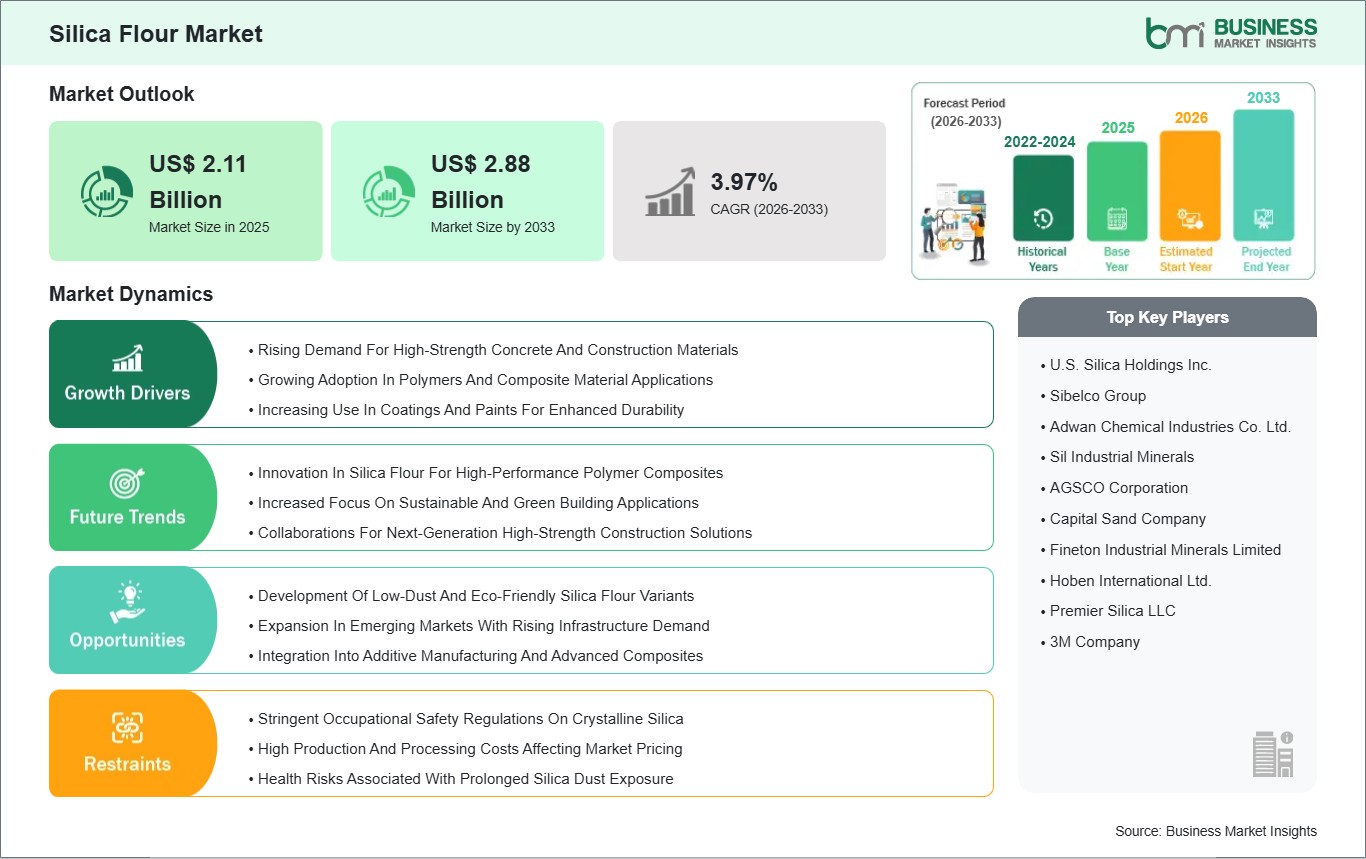
The global silica flour market exists because multiple industrial sectors use the material for its versatile performance capabilities which make it essential for construction and industrial needs as well as polymer and coating production. Silica flour exists as a fine particulate form of crystalline silica which people use to create various products because of its excellent hardness and thermal resistance and chemical inertness. The material functions as a reinforcing filler and a functional extender and a performance enhancer for various uses. The construction and building materials sectors show strong industrial demand because silica flour enhances concrete strength and abrasion resistance and 3dimensional stability. The product serves multiple purposes in paint and coatings formulations by improving mechanical durability and preventing cracking and enhancing weather resistance for exterior finishes.
The plastics and polymers industry serves as the primary driver which controls global demand because silica flour works as a reinforcing filler that improves material performance through better rigidity and thermal properties in composite materials. Silica flour enables precise material property control in emerging applications such as 3D printing and advanced composites because it helps manufacturers develop products that meet specific requirements. The automotive and electronics industries increasingly adopt silica-enriched materials because they need reliable performance and durability in high-temperature and high-stress conditions which makes the material useful across various industries. Environmental and regulatory trends are also shaping market demand. Sustainable building practices create growing interest in mineral additives which provide energy efficiency benefits and structural longevity improvement yet remain free from hazardous chemical constituents.
Silica flour serves as an ideal material because its inert properties and eco-friendly formulation compatibility meet the requirements of green construction and sustainable industrial product specifications. The market experiences strong global momentum yet the market still needs to overcome various obstacles. Multiple regions have implemented regulatory scrutiny because of health and safety concerns that arise from crystalline silica exposure specifically from respirable crystalline silica. Industrial manufacturers need to follow strict workplace safety regulations while they execute dust control systems to protect their workers from exposure hazards which will increase their operational expenses. The supply chain process becomes unpredictable when there are changes in raw material supply and transportation systems which affect specific local markets. The worldwide demand for silica flour remains strong because material processing innovations and new industrial applications emerge across primary end-use sectors.
Segment Analysis
Silica Flour Market Segmentation
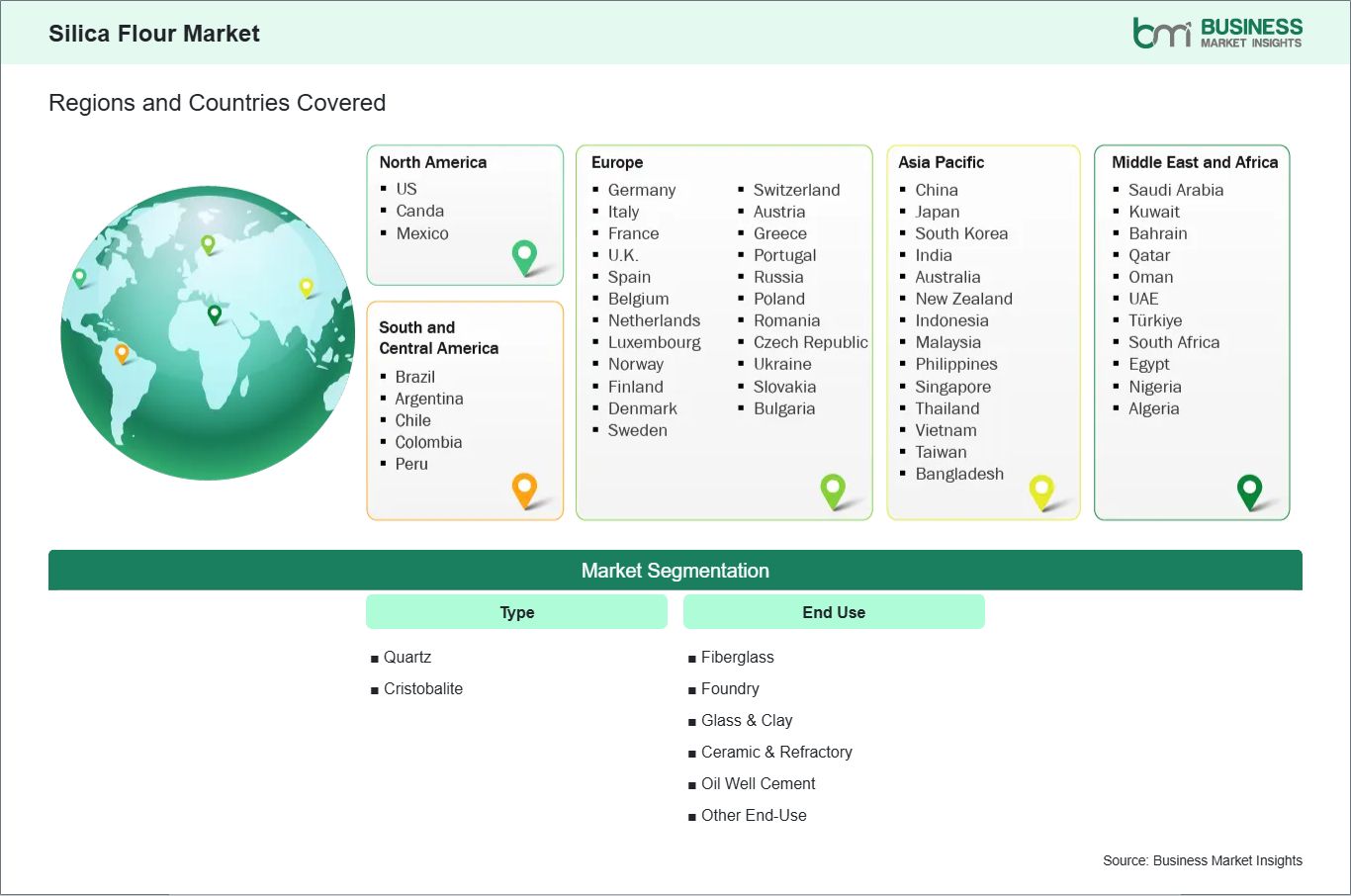
Key segments that contributed to the derivation of the silica flour market analysis are type and end use.
- By type, the silica flour market is segmented into quartz and cristobalite. The quartz segment dominated the market in 2025.
- Based on end use, the silica flour market is categorized into fiberglass, foundry, glass & clay, ceramic & refractory, oil well cement, and other end-use. The fiberglass segment dominated the market in 2025.
Market Forces
Silica Flour Market Drivers and Opportunities
Rising demand for high‑strength concrete and construction materials
The construction industry requires high-strength concrete and durable building materials which drive the global silica flour market according to its current size. The increasing urban development throughout Asia Pacific and Africa creates a higher need for strong infrastructure which includes bridges and tunnels and high-rise buildings thus making silica flour an essential material for bettering concrete strength. The combination of its small particle dimensions and its high crystalline silica content enables the material to deliver better compressive strength and decreased permeability and increased resistance to abrasion which are essential for buildings that experience heavy weight and intense weather conditions. The requirements for high-strength concrete which needs to last long with less need for maintenance have increased because North America and Europe face both infrastructure renovation needs and strict building regulations.
Manufacturers now use silica flour to create specialized cement and mortar mixes which enable them to develop custom concrete solutions for precast concrete and architectural finishes and structural overlays. The applications achieve sustainability targets while reducing lifecycle costs through their ability to minimize shrinkage and boost material strength. The United States and Western European countries constitute important demand drivers because they implement extensive infrastructure modernization projects. Middle Eastern nations use silica flour in their major civil projects which focus on transportation and urban development to develop advanced concrete systems that can resist extreme temperature changes and abrasive environments.
Development of low‑dust and eco‑friendly silica flour variants
t Environmental and health issues drive the global silica flour market to grow because manufacturers create environmentally safe products that produce less dust. North America and Europe implement stricter occupational safety regulations because traditional silica flour handling methods create respiratory hazards through airborne crystalline silica dust. The acquisition of advanced milling and surface treatment technologies enables producers to minimize dust emissions during processing and application while they enhance workplace safety and product performance. Sustainable production methods are becoming more popular because they help with dust control. The Asia Pacific region currently experiences rapid growth in both construction and industrial sectors, which leads manufacturers to create products that use energy-saving production techniques and produce smaller particle sizes for reduced environmental effects.
These technological advancements support the increasing demand for green building certifications and environmentally friendly material standards in markets throughout Australia, China, and Japan. European research projects investigate agricultural and industrial by-product silica flour to create new functional mineral additives that support circular economy goals. The eco-friendly innovations attract interest because they provide environmental compliance and better material performance for coatings and polymers and concrete systems. The market development shows a global trend that combines safer and sustainable methods with high-value applications for silica flour.
Size and Share Analysis
Silica Flour Market Size and Share Analysis
The silica flour market demonstrates steady growth, with size and share analysis highlighting evolving trends and competitive dynamics among key players. The report examines subsegments categorized within type and end use, offering insights into their contribution to overall market performance.
By type, the quartz subsegment dominated the market in 2025, driven by its high purity, excellent thermal stability, and wide application across fiberglass, foundry, and refractory industries.
Based on end use, the fiberglass subsegment dominated the market in 2025, driven by growing demand for lightweight, high-strength materials in construction, automotive, and insulation applications.
Report Coverage
Silica Flour Market Report Coverage and Deliverables
The "Silica Flour Market Size and Forecast (2022 - 2033)" report provides a detailed analysis of the market covering below areas:
- Silica Flour Market size and forecast at global, regional, and country levels for all the key market segments covered under the scope
- Silica Flour Market trends, as well as drivers, restraints, and opportunities
- Silica Flour Market analysis covering key trends, global and regional framework, major players, regulations, and recent developments
- Industry landscape and competition analysis covering market concentration, heat map analysis, prominent players, and recent developments for the Silica Flour Market
- Detailed company profiles, including SWOT analysis
Geographic Insights
Silica Flour Market Geographic Insights
The geographical scope of the Silica Flour Market report is divided into North America, Asia Pacific, Europe, Middle East & Africa, and South & Central America. North America held the largest share in 2025.
The global silica flour market shows different regional market trends because North America leads the market through its established industrial system and developed construction industry and high demand from polymer and coatings and specialized product markets. The United States drives regional consumption with extensive infrastructure projects, high-performance concrete, and a focus on durable, sustainable building materials, where silica flour enhances strength, abrasion resistance, and long-term structural performance.
The fastest-growing market in Asia Pacific develops through urbanization and automotive manufacturing expansion and industrial growth which drives demand for silica-enhanced concrete and coatings and polymer composites. The construction boom together with 3D printing and advanced composite materials establishes Asia Pacific as the main area for market expansion.
Sustainable building material demand together with environmental regulations and sustainability initiatives drives the construction market in Europe which experiences steady growth through its major markets in Germany and France and the UK. Silica flour finds extensive use in low-VOC coatings and eco-friendly composites and high-strength cement applications which support green construction regulations.
The Middle East and Africa region exhibits moderate economic expansion which occurs because three nations, the UAE and Saudi Arabia and South Africa, utilize its infrastructure development and oil and gas initiatives and commercial building activities to meet their need for materials which possess superior durability and chemical resistance and thermal stability.
The South and Central America region experiences growth through its Brazilian and Mexican markets which benefit from rising construction work and automotive manufacturing and industrial production that increasingly uses silica flour to produce high-performance cement and polymer and coating products. All regions show industrial activity that concentrates on sustainable building practices and long-lasting infrastructure development and cutting-edge composite material production which drives worldwide demand for silica flour.
Regional market forces are determined by three factors which include regulatory compliance and safety standards for respirable crystalline silica and supply chain operations. North America maintains its position as the leading market through its market volume and advanced technological capabilities while Asia Pacific and Europe and emerging markets show rapid growth which creates a market that serves global applications.
Industry Activity
Recent Developments
The Silica Flour Market is evaluated by gathering qualitative and quantitative data post primary and secondary research, which includes important corporate publications, association data, and databases. A few of the key developments in the silica flour market are:
- In January 2024, Evonik Industries AG announced that it has expanded production of precipitated silica at its Charleston, South Carolina site by adding a new production line to meet increased silica demand from the tire, oral care, and other industries, strengthening local supply chains and sustainability performance.
- In October 2023, SCR‑Sibelco NV announced that it completed its second tranche investment into its joint venture with Diatreme Resources, increasing its joint venture interest to support development of high‑purity silica sand projects in Far North Queensland, Australia.
Trust & Transparency
Research Methodology
The market analysis combines proprietary research with secondary data from government agencies, company disclosures, regulatory filings, industry databases and expert interviews. Market estimates are validated through data triangulation, cross-market benchmarking and analyst
review.
View Full Research Methodology
Key Sources Referred:
World Health Organization (WHO) Organisation for Economic Cooperation and Development (OECD) The World Bank Group Worldometer The Lancet International Bar Association International Trade Administration