Market Summary
Executive Summary and Global Market Analysis
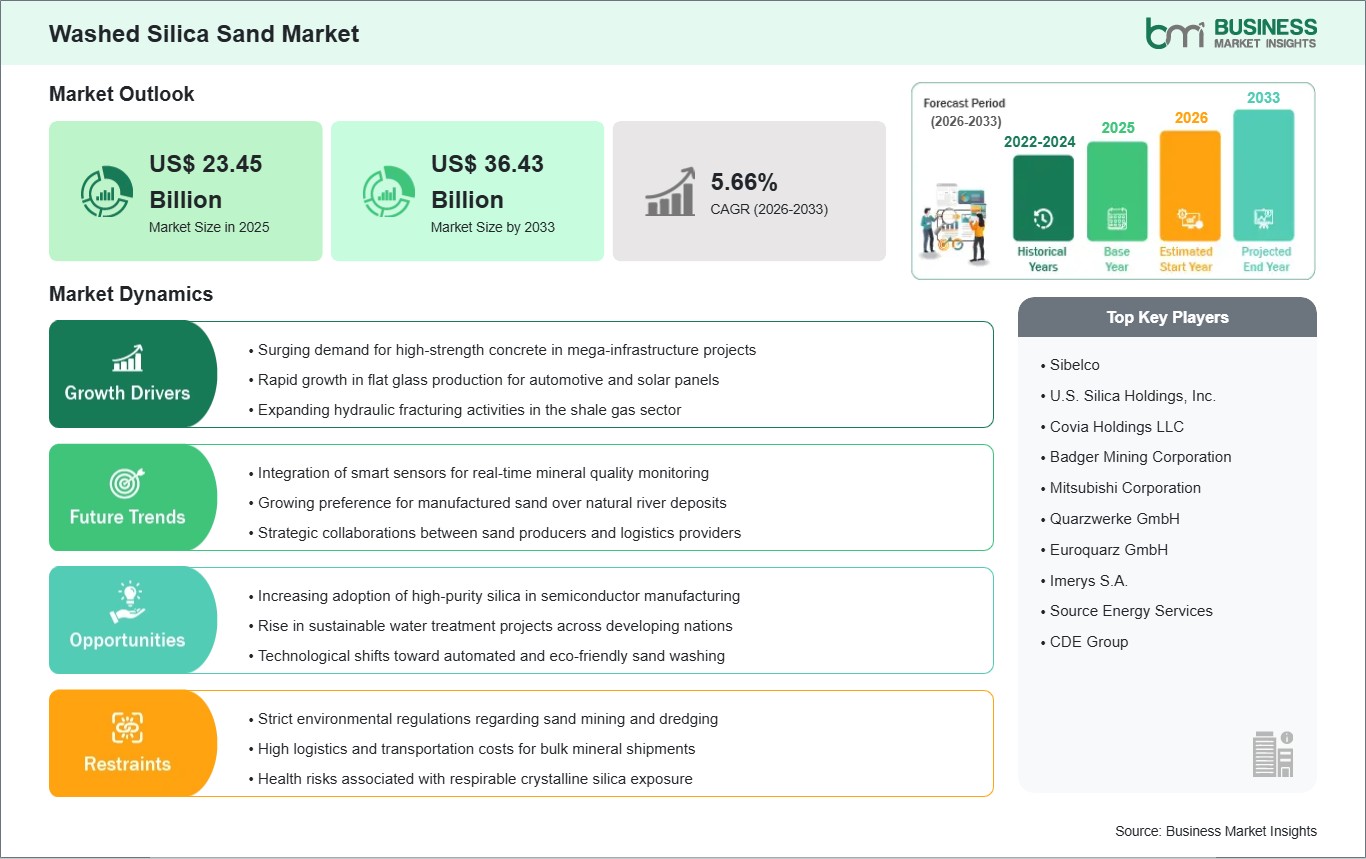
The washed silica sand market is presently undergoing a major transformation owing to the dual pressures of global urbanization and the high-tech industrial revolution. As it is an essential component for glass, concrete, and castings, washed silica sand is an essential part of the modern global economy. The market has now gone beyond just extraction, with an increasing focus on advanced processing methods for ensuring uniformity in particles and purity in chemical composition. The driving forces behind this phenomenon include the construction and glass manufacturing industries, which account for an enormous share of global demand. The focus on sustainability in mining operations is another factor.
Besides these conventional applications, new vectors for growth are being created in the energy and electronics industries. For instance, the growth of hydraulic fracturing in North America and the global drive for solar energy infrastructure have created a strong need for specialized sands. Despite challenges posed by stringent labor safety regulations and escalating logistical costs, innovation in washing technology is ensuring that producers remain profitable. In the future, this market is expected to experience growth as industrial customers become more inclined to using high-quality, processed minerals rather than their raw counterparts to ensure product performance and reliability.
Segment Analysis
Washed Silica Sand Market Segmentation
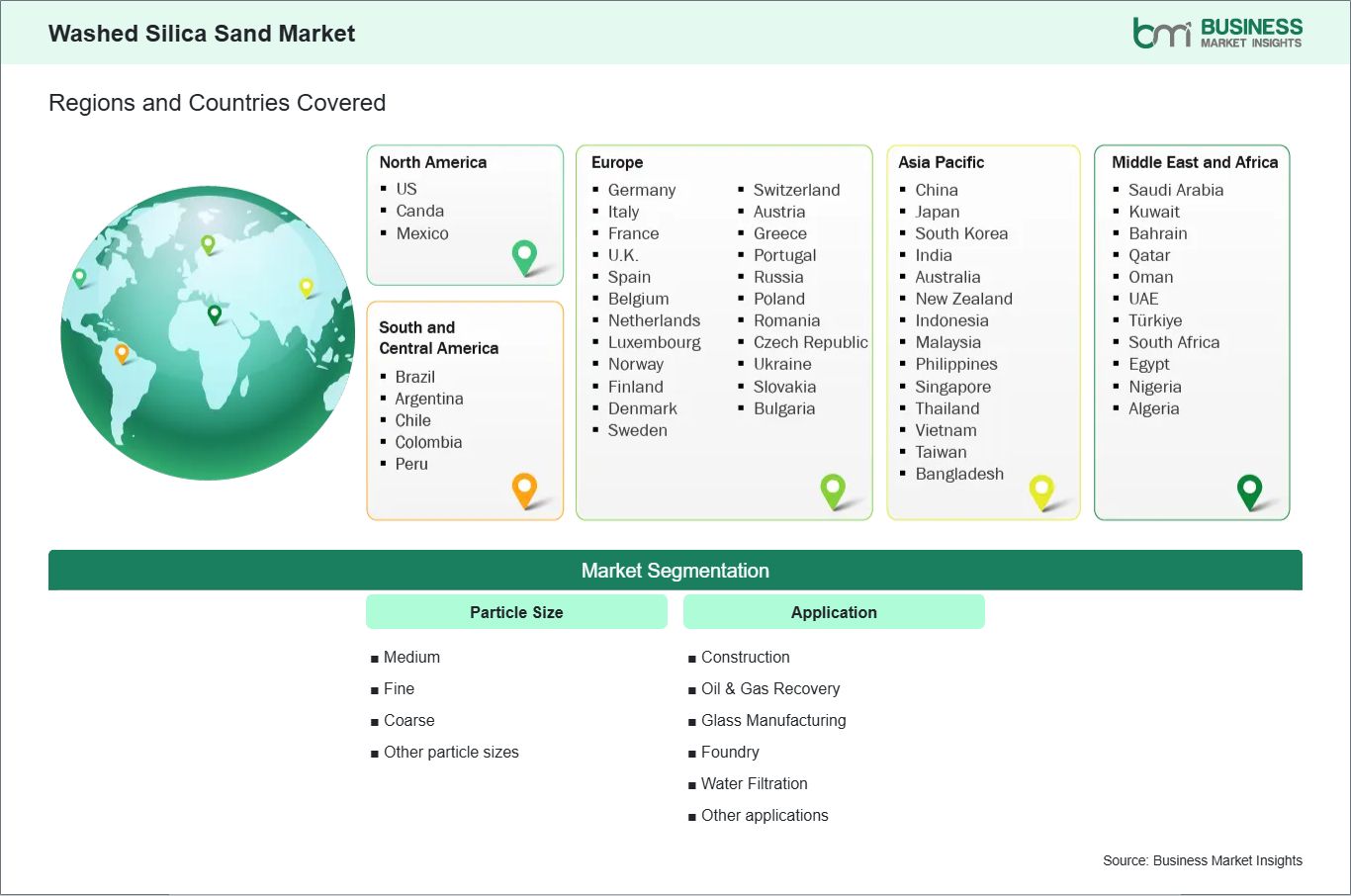
Key segments that contributed to the derivation of the Washed Silica Sand market analysis are particle size and application.
- By particle size, the washed silica sand market is segmented into Medium, Fine, Coarse, and Other particle sizes. The Medium segment dominated the market in 2025.
- By application, the washed silica sand market is segmented into Construction, Oil & Gas Recovery, Glass Manufacturing, Foundry, Water Filtration, and Other applications. The Construction segment dominated the market in 2025.
Market Forces
Washed Silica Sand Market Drivers and Opportunities
Surging demand for high-strength concrete in mega-infrastructure projects
The construction industry serves as the primary engine for the washed silica sand market, specifically through the escalating need for high-performance concrete. Modern engineering feats, such as skyscrapers, bridges, and smart-city developments, require concrete with superior durability and compression strength. Unlike raw pit sand, washed silica sand is processed to remove impurities like clay, silt, and organic matter that can weaken the chemical bond in cement. This purity is essential for ensuring the structural longevity of large-scale assets, particularly in coastal or high-moisture environments where mineral consistency prevents premature degradation and cracking.
Furthermore, the rise in prefabricated construction modules and specialized masonry products has heightened the requirement for graded and washed sand. These manufacturing processes rely on tight particle size distributions to maintain aesthetic and functional uniformity. As government-backed infrastructure bills continue to launch across North America and Asia, the volume of washed silica sand required for high-grade mortar, grouts, and asphalt mixtures is reaching unprecedented levels. This sustained demand from the heavy construction sector provides a stable foundation for the market, as builders prioritize material quality to meet rigorous modern safety and performance standards.
Increasing adoption of high-purity silica in semiconductor manufacturing
The rapid expansion of the digital economy has opened a lucrative avenue for high-purity washed silica sand within the electronics and semiconductor industries. Silica is a fundamental precursor for silicon wafers and various electronic components that power everything from smartphones to advanced artificial intelligence servers. While this application requires ultra-high purity levels often exceeding 99 percent silicon dioxide, the initial washing and refining stages of high-grade silica sand deposits are the critical starting point. As global chip manufacturers diversify their supply chains and build new fabrication plants, the demand for premium-grade silica feedstock has grown significantly.
This opportunity is further amplified by the global transition toward renewable energy, specifically the production of photovoltaic solar cells. Solar panels require high-clarity glass and specialized silicon components, both of which are heavily dependent on the quality of the refined silica sand used in the melt. By investing in advanced attrition scrubbing and acid leaching technologies, silica producers can move up the value chain from basic construction aggregates to high-tech industrial fillers. This shift allows companies to capture higher margins and insulate themselves from the price volatility often found in the more commodity-driven segments of the market.
Size and Share Analysis
Washed Silica Sand Market Size and Share Analysis
The global Washed Silica Sand market is experiencing steady growth, with market size and share analysis reflecting evolving treatment preferences and competitive dynamics among key players. The report evaluates important subsegments categorized within particle size and application highlighting their respective contributions to overall market performance.
By particle size, the Medium subsegment dominated the market in 2025 due to its extreme versatility across a broad range of industrial requirements. Its optimal balance of flowability and structural integrity makes it the standard choice for most concrete mixes, industrial mortars, and standard foundry applications.
By application, the Construction subsegment dominated the market in 2025 because of the global surge in urbanization and infrastructure development. The high demand for reliable, contaminant-free sand for high-strength concrete, specialized grouts, and flooring systems ensures that this sector consumes the largest volume of processed silica.
Report Coverage
Washed Silica Sand Market Report Coverage and Deliverables
The "Washed Silica Sand Market Size and Forecast (2022 - 2033)" report provides a detailed analysis of the market covering below areas:
- Washed Silica Sand market size and forecast at the regional and country levels for segments covered under the scope
- Washed Silica Sand market trends, as well as drivers, restraints, and opportunities
- Washed Silica Sand market analysis covering key trends, regional framework, major players, regulations, and recent developments
- Industry landscape and competition analysis covering market concentration, heat map analysis, prominent players, and recent developments for the Washed Silica Sand market
- Detailed company profiles, including SWOT analysis
Geographic Insights
Washed Silica Sand Market Geographic Insights
The geographical scope of the Washed Silica Sand market report is divided into: North America, Asia Pacific, Europe, Middle East & Africa, and South & Central America. North America held the largest share in 2025.
North America maintains a commanding position in the washed silica sand market, primarily fueled by the intensive industrial landscape of the United States. The region benefits from vast, high-quality silica deposits, particularly in the Midwest, which provide a reliable source of raw material for diverse applications. The dominance is largely attributed to the robust oil and gas sector, where washed silica sand is a critical proppant for hydraulic fracturing operations in shale basins. Unlike other regions, North America has a highly integrated supply chain that links mining sites directly to major industrial hubs via advanced rail and trucking networks, allowing for the efficient movement of bulk minerals across the continent.
Beyond energy, the North American construction and glass industries contribute significantly to the regional market share. The ongoing renewal of aging public infrastructure and the high demand for specialty glass in the automotive and pharmaceutical sectors necessitate a constant supply of premium washed sand. Regional market players are also leading the way in adopting automated washing and classification technologies to comply with strict environmental and occupational health standards, such as those set by OSHA regarding silica dust. This proactive regulatory environment, combined with a steady stream of capital investment in new processing facilities, ensures that North America remains the most influential and technologically advanced region in the global market.
Industry Activity
Recent Developments
The Washed Silica Sand market is evaluated by gathering qualitative and quantitative data post primary and secondary research, which includes important corporate publications, association data, and databases. A few of the key developments in the Washed Silica Sand market are:
- In 2025, Covia Holdings LLC, announced strategic initiatives to consolidate its market presence, including mergers and ESG-focused operational enhancements to strengthen its silica sand portfolio and sustainability positioning.
- In August 2024, VRX Silica Limited, announced ongoing development activities and project advancements for its silica sand projects in Australia, aimed at supplying high-quality washed silica sand to Asian markets.
- In 2024, SCR-Sibelco NV, announced continued expansion of its silica sand processing capabilities, focusing on advanced washing and purification technologies to meet rising demand for high-purity applications such as glass and electronics.
Trust & Transparency
Research Methodology
The market analysis combines proprietary research with secondary data from government agencies, company disclosures, regulatory filings, industry databases and expert interviews. Market estimates are validated through data triangulation, cross-market benchmarking and analyst
review.
View Full Research Methodology
Key Sources Referred:
American Chemistry Council (ACC)International Council of Chemical Associations (ICCA)European Chemical Industry Council (Cefic)China National Building Materials Group (CNBM)Indian Minerals & Granite Exporters Association (IMGEA)Japan Mining Industry Association (JMIA)Brazilian Mining Association (IBRAM)Gulf Petrochemicals and Chemicals Association (GPCA)Company Annual ReportsCompany Investor Presentations