
Real and Compound Chocolate Market Outlook: Size, Share, Trends, Growth Analysis, Competitive Landscape & Forecast, 2022-2033

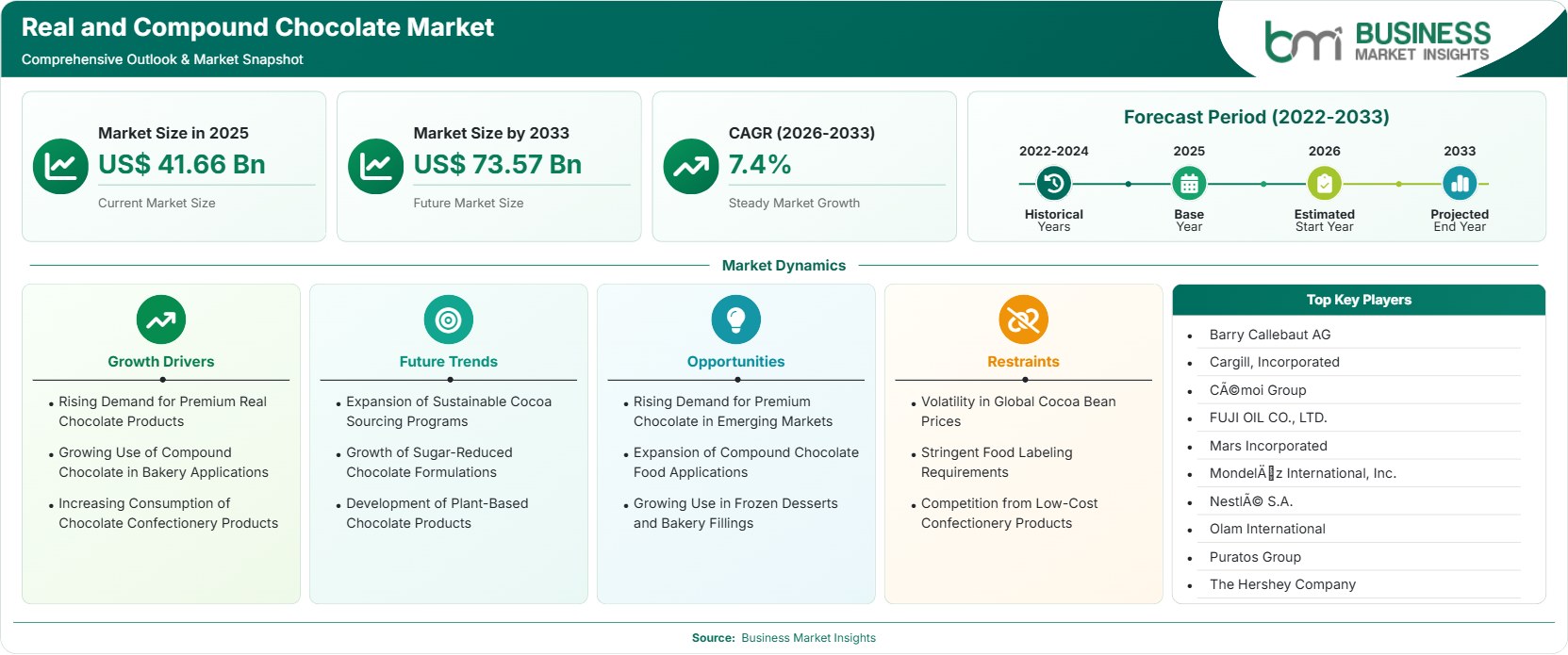
The Real and Compound Chocolate Market size was valued at US$ 41.66 Billion in 2025 and is projected to reach US$ 73.57 Billion by 2033, growing at a CAGR of 7.37% during 2026–2033. Rising preference for high-end confections, expansion of applications in baking and desserts, rising chocolate consumption in developing countries, and product innovation have become major factors driving market growth. The increasing adoption of sustainable cocoa sourcing and clean-label formulations is opening new avenues in the global food industry.

Report Coverage
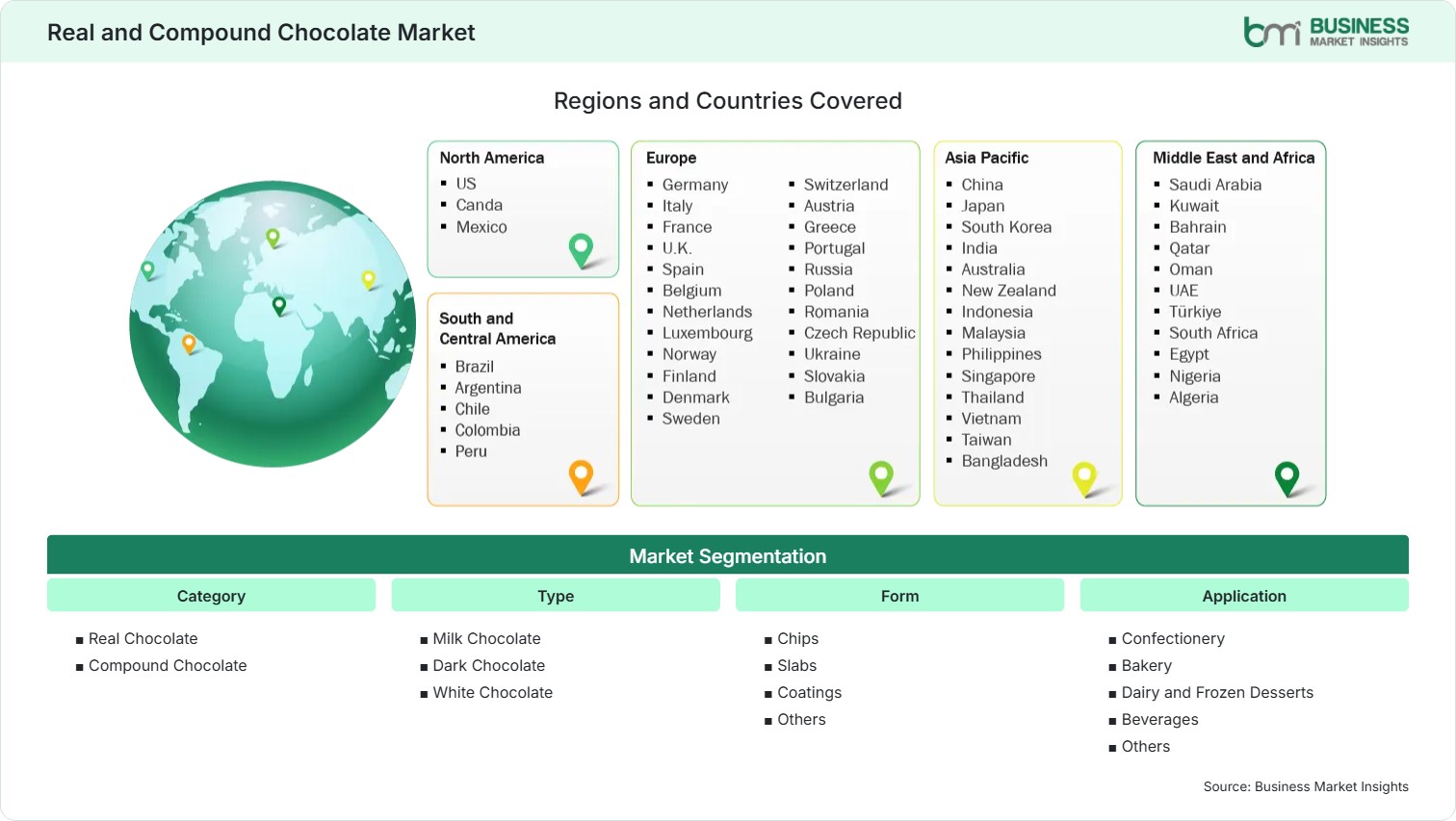
  • Category: Real Chocolate, Compound Chocolate
  • Type: Milk Chocolate, Dark Chocolate, White Chocolate
  • Form: Chips, Slabs, Coatings, Others
  • Application: Confectionery, Bakery, Dairy and Frozen Desserts, Beverages, Others
US$ 41.66 Bn Market size in 2025
US$ 73.57 Bn Market Size by 2033
7.4% CAGR, 2026 - 2033
2026-2033 Forecast Period

01 AI Overview

Real and Compound Chocolate Market Summary

  • North America Region: This region holds a real and compound chocolate market share of 27–30% in 2025 and is projected to grow at a CAGR of 6.8–7.2% during 2026–2033. Premium confectionery demand, product innovation, and expanding bakery applications continue supporting market growth. The U.S. market accounts for 22–25% of the global market and is expected to grow at a CAGR of 6.9–7.3%, supported by rising premium chocolate consumption and new product launches.
  • Fastest Growing Region: Asia Pacific accounts for 30–33% of the global market in 2025 and is projected to register the fastest CAGR of 8.1–8.5% during the forecast period. Rising disposable incomes, westernized food preferences, and expanding retail distribution continue driving chocolate consumption across the region.
  • Leading Segment: Real Chocolate holds 61–64% of the market in 2025 and is anticipated to grow at a CAGR of 7.5–7.9%. Increasing demand for premium products, authentic cocoa content, and clean-label ingredients continues supporting segment leadership.
  • High Growth Segment: Bakery accounts for 27–30% of the market in 2025 and is expected to register a CAGR of 8.2–8.6% through 2033. Rising demand for premium baked products and artisanal desserts continues accelerating chocolate ingredient consumption.
  • Key Market Opportunity: Expanding premium chocolate consumption, sustainable cocoa sourcing initiatives, and innovative chocolate formulations are creating attractive opportunities for manufacturers serving confectionery, bakery, and foodservice industries.
  • Major Market Players: Barry Callebaut AG, Cargill, Incorporated, Cémoi Group, FUJI OIL CO., LTD., Mars Incorporated, Mondelēz International, Inc., Nestlé S.A., Olam International, Puratos Group, and The Hershey Company.
02 Strategic Insights

Real and Compound Chocolate Market: Strategic Insights

real-and-compound-chocolate-market-market-strategic-framework
FREE PDF
Request your free sample
Request free sample
03 Stakeholder View

Key Takeaways

  • The market ecosystem includes cocoa growers, ingredient processors, chocolate manufacturers, food processors, distributors, retailers, and food service providers.
  • Growth prospects for premium chocolate and industrial bakery are promising since consumers are becoming more particular about the quality of their ingredients.
  • Innovations include sustainability of cocoa, reduced sugar content, functional chocolate products, use of plant based ingredients, and improvements in processing techniques..
  • Asia Pacific offers the strongest investment potential owing to rising disposable incomes, expanding organized retail, growing bakery industries, and increasing consumer preference for premium chocolate products.
  • The real and compound chocolate market forecast suggest that the strategic acquisitions, capacity expansions, and long-term cocoa sourcing partnerships continue helping manufacturers secure raw material availability and strengthen global market positions.
  • Growing demand for customized chocolate solutions across bakery, dairy, beverages, and confectionery applications is encouraging investments in flexible manufacturing capabilities.
04 Geographic Outlook

Real and Compound Chocolate Market Regional Highlights

North America Real and Compound Chocolate Market

North America accounted for 27–30% of the global Real and Compound Chocolate Market share in 2025 and is projected to grow at a CAGR of 6.8–7.2% through 2033. Strong consumer demand for premium chocolates, expanding bakery applications, and continuous product innovation continue supporting regional growth. Manufacturers are introducing healthier formulations and sustainably sourced chocolate products to address evolving consumer preferences.

  • The need for premium and artisan chocolates is growing, making companies invest more in producing more products.
  • There is continuous investment in sustainability of raw materials used in production of chocolate.
  • There is an increasing need for chocolate inclusion and coating, leading to expansion in bakery and frozen desserts.
  • Automation and technological advancements in processing help make the process easier.

US Real and Compound Chocolate Market

The United States accounts for 22–25% of the global market and is projected to register a CAGR of 6.9–7.3% during the forecast period. Premium confectionery demand, seasonal chocolate consumption, and continuous product innovation continue supporting market expansion. Strong retail distribution and increasing consumer preference for premium ingredients further strengthen industry growth.

  • Premium and organic chocolate launches continue expanding product offerings across supermarkets and specialty retail stores.
  • Bakery manufacturers increasingly utilize high-quality chocolate ingredients for premium baked products and desserts.
  • Consumer demand for reduced-sugar and functional chocolates continues encouraging product innovation.
  • Investments in domestic manufacturing improve supply chain resilience and production flexibility.

Europe Real and Compound Chocolate Market

Europe held 32–35% of the global market in 2025 and is expected to grow at a CAGR of 7.0–7.4% through 2033. Strong chocolate manufacturing heritage, premium product demand, and sustainability initiatives continue supporting regional leadership. Established confectionery manufacturers remain focused on innovation, premiumization, and responsible cocoa sourcing.

  • Germany remains the leading regional market with a CAGR of 6.9–7.3%, supported by strong confectionery manufacturing and exports.
  • Poland is projected to register the fastest growth at a CAGR of 7.7–8.1%, driven by expanding food processing and confectionery production.
  • Premium and single-origin chocolate demand continues supporting higher-value product development.
  • Sustainability certifications continue influencing purchasing decisions across industrial and retail customers.
  • Manufacturers are investing in energy-efficient production technologies and responsible sourcing programs.

Asia Pacific Real and Compound Chocolate Market

Asia Pacific represented 30–33% of the global market in 2025 and is projected to record the fastest CAGR of 8.1–8.5% through 2033. Rising disposable incomes, urbanization, western dietary influences, and rapid expansion of bakery and confectionery industries continue supporting regional growth. International manufacturers are expanding production and distribution networks to meet increasing consumer demand.

  • China leads regional consumption while growing at a CAGR of 8.0–8.4%, supported by premium chocolate demand and retail expansion.
  • India is expected to witness the fastest regional growth with a CAGR of 8.7–9.1%, driven by rising disposable income and expanding organized retail.
  • Growing café culture continues increasing chocolate usage across beverages and desserts.
  • E-commerce channels improve accessibility to premium domestic and imported chocolate products.
  • Manufacturers continue expanding localized production to serve rising regional demand efficiently.

Rest of World Real and Compound Chocolate Market

The Rest of World accounted for 8–10% of the global market in 2025 and is projected to expand at a CAGR of 7.2–7.6% during the forecast period. Growing urbanization, expanding retail infrastructure, and increasing demand for premium confectionery continue supporting market development across South & Central America and the Middle East & Africa.

  • Brazil remains the leading regional market with a CAGR of 7.3–7.7%, supported by strong confectionery production and domestic chocolate consumption.
  • Saudi Arabia is projected to register the fastest growth with a CAGR of 7.8–8.2%, driven by premium food consumption and expanding retail investments.
  • Premium gifting culture continues increasing chocolate sales across key regional markets.
  • International manufacturers continue strengthening regional distribution partnerships and local production capabilities.
  • Growing tourism and hospitality sectors support increasing chocolate demand across foodservice applications.
global-market-geography
FREE PDF
Request your free sample
Request free sample
05 Segment Analysis

Real and Compound Chocolate Market Segmentation

Category

The Category segment differentiates products based on cocoa composition, manufacturing processes, and end-use applications. Real Chocolate accounted for 61–64% of the market in 2025 and is projected to grow at a CAGR of 7.5–7.9% through 2033. Demand for authentic cocoa flavor, premium confectionery, and clean-label products continues driving adoption. The market size continues expanding with innovation across premium and industrial applications.

  • Real Chocolate: Manufactured using cocoa butter, real chocolate remains the preferred choice for premium confectionery, bakery, and gourmet applications due to its superior taste, texture, and consumer perception.
  • Compound Chocolate: Produced using vegetable fats instead of cocoa butter, compound chocolate offers cost efficiency, improved heat resistance, and excellent processing characteristics for industrial food manufacturing.

Type

Product type influences flavor profile, consumer preference, and application diversity across confectionery and food processing industries. Milk Chocolate held the largest share of 46–49% in 2025 and is anticipated to register a CAGR of 7.3–7.7% through 2033. Growing premiumization and product diversification continue shaping Real and Compound Chocolate Market trends across global retail and industrial sectors.

  • Milk Chocolate: Widely consumed across confectionery, bakery, and gifting applications due to its balanced sweetness, creamy texture, and broad consumer acceptance.
  • Dark Chocolate: Demand continues increasing because of its higher cocoa content, premium positioning, and growing consumer preference for products associated with wellness and reduced sugar intake.
  • White Chocolate: Popular across bakery, confectionery, and dessert applications, white chocolate supports product innovation through flavor combinations and decorative applications.

Form

The Form segment reflects the processing requirements of industrial food manufacturers and artisanal producers. Coatings accounted for 35–38% of the market in 2025 and are projected to grow at a CAGR of 7.6–8.0% through 2033. Increasing production of confectionery, bakery, and frozen desserts continues supporting demand for versatile chocolate coating solutions.

  • Chips: Extensively used in cookies, muffins, cakes, and desserts, chocolate chips offer convenient processing and consistent product quality across industrial and commercial bakeries.
  • Slabs: Preferred by confectionery manufacturers and chocolatiers for molding, shaping, and customized product development across premium chocolate applications.
  • Coatings: Widely utilized for enrobing bakery products, confectionery, frozen desserts, and snack items while providing visual appeal and product protection.

Application

Application remains the primary demand driver for chocolate ingredients across multiple food industries. Confectionery represented 39–42% of the market in 2025 and is expected to register a CAGR of 7.4–7.8% during the forecast period. Product innovation, premium gifting, and expanding seasonal consumption continue strengthening chocolate demand across developed and emerging markets.

  • Confectionery: The largest application driven by continuous product launches, premium gifting trends, and strong consumer demand for chocolate bars, pralines, and filled confectionery products.
  • Bakery: Chocolate ingredients are increasingly incorporated into cakes, pastries, cookies, muffins, and artisan baked goods to enhance flavor, texture, and visual appeal.
  • Dairy and Frozen Desserts: Ice creams, flavored milk, yogurts, and frozen desserts increasingly utilize chocolate ingredients to diversify product portfolios and meet changing consumer preferences.
  • Beverages: Rising café culture and premium beverage consumption continue driving demand for chocolate syrups, powders, and specialty beverage formulations.
06 Market Forces

Real and Compound Chocolate Market Dynamics

Key Market Drivers

Rising Demand for Premium Real Chocolate Products

The consumer’s preferences for chocolates have been continuously evolving towards the consumption of high-quality products that are manufactured with higher content of cocoa, natural components, and sustainable sources of cocoa. With disposable incomes increasing and a continuous need for artisanal chocolates and clean-label products, manufacturers are constantly being encouraged to develop their product range. The efforts in ethical sourcing of cocoa, product differentiation, and creation of new flavors further enhance consumers’ trust.

Growing Use of Compound Chocolate in Bakery Applications

The reason why the use of compound chocolate is growing in the bakery industry is that it is efficient in terms of cost, workable, and more stable when processed under different conditions. Compound chocolate provides consistency in quality without relying on cocoa butter and is appropriate for coatings, filling, decorations, and molded bakery products. The increased manufacture of bakery products in industries and innovations in food products is promoting the use of compound chocolate.

Increasing Consumption of Seasonal Chocolate Confectionery Products

Celebrations of different seasons and the practice of giving gifts still play an important role in creating demand for chocolate products. Every year, the chocolate industry develops special editions of its products and unique packaging, trying to take advantage of various holidays and events. Increased sales promotion, development of online sales channels, and increased expenditure by consumers on gifting products support greater consumption of chocolates.

Key Market Opportunities

Rising Demand for Premium Chocolate in Emerging Markets

Rapid urbanization, rising disposable incomes, and changing consumer lifestyles are driving demand for premium chocolate across Asia, Latin America, and the Middle East. International manufacturers are expanding retail networks, localized production, and premium product portfolios to capture growing consumer spending. Modern retail growth, e-commerce expansion, and increasing awareness of high-quality chocolate are further supporting market penetration. Demand for premium gifting, seasonal products, and artisanal chocolate is also creating new opportunities for manufacturers seeking long-term growth in emerging real and compound chocolate market.

Expansion of Compound Chocolate for Food Processing

The use of compound chocolate by food companies has grown steadily owing to its efficiency, adaptability, and consistency during large scale processing. There is an ongoing need from the bakery, confectionary, dairy, and snack industries that is presenting numerous chances to formulate products based on varied applications. Food companies have invested in ingredients, processing techniques, and product development to improve their functionality and consistency. The growing production of processed foods is further increasing the use of compound chocolate.

Growing Use in Frozen Desserts and Bakery Fillings

The components of chocolate are witnessing increased demand in applications such as frozen desserts, bakery fillings, and gourmet ready-to-eat products due to new developments by food producers. The trend in consumer taste towards indulgent desserts and gourmet bakery products is increasing the consumption of chocolate coating, inclusion, filling, and decorative ingredients. Flavor and texture innovation, heat-stable solutions, and natural ingredients are providing new avenues. Increased demand for gourmet ready-to-eat foods and seasonal desserts is opening up more markets for chocolate ingredient producers.

Market Restraints and Challenges

Volatility in Global Cocoa Bean Prices

Factor: Cocoa production is influenced by weather conditions, crop diseases, geopolitical factors, and supply chain disruptions, resulting in frequent fluctuations in global cocoa bean prices.

Impact: Rising raw material costs reduce manufacturer profit margins, increase production expenses, and lead to higher product prices, making long-term procurement planning and pricing strategies more challenging.

Stringent Food Labeling Requirements

Factor: Food safety authorities continue strengthening labeling regulations related to ingredient declarations, allergen information, nutritional content, and product traceability across domestic and international markets.

Impact: Compliance increases regulatory costs, requires continuous product reformulation and packaging updates, and extends product approval timelines, creating additional operational challenges for chocolate manufacturers serving multiple global markets.

07 Company Analysis

Competitive Landscape

The market is highly competitive with multinational ingredient suppliers and confectionery manufacturers focusing on premium product innovation, sustainable cocoa sourcing, processing efficiency, and customized chocolate solutions. The Real and Compound Chocolate Market analysis indicates increasing investments in production expansion, ethical sourcing programs, and application-specific chocolate formulations to strengthen global market presence.

Company Name

Overview

Products and Services Relevant to this Market

Barry Callebaut AG

Global chocolate manufacturer serving industrial food and confectionery customers.

Real chocolate, compound chocolate, cocoa ingredients, fillings, coatings, and customized chocolate solutions.

Cargill, Incorporated

Global food ingredient company with integrated cocoa processing operations.

Chocolate ingredients, compound coatings, cocoa powders, fillings, and specialty chocolate products.

Cémoi Group

French chocolate manufacturer specializing in cocoa processing and premium chocolate products.

Real chocolate, compound chocolate, cocoa ingredients, bars, coatings, and industrial chocolate solutions.

FUJI OIL CO., LTD.

Leading supplier of specialty fats and chocolate ingredients worldwide.

Compound chocolate, confectionery coatings, fillings, cocoa preparations, and bakery ingredients.

Mars Incorporated

Global confectionery company with an extensive premium chocolate portfolio.

Chocolate confectionery, seasonal chocolates, snack bars, and premium chocolate products.

Mondelēz International, Inc.

Multinational snack company with globally recognized chocolate brands.

Chocolate bars, compound products, confectionery, baking chocolates, and seasonal offerings.

Nestlé S.A.

Global food manufacturer offering premium and everyday chocolate products.

Chocolate confectionery, baking chocolate, cocoa ingredients, and premium chocolate products.

Olam International

Integrated cocoa processor supplying ingredients to food manufacturers globally.

Cocoa products, chocolate ingredients, cocoa liquor, butter, powders, and specialty solutions.

Puratos Group

Global bakery and patisserie ingredient supplier.

Compound chocolate, bakery fillings, coatings, inclusions, and chocolate decorations.

The Hershey Company

Leading confectionery manufacturer with diversified chocolate product portfolio.

Chocolate bars, baking chocolate, confectionery ingredients, syrups, and seasonal chocolate products.


10 Trust & Transparency

Research Methodology

The market analysis combines proprietary research with secondary data from government agencies, company disclosures, regulatory filings, industry databases and expert interviews. Market estimates are validated through data triangulation, cross-market benchmarking and analyst review.

View Full Research Methodology

11 Questions Answered

Frequently Asked Questions

What does the real and compound chocolate market report include?

The market report provides comprehensive analysis of market size, segmentation, regional insights, competitive landscape, emerging trends, growth opportunities, restraints, and recent industry developments.

Which application is expected to grow the fastest?

Bakery is projected to witness the fastest growth due to rising consumption of premium baked goods, artisanal desserts, chocolate-filled products, and innovative confectionery ingredients.

Which category dominates the market?

Real chocolate dominates the market owing to increasing consumer preference for authentic cocoa content, premium quality, clean-label ingredients, and superior taste across confectionery and bakery applications.

Which region leads the market?

Europe leads the market due to its well-established chocolate manufacturing industry, strong premium chocolate consumption, advanced processing capabilities, and long-standing confectionery heritage.

What is driving the market?

Growing demand for premium confectionery, expanding bakery applications, rising disposable incomes, product innovation, and increasing consumer preference for sustainably sourced chocolate products are the major growth drivers.

Access the Full Real and Compound Chocolate Market Report

Get segment-level forecasts, regional estimates, competitive benchmarking, company profiles and downloadable Excel datasets.

Access the full Real and Compound Chocolate Market Report
350 pages PDF & Excel | 2026-08-03