Protective Clothing Market Outlook (2022-2033)

Historic Data: 2022-2024   |   Base Year: 2025   |   Forecast Period: 2026-2033
Report Content: Market Scope, Market Segmentation, Market Dynamics, and Competitive Analysis

Report Coverage:
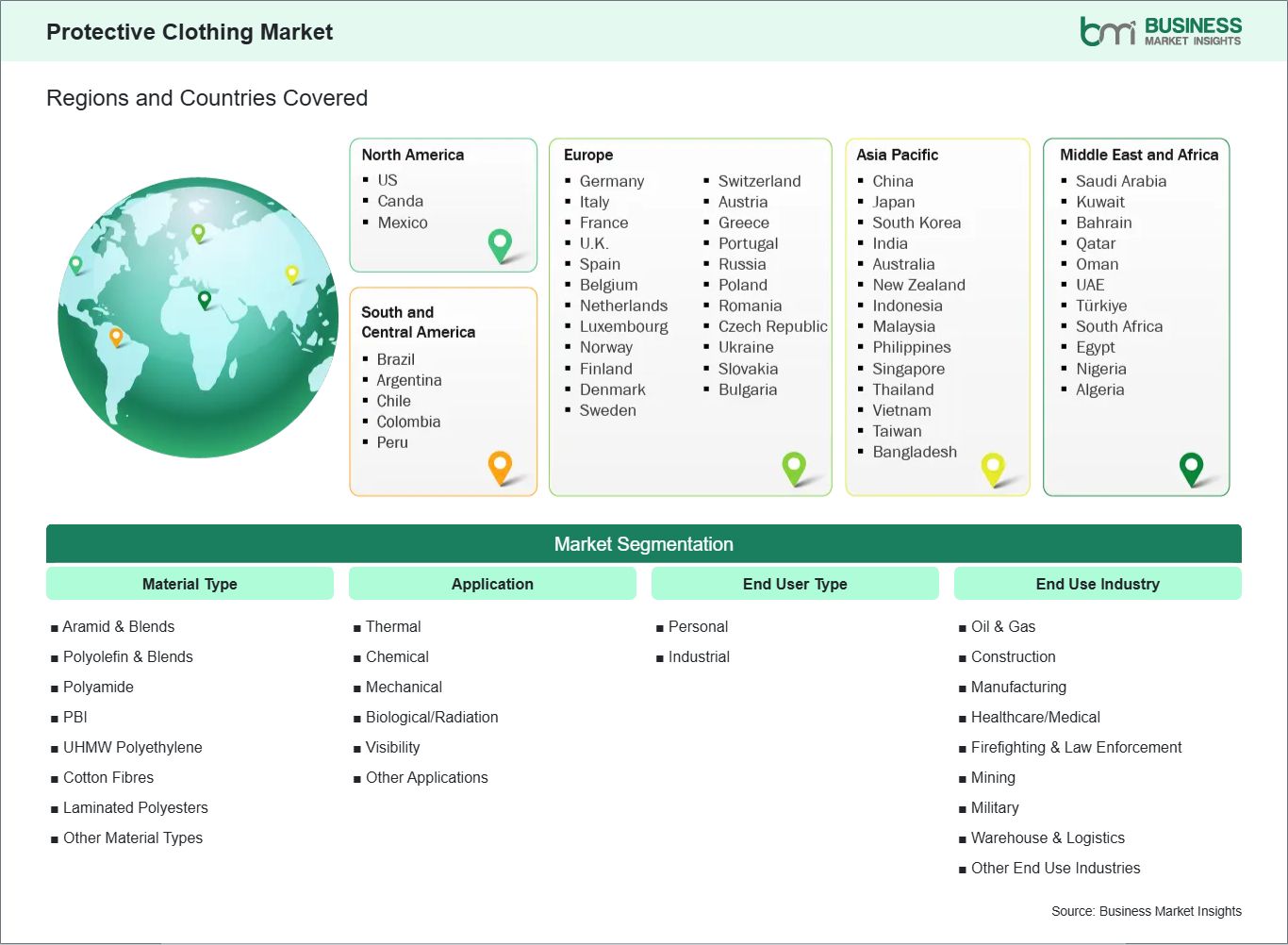
  • Material Type (Aramid & Blends, Polyolefin & Blends, Polyamide, PBI, UHMW Polyethylene, Cotton Fibres, Laminated Polyesters, Other Material Types)
  • Application (Thermal, Chemical, Mechanical, Biological/Radiation, Visibility, Other Applications)
  • End User Type (Personal, Industrial)
  • End Use Industry (Oil & Gas, Construction, Manufacturing, Healthcare/Medical, Firefighting & Law Enforcement, Mining, Military, Warehouse & Logistics, Other End Use Industries)

No. of Pages: 395
Report Code: BMIPUB00034227
Category: Chemicals and Materials
Protective Clothing Market

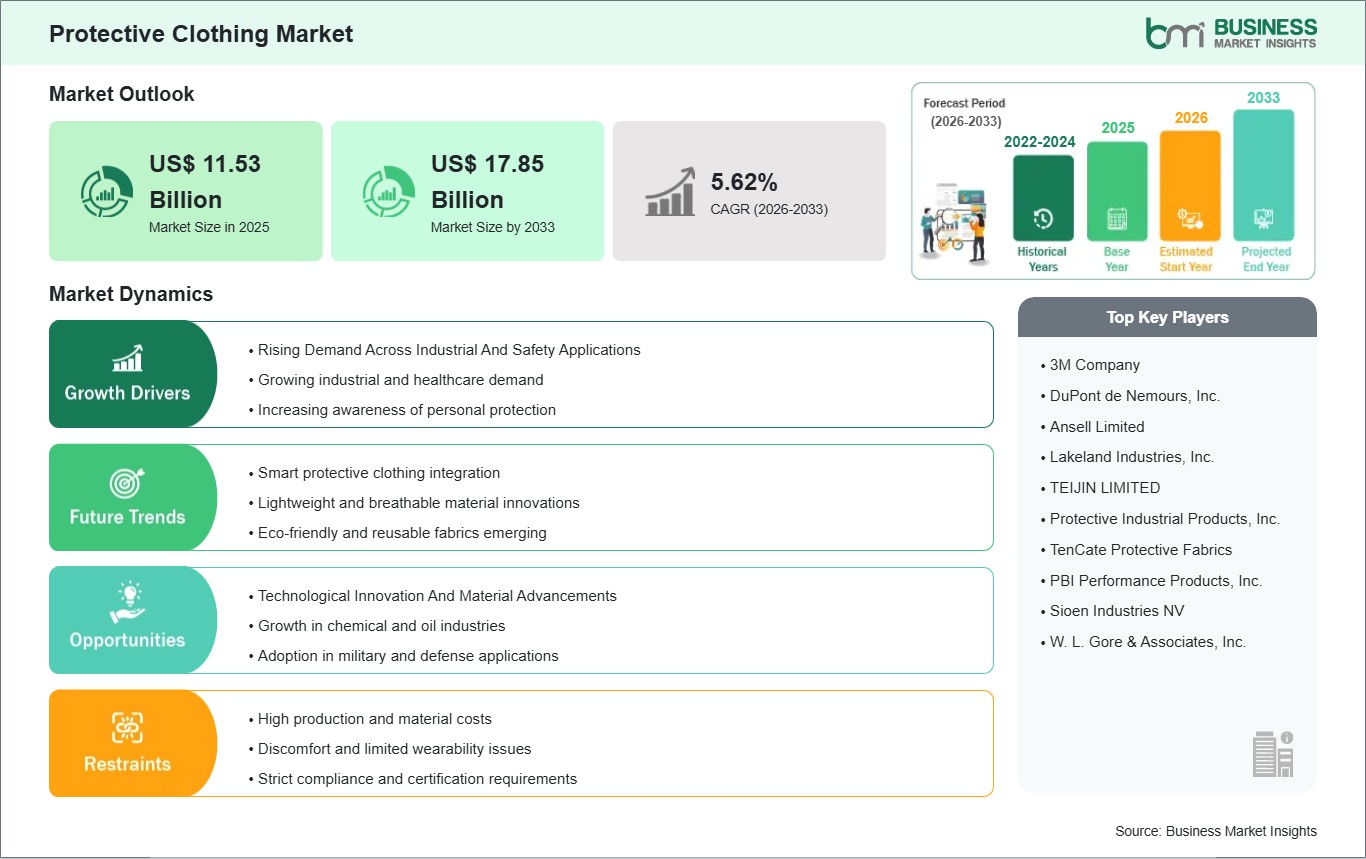
The Protective Clothing Market size is expected to reach US$ 17.85 billion by 2033 from US$ 11.53 billion in 2025. The market is estimated to record a CAGR of 5.62% from 2026 to 2033.

Executive Summary and Global Market Analysis:

The protective clothing market is witnessing gradual progress with growing emphasis on protecting workers in various industries. Protective clothing, which includes flame-resistant apparel, high-visibility clothing, chemical protective apparel, cut-resistant apparel, and biological protective apparel, is in high demand in the oil and gas industry, manufacturing sector, healthcare industry, construction industry, and mining sector.

The growth in industrial activities, coupled with stringent workplace safety regulations in developed countries, is fueling demand for performance-driven protective clothing that meets international standards set by organizations such as ISO, NFPA, and EN. The COVID-19 pandemic also had a significant impact on the protective clothing market. The pandemic created a sense of urgency in organizations that invested in PPEs in healthcare services and other frontline services. The protective clothing market is driven by both regulatory requirements and technology. Protective clothing manufacturers are making significant investments in R&D in materials science. The focus is on developing ultra-lightweight materials, breathable materials, moisture-wicking materials, and integrating smart sensors in protective apparel. Differentiation among players is also driven by certifications, durability, ergonomics, and materials science.

In addition, although price sensitivity in cost-competitive segments compresses margin, value-added propositions in meeting industry-specific requirements command premium positioning. In terms of supply chain, there have also been notable changes with an emphasis placed on near-shoring production facilities to minimize lead times, strengthen inventory robustness, and enable rapid deployment in response to emergency demand spikes. However, industry participants must balance cost pressures with quality assurance and address variability in raw material costs, particularly in technical textiles and high-performance fibers.

In conclusion, it is evident that the protective clothing market is resilient with strong underlying safety requirements, reinforced by continuous regulatory support and innovation in performance textiles, ensuring strong growth prospects in line with industrialization and safety imperatives.

Protective Clothing Market - Strategic Insights:

global-market-strategic-framework
Get more information on this report

Protective Clothing Market Segmentation Analysis:

Key segments that contributed to the derivation of the protective clothing market analysis are material type, application, end‑user type, and end‑use industry.

By Material Type, the protective clothing market is segmented into aramid & blends, polyolefin & blends, polyamide, PBI, UHMW polyethylene, cotton fibres, laminated polyesters, and other material types. The aramid & blends segment dominated the market in 2025.

Based on Application, the protective clothing market is classified into thermal, chemical, mechanical, biological/radiation, visibility, and other applications. The thermal segment dominated the market in 2025.

On the Basis of End‑User Type, the protective clothing market is segmented into personal and industrial. The industrial segment dominated the market in 2025.

In Terms of End‑Use Industry, the protective clothing market is segmented into oil & gas, construction, manufacturing, healthcare/medical, firefighting & law enforcement, mining, military, warehouse & logistics, and other end‑use industries. The manufacturing segment dominated the market in 2025.

Protective Clothing Market Drivers and Opportunities:

Rising Demand Across Industrial And Safety Applications

The global protective clothing industry is growing steadily, and this growth can be attributed to the increasing awareness of safety and regulatory compliance. Protective clothing acts as a barrier against physical, chemical, biological, and environmental hazards. It protects workers in various industries, such as manufacturing, construction, and healthcare, from exposure to hazardous materials and accidents.

Protective clothing may vary from general work clothing to specialized clothing for specific applications, such as chemical, flame, and visibility resistance. In the medical field, disposable gowns, gloves, and masks are of prime importance for workers. In construction and manufacturing, clothing helps workers withstand accidents and harsh environmental conditions. The adaptability of protective clothing for various applications makes it a necessity, and this highlights the need for reliable safety products.

The industry also benefits from innovations in textile technology, which include lighter weight, moisture-wicking, and ergonomic styles that provide comfort without sacrificing performance. This encourages the industry to be adopted in industries that require safety and mobility. The protective clothing reduces operational risks, liabilities, and boosts the confidence of employees. The growing trend in employee comfort, workplace safety regulations, and regulatory requirements will continue to fuel industry growth worldwide. The durability, performance, and flexibility of protective clothing ensure that it will always be an integral part of workplace safety strategies.

Technological Innovation And Material Advancements

The protective clothing industry is also witnessing significant innovation in terms of development. Protective clothing manufacturers are focusing on developing high-performance materials that offer greater protection against heat, chemical, cut, and microbiological hazards. Lightweight, breathable, flexible materials make protective clothing more comfortable for long-term wear, making it more acceptable for users in high-hazard environments.

Smart materials have also been developed that respond to particular hazards. For example, heat-sensitive materials or chemical-resistant materials have been developed. Such technologies have opened up more opportunities for protective clothing. Ergonomic design and lightweight materials ensure that protective clothing does not hinder user mobility, productivity, or comfort.

Occupational health concerns, coupled with changes in industrial safety standards, have created demand for protective clothing. Organizations have also started using environmentally friendly manufacturing techniques in producing protective gear. This is aimed at minimizing environmental impacts. With all these aspects in mind, protective clothing is still essential in today’s industries. It is aimed at improving performance, safety, and comfort. The global demand for protective gear is still on the increase.

Protective Clothing Market Size and Share Analysis:

The protective clothing market demonstrates steady growth, with size and share analysis highlighting evolving trends and competitive dynamics among key players. The report examines subsegments categorized within material type, application, end‑user type, and end‑use industry, offering insights into their contribution to overall market performance.

By Material Type, the aramid & blends subsegment dominated the market in 2025, driven by its exceptional resistance to heat, flames, and mechanical stress.

Based on Application, the thermal subsegment dominated the market in 2025, owing to rising safety requirements in high‑temperature industrial environments.

On the Basis of End‑User Type, the industrial subsegment dominated the market in 2025, propelled by stringent workplace safety mandates and recurring protective clothing needs across industrial sectors.

In terms of End‑Use Industry, the manufacturing subsegment dominated the market in 2025, fueled by the high demand for protective apparel amidst complex machinery, heat, and chemical exposures.

Protective Clothing Market Report Highlights:

Report Attribute Details
Market size in 2025 US$ 11.53 Billion
Market Size by 2033 US$ 17.85 Billion
Global CAGR (2026 - 2033)5.62%
Historical Data 2022-2024
Forecast period 2026-2033
Segments Covered By Material Type
  • Aramid & Blends
  • Polyolefin & Blends
  • Polyamide
  • PBI
  • UHMW Polyethylene
  • Cotton Fibres
  • Laminated Polyesters
  • Other Material Types
By Application
  • Thermal
  • Chemical
  • Mechanical
  • Biological/Radiation
  • Visibility
  • Other Applications
By End User Type
  • Personal
  • Industrial
By End Use Industry
  • Oil & Gas
  • Construction
  • Manufacturing
  • Healthcare/Medical
  • Firefighting & Law Enforcement
  • Mining
  • Military
  • Warehouse & Logistics
  • Other End Use Industries
Regions and Countries Covered
North America US, Canada, Mexico
Europe Belgium, Austria, Finland, Denmark, Greece, Poland, Romania, Russia, Ukraine, Czech Republic, Slovakia, Bulgaria, Italy, Luxembourg, Germany, Switzerland, France, Netherlands, Norway, Portugal, Spain, Sweden, United Kingdom
Asia-Pacific Australia, China, India, Japan, South Korea, Indonesia, Malaysia, Philippines, Singapore, Thailand, Vietnam, Bangladesh, New Zealand, Taiwan
South and Central America Brazil, Argentina, Peru, Chile, Colombia
Middle East and Africa Bahrain, Kuwait, Oman, Qatar, Saudi Arabia, United Arab Emirates, Turkiye, South Africa, Egypt, Algeria, Nigeria
Market leaders and key company profiles
  • 3M Company
  • DuPont de Nemours, Inc.
  • Ansell Limited
  • Lakeland Industries, Inc.
  • TEIJIN LIMITED
  • Protective Industrial Products, Inc.
  • TenCate Protective Fabrics
  • PBI Performance Products, Inc.
  • Sioen Industries NV
  • W. L. Gore & Associates, Inc.
Get more information on this report

Protective Clothing Market Report Coverage and Deliverables:

The "Protective Clothing Market Size and Forecast (2022 - 2033)" report provides a detailed analysis of the market covering below areas:

  • Protective Clothing Market size and forecast at global, regional, and country levels for all the key market segments covered under the scope
  • Protective Clothing Market trends, as well as drivers, restraints, and opportunities
  • Protective Clothing Market analysis covering key trends, global and regional framework, major players, regulations, and recent developments
  • Industry landscape and competition analysis covering market concentration, heat map analysis, prominent players, and recent developments for the Protective Clothing Market
  • Detailed company profiles, including SWOT analysis

Protective Clothing Market Geographic Insights:

The geographical scope of the Protective Clothing Market report is divided into North America, Asia Pacific, Europe, Middle East & Africa, and South & Central America. North America held the largest share in 2025.

Regional‑level dynamics in the protective clothing market illustrate distinct growth drivers shaped by regulatory environments, industrial profiles, and localized risk exposure. In North America, the market is substantial and well‑structured, supported by stringent OSHA and ANSI safety mandates, robust industrial activity in oil & gas, manufacturing, construction, and a deeply entrenched culture of workplace safety. The United States and Canada maintain strong institutional frameworks for certification, compliance, and quality assurance, which elevate demand for high‑performance protective apparel certified to NFPA and ASTM standards. In addition, heightened awareness of worker health following pandemic disruptions continues to sustain procurement across healthcare and public service sectors. Europe registers solid and steady growth, led by Germany, France, and the UK, where comprehensive safety legislation and enforcement influence protective wear adoption across construction, metal fabrication, and transportation industries. European buyers increasingly favor sustainable and recyclable protective textiles, aligning with regional circular economy agendas. The Asia Pacific region is the fastest‑growing market, with China, India, Japan, and South Korea driving demand through expanding industrialization, infrastructure development, and large‑scale manufacturing ecosystems. Rapid urbanization and growing awareness of occupational hazards are prompting institutional investment in PPE procurement and safety training programs. In the Middle East & Africa, demand is emerging predominantly from oil & gas, petrochemical, and mining operations, with the UAE, Saudi Arabia, and South Africa at the forefront. Growth is moderated by infrastructure variability and differing regulatory maturity levels across countries, though targeted safety initiatives and investment in industrial zones are supporting progressive adoption. South & Central America, led by Brazil and Mexico, demonstrates moderate expansion, driven by construction, agriculture, and industrial segments, even as economic fluctuations and regulatory differences influence procurement strategies. Collectively, these regional factors underscore the interplay between safety regulation, industrial composition, and economic investment in shaping protective clothing demand across global markets.

global-market-geography
Get more information on this report

Protective Clothing Market Research Report Guidance:

  • The report includes qualitative and quantitative data in the Protective Clothing Market across material type, application, end‑user type, end‑use industry, and geography.
  • The report starts with the key takeaways (chapter 2), highlighting key trends and outlook of the Protective Clothing Market.
  • Chapter 3 focuses on the research methodology of the study.
  • Chapter 4 includes ecosystem analysis.
  • Chapter 5 highlights the major industry dynamics in the Protective Clothing Market, including factors that are driving the market, prevailing deterrents, potential opportunities, as well as future trends. Impact analysis of these drivers and restraints is also covered in this section.
  • Chapter 6 discusses the Protective Clothing Market scenario, in terms of historical market revenues, and forecast till the year 2033.
  • Chapters 7 to 11 cover Protective Clothing Market segments across material type, application, end‑user type, end‑use industry, and geography across North America, Asia Pacific, Europe, the Middle East & Africa, and South & Central America. They cover the market revenue forecast and factors driving the market.
  • Chapter 12 describes the competitive analysis along with the heat map analysis for the key players operating in the market.
  • Chapter 13 describes the industry landscape analysis. It provides detailed descriptions of business activities such as market initiatives, new developments, mergers, and joint ventures globally, along with a competitive landscape.
  • Chapter 14 provides detailed profiles of the major companies operating in the Protective Clothing Market. Companies have been profiled on the basis of their key facts, business descriptions, products, financial overview, SWOT analysis, and key developments.
  • Chapter 15, i.e., the appendix, is inclusive of a brief overview of the company, a list of abbreviations, and a disclaimer.

Protective Clothing Market News and Key Development:

The Protective Clothing Market is evaluated by gathering qualitative and quantitative data post primary and secondary research, which includes important corporate publications, association data, and databases. A few of the key developments in the protective clothing market are:

  • In November 2025, DuPont announced that it had launched Tyvek APX, a next‑generation disposable chemical protective garment fabric at A+A 2025 in Düsseldorf, Germany designed to deliver significantly enhanced breathability and comfort while maintaining high levels of protective performance for workers in hazardous environments.
  • In November 2025, HB Protective Wear GmbH & Co. KG announced that it had introduced TEMPEX COLD Pro a cold‑protection PPE garment designed for deep‑freeze industrial environments combining ergonomic fit, functional design, and sustainable material quality, showcased at the A+A 2025 global safety trade fair. This launch also included new ESD protective clothing lines like CONDUCTEX Green Turtle and CONDUCTEX Cotton Knit Green Turtle for electrostatic discharge‑sensitive work zones.

Key Sources Referred:

  • International Organization for Standardization (ISO)
  • American Society for Testing and Materials (ASTM International)
  • Bureau of Indian Standards (BIS)
  • Environmental Protection Agency (EPA), USA
  • European Chemicals Agency (ECHA)
  • Central Pollution Control Board (CPCB), India
  • Ministry of Chemicals and Fertilizers, India
  • American Chemistry Council (ACC)
  • Indian Chemical Council (ICC)
  • European Chemical Industry Council (Cefic)
  • Specialty Chemical Association of India (SCAI)
  • Company Websites
  • Company Annual Reports
  • Company Investor Presentations
The List of Companies - Protective Clothing Market
  • 3M Company
  • DuPont de Nemours, Inc.
  • Ansell Limited
  • Lakeland Industries, Inc.
  • TEIJIN LIMITED
  • Protective Industrial Products, Inc.
  • TenCate Protective Fabrics
  • PBI Performance Products, Inc.
  • Sioen Industries NV
  • W. L. Gore & Associates, Inc.
Frequently Asked Questions
How big is the Protective Clothing Market?

The Protective Clothing Market is valued at US$ 11.53 Billion in 2025, it is projected to reach US$ 17.85 Billion by 2033.

What is the CAGR for Protective Clothing Market by (2026 - 2033)?

As per our report Protective Clothing Market, the market size is valued at US$ 11.53 Billion in 2025, projecting it to reach US$ 17.85 Billion by 2033. This translates to a CAGR of approximately 5.62% during the forecast period.

What segments are covered in this report?

The Protective Clothing Market report typically cover these key segments-

  • Material Type (Aramid & Blends, Polyolefin & Blends, Polyamide, PBI, UHMW Polyethylene, Cotton Fibres, Laminated Polyesters, Other Material Types)
  • Application (Thermal, Chemical, Mechanical, Biological/Radiation, Visibility, Other Applications)
  • End User Type (Personal, Industrial)
  • End Use Industry (Oil & Gas, Construction, Manufacturing, Healthcare/Medical, Firefighting & Law Enforcement, Mining, Military, Warehouse & Logistics, Other End Use Industries)

What is the historic period, base year, and forecast period taken for Protective Clothing Market?

The historic period, base year, and forecast period can vary slightly depending on the specific market research report. However, for the Protective Clothing Market report:

  • Historic Period : 2022-2024
  • Base Year : 2025
  • Forecast Period : 2026-2033
  • Who are the major players in Protective Clothing Market?

    The Protective Clothing Market is populated by several key players, each contributing to its growth and innovation. Some of the major players include:

  • 3M Company
  • DuPont de Nemours, Inc.
  • Ansell Limited
  • Lakeland Industries, Inc.
  • TEIJIN LIMITED
  • Protective Industrial Products, Inc.
  • TenCate Protective Fabrics
  • PBI Performance Products, Inc.
  • Sioen Industries NV
  • W. L. Gore & Associates, Inc.
  • Who should buy this report?

    The Protective Clothing Market report is valuable for diverse stakeholders, including:

    • Investors: Provides insights for investment decisions pertaining to market growth, companies, or industry insights. Helps assess market attractiveness and potential returns.
    • Industry Players: Offers competitive intelligence, market sizing, and trend analysis to inform strategic planning, product development, and sales strategies.
    • Suppliers and Manufacturers: Helps understand market demand for components, materials, and services related to concerned industry.
    • Researchers and Consultants: Provides data and analysis for academic research, consulting projects, and market studies.
    • Financial Institutions: Helps assess risks and opportunities associated with financing or investing in the concerned market.

    Essentially, anyone involved in or considering involvement in the Protective Clothing Market value chain can benefit from the information contained in a comprehensive market report.

    Available Report Formats

    pdf-format excel-format pptx-format
    Buy Now
    Sales Assistance
    +1 646 791 7070 (US & UK)
    Customization Form

    Please tell us your area of interest
    (Market Segments/ Regions and Countries/ Companies)