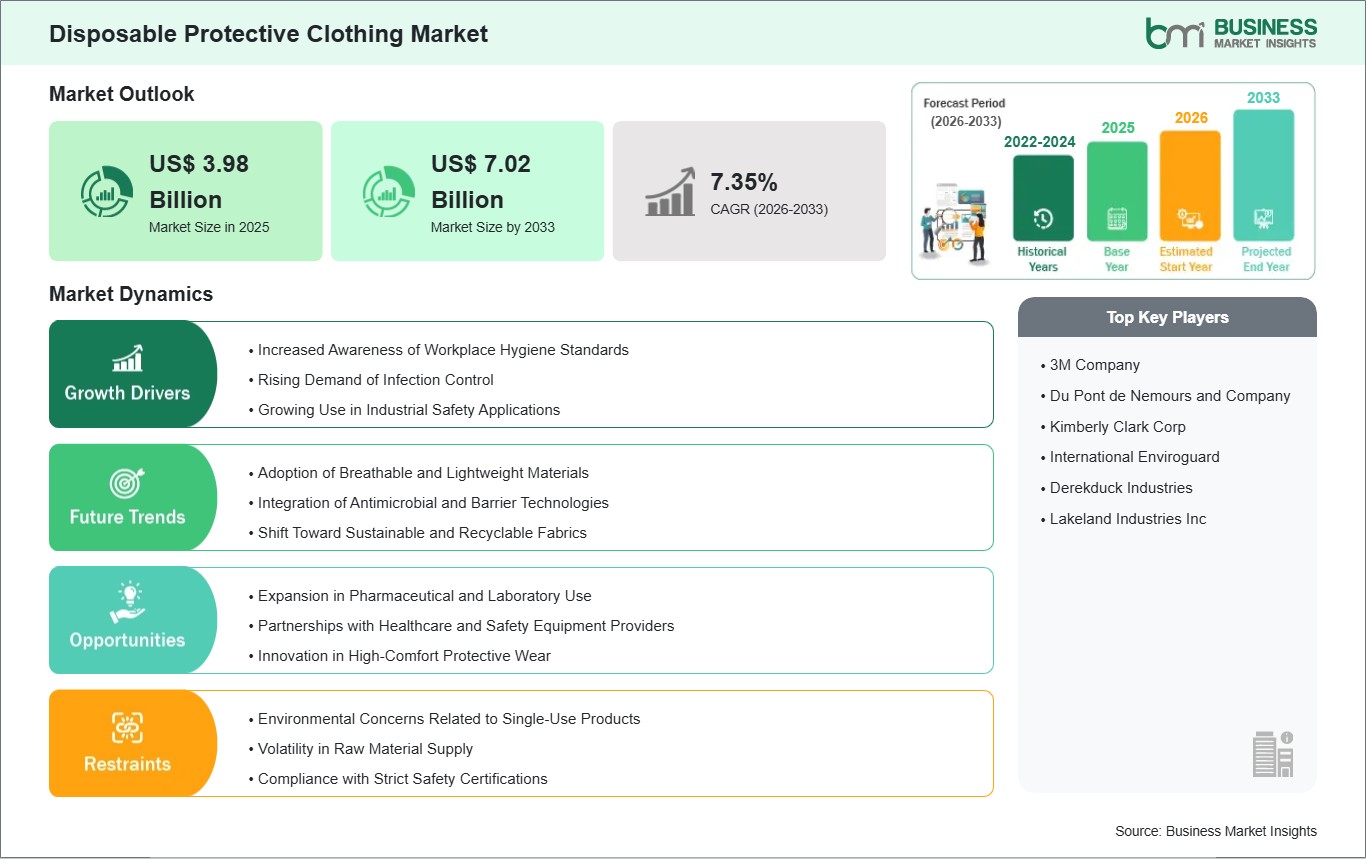
The Disposable Protective Clothing Market size is expected to reach US$ 7.02 Billion by 2033 from US$ 3.98 Billion in 2025. The market is estimated to record a CAGR of 7.35% from 2026 to 2033.
The global disposable protective clothing market is one of the most significant segments within the overall personal protective equipment industry. The segment is defined by personal protective equipment that is manufactured with single-use capabilities within controlled environments. The main difference between disposable personal protective equipment and reusable personal protective equipment is that disposable personal protective equipment is manufactured with the ability to eliminate carryover, thereby becoming indispensable in industries that cannot afford contamination. The global disposable protective clothing market is being influenced by a paradigm shift that is being caused by risk mitigation strategies. Industries are increasingly adopting standardized personal protective equipment that not only reduces liability but also increases compliance with changing safety standards. The globalization of industries, especially within pharmaceuticals and food processing industries, has increased the need to ensure that all equipment is handled in a contamination-free manner. The other significant influence on this market is that preparedness is becoming increasingly essential. The ability to stockpile equipment is becoming part of overall risk management strategies. This reliance on synthetic, non-biodegradable materials has given rise to concerns regarding waste disposal, especially in countries with stringent environmental regulations. Secondly, the supply of raw materials, which are subject to variation, might hinder production. This has made companies think about the materials used, thus slowly altering the competitive environment.

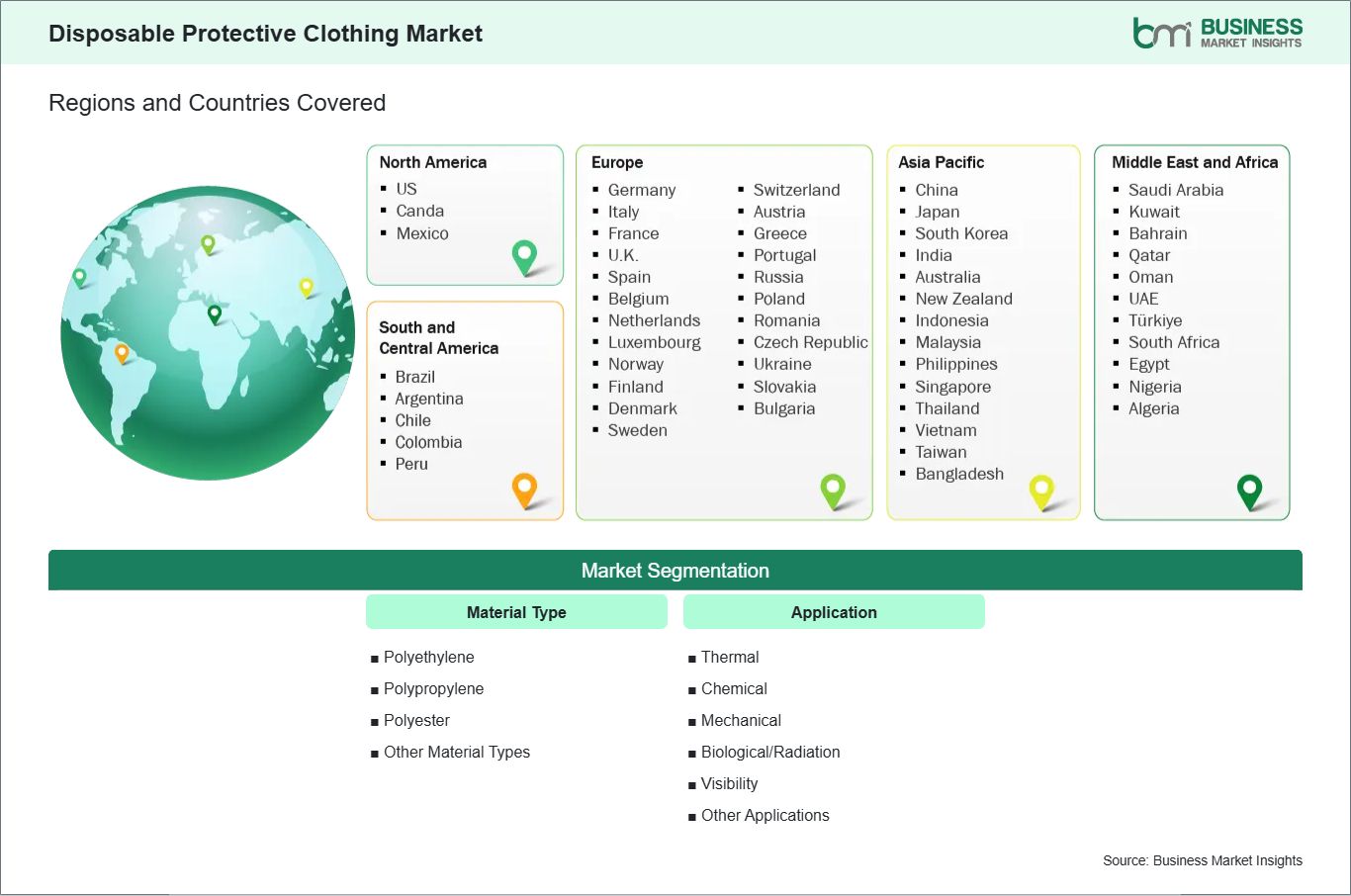
Key segments that contributed to the derivation of the disposable protective clothing market analysis are material type, application, and end user.
The global market for disposable protective clothing is growing quickly as more industries focus on workplace hygiene and safety. Employers are putting worker protection first to limit exposure to hazardous substances, contaminants, and infectious agents. Items like coveralls, gowns, and masks are popular because they are convenient, affordable, and help lower the risk of cross-contamination in controlled settings.
Strict occupational safety rules are also driving demand for disposable protective clothing. Industries such as manufacturing, healthcare, and food processing require workers to wear protective gear regularly to meet hygiene standards. Since these items are disposable, they do not need to be washed, which helps maintain high levels of cleanliness.
Changing workplace environments are also increasing the demand for these products. New designs focus on both safety and comfort for users, making disposable protective clothing an important part of modern workplace hygiene.
The use of disposable protective clothing is expanding significantly within pharmaceutical manufacturing and laboratory environments, where contamination control is of utmost importance. These settings require strict adherence to cleanliness standards to ensure product integrity and accurate research outcomes. Disposable garments provide an effective barrier against particulate matter and biological contaminants, supporting sterile conditions in sensitive operations.
The advancements in pharmaceutical manufacturing processes, as well as laboratory research, are also creating a greater need for such specific protective apparel. High-performance disposable apparel is intended to provide better chemical, liquid, and biological resistance. The reliability of such apparel ensures that there is greater compliance with stringent quality standards.
The emphasis on research and development activities, such as biotechnology and life sciences, is also leading to greater growth in this market. As research activities become more complex, so is the need for reliable protective apparel. Disposable protective apparel ensures that researchers are able to work safely, thereby emphasizing its importance as a critical component in pharmaceutical as well as laboratory research worldwide.

The disposable protective clothing market is experiencing steady growth, with market size and share analysis reflecting evolving treatment preferences and competitive dynamics among key players. The report evaluates important subsegments categorized within material type, application, and end user, highlighting their respective contributions to overall market performance.
By material type, the Polyethylene subsegment dominated the Disposable Protective Clothing market in 2025. Polyethylene offers lightweight, durable, and cost-effective protection, making it widely adopted across various industries.
Based on application, the Biological/Radiation subsegment dominated the Disposable Protective Clothing market in 2025. Protective clothing for biological and radiation hazards ensures worker safety in high-risk environments, driving strong demand for this segment.
In terms of end user, the Manufacturing subsegment dominated the Disposable Protective Clothing market in 2025. Manufacturing industries require reliable protective clothing to safeguard workers from chemical, mechanical, and biological hazards, reinforcing the leading position of this segment.
| Report Attribute | Details |
|---|---|
| Market size in 2025 | US$ 3.98 Billion |
| Market Size by 2033 | US$ 7.02 Billion |
| Global CAGR (2026 - 2033) | 7.35% |
| Historical Data | 2022-2024 |
| Forecast period | 2026-2033 |
| Segments Covered | By Material Type
|
|
Regions and Countries Covered
| |
| North America | US, Canada, Mexico |
| Europe | Belgium, Austria, Finland, Denmark, Greece, Poland, Romania, Russia, Ukraine, Czech Republic, Slovakia, Bulgaria, Italy, Luxembourg, Germany, Switzerland, France, Netherlands, Norway, Portugal, Spain, Sweden, United Kingdom |
| Asia-Pacific | Australia, China, India, Japan, South Korea, Indonesia, Malaysia, Philippines, Singapore, Thailand, Vietnam, Bangladesh, New Zealand, Taiwan |
| South and Central America | Brazil, Argentina, Peru, Chile, Colombia |
| Middle East and Africa | Bahrain, Kuwait, Oman, Qatar, Saudi Arabia, United Arab Emirates, Turkiye, South Africa, Egypt, Algeria, Nigeria |
| Market leaders and key company profiles |
|
The "Disposable Protective Clothing Market Size and Forecast (2022 - 2033)" report provides a detailed analysis of the market covering below areas:
The geographical scope of the Disposable Protective Clothing market report is divided into five regions: North America, Asia Pacific, Europe, Middle East & Africa, and South & Central America. The Disposable Protective Clothing market in North America is expected to grow during the forecast period.
North America has a leading position in the disposable protective clothing market, not just because of volume but also because of its structured and compliant safety management strategies. The leading position of North America is based on its safety culture, in which regulatory bodies, as well as corporate responsibility models, ensure that certified safety equipment is always used in various industries. The distinctive feature of the North American market is that it has already started adopting specification-based procurement strategies. The end users need equipment that should be able to meet specific criteria in terms of efficiency, resistance, etc. As a result, there is a significant focus on differentiation in this market, with suppliers trying to create differentiated products on the basis of fabrics, ergonomics, etc. There is also a greater inclination towards integrating this equipment with other safety management strategies. Another notable trend is the increased focus on product lifecycle and environmental concerns. Organisations are beginning to assess, in addition to the protective capabilities, the end-of-life implications of disposable wear. This has created opportunities for the development of recyclable materials and waste management partnerships. While there are concerns related to cost factors and environmental regulations, North America remains at the forefront in terms of quality assurance, regulatory compliance, and innovation-oriented product development, thus establishing a benchmark for the global marketplace.

The disposable protective clothing market is evaluated by gathering qualitative and quantitative data post primary and secondary research, which includes important corporate publications, association data, and databases. A few of the key developments in the disposable protective clothing market are:
The Disposable Protective Clothing Market is valued at US$ 3.98 Billion in 2025, it is projected to reach US$ 7.02 Billion by 2033.
As per our report Disposable Protective Clothing Market, the market size is valued at US$ 3.98 Billion in 2025, projecting it to reach US$ 7.02 Billion by 2033. This translates to a CAGR of approximately 7.35% during the forecast period.
The Disposable Protective Clothing Market report typically cover these key segments-
The historic period, base year, and forecast period can vary slightly depending on the specific market research report. However, for the Disposable Protective Clothing Market report:
The Disposable Protective Clothing Market is populated by several key players, each contributing to its growth and innovation. Some of the major players include:
The Disposable Protective Clothing Market report is valuable for diverse stakeholders, including:
Essentially, anyone involved in or considering involvement in the Disposable Protective Clothing Market value chain can benefit from the information contained in a comprehensive market report.
Please tell us your area of interest
(Market Segments/ Regions and Countries/ Companies)