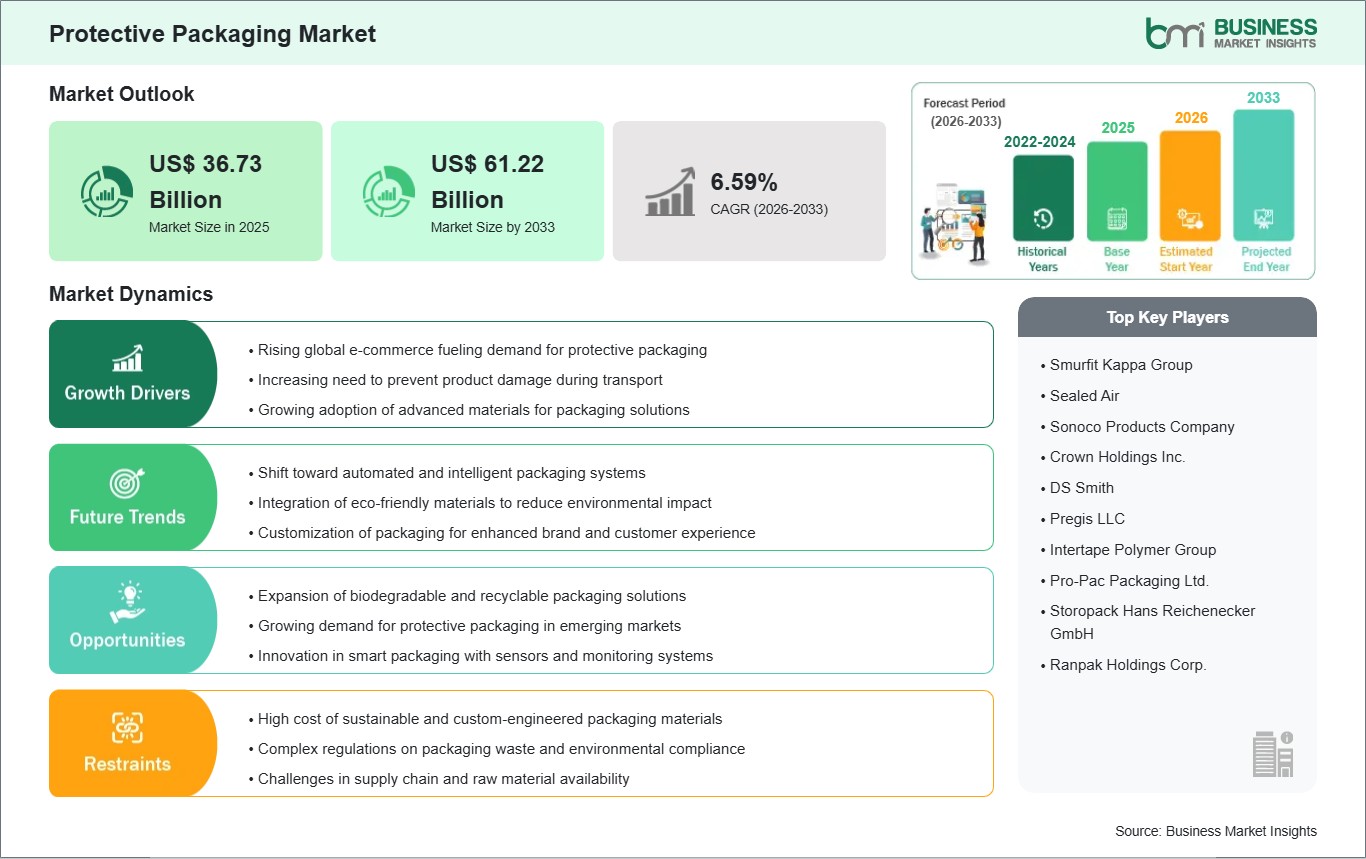
The Protective Packaging Market size is expected to reach US$ 61.22 billion by 2033 from US$ 36.73 billion in 2025. The market is estimated to record a CAGR of 6.59% from 2026 to 2033.
The global protective packaging market operates as an essential part of the entire packaging industry, which develops solutions that protect products throughout their storage, handling and transport phases. Protective packaging uses multiple materials and systems that protect products from delivery system impacts, contamination and vibration damage while preserving product integrity through transportation networks. The market has developed throughout the world because businesses face more complicated product delivery systems, as e‑commerce operations expand and customers demand better product quality and safety standards.
Businesses from manufacturing to retailing to logistics work to implement protective packaging measures, which help them decrease product damage and cut down product returns while boosting customer satisfaction. The electronics and automotive components, pharmaceuticals, food and beverages and consumer goods industries all require protective packaging because their products need to remain intact and follow established product handling rules.
The global protective packaging market receives its main growth impetus from two factors, which include the continuing growth of international supply chains and rising e‑commerce demand. The need for dependable protective packaging has grown stronger as companies enhance their cross-border shipping and direct consumer distribution systems. The industry now adopts lightweight recyclable materials that engineers create to make products that protect while meeting environmental objectives through their design.
The packaging requirements in the electronics and medical device industries need solutions that protect products from both physical harm and electrostatic discharge, as well as environmental chemical products. The requirement for protective solutions has created a need for advanced material systems, which include smart technologies that use RFID tags and real-time package integrity monitoring systems. The market operates under specific limitations. The growing demand for sustainable solutions makes it difficult to use traditional protective packaging materials because people now examine their environmental effects. Manufacturers need to create materials that meet both performance and sustainability standards, which leads to the development of products that can be recycled, composted or turned into biodegradable materials.
The existence of multiple waste management regulations and material bans in different regions makes it difficult for businesses to create products, choose materials and determine their expenses. The world economy depends on protective packaging since it supports all distribution systems that distribute products worldwide, while ongoing technological developments and environmentally friendly practices continue to drive its progress.

Key segments that contributed to the derivation of the protective packaging market analysis are material, type, function, and application.
The global protective packaging market is expanding because of the e-commerce industry and omnichannel retailing, which are experiencing rapid growth. The increase in online shopping by consumers results in companies needing to meet their customer demands for product safety, delivery reliability and presentation quality. Protective packaging solutions, which include molded pulp and foam inserts, bubble wraps and corrugated materials, have become essential for delivering intact products to customers, especially for fragile electronics, consumer appliances and specialty items.
Industrial and logistics companies are using customized protective packaging solutions in their supply chain operations to decrease product returns and prevent damage claims while improving their operational performance. The implementation of automated packaging systems together with just-in-time material delivery systems is becoming more common because these systems enable businesses to achieve accurate sizing and effective cushioning while minimizing material waste.
The demand driven by e-commerce is creating a need for both new materials and product design improvements. The industry is moving towards lightweight recyclable solutions that offer protection against impacts while maintaining environmentally friendly shipping practices. The sectors of pharmaceuticals, cosmetics and high-end consumer goods are adopting advanced protective solutions to preserve product integrity and meet regulatory requirements and enhance brand reputation, which makes e-commerce a crucial factor driving worldwide protective packaging expansion.
Sustainability is emerging as a major opportunity in the global protective packaging market. Manufacturers and brands are investing in biodegradable, compostable, and recyclable packaging materials to reduce environmental impact, comply with regulations, and meet the growing consumer preference for eco-friendly solutions. Corrugated inserts, molded pulp, and biodegradable foams are increasingly replacing conventional plastics in industrial, retail, and e-commerce applications.
Companies are also experimenting with hybrid solutions that combine durability with reduced material usage. For example, protective packaging for electronics or medical devices is being engineered with lightweight recyclable polymers or molded fiber systems, ensuring protection without compromising environmental responsibility.
Emerging markets in Asia Pacific, Latin America, and the Middle East are showing particular potential for sustainable packaging adoption. Local manufacturers are exploring cost-effective eco-friendly alternatives to meet both industrial demands and global supply chain sustainability goals. The focus on recyclable and biodegradable materials not only addresses regulatory pressures but also helps companies differentiate their offerings and align with corporate social responsibility initiatives, making sustainable protective packaging a significant growth opportunity worldwide.
The protective packaging market demonstrates steady growth, with size and share analysis highlighting evolving trends and competitive dynamics among key players. The report examines subsegments categorized within material, type, function, and application, offering insights into their contribution to overall market performance.
By material, the foam plastics subsegment dominated the market in 2025, driven by its lightweight nature, shock‑absorbing performance, and ability to be customized to protect delicate goods.
Based on type, the flexible protective packaging subsegment dominated the market in 2025, driven by its adaptability, cost‑efficiency, and strong demand across e‑commerce and general shipping needs.
On the basis of function, the cushioning subsegment dominated the market in 2025, driven by widespread necessity to absorb impacts and safeguard products during transportation and handling.
In terms of application, the industrial goods subsegment dominated the market in 2025, driven by extensive global trade, complex supply chains, and high protection requirements for heavy and sensitive equipment.
| Report Attribute | Details |
|---|---|
| Market size in 2025 | US$ 36.73 Billion |
| Market Size by 2033 | US$ 61.22 Billion |
| Global CAGR (2026 - 2033) | 6.59% |
| Historical Data | 2022-2024 |
| Forecast period | 2026-2033 |
| Segments Covered | By Material
|
|
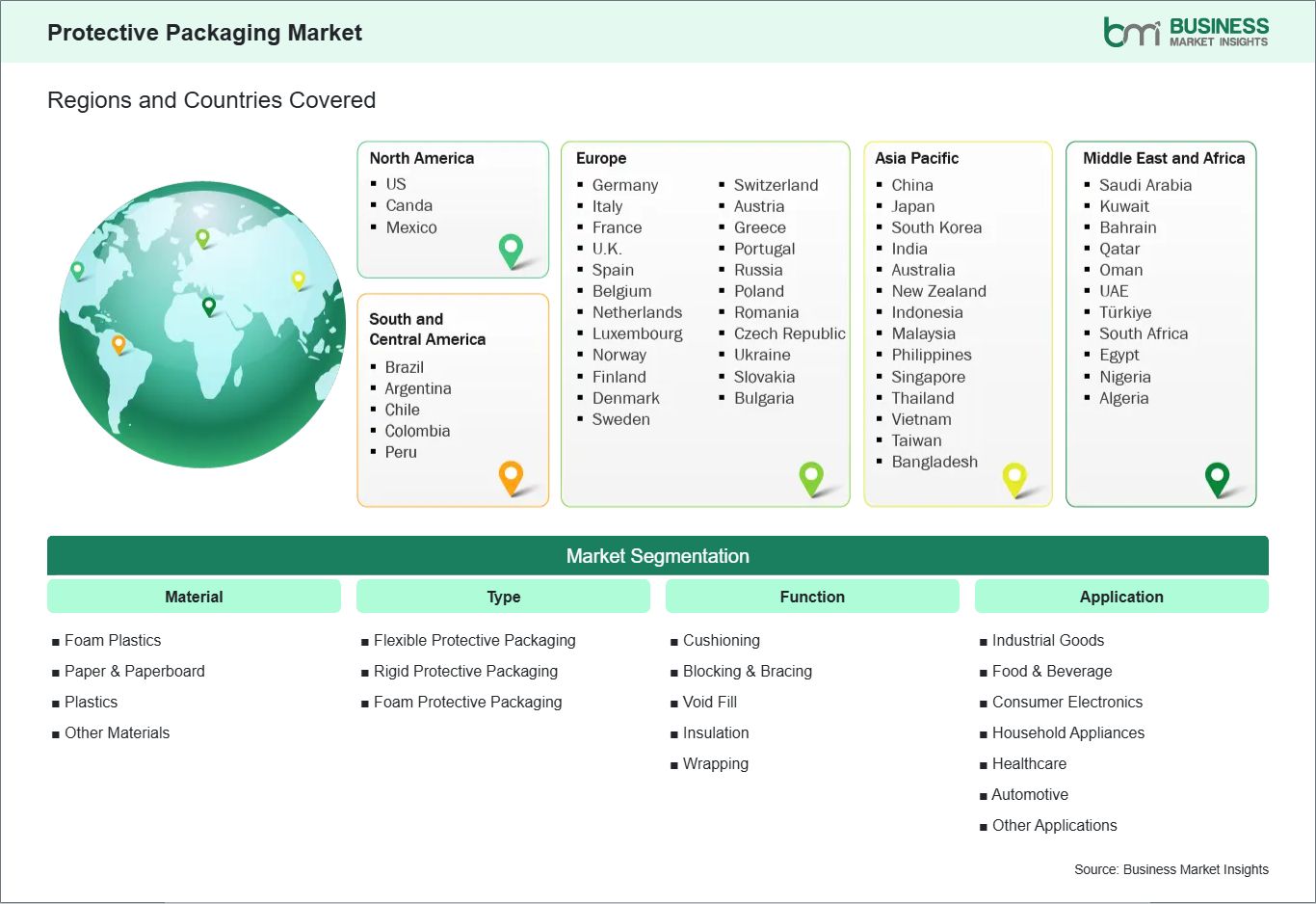
Regions and Countries Covered
| |
| North America | US, Canada, Mexico |
| Europe | Belgium, Austria, Finland, Denmark, Greece, Poland, Romania, Russia, Ukraine, Czech Republic, Slovakia, Bulgaria, Italy, Luxembourg, Germany, Switzerland, France, Netherlands, Norway, Portugal, Spain, Sweden, United Kingdom |
| Asia-Pacific | Australia, China, India, Japan, South Korea, Indonesia, Malaysia, Philippines, Singapore, Thailand, Vietnam, Bangladesh, New Zealand, Taiwan |
| South and Central America | Brazil, Argentina, Peru, Chile, Colombia |
| Middle East and Africa | Bahrain, Kuwait, Oman, Qatar, Saudi Arabia, United Arab Emirates, Turkiye, South Africa, Egypt, Algeria, Nigeria |
| Market leaders and key company profiles |
|
The "Protective Packaging Market Size and Forecast (2022 - 2033)" report provides a detailed analysis of the market covering below areas:
The geographical scope of the Protective Packaging Market report is divided into North America, Asia Pacific, Europe, Middle East & Africa, and South & Central America. North America held the largest share in 2025.
North America holds the leading position in global protective packaging markets because of its developed industrial sector, established supply chain networks and its robust system of safety and sustainability regulations. The United States and Canada lead in adopting innovative packaging solutions that protect fragile goods during storage and transit, especially in sectors like electronics, automotive, pharmaceuticals, and consumer goods. The e-commerce market has reached a high level of development, which has created a need for protective packaging solutions. Companies now create personalized protective solutions through their use of custom cushioning, molded inserts and anti-static materials to protect products and improve customer satisfaction.
Europe serves as an important market that operates under strict regulatory standards while pursuing sustainable practices and implementing industrial automation. The development of new materials and packaging solutions has been stimulated by Germany, France and the U.K., which promote the use of recyclable, biodegradable and lightweight packaging for industrial products and online shopping deliveries.
The Asia Pacific market experiences rapid expansion because manufacturing capabilities continue to grow, industrial output rises and e-commerce platforms expand throughout China, India, Japan and South Korea. Multinational and local companies in the region now use advanced packaging technology and automation to meet their protective packaging needs which encompass electronics and consumer goods and pharmaceuticals and food and beverage products.
The Middle East and Africa region experiences market growth through industrial projects, which create new logistics networks and make product safety a priority in construction, oil and gas and healthcare industries, yet market adoption faces challenges from high costs and weak regulatory enforcement.
The market in South and Central America grows steadily through industrial export demand, food processing requirements and healthcare packaging needs, especially in Brazil, Mexico and Argentina, although infrastructure and supply chain problems can lead to inconsistent supply. The market development in all regions depends on three main factors, which include sustainability needs, regulatory requirements and technological advancements. The protective packaging market worldwide undergoes different development patterns because North America leads in innovation and regulatory compliance and e-commerce adoption, and each region has specific industrialization drivers that operate in the Asia Pacific, Europe and Middle East and Latin America emerging markets.

The Protective Packaging Market is evaluated by gathering qualitative and quantitative data post primary and secondary research, which includes important corporate publications, association data, and databases. A few of the key developments in the protective packaging market are:
The Protective Packaging Market is valued at US$ 36.73 Billion in 2025, it is projected to reach US$ 61.22 Billion by 2033.
As per our report Protective Packaging Market, the market size is valued at US$ 36.73 Billion in 2025, projecting it to reach US$ 61.22 Billion by 2033. This translates to a CAGR of approximately 6.59% during the forecast period.
The Protective Packaging Market report typically cover these key segments-
The historic period, base year, and forecast period can vary slightly depending on the specific market research report. However, for the Protective Packaging Market report:
The Protective Packaging Market is populated by several key players, each contributing to its growth and innovation. Some of the major players include:
The Protective Packaging Market report is valuable for diverse stakeholders, including:
Essentially, anyone involved in or considering involvement in the Protective Packaging Market value chain can benefit from the information contained in a comprehensive market report.
Please tell us your area of interest
(Market Segments/ Regions and Countries/ Companies)