Market Summary
Executive Summary and Global Market Analysis
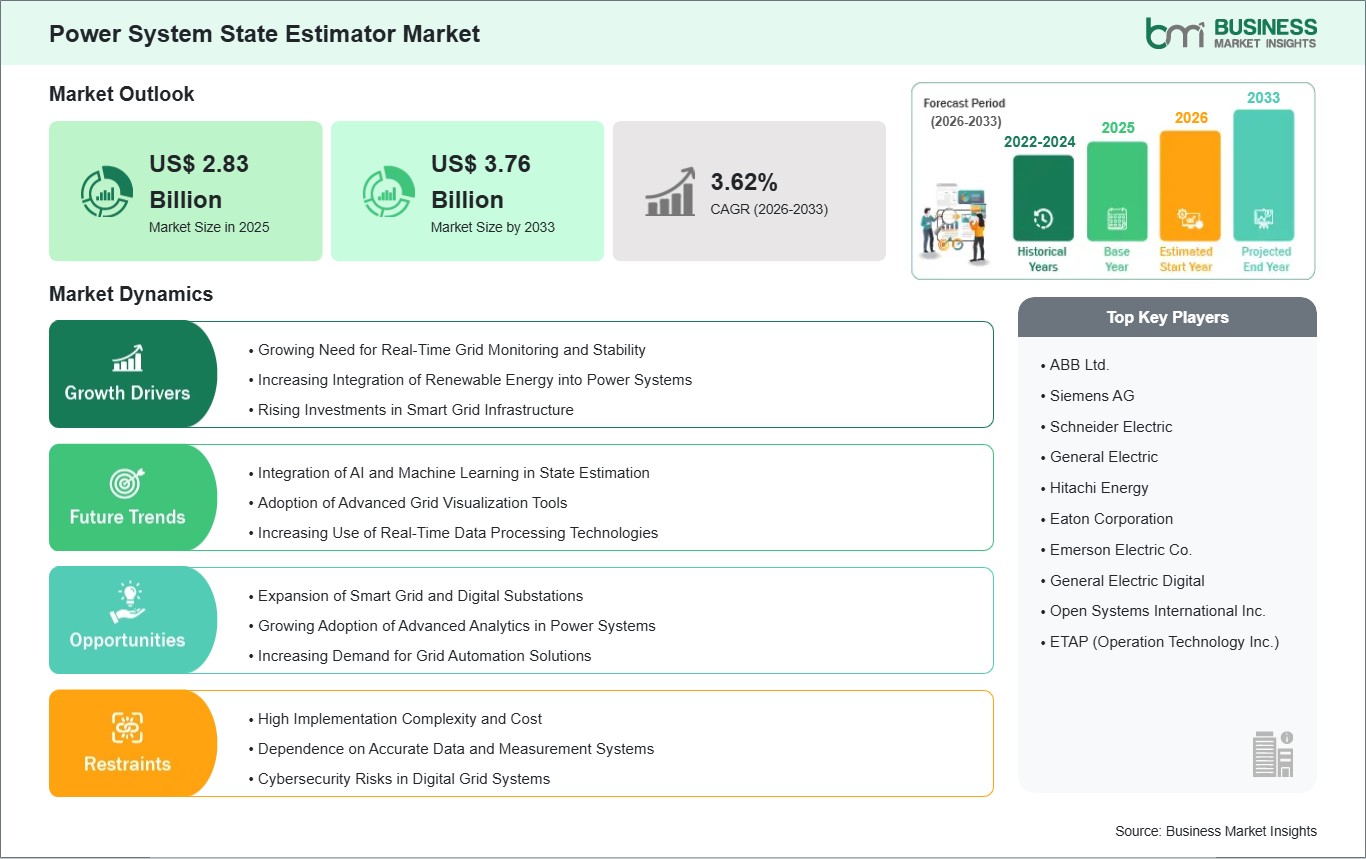
The power system state estimator market is gaining importance as the utilities are focusing on improving the reliability, efficiency, and real-time monitoring of the power system. State estimators are considered essential tools that are used to find the operating state of the power system by evaluating the data from different sensors and measurement devices installed in the power system. As the complexity of the power system increases with the addition of renewable energy resources and distributed generation, the accurate state estimation plays a significant role in maintaining the stability of the power system. The power system state estimator market is also gaining importance due to the rapid development of smart grid infrastructure and digital substations, which are producing more real-time data. The advanced solution techniques such as weighted least squares and Kalman filters are being widely used to improve the accuracy of the state estimation system. Furthermore, the integration of AI and ML is also improving the efficiency of the state estimation system. As the power system is evolving and the digital transformation is gaining momentum, the power system state estimator market is likely to witness significant growth in the future.
Segment Analysis
Power System State Estimator Market Segmentation
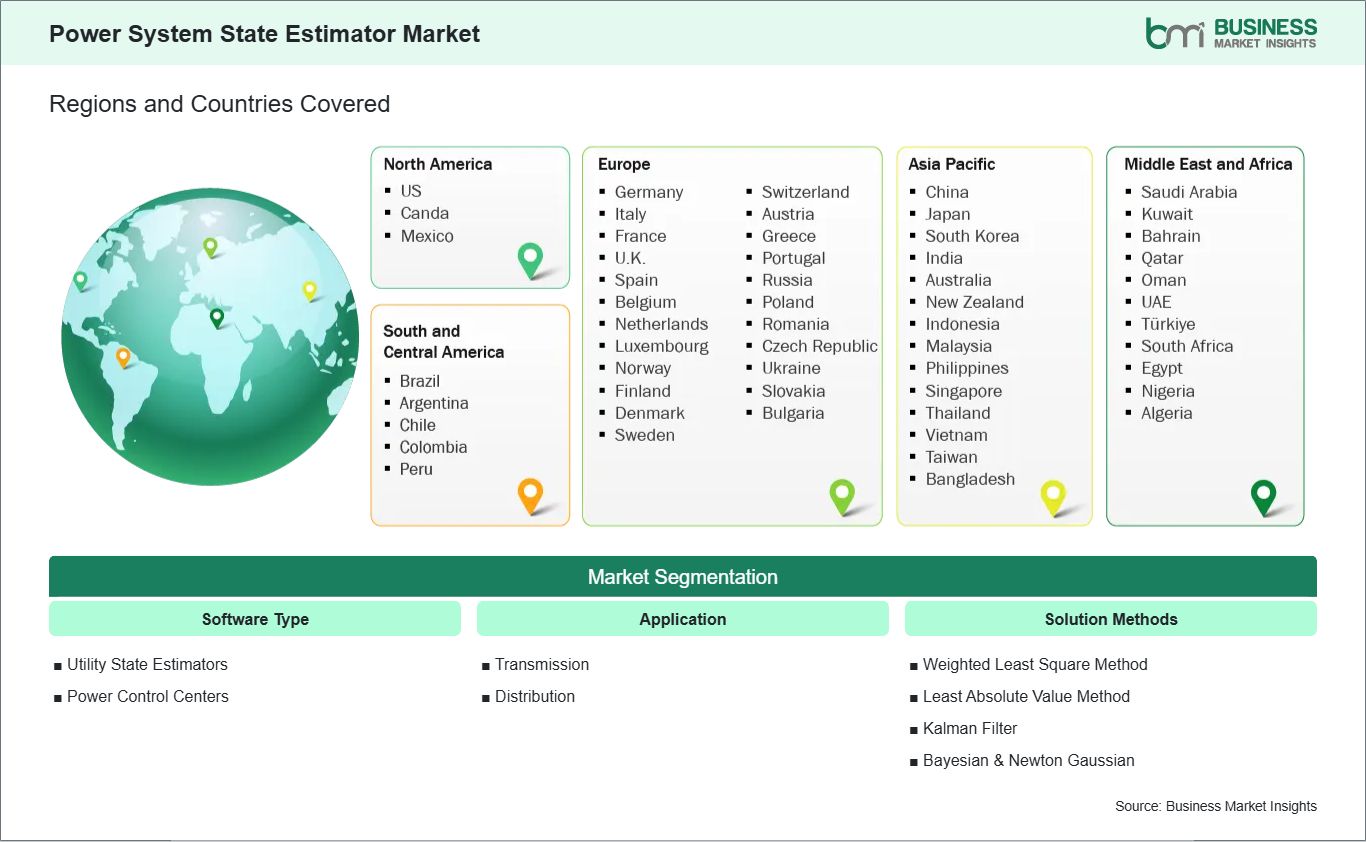
Key segments that contributed to the derivation of the Power System State Estimator market analysis are software type, application, and solution methods.
- By software type, the power system state estimator market is segmented into Utility State Estimators and Power Control Centers. The Utility State Estimators segment dominated the market in 2025.
- By application, the power system state estimator market is segmented into Transmission and Distribution. The Transmission segment dominated the market in 2025.
- By solution methods, the power system state estimator market is segmented into Weighted Least Square Method, Least Absolute Value Method, Kalman Filter, and Bayesian & Newton Gaussian. The Weighted Least Square Method segment dominated the market in 2025.
Market Forces
Power System State Estimator Market Drivers and Opportunities
Growing Need for Real-Time Grid Monitoring and Stability
Increased demand for real-time grid monitoring and stability has driven the growth of the power system's state estimator market. New technologies such as distributed energy resources and varying power demand are making modern power systems more complex and interrelated. Utilities require accurate, real-time visibility of grid conditions to operate efficiently and reliably. The use of state estimators allows operators to see voltage levels, power flows, and system health in real time. The rise in the likelihood of grid disturbances and failures has caused utilities to focus on advanced monitoring systems that provide greater situational awareness and assist in their decision-making processes. Power system state estimators are capable of detecting anomalies, predicting failures, and providing corrective measures prior to the occurrence of these issues. The increased use of smart grid technology and digital substations will further contribute to continued high demand for state estimator solutions. Demand for reliable real-time monitoring systems will continue to grow as the electric grid continues to evolve, resulting in significant growth for the state estimator market.
Expansion of Smart Grid and Digital Substations
The expansion of smart grid infrastructure and digital substations presents significant opportunities for the power system state estimator market. Smart grids rely on advanced communication, automation, and data analytics technologies to improve the efficiency and reliability of power systems. State estimators are essential components of these systems, enabling accurate monitoring and control of grid operations. Digital substations are increasingly being deployed to replace traditional infrastructure, offering enhanced data acquisition and real-time control capabilities. These substations generate large volumes of data, which can be effectively utilized by state estimators to provide accurate system insights. Utilities are investing in modernizing grid infrastructure to accommodate renewable energy integration and improve operational efficiency. As smart grid adoption accelerates globally, the demand for advanced state estimation solutions is expected to rise, creating strong growth opportunities for market players.
Size and Share Analysis
Power System State Estimator Market Size and Share Analysis
The global Power System State Estimator market is experiencing steady growth, with market size and share analysis reflecting evolving treatment preferences and competitive dynamics among key players. The report evaluates important subsegments categorized within software type, application, and solution methods, highlighting their respective contributions to overall market performance.
By software type, the Utility State Estimators subsegment dominated the market in 2025 due to their ability to provide accurate real-time grid visibility, detect system abnormalities, support decision-making, and ensure stable power system operations across complex and interconnected transmission and distribution networks.
By application, the Transmission subsegment dominated the market in 2025 due to increasing need for precise monitoring of high-voltage networks, ensuring grid stability, preventing cascading failures, supporting renewable integration, and enabling efficient long-distance electricity transmission across large interconnected power systems.
By solution methods, the Weighted Least Square Method subsegment dominated the market in 2025 due to its computational efficiency, robustness, and ability to handle measurement errors effectively, making it the most widely adopted technique for accurate and reliable power system state estimation in modern grids.
Report Coverage
Power System State Estimator Market Report Coverage and Deliverables
The "Power System State Estimator Market Size and Forecast (2022 - 2033)" report provides a detailed analysis of the market covering below areas:
- Power System State Estimator market size and forecast at the regional and country levels for segments covered under the scope
- Power System State Estimator market trends, as well as drivers, restraints, and opportunities
- Power System State Estimator market analysis covering key trends, regional framework, major players, regulations, and recent developments
- Industry landscape and competition analysis covering market concentration, heat map analysis, prominent players, and recent developments for the Power System State Estimator market
- Detailed company profiles, including SWOT analysis
Geographic Insights
Power System State Estimator Market Geographic Insights
The geographical scope of the Power System State Estimator market report is divided into: North America, Asia Pacific, Europe, Middle East & Africa, and South & Central America. North America held the largest share in 2025.
North America dominated the power system state estimator market due to strong investments in smart grid infrastructure and advanced power system technologies. The region has a highly developed electricity network with a strong focus on grid modernization, reliability, and resilience. Utilities in the United States and Canada are increasingly adopting advanced monitoring and control systems to manage complex and interconnected power networks effectively. The growing integration of renewable energy sources such as wind and solar is further driving the need for accurate state estimation solutions in the region. Additionally, the presence of leading technology providers and continuous advancements in digital grid technologies are supporting market growth. Government initiatives promoting energy efficiency and grid reliability are also encouraging the adoption of advanced state estimation systems. With ongoing investments in grid modernization and digital transformation, North America is expected to maintain its leading position in the global market.
Industry Activity
Recent Developments
The Power System State Estimator market is evaluated by gathering qualitative and quantitative data post primary and secondary research, which includes important corporate publications, association data, and databases. A few of the key developments in the Power System State Estimator market are:
- In February 2025, General Electric announced enhancements to its GridOS platform, enabling advanced grid orchestration and real-time visibility of grid conditions, supporting state estimation and grid optimization capabilities.
- In September 2023, ABB Ltd. announced upgrades to its ABB Ability Energy Management System with enhanced digital analytics and real-time monitoring features that support power system state estimation and grid stability functions.
- In May 2024, Schneider Electric announced new advancements in its EcoStruxure Grid solutions incorporating AI-driven analytics for improved grid visibility, state estimation, and decision-making in modern power networks.
Trust & Transparency
Research Methodology
The market analysis combines proprietary research with secondary data from government agencies, company disclosures, regulatory filings, industry databases and expert interviews. Market estimates are validated through data triangulation, cross-market benchmarking and analyst
review.
View Full Research Methodology
Key Sources Referred:
International Electrotechnical CommissionInstitute of Electrical and Electronics EngineersInternational Organization for StandardizationBureau of Indian StandardsCentral Electricity AuthorityMinistry of PowerIndian Electrical and Electronics Manufacturers' AssociationEuropean Committee for Electrotechnical StandardizationVDE Association for Electrical Electronic & Information TechnologiesCompany WebsitesCompany Annual ReportsCompany Investor Presentations