Market Summary
Executive Summary and Global Market Analysis
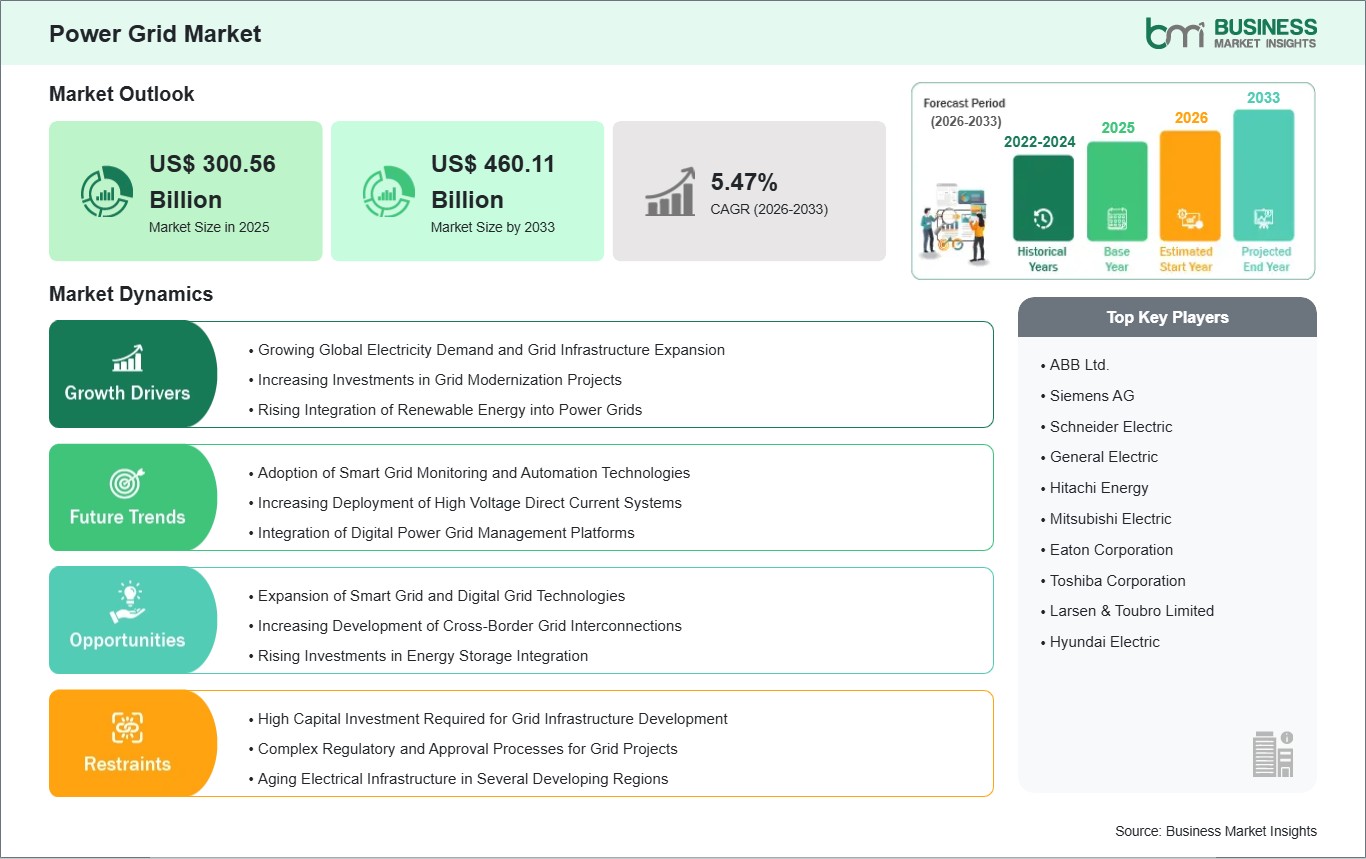
The power grid market is a significant sector in facilitating efficient electricity generation, transmission, and distribution in energy systems around the world. Power grid systems are essentially the backbone of a country’s energy system, providing a link between power generation plants and end users in various sectors such as residential, commercial, and industrial areas. Some of the most important equipment in power grid systems include transformers, transmission lines, switchgear, and substations that ensure efficient and reliable electricity supply across a wide area.
With a rise in electricity demand in recent years due to rapid industrialization and urbanization around the world, investments in power grid systems are witnessing tremendous growth. In addition to this, a rise in renewable energy sources such as solar and wind power is also contributing to the development and modernization of electrical grid systems. Advanced technologies including smart grids, digital monitoring platforms, and automated power distribution systems are improving grid efficiency and reliability. Besides, energy storage and cross-border grid interconnections are being used to upgrade the power distribution systems in different regions.
With countries continuously spending on energy security and developing electricity systems based on sustainability, the requirement for highly developed power grid technologies will maintain a steady rise. These factors are expected to drive the long-term development of the global power grid market.
Segment Analysis
Power Grid Market Segmentation
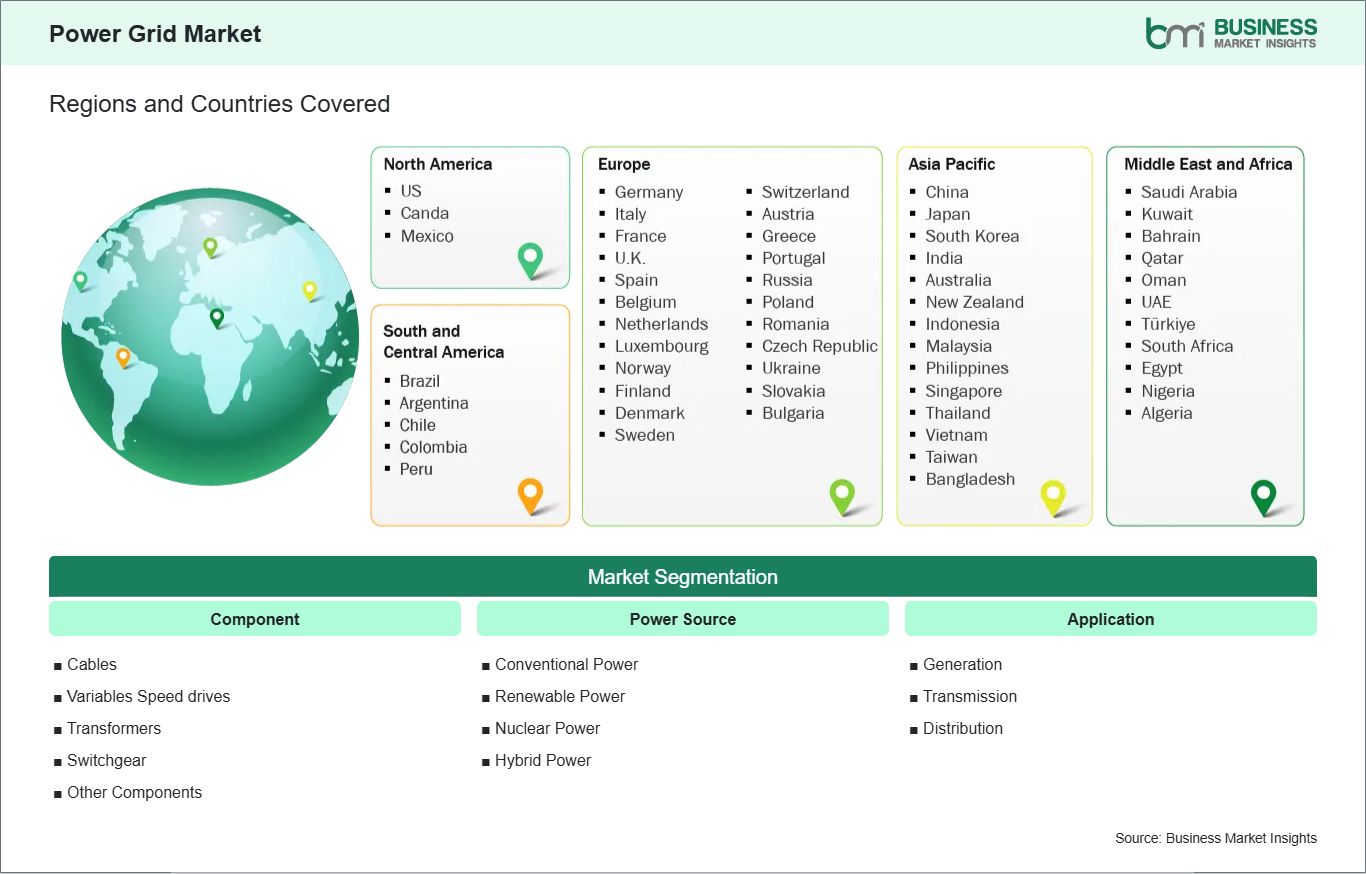
Key segments that contributed to the derivation of the Power Grid market analysis are component, power source, and application.
- By component, the power grid market is segmented into Cables, Variable Speed Drives, Transformers, Switchgear, and Others. The Transformers segment dominated the market in 2025.
- By power source, the power grid market is segmented into Conventional Power, Renewable Power, Nuclear Power, and Hybrid Power. The Conventional Power segment dominated the market in 2025.
- By application, the power grid market is segmented into Generation, Transmission, and Distribution. The Transmission segment dominated the market in 2025.
Market Forces
Power Grid Market Drivers and Opportunities
Growing Global Electricity Demand and Grid Infrastructure Expansion
The continuous increase in global electricity demand is a major driver for the power grid market. Rapid urbanization, industrial expansion, and population growth are significantly increasing electricity consumption across residential, commercial, and industrial sectors. Countries around the world are expanding their electrical infrastructure to ensure reliable power supply for growing energy requirements. Power grid systems play a critical role in enabling efficient electricity generation, transmission, and distribution across large geographical regions.
Governments and utility providers are investing heavily in upgrading existing grid infrastructure and building new transmission and distribution networks. These investments help improve electricity reliability, reduce power outages, and support growing energy demand. Many developing economies are also focusing on expanding rural electrification programs and strengthening national power networks. These initiatives require significant investments in transformers, transmission lines, substations, and other grid components. As electricity demand continues to increase globally, governments and utilities are prioritizing grid expansion projects to support stable and reliable energy distribution.
Expansion of Smart Grid and Digital Grid Technologies
The increasing adoption of smart grid technologies is creating major opportunities for the power grid market. Smart grids integrate advanced communication, monitoring, and automation technologies that enable utilities to manage electricity networks more efficiently and improve overall power system reliability. Smart grid systems allow real-time monitoring of electricity flow, enabling faster detection of faults and improved grid stability. These technologies help utilities optimize electricity distribution, reduce transmission losses, and improve power quality across large electrical networks. As energy demand becomes more complex, utilities are increasingly investing in digital grid infrastructure.
The growing integration of renewable energy sources such as solar and wind power is also accelerating smart grid deployment. Renewable energy generation can introduce variability into power systems, making advanced grid monitoring and control systems essential. As governments continue investing in digital energy infrastructure and smart grid modernization programs, demand for advanced power grid technologies is expected to increase significantly.
Size and Share Analysis
Power Grid Market Size and Share Analysis
The global Power Grid market is experiencing steady growth, with market size and share analysis reflecting evolving treatment preferences and competitive dynamics among key players. The report evaluates important subsegments categorized within component, power source, and application, highlighting their respective contributions to overall market performance.
By component, the Transformers subsegment dominated the market in 2025 due to their essential function in adjusting voltage levels during electricity transmission and distribution, enabling efficient power flow across grid networks while maintaining system stability and reducing transmission losses.
By power source, the Conventional Power subsegment dominated the market in 2025 due to the continued dominance of coal, natural gas, and oil-based power generation infrastructure that remains the primary electricity source supporting large-scale grid operations worldwide.
By application, the Transmission subsegment dominated the market in 2025 due to growing investments in high-voltage transmission lines and grid interconnection projects required to transport electricity efficiently from power plants to regional distribution networks.
Report Coverage
Power Grid Market Report Coverage and Deliverables
The "Power Grid Market Size and Forecast (2022 - 2033)" report provides a detailed analysis of the market covering below areas:
- Power Grid market size and forecast at the regional and country levels for segments covered under the scope
- Power Grid market trends, as well as drivers, restraints, and opportunities
- Power Grid market analysis covering key trends, regional framework, major players, regulations, and recent developments
- Industry landscape and competition analysis covering market concentration, heat map analysis, prominent players, and recent developments for the Power Grid market
- Detailed company profiles, including SWOT analysis
Geographic Insights
Power Grid Market Geographic Insights
The geographical scope of the Power Grid market report is divided into: North America, Asia Pacific, Europe, Middle East & Africa, and South & Central America. North America held the largest share in 2025.
North America dominated the power grid market in 2025 due to the presence of advanced electricity infrastructure and strong investments in grid modernization technologies. The United States and Canada have well-established power transmission and distribution networks that support large-scale electricity demand across residential, commercial, and industrial sectors. Utilities in the region are actively upgrading aging grid infrastructure to improve system reliability and reduce power outages.
Significant investments in smart grid technologies and digital grid monitoring platforms are further strengthening the region's power infrastructure. Utilities are deploying advanced technologies such as automated substations, high-voltage transmission systems, and grid monitoring software to enhance electricity distribution efficiency. Additionally, increasing integration of renewable energy sources such as wind and solar power is driving the need for more advanced grid management systems. Government initiatives supporting energy infrastructure modernization and electricity reliability are also contributing to market growth.
North America continues to invest in advanced power grid technologies to support energy security and sustainable electricity distribution. These factors are expected to help the region maintain its dominant position in the global power grid market.
Industry Activity
Recent Developments
The Power Grid market is evaluated by gathering qualitative and quantitative data post primary and secondary research, which includes important corporate publications, association data, and databases. A few of the key developments in the Power Grid market are:
- In February 2024, Siemens announced the launch of Gridscale X, a software platform designed to enable autonomous grid management and support utilities in scaling grid capacity, improving distributed energy resource visibility, and accelerating digital transformation in power grid operations.
- In March 2024, Hitachi Energy announced a collaboration with Grid United to deploy high-voltage direct current (HVDC) technology for transmission projects aimed at interconnecting eastern and western U.S. power grids and significantly boosting transmission capacity.
- In August 2024, Hitachi Energy announced the launch of the world’s highest-voltage SF₆-free switchgear, including the EconiQ 550 kV circuit breaker, designed to reduce greenhouse-gas emissions and modernize high-voltage power grid infrastructure..
Trust & Transparency
Research Methodology
The market analysis combines proprietary research with secondary data from government agencies, company disclosures, regulatory filings, industry databases and expert interviews. Market estimates are validated through data triangulation, cross-market benchmarking and analyst
review.
View Full Research Methodology
Key Sources Referred:
International Electrotechnical Commission Institute of Electrical and Electronics Engineers International Organization for Standardization Bureau of Indian Standards Central Electricity Authority Ministry of Power Indian Electrical and Electronics Manufacturers' Association European Committee for Electrotechnical Standardization VDE Association for Electrical Electronic & Information Technologies Company Websites Company Annual Reports Company Investor Presentations