
Pharmaceutical Blockchain Market Outlook: Size, Share, Trends, Growth Analysis, Competitive Landscape & Forecast, 2026-2033

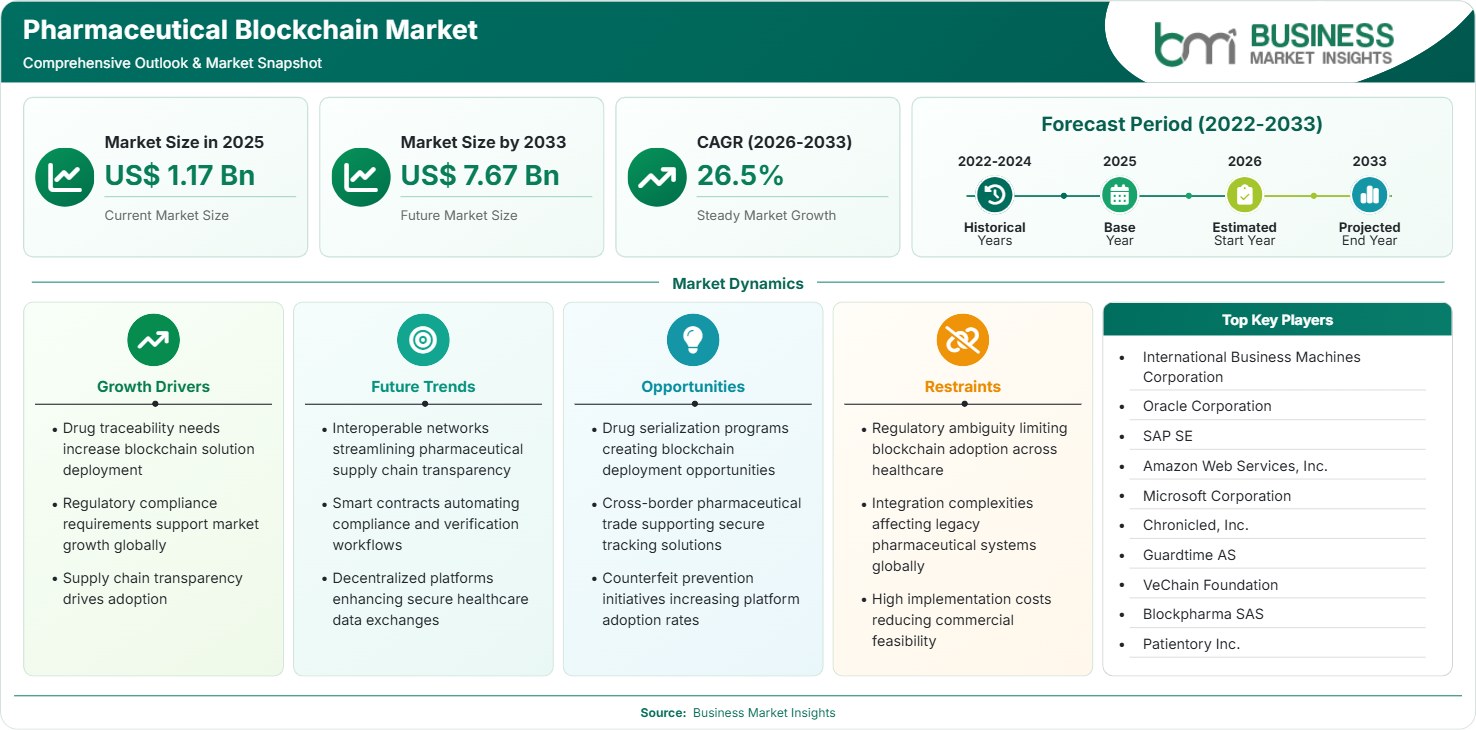
The Pharmaceutical Blockchain Market size was valued at US$ 1.17 Billion in 2025 and is projected to reach US$ 7.67 Billion by 2033, growing at a CAGR of 26.50% during 2026–2033. Rising drug traceability requirements, counterfeit prevention initiatives, DSCSA compliance mandates, multi-party data exchange needs, and growing adoption of decentralized supply-chain platforms create substantial opportunities across pharmaceutical ecosystems.

Report Coverage
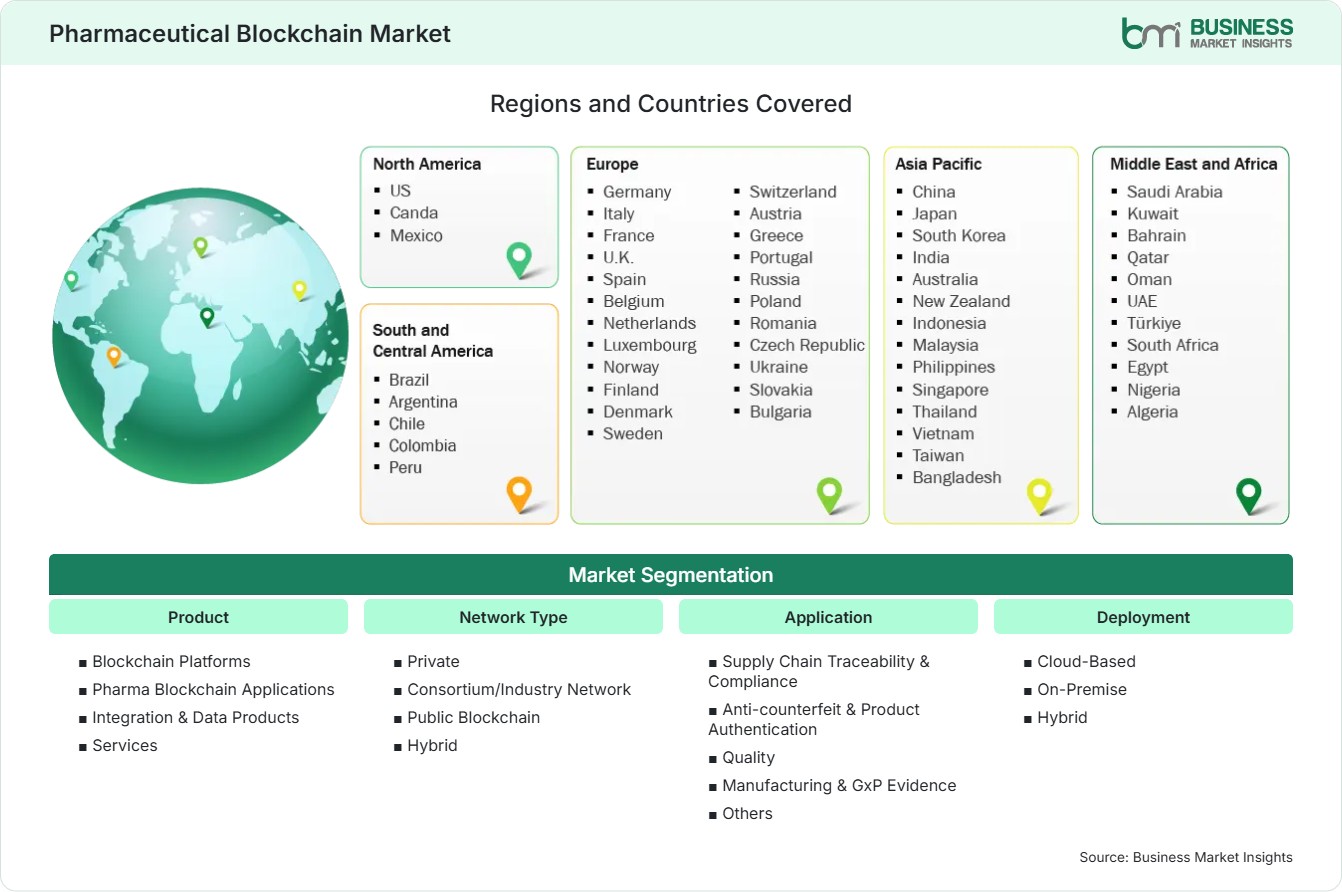
  • Product: Blockchain Platforms, Pharma Blockchain Applications, Integration & Data Products, Services
  • Network Type: Private, Consortium/Industry Network, Public Blockchain, Hybrid
  • Application: Supply Chain Traceability & Compliance, Anti-counterfeit & Product Authentication, Quality, Manufacturing & GxP Evidence, Others
  • Deployment: Cloud-Based, On-Premise, Hybrid
  • End User: Pharma & Biopharma Manufacturers, CMOs/CDMOs, Healthcare Providers & Health Systems, Others
US$ 1.17 Bn Market size in 2025
US$ 7.67 Bn Market Size by 2033
26.5% CAGR, 2026 - 2033
2026-2033 Forecast Period

AI Overview

Pharmaceutical Blockchain Market Summary

  • North America Region: North America holds a market share of 38%–42% in 2025, growing with a CAGR of 24%–27% during 2026–2033. Adoption is supported by DSCSA compliance requirements, mature digital infrastructure, serialization investments, distributor participation, and expanding blockchain-enabled pharmaceutical verification networks. The U.S. market benefits from large pharmaceutical manufacturing bases, DSCSA implementation, and growing consortium-driven interoperability initiatives, supporting a CAGR of 24%–27%.
  • Fastest Growing Region: Asia Pacific holds a market share of 23%–27% in 2025, expanding at a CAGR of 29%–32% through 2033. Growth is fueled by pharmaceutical exports, anti-counterfeit initiatives, digital health investments, government-backed traceability frameworks, expanding contract manufacturing, and increasing demand for trusted cross-border supply-chain validation.
  • Leading Segment: Supply Chain Traceability & Compliance accounts for 32%–36% of the Pharmaceutical Blockchain Market share in 2025 and is projected to grow at a CAGR of 27%–30%. Stringent regulatory oversight, serialization mandates, product lineage verification, recalls management, and secure stakeholder collaboration continue accelerating implementation across pharmaceutical networks worldwide.
  • High Growth Segment: Consortium/Industry Network represents a 28%–32% share in 2025 while advancing at a CAGR of 29%–33%. Industry participants increasingly favor shared governance structures that balance security, scalability, interoperability, compliance management, and cost-efficient participation among manufacturers, distributors, logistics providers, and hospitals.
  • Key Market Opportunity: Expanding biologics distribution networks and cross-border pharmaceutical trade create strong demand for interoperable blockchain platforms that support authenticity verification, temperature-sensitive shipment tracking, regulatory reporting, and trusted ecosystem-wide collaboration.
  • Major Market Players: International Business Machines Corporation, Oracle Corporation, SAP SE, Amazon Web Services, Inc., Microsoft Corporation, Chronicled, Inc., Guardtime AS, VeChain Foundation, Blockpharma SAS, Patientory Inc.
Strategic Insights

Pharmaceutical Blockchain Market: Strategic Insights

Pharmaceutical Blockchain Market Strategic Framework
FREE PDF
Request your free sample
Request free sample
Stakeholder View

Key Takeaways

  • The value chain is increasingly shifting toward network-based collaboration where manufacturers, distributors, regulators, and healthcare providers operate through shared digital records, reducing fragmented data environments and strengthening chain-of-custody transparency.
  • Supply chain verification, anti-counterfeit authentication, and consortium-led networks represent the most attractive commercialization opportunities due to expanding serialization mandates and global pharmaceutical trade complexity.
  • Innovation is moving toward integration of blockchain with AI analytics, IoT-enabled monitoring devices, smart contracts, and digital product passports capable of supporting automated compliance workflows.
  • Asia Pacific offers one of the strongest investment cases as pharmaceutical manufacturing capacity expansion, export-oriented production, and government-backed digitalization initiatives accelerate enterprise deployment.
  • Strategic partnerships increasingly dominate industry development, with technology vendors collaborating with pharmaceutical manufacturers, logistics companies, and healthcare systems to establish scalable ecosystem frameworks.
  • Contract manufacturing organizations and CDMOs are becoming influential adopters as sponsors seek transparent quality documentation and tamper-resistant manufacturing records across distributed production environments.
Geographic Outlook

Pharmaceutical Blockchain Market Regional Highlights

North America Pharmaceutical Blockchain Market

North America accounted for approximately 38%–42% of global revenue in 2025 and is projected to expand at a CAGR of 24%–27% through 2033. The region benefits from advanced pharmaceutical infrastructure, widespread serialization adoption, and strong regulatory oversight. The Pharmaceutical Blockchain Market share remains highest in this region because leading manufacturers, wholesalers, and technology providers actively participate in interoperable verification networks. Growing investment in DSCSA compliance, authentication solutions, and real-time traceability platforms continues to support long-term commercial deployment across pharmaceutical supply chains.

  • DSCSA implementation deadlines continue to encourage manufacturers and distributors to invest in interoperable verification systems capable of supporting serialization, transaction validation, and end-to-end pharmaceutical traceability requirements across national supply networks.
  • Consortium-led deployment models are gaining traction as stakeholders seek secure data-sharing environments that improve regulatory reporting, reduce reconciliation burdens, and strengthen ecosystem collaboration without compromising proprietary information.
  • Pharmaceutical logistics networks are increasingly integrating IoT sensors with blockchain records to ensure product integrity, monitor storage conditions, and improve accountability throughout transportation and warehousing operations.
  • Major healthcare institutions continue exploring distributed ledger technologies for credential management, quality reporting, and supply-chain documentation, creating adjacent opportunities beyond traditional serialization compliance use cases.

US Pharmaceutical Blockchain Market

The United States represents approximately 78%–82% of North American demand and is expected to grow at a CAGR of 24%–27% through 2033. Strong pharmaceutical R&D spending, regulatory digitization, and large-scale distribution infrastructure support commercial adoption. The Pharmaceutical Blockchain Market growth in the country is reinforced by active participation from leading technology firms, wholesalers, manufacturers, and healthcare networks pursuing secure multi-party transaction validation and product authentication.

  • DSCSA-driven interoperability requirements remain a primary catalyst for enterprise spending on traceability platforms, product verification networks, and blockchain-supported compliance infrastructure.
  • Large pharmaceutical distributors increasingly prioritize automated verification workflows that reduce administrative complexity while improving accuracy across trading partner ecosystems.
  • Growing cybersecurity concerns are encouraging healthcare organizations to evaluate decentralized architectures that provide stronger auditability and immutable transaction histories.
  • Strategic partnerships between technology providers and pharmaceutical companies continue accelerating production-scale deployment across commercial supply chains.

Europe Pharmaceutical Blockchain Market

The Europe region held 27% - 31% of the Pharmaceutical Blockchain Market share in 2025 and is expected to grow at 25%- 28%. The harmonization of regulations, manufacturing strength, and anti-counterfeit efforts are driving market growth in the region. Germany is leading adoption in this market with a CAGR of 25% - 28%, whereas France has shown rapid implementation at 27% - 30%, due to digital healthcare innovation initiatives and authentication-focused technology investments.

  • Compliance-focused investments across the European pharmaceutical industry continue strengthening demand for immutable documentation and product provenance solutions.
  • Regional manufacturers increasingly explore blockchain-powered quality documentation management to support audits and cross-border regulatory requirements.
  • Drug falsification prevention strategies remain an important catalyst for authentication-focused deployments throughout pharmaceutical distribution networks.
  • Integration of blockchain with sustainability reporting and supply-chain transparency initiatives is emerging as a differentiating factor among large manufacturers.

Asia Pacific Pharmaceutical Blockchain Market

Asia Pacific accounted for about 23%-27% of the Global Pharmaceutical Blockchain Market's total market revenue share in 2025 and is expected to exhibit the fastest CAGR of 29%-32% through 2033. Increased pharmaceutical production capabilities, exports, and government digital healthcare projects are driving the market growth. Presently, China leads the region due to economies of scale, whereas India experiences the fastest growth rate, at 30%-33%, supported by investments in serialization, contract manufacturing expansion, and supply-chain modernization initiatives serving international pharmaceutical markets.

  • Pharmaceutical exporters increasingly utilize blockchain-enabled verification frameworks to improve trust, streamline documentation requirements, and satisfy traceability expectations among overseas regulators and multinational buyers.
  • India’s expanding CDMO ecosystem is driving demand for secure quality documentation and transparent manufacturing records that support global compliance requirements.
  • China continues strengthening investment in smart manufacturing platforms integrating blockchain, industrial IoT, and enterprise resource planning systems.
  • Governments across Southeast Asia are accelerating healthcare digitalization programs, creating favorable conditions for distributed-ledger adoption in regulated pharmaceutical environments.
  • Growing prevalence of counterfeit medicines across selected emerging markets encourages authentication-focused deployments among manufacturers, distributors, and healthcare stakeholders.

Rest of World Pharmaceutical Blockchain Market

The Rest of World region accounted for approximately 8%–12% of the Pharmaceutical Blockchain Market in 2025 and is forecast to expand at a CAGR of 26%–29%. South & Central America benefit from pharmaceutical distribution modernization initiatives and expanding regulatory oversight. Brazil remains the leading market with growth of 26%–29%. In the Middle East & Africa, healthcare digitization and pharmaceutical investment programs are creating opportunities, with the UAE emerging as the fastest-growing market at 28%–31% through the forecast period.

  • Pharmaceutical traceability regulations across selected Latin American countries continue supporting investments in digital verification infrastructure and product authentication systems.
  • Brazil's pharmaceutical industry increasingly evaluates blockchain-enabled compliance solutions to improve supply-chain transparency and reduce counterfeit risks.
  • Gulf countries are investing in healthcare technology transformation programs that support secure data exchange and pharmaceutical monitoring capabilities.
  • International aid programs and healthcare modernization initiatives are creating opportunities for traceability-focused deployments throughout selected African markets.
  • Regional stakeholders increasingly collaborate with global technology providers to establish scalable and interoperable pharmaceutical verification ecosystems.
Global Market Geography
FREE PDF
Request your free sample
Request free sample
Segment Analysis

Pharmaceutical Blockchain Market Segmentation

Product

The product segment held around 34% - 38% market share in 2025 and is expected to witness growth at a CAGR of 25% - 28% by 2033. The scope of the Pharmaceutical Blockchain Market has been growing as companies seek platform ecosystems that encompass infrastructure, applications, integration, and professional services.

  • Blockchain Platforms: Foundational infrastructure enabling decentralized transaction recording, stakeholder collaboration, and immutable audit trails across pharmaceutical manufacturing, logistics, and distribution environments while supporting interoperability requirements.
  • Pharma Blockchain Applications: Purpose-built software solutions addressing product authentication, serialization validation, regulatory compliance management, recalls coordination, and pharmaceutical supply-chain visibility requirements across multi-party ecosystems.
  • Integration & Data Products: Connect legacy enterprise systems, serialization repositories, ERP environments, and quality-management platforms while improving data consistency, verification accuracy, and operational visibility throughout pharmaceutical networks.
  • Services: Consulting, implementation, customization, governance planning, integration support, cybersecurity assessments, and managed services helping organizations accelerate deployment and maximize blockchain program effectiveness.

Network Type

Network Type earned around 28%-32% of market revenue in 2025. The demand is rising as companies review their efficiency, scalability, security, and governance interoperability. It has become highly appealing to consortium-based networks, as it enables shared costs and reliable cooperation among many parties involved. The segment is forecast to grow at a 29%-33% CAGR through 2033.

  • Private: Favored by organizations handling sensitive operational data requiring strict access controls, centralized governance, compliance oversight, and customized deployment frameworks supporting enterprise-specific workflows.
  • Consortium/Industry Network: Enables trusted collaboration among manufacturers, distributors, regulators, and healthcare institutions through shared governance structures that improve traceability, interoperability, and compliance efficiency.
  • Public Blockchain: Limited but growing adoption for authentication transparency applications where broad verification capabilities and decentralized trust mechanisms provide value across geographically dispersed stakeholders.
  • Hybrid: Combines private governance with selective public-network validation, supporting security requirements while delivering greater transparency and operational flexibility across complex pharmaceutical ecosystems.

Application

Applications have the highest share, accounting for around 42%–46% of total revenues in 2025, with a CAGR of 27%–30%. Regulatory requirements, anti-counterfeiting programs, and business process transparency continue to influence product adoption decisions. Organizations are now focusing on achieving specific objectives like authentication accuracy, compliance efficiency, recall efficiency, and partner-wide information visibility.

  • Supply Chain Traceability & Compliance: Dominant use case enabling product journey tracking, serialization validation, regulatory reporting, and transaction traceability across manufacturing, distribution, and dispensing environments.
  • Anti-counterfeit & Product Authentication: Supports verification of pharmaceutical legitimacy through immutable records, helping stakeholders identify unauthorized products and strengthen patient safety protections.
  • Quality, Manufacturing & GxP Evidence: Facilitates tamper-resistant recording of quality processes, manufacturing events, and compliance evidence supporting audits, inspections, and regulatory documentation requirements.

Deployment

Deployment trends continue to shift toward scalable architectures. The market share for this category stood at around 22% - 26% of the Pharmaceutical Blockchain Market in 2025 and is expected to expand at a 28% - 31% CAGR. Organizations today consider all cost-related, cybersecurity-related, regulatory, and integration factors while choosing their deployment models.

  • Cloud-based: Preferred for scalability, simplified implementation, lower upfront infrastructure costs, and integration with advanced analytics, AI capabilities, and global collaboration environments.
  • On-premises: Chosen by organizations prioritizing direct infrastructure control, sensitive data management, internal governance requirements, and customized compliance frameworks.
  • Hybrid: Increasingly adopted to combine cloud scalability with localized control, enabling flexible deployment strategies aligned with operational and regulatory requirements.

End User

End-user adoption has continued to increase in the pharmaceutical industry. This market share accounted for about 30%–34% of the total market share as of 2025 and is projected to have a CAGR of 27%–31% through 2033. Growth in ecosystem participation creates more value for the network and enhances verification capacity.

  • Pharma & Biopharma Manufacturers: Lead adoption as product authenticity, regulatory compliance, serialization management, and global supply-chain visibility remain critical strategic priorities.
  • CMOs/CDMOs: Utilize blockchain technologies to support transparent manufacturing documentation, quality records, client collaboration, and compliance assurance throughout outsourced production workflows.
  • Healthcare Providers & Health Systems: Explore blockchain-enabled verification capabilities for procurement transparency, product authenticity assurance, and secure pharmaceutical transaction management.
Market Forces

Pharmaceutical Blockchain Market Dynamics

Key Market Drivers

Stringent Pharmaceutical Traceability Regulations

The continued expansion of regulations on pharmaceutical serialization and traceability is a major driving force. Regulatory systems in major pharmaceutical markets demand end-to-end product transparency, transaction verification, and documentation. The implementation of the Drug Supply Chain Security Act in the United States and other global compliance projects are forcing companies to adopt secure data-sharing frameworks. The Pharmaceutical Blockchain Market growth is driven by the ability to create an immutable record of all transactions without increasing the burden of manual reconciliation. Organizations need tools that can handle big volumes of product verification, recall operations, and compliance reporting.

Escalating Counterfeit Drug Risks Across Global Supply Chains

Nevertheless, counterfeit drugs continue to be an issue for the health care industry, pharma companies, and regulators. The rise of international pharmaceutical trade introduces additional complications for product verification and supplier transparency. Immutable ledgers can be used to build authentication platforms to establish product provenance and manage the chain of custody. More stakeholders are turning to distributed-ledger technology to ensure mutual trust among all ecosystem players and minimize the risk of product substitution. The Pharmaceutical Blockchain Market trends show rising demand for digital product verification solutions that deliver better patient safety outcomes and financial gains through reduced losses from counterfeit activities.

Integration of Blockchain with Digital Health Infrastructure

Transformation initiatives in the healthcare and life sciences industries are paving the way for blockchain adoption in many ways. Distributed ledger technologies are being integrated with cloud platforms, IoT tracking, AI-powered analytics, and other enterprise applications. This improves transparency and increases real-time visibility within pharmaceutical supply chain operations. The use of smart contracts is making compliance management easier by automating processes, thereby reducing delays and administrative costs. Growing interest in interoperability and the security of healthcare information sharing will further increase blockchain adoption. In light of the growing need for robust digital ecosystems that facilitate compliance, blockchain continues to attract investment.

Key Market Opportunities

Cross-Border Pharmaceutical Trade Digitization

Global pharmaceutical trade continues to become more complex due to diversified manufacturing networks and multinational distribution structures. A blockchain platform is a perfect solution for recording the flow of products within a jurisdiction while increasing regulatory transparency among regulators, logistics providers, and manufacturers. Businesses looking to expand through exporting require solutions to improve documentation and speed up compliance checks. According to Pharmaceutical Blockchain Market Forecasts, investments can be made in innovative solutions that help develop interoperable international traceability frameworks. The new markets that export pharmaceutical products are seen as key demand centers.

Expansion of Biologics and Specialty Drug Monitoring

Biologics, cell therapies, and specialty medicines need strict temperature management, quality control, and custody monitoring. The use of blockchain technology ensures data integrity for tracking and compliance verification throughout the entire product lifecycle. Players are increasingly adopting IoT-based monitoring technologies alongside distributed ledger technologies to improve shipment traceability and integrity. Such features are especially important for high-end pharmaceutical drugs whose quality deviations will have considerable clinical and financial repercussions. The rise of advanced therapies offers many opportunities for blockchain companies to provide integrated services that combine authentication, monitoring, compliance reporting, and ecosystem-wide data transparency.

Consortium-Based Healthcare Ecosystem Development

There is a growing realization among industry members that the value of isolated instances is minimal compared with that of collaborative ecosystems. Consortium-based networks enable manufacturers, distributors, healthcare organizations, and regulators to exchange verified data without being bound by any central ownership issues. The approach makes the solution scalable, while enabling the distribution of implementation costs among the members. Favorable conditions for implementation through a consortium approach are becoming more common, driven by increasing demand for interoperability models. Companies in the pharmaceutical industry interested in compliance management and traceability are promoting collaborative approaches that provide insight into the entire network.

Market Restraints and Challenges

Data Interoperability and Legacy System Integration Complexity

Factor: The pharmaceutical industry relies on many legacy systems across production, logistics, quality control, and compliance. Impact: Incorporating blockchain-based platforms into the current system may lead to increased implementation costs, longer timeframes, and difficulty managing processes. Enterprises may have data infrastructure that is fragmented and has taken decades to develop. Customization and re-engineering of processes may be required for successful integration. There may be differences in data governance rules amongst parties in the network, leading to difficulties during implementation. These issues may discourage organizations from adopting blockchain, especially smaller pharmaceutical firms.

Governance, Privacy, and Regulatory Uncertainty

Factor: Regulations governing decentralized data management, international data sharing, and network governance are constantly evolving. Impact: Organizations might be hesitant to invest due to uncertainties regarding compliance and ongoing responsibilities. For pharmaceutical companies, it is necessary to strike a balance between the benefits of transparency and the need to protect confidentiality regarding intellectual property rights, production processes, and business relationships. Governance of the network itself is a question that needs to be settled by several parties with different interests. Uncertainty in governance leads to low adoption even when there are operational advantages in the network.

Company Analysis

Competitive Landscape

Pharmaceutical Blockchain Market analysis indicates competition is centered on enterprise blockchain infrastructure, pharmaceutical traceability applications, interoperability services, and consortium-based ecosystem development.

Company Name

Overview

Products and Services relevant to this market

International Business Machines Corporation

Global technology provider offering enterprise blockchain infrastructure, consulting, integration, and digital transformation capabilities for regulated industries.

Blockchain platforms, supply-chain traceability solutions, cloud integration, consulting services, digital identity capabilities, and compliance-focused deployment support.

Oracle Corporation

Enterprise software provider serving life sciences organizations with cloud, database, and supply-chain management solutions.

Blockchain-enabled supply-chain applications, pharmaceutical tracking tools, cloud services, analytics, and compliance management platforms.

SAP SE

Major enterprise software company supporting end-to-end business process digitalization across manufacturing and healthcare sectors.

Supply-chain visibility platforms, blockchain integration capabilities, ERP connectivity, analytics, and pharmaceutical compliance solutions.

Amazon Web Services, Inc.

Cloud infrastructure leader providing scalable blockchain deployment environments and enterprise integration capabilities.

Managed blockchain services, cloud infrastructure, data management tools, analytics, and secure application hosting.

Microsoft Corporation

Technology provider delivering cloud-based digital transformation platforms for healthcare and life sciences customers.

Azure-based blockchain ecosystem support, identity management, cloud services, analytics, and interoperability solutions.

Chronicled, Inc.

Pharmaceutical-focused blockchain specialist supporting trusted trading networks and compliance-driven ecosystem collaboration.

MediLedger-related network capabilities, verification solutions, partner onboarding, and pharmaceutical supply-chain applications.

Guardtime AS

Cybersecurity and blockchain company specializing in integrity assurance and trusted digital record management.

Data integrity platforms, audit verification systems, compliance tools, and secure transaction validation technologies.

VeChain Foundation

Blockchain ecosystem organization focused on traceability, provenance, and enterprise transparency use cases.

Product authentication tools, traceability platforms, ecosystem infrastructure, and supply-chain visibility capabilities.

Blockpharma SAS

Specialized healthcare technology company addressing pharmaceutical authentication and anti-counterfeit challenges.

Drug verification applications, product authentication solutions, patient-focused validation tools, and traceability technologies.

Patientory Inc.

Healthcare-focused company supporting secure data exchange and decentralized healthcare information management.

Blockchain-enabled healthcare data solutions, interoperability services, security tools, and patient information platforms.

Trust & Transparency

Research Methodology

The market analysis combines proprietary research with secondary data from government agencies, company disclosures, regulatory filings, industry databases and expert interviews. Market estimates are validated through data triangulation, cross-market benchmarking and analyst review.

View Full Research Methodology

Questions Answered

Frequently Asked Questions

Which end-user group is expected to create strong future demand?

Pharma and biopharma manufacturers remain the largest adopters, while CMOs and CDMOs are emerging as high-potential users due to increasing requirements for transparent manufacturing records, client collaboration, and regulatory documentation.

What insights does the Pharmaceutical Blockchain Market Report provide?

The Market Report evaluates revenue outlook, technology adoption patterns, competitive positioning, regional demand dynamics, segment performance, investment opportunities, and key strategic developments shaping industry expansion through 2033.

How are consortium networks influencing market development?

Consortium models enable stakeholders to share governance, infrastructure costs, and trusted data while maintaining operational independence. Such networks improve interoperability and strengthen ecosystem-wide collaboration compared with isolated enterprise deployments.

Which application area generates the highest revenue contribution?

Supply Chain Traceability & Compliance leads revenue generation because manufacturers, distributors, and regulators require end-to-end product visibility, transaction verification, and audit-ready documentation supporting product authentication and regulatory compliance.

What factors are accelerating adoption of blockchain in pharmaceutical supply chains?

Serialization mandates, anti-counterfeit initiatives, growing compliance requirements, and demand for trusted transaction records are encouraging pharmaceutical organizations to deploy blockchain-enabled verification and traceability solutions across increasingly complex distribution networks.

Access the Full Pharmaceutical Blockchain Market Report

Get segment-level forecasts, regional estimates, competitive benchmarking, company profiles and downloadable Excel datasets.

Access the full Pharmaceutical Blockchain Market Report
350 pages PDF & Excel | 2026-11-10
Similar Research

Related Market Reports