Market Summary
Executive Summary and Global Market Analysis
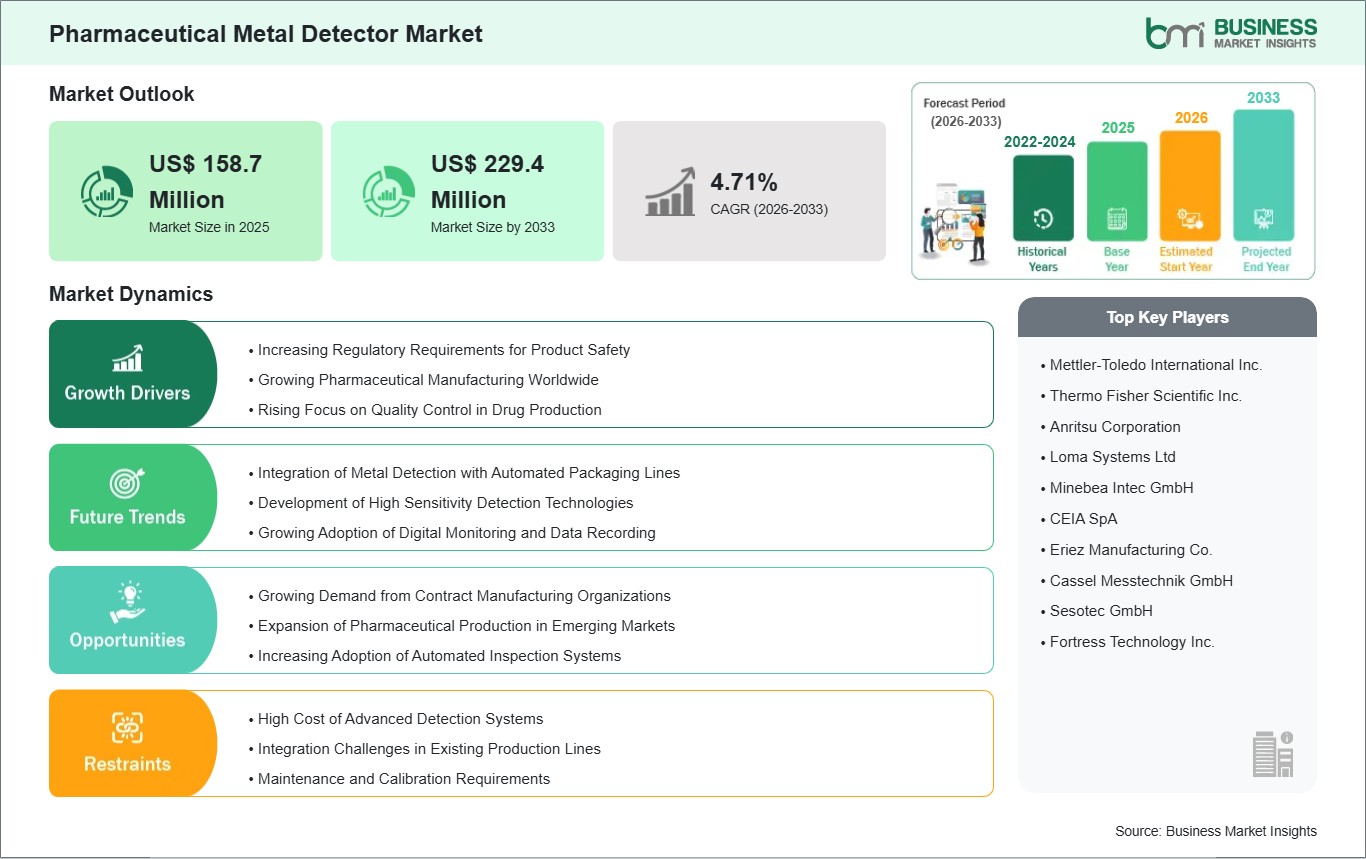
The pharmaceutical metal detector market is expanding as drug manufacturers focus on maintaining high product safety and quality standards. Pharmaceutical metal detectors are used to identify and remove metal contaminants from products during manufacturing and packaging processes. These systems are widely used in the production of tablets, capsules, powders, granules, and liquid medicines. By detecting metal particles in pharmaceutical products, manufacturers can prevent contamination and ensure compliance with strict regulatory requirements.
Growing pharmaceutical production and increasing regulatory oversight are driving the demand for metal detection systems. Pharmaceutical companies are implementing advanced inspection technologies to ensure that products meet safety standards before reaching the market. Metal detectors are often integrated into automated production lines, allowing continuous monitoring of products during processing and packaging. As pharmaceutical manufacturing continues to expand and quality control requirements become more stringent, the adoption of pharmaceutical metal detection systems is expected to increase steadily across global production facilities.
Segment Analysis
Pharmaceutical Metal Detector Market Segmentation
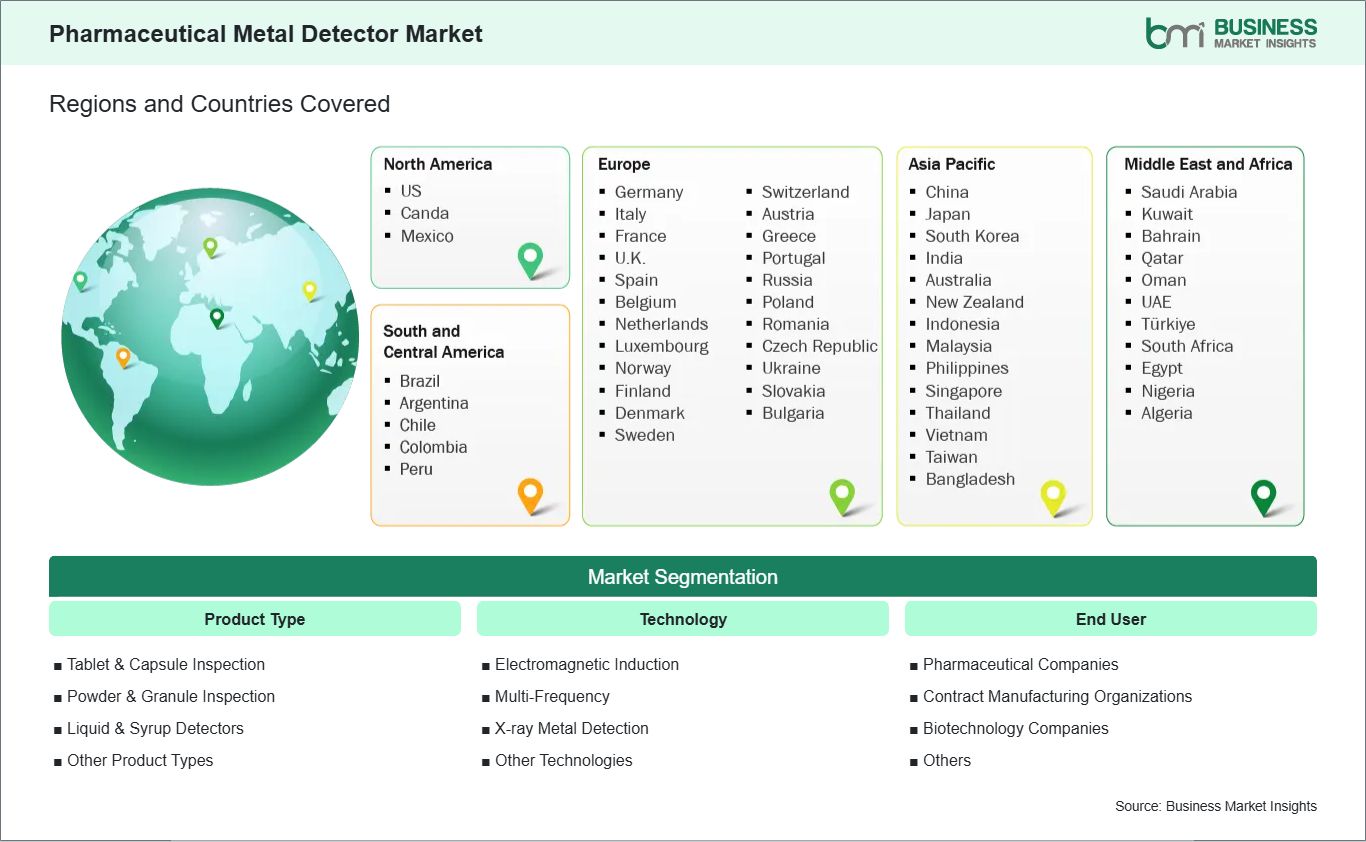
Key segments that contributed to the derivation of the pharmaceutical metal detector market analysis are product type, technology, end user.
- By product type, the pharmaceutical metal detector market is segmented into tablet & capsule inspection, powder & granule inspection, liquid & syrup detectors, and others. The tablet & capsule inspection segment dominated the market in 2025.
- By technology, the market is classified into electromagnetic induction, multi-frequency, X-ray metal detection, and others. The electromagnetic induction segment dominated the market in 2025.
- By end user, the market is segmented into pharmaceutical companies, contract manufacturing organizations, biotechnology companies, and others. The pharmaceutical companies segment dominated the market in 2025.
Market Forces
Pharmaceutical Metal Detector Market Drivers and Opportunities
Increasing Regulatory Requirements for Product Safety
Increasing regulatory requirements for product safety are a major driver for the pharmaceutical metal detector market. Pharmaceutical manufacturers must ensure that their products are free from metal contamination during the production process. Regulatory authorities require strict quality control measures to protect patient safety and maintain the integrity of pharmaceutical products.
Metal detectors are widely used in pharmaceutical production lines to detect and remove metal contaminants that may enter products during manufacturing. These contaminants can originate from machinery wear, processing equipment, or packaging materials. By identifying metal particles early in the production process, manufacturers can prevent contaminated products from reaching the market.
Regulatory agencies require pharmaceutical companies to maintain strict inspection and quality assurance systems. Metal detection equipment helps manufacturers comply with these requirements by ensuring product safety and reducing the risk of product recalls. As regulatory standards for pharmaceutical manufacturing continue to become more stringent, the demand for reliable metal detection technologies is expected to increase across the industry.
Growing Demand from Contract Manufacturing Organizations
The growing demand from contract manufacturing organizations (CMOs) presents significant opportunities for the pharmaceutical metal detector market. Many pharmaceutical companies are outsourcing drug production to CMOs in order to reduce manufacturing costs and improve operational efficiency. These organizations must maintain high quality standards to meet the requirements of their clients and regulatory authorities.
Contract manufacturers often produce large volumes of pharmaceutical products for multiple companies. As a result, they require advanced inspection and contamination detection systems to ensure product safety. Pharmaceutical metal detectors help CMOs monitor production lines and detect metal contaminants in tablets, capsules, powders, and liquids.
In addition, CMOs must comply with international regulatory guidelines and maintain strict quality assurance procedures. Metal detection systems support these requirements by providing reliable contamination detection during manufacturing and packaging processes. As pharmaceutical outsourcing continues to grow globally, the demand for metal detection equipment in contract manufacturing facilities is expected to increase significantly.
Size and Share Analysis
Pharmaceutical Metal Detector Market Size and Share Analysis
The global pharmaceutical metal detector market is experiencing steady growth, with market size and share analysis reflecting evolving treatment preferences and competitive dynamics among key players. The report evaluates important subsegments categorized within product type, technology, end user, highlighting their respective contributions to overall market performance.
By product type, the tablet & capsule inspection subsegment dominated the market in 2025 due to the high production volume of solid dosage forms and strict quality control requirements in pharmaceutical manufacturing.
By technology, the electromagnetic induction subsegment dominated the market in 2025 because it is widely used for detecting metal contaminants in pharmaceutical products with high sensitivity and reliability.
By end user, the pharmaceutical companies subsegment dominated the market in 2025 due to the need for strict contamination control and regulatory compliance during drug manufacturing processes.
Report Coverage
Pharmaceutical Metal Detector Market Report Coverage and Deliverables
The "Pharmaceutical Metal Detector Market Size and Forecast (2022 - 2033)" report provides a detailed analysis of the market covering below areas:
- Pharmaceutical Metal Detector market size and forecast at the regional and country levels for segments covered under the scope
- Pharmaceutical Metal Detector market trends, as well as drivers, restraints, and opportunities
- Pharmaceutical Metal Detector market analysis covering key trends, regional framework, major players, regulations, and recent developments
- Industry landscape and competition analysis covering market concentration, heat map analysis, prominent players, and recent developments for the Pharmaceutical Metal Detector market
- Detailed company profiles, including SWOT analysis
Geographic Insights
Pharmaceutical Metal Detector Market Geographic Insights
The geographical scope of the pharmaceutical metal detector market report is divided into: North America, Asia Pacific, Europe, Middle East & Africa, and South & Central America. North America held the largest share in 2025.
North America dominates the pharmaceutical metal detector market due to the strong presence of pharmaceutical manufacturers and strict regulatory frameworks in the region. Regulatory authorities require pharmaceutical companies to maintain rigorous quality control processes to ensure product safety. Metal detection systems are widely used in pharmaceutical production lines to detect contaminants and support compliance with industry standards.
The region also benefits from advanced manufacturing infrastructure and high adoption of automated inspection technologies. Pharmaceutical companies in North America invest heavily in quality assurance systems to maintain product integrity and prevent contamination during drug production. Metal detectors help manufacturers monitor production lines and ensure that pharmaceutical products meet strict safety requirements.
In addition, the presence of leading pharmaceutical companies and technology providers contributes to the development and adoption of advanced detection systems. Continuous investment in pharmaceutical research, manufacturing expansion, and quality control technologies supports the growth of the market in the region. These factors help North America maintain its leading position in the global pharmaceutical metal detector market.
Industry Activity
Recent Developments
The pharmaceutical metal detector market is evaluated by gathering qualitative and quantitative data post primary and secondary research, which includes important corporate publications, association data, and databases. A few of the key developments in the Pharmaceutical Metal Detector market are:
- In September 2023, Anritsu Infivis, announced the introduction of the XR75 Pharma X-ray inspection system designed for pharmaceutical and nutraceutical production lines, enabling inspection of capsule and tablet packs while simultaneously detecting contaminants and verifying product quality during packaging inspection.
- In 2023, Anritsu Infivis, highlighted its M6 Tablet Metal Detector designed specifically for pharmaceutical and nutraceutical applications to detect metal contaminants in tablets and capsules during production and packaging processes, strengthening its pharmaceutical inspection portfolio.
Trust & Transparency
Research Methodology
The market analysis combines proprietary research with secondary data from government agencies, company disclosures, regulatory filings, industry databases and expert interviews. Market estimates are validated through data triangulation, cross-market benchmarking and analyst
review.
View Full Research Methodology
Key Sources Referred:
The World BankISPE (International Society for Pharmaceutical Engineering)PDA (Parenteral Drug Association)USP (United States Pharmacopeia)FDA (U.S. Food and Drug Administration)Company WebsitesCompany Annual ReportsCompany Investor Presentations