
Online Accommodation Booking Market Outlook: Size, Share, Trends, Growth Analysis, Competitive Landscape & Forecast, 2026-2033

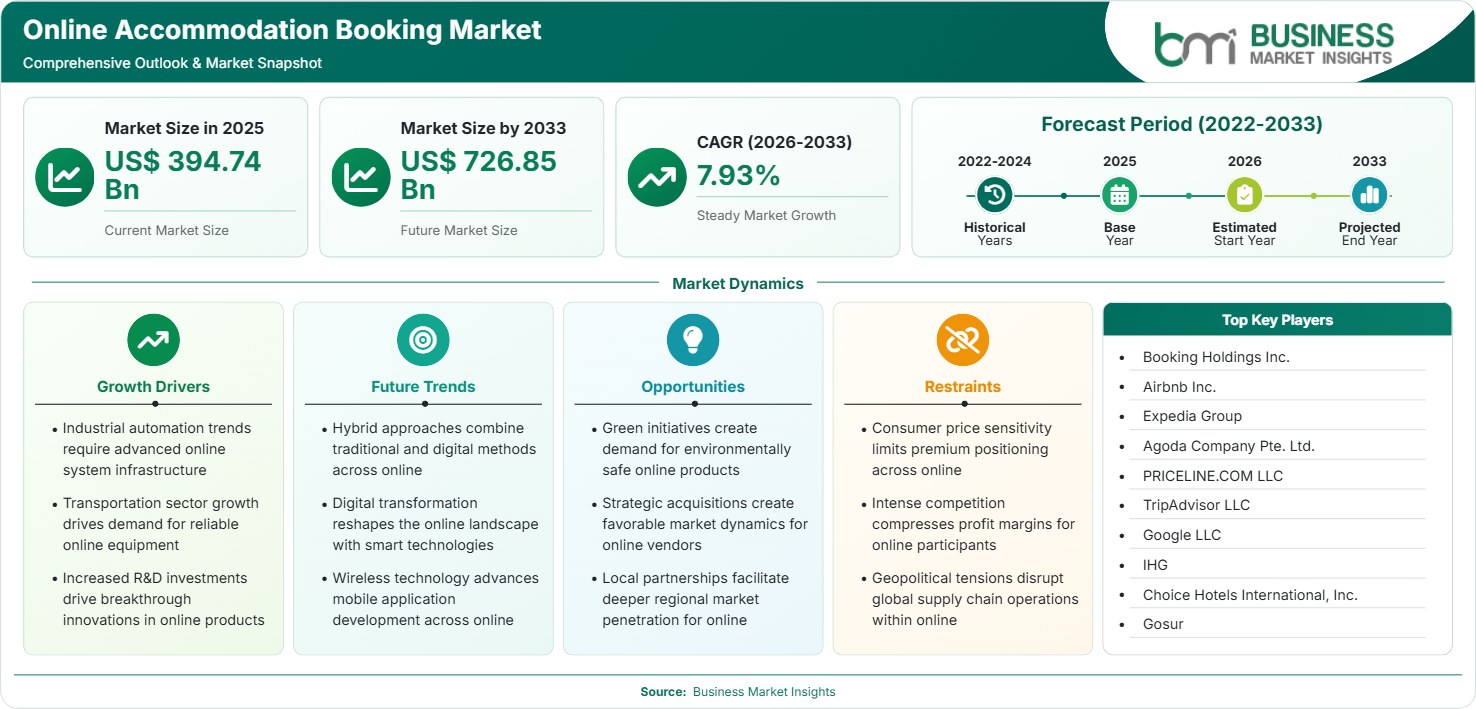
The Online Accommodation Booking Market size was valued at US$394.74 Billion in 2025 and is projected to reach US$726.85 Billion by 2033, growing at a CAGR of 7.93% during 2026–2033, driven by mobile-first booking, AI personalization, expanding digital payments, and rising travel demand.

Report Coverage
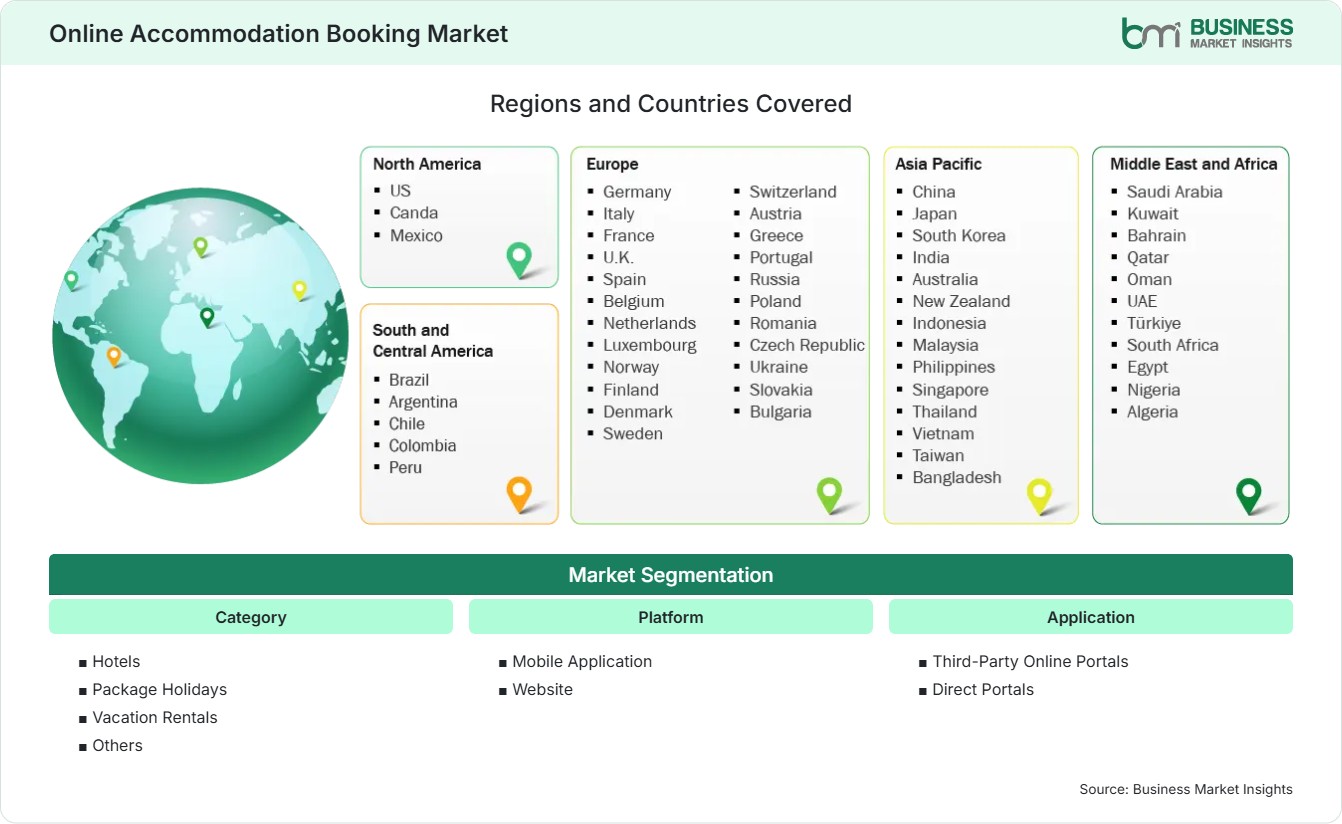
  • Category: Hotels, Package Holidays, Vacation Rentals, Others
  • Platform: Mobile Application, Website
  • Application: Third-Party Online Portals, Direct Portals
US$ 394.74 Bn Market size in 2025
US$ 726.85 Bn Market Size by 2033
7.93% CAGR, 2026 - 2033
2026-2033 Forecast Period

01 AI Overview

Online Accommodation Booking Market Summary

  • North America Region: North America holds a 34%–37% share in 2025, growing at a 6.5%–7.5% CAGR during 2026–2033, supported by mature digital travel infrastructure, loyalty ecosystems, mobile booking, alternative lodging adoption, personalized discovery, and integrated payment capabilities. The US accounts for 78%–82% of North America's share, with a 6.4%–7.4% CAGR, driven by high online penetration, strong hotel chains, sophisticated loyalty programs, and AI-enabled trip planning.
  • Fastest Growing Region: Asia Pacific holds a 28%–32% share in 2025, expanding at an 8.8%–10.2% CAGR during 2026–2033, driven by rising disposable incomes, expanding domestic tourism, smartphone adoption, digital wallets, low-cost air connectivity, and increasing accommodation inventory across emerging destinations.
  • Leading Segment: Hotels account for a 58%–62% share in 2025, advancing at a 7.1%–8.0% CAGR during 2026–2033, supported by broad inventory, standardized service expectations, loyalty integration, business travel recovery, branded accommodation expansion, and increasingly personalized digital reservation experiences.
  • High Growth Segment: Mobile Application is estimated at a 42%–46% share in 2025, growing at an 8.8%–10.0% CAGR during 2026–2033, propelled by app-exclusive pricing, digital wallets, location services, push notifications, personalized recommendations, loyalty benefits, and seamless booking management.
  • Key Market Opportunity: AI-assisted discovery, conversational booking, dynamic packaging, alternative accommodation, embedded payments, and creator-led commerce create opportunities to improve conversion, reduce abandonment, increase ancillary revenue, and deepen customer loyalty.
  • Major Market Players: Booking Holdings Inc.; Airbnb, Inc.; Expedia Group, Inc.; Agoda Company Pte. Ltd.; PRICELINE.COM LLC; Tripadvisor, Inc.; Google LLC; InterContinental Hotels Group PLC; Choice Hotels International, Inc.; Go-Sur; Oravel Stays Limited; trivago N.V.
02 Strategic Insights

Online Accommodation Booking Market: Strategic Insights

Online Accommodation Booking Market Strategic Framework
FREE PDF
Request your free sample
Request free sample
03 Stakeholder View

Key Takeaways

  • The value chain is consolidating around platforms capable of combining accommodation inventory, metasearch visibility, payments, loyalty, customer service, and ancillary travel products. Suppliers increasingly balance third-party distribution against direct channels to optimize acquisition costs and customer ownership.
  • Mobile applications and alternative accommodation formats offer the strongest upside because they combine high-frequency digital engagement with personalized offers, location-aware recommendations, flexible cancellation, and increasingly sophisticated loyalty mechanics.
  • AI is moving beyond recommendation engines into itinerary generation, conversational search, image interpretation, booking assistance, and post-booking support. Agoda's Booking Form Bot, launched in January 2026, addresses last-minute booking questions around cancellation, promotions, and pricing directly within the reservation flow.
  • India represents a compelling investment case because online travel behavior is already established while AI-assisted planning is accelerating. Agoda reported that nine in ten Indian travelers used travel apps when booking trips in its 2025 survey, creating favorable conditions for app-based accommodation discovery and conversion.
  • Capital allocation is increasingly favoring technology, loyalty, hotel distribution, payment infrastructure, and portfolio expansion rather than standalone booking interfaces. The competitive advantage is shifting toward ecosystems that can monetize each traveler across multiple stages of the journey.
  • Direct and third-party channels are becoming complementary rather than mutually exclusive. Hotel groups can use third-party platforms for incremental reach while deploying loyalty benefits, member pricing, and first-party data to increase direct conversion and reduce dependency on paid acquisition.
04 Geographic Outlook

Online Accommodation Booking Market Regional Highlights

North America Online Accommodation Booking Market

North America held an estimated 34%–37% Online Accommodation Booking Market share in 2025 and is projected to expand at a 6.5%–7.5% CAGR through 2033. The region benefits from mature online booking behavior, extensive branded lodging supply, high credit-card penetration, strong loyalty ecosystems, and widespread mobile adoption. The US remains the dominant contributor, while Canada supports cross-border leisure and outdoor tourism demand. Alternative lodging, flexible cancellation, and AI-powered discovery are strengthening platform engagement as travelers compare price, location, reviews, and loyalty benefits before booking.

  • Mature hotel chains continue integrating loyalty accounts, member rates, mobile check-in, and personalized offers, increasing the strategic value of first-party traveler data across accommodation distribution channels.
  • Vacation rentals are expanding platform inventory in urban, resort, and extended-stay categories, creating additional choice for families, remote workers, and travelers seeking larger properties with kitchen facilities.
  • AI-assisted search is reshaping discovery by reducing the need for repetitive filtering and enabling travelers to describe preferences around location, budget, amenities, and trip purpose.
  • Payment tokenization, digital wallets, flexible cancellation, and buy-now-pay-later functionality are improving checkout convenience while helping platforms address abandonment during high-consideration accommodation purchases.

US Online Accommodation Booking Market

The US represented approximately 78%–82% of North America's Online Accommodation Booking Market share in 2025 and is forecast to grow at a 6.4%–7.4% CAGR through 2033. The country's mature travel ecosystem combines extensive hotel inventory, large vacation-rental supply, strong loyalty programs, and sophisticated digital payments. Online booking is deeply embedded in leisure and business travel, while platform competition increasingly centers on personalization, customer retention, direct connectivity, and ancillary monetization rather than simple inventory aggregation.

  • Branded hotel groups are strengthening direct booking propositions through loyalty pricing, mobile applications, personalized rewards, and integrated digital services, while maintaining third-party distribution for incremental demand generation.
  • Alternative accommodation continues broadening beyond leisure tourism into extended stays, group travel, business trips, and experience-led journeys, increasing competition between traditional lodging and platform-based rental inventory.
  • AI-powered search and conversational planning are becoming important acquisition interfaces as travelers increasingly expect recommendations that combine accommodation preferences with destination activities, transportation, and budget considerations.

Europe Online Accommodation Booking Market

Europe accounted for an estimated 25%–29% share in 2025 and is projected to grow at a 6.8%–8.0% CAGR through 2033. The region benefits from dense tourism networks, extensive short-haul connectivity, mature hotel infrastructure, and strong cross-border travel. Germany, the UK, France, Italy, and Spain remain leading countries, while Türkiye and Poland represent higher-growth opportunities at approximately 8.0%–10.0% and 7.8%–9.2% CAGRs, respectively, supported by tourism investment, urban travel, and digital adoption.

  • Cross-border travel supports multilingual booking interfaces, localized payment options, and flexible cancellation policies, encouraging platforms to invest in regional personalization and customer service capabilities.
  • France, Spain, Italy, Germany, and the UK remain important accommodation destinations, while Türkiye and Poland provide comparatively faster digital booking expansion and increasing hotel and alternative lodging inventory.
  • Regulatory scrutiny of platform relationships, consumer rights, pricing transparency, and short-term rentals is encouraging greater compliance investment and influencing how platforms manage supplier relationships and property listings.
  • Rail-linked tourism and city-break travel are strengthening demand for mobile booking, especially where travelers compare multiple destinations and accommodation options during compressed planning cycles.
  • Sustainability information is becoming increasingly relevant to European travelers, encouraging platforms and lodging providers to surface environmental credentials, transport accessibility, and responsible tourism attributes during discovery.

Asia Pacific Online Accommodation Booking Market

Asia Pacific accounted for approximately 28%–32% of the Online Accommodation Booking Market in 2025 and is expected to expand at an 8.8%–10.2% CAGR through 2033. China, Japan, India, Australia, and South Korea remain leading markets, while India, Indonesia, and Vietnam show higher growth potential, with CAGRs of approximately 10.0%–12.0%, 9.5%–11.0%, and 9.2%–10.8%, respectively, supported by smartphone adoption, domestic tourism, expanding middle-class travel, and digital payments.

  • Mobile-first travel behavior is particularly strong across Asia Pacific, where super-app ecosystems, digital wallets, instant payments, and localized interfaces reduce friction between travel discovery and accommodation purchase.
  • India is emerging as a high-potential destination for AI-assisted travel planning, with Agoda reporting strong consumer receptiveness to AI recommendations and established use of travel applications.
  • Southeast Asian destinations benefit from expanding international tourism, low-cost aviation, and increasing hotel supply, creating opportunities for platforms to aggregate fragmented accommodation inventory.
  • China, Japan, South Korea, and Australia provide relatively mature digital travel ecosystems, while emerging Southeast Asian economies offer stronger incremental growth as online booking penetration rises.
  • Regional platforms are increasingly combining accommodation with flights, activities, payments, and loyalty, enabling higher transaction frequency and improving opportunities for cross-selling across the travel journey.

Rest of World Online Accommodation Booking Market

South and Central America represented part of the remaining regional opportunity, supported by expanding domestic tourism, improving mobile connectivity, and rising adoption of digital payments. Brazil and Mexico lead regional booking activity, while Colombia and Chile offer higher-growth potential, with estimated CAGRs of 8.0%–9.5% and 7.5%–9.0%, respectively. Platform localization and broader hotel inventory remain important expansion levers.

The Middle East and Africa represent an emerging digital accommodation opportunity, with the UAE and Saudi Arabia leading current demand and Egypt and Morocco offering attractive tourism-led growth. The combined Rest of World region is estimated at 8%–12% share in 2025 and a 7.8%–9.5% CAGR through 2033.

  • Brazil and Mexico benefit from large domestic travel bases, established hotel networks, and increasing consumer comfort with mobile reservations and digital payment methods.
  • Saudi Arabia and the UAE are attracting accommodation investment through tourism diversification, major events, infrastructure development, and destination development initiatives.
  • Egypt and Morocco provide strong potential for digitally enabled travel distribution as international tourism expands and accommodation supply becomes increasingly accessible through online platforms.
  • Local payment methods, multilingual interfaces, and flexible cancellation options remain important competitive differentiators in markets where payment preferences and traveler expectations vary substantially.
Global Market Geography
FREE PDF
Request your free sample
Request free sample
05 Segment Analysis

Online Accommodation Booking Market Segmentation

Category

Category segmentation is led by hotels, which represented an estimated 58%–62% share of the Online Accommodation Booking Market in 2025 and is projected to grow at a 7.1%–8.0% CAGR from 2026–2034. Hotels benefit from standardized inventory, loyalty integration, business travel demand, and broad platform visibility, while vacation rentals provide differentiated accommodation experiences and increasingly compete for mainstream leisure demand.

  • Hotels: Hotels remain the primary digital accommodation category because travelers value standardized services, loyalty benefits, predictable cancellation terms, and extensive geographic coverage across business and leisure destinations.
  • Package Holidays: Package holidays combine accommodation with flights or other travel components, attracting price-sensitive consumers seeking convenience, bundled value, and simplified trip planning through integrated booking platforms.
  • Vacation Rentals: Vacation rentals appeal to families, groups, and extended-stay travelers requiring kitchens, multiple bedrooms, privacy, and residential amenities, with platform technology improving discovery and trust.

Platform

Platform segmentation is increasingly shaped by mobile engagement, with mobile applications estimated at a 42%–46% share in 2025 and expanding at an 8.8%–10.0% CAGR from 2026–2034. The Online Accommodation Booking Market scope is broadening as applications integrate loyalty, payments, messaging, AI recommendations, and post-booking services, strengthening repeat usage and customer retention.

  • Mobile Application: Mobile applications enable personalized recommendations, app-exclusive pricing, location-aware discovery, push notifications, digital wallets, loyalty benefits, and real-time reservation management throughout the travel journey.
  • Website: Websites remain essential for high-consideration bookings, complex searches, desktop research, corporate travel, and travelers comparing extensive accommodation information before finalizing reservations.

Application

Application segmentation reflects the balance between third-party reach and supplier-owned customer relationships. Third-party online portals remain influential because of extensive inventory and comparison functionality, while direct portals benefit from loyalty programs, member pricing, and first-party customer data. These dynamics continue shaping channel economics and distribution strategies.

  • Third-Party Online Portals: Third-party portals aggregate extensive accommodation inventory, enable price comparison, and provide discovery scale, making them valuable for independent hotels and travelers seeking broad selection.
  • Direct Portals: Direct portals allow accommodation providers to control customer relationships, personalize offers, promote loyalty benefits, reduce intermediary dependence, and capture first-party data for retention strategies.
06 Market Forces

Online Accommodation Booking Market Dynamics

Key Market Drivers

Mobile-First Booking and Digital Payment Adoption

Mobile-first mindset is one of the important factors responsible for the market’s development since more and more customers use smartphones in order to find, compare, book and manage accommodation. According to the 2025 Global Passenger Survey by IATA, there was also a trend towards mobile travel where 19% of passengers prefer web applications to 16% in 2024. Mobile payments rose up to 28% from 20%. These trends support Online Accommodation Booking Market trends centered on app-exclusive pricing, one-click checkout, biometric authentication, digital receipts, and real-time booking management. Platforms that integrate payment flexibility, loyalty benefits, and personalized recommendations within a single mobile journey can increase conversion while reducing friction during high-intent reservation sessions.

AI-Powered Personalization and Conversational Discovery

Artificial intelligence is changing accommodation discovery by transforming keyword-based search into intent-driven interaction. Travelers can now provide information about destination, budget, preferred amenities, trip duration, and interests in natural language form to enable the platform to make more tailored accommodation recommendations for users. Google’s innovations in the field of travel AI for 2025 illustrated how the experience of searching can be combined with trip planning and booking. Agoda has implemented AI technology for vacation booking and planning. This evolution strengthens Online Accommodation Booking Market growth through the optimization of the process of discovery and through possible reduction of abandonment due to information overload. The competitive challenge lies in the area of proprietary traveler data, recommendations, conversational UI, and contextual merchandising to turn travel intent into bookable rooms.

Expansion of Integrated Travel Ecosystems

Travel platforms have started venturing beyond lodging to incorporate air, activities, transfers, payment, and loyalty into their businesses. Such an ecosystem helps the business create a higher lifetime value for each customer since they can make several purchases within the ecosystem. For instance, Agoda says that their ecosystem allows users to benefit from more than six million holiday homes, over 130,000 flights, and more than 300,000 activities. For hotel suppliers, ecosystem participation can create incremental demand while increasing competition for visibility. The strategic implication is that Online Accommodation Booking Market trends will have increased reflection on cross-category data integration, bundled purchases, loyalty economics, and the capability of providing an integrated experience from inspiration through post-trip engagement.

Key Market Opportunities

AI Agents and Automated Booking Assistance

AI agents create an opportunity to redesign accommodation booking around conversational commerce rather than conventional search interfaces. Rather than going through numerous filters, travelers can provide criteria and let AI systems filter properties, make comparisons between the cancellation policies, find the best deals, and book hotels accordingly. Agoda’s Booking Form Bot is an example of how this technology can be used for immediate practical purposes, as the bot helps answer queries at checkout, especially those related to cancellations and promotions as well as any other uncertainties that may arise.The opportunity extends toward agentic booking workflows capable of monitoring prices, managing itinerary changes, and coordinating accommodation with flights and activities. Online Accommodation Booking Market Forecasts will increasingly rely on how well platforms translate AI-generated intent into transactions that can be measured while ensuring transparency, supplier control, privacy adherence, and adequate customer service.

Emerging Travel Economies and Mobile-First Consumers

Up-and-coming travel economies create plenty of scope for growth for booking platforms due to the simultaneous growth of both accommodation supply and digital demand. Some countries such as India, Indonesia, Vietnam, Saudi Arabia, and Latin America have a rising volume of tourists in addition to more smartphones and acceptance of digital payments. The Indian market is especially appealing because, according to Agoda's research of 2026, 68 percent of people will use AI on their upcoming trip and 88 percent of them trusted AI recommendations. Investment options may range from purchasing inventory locally, integrating payments regionally, multilingual support for customers, to collaboration with finance apps. It is easier for platforms that create robust local ecosystems from the get-go to win back returning customers and build good supplier relations before things heat up.

Creator Commerce and Social Travel Discovery

The process of discovery of places to visit will become more and more affected by creators, short videos, recommendations on social networks, and community-based content. This opens up new possibilities to combine inspiration and accommodation bookings, bridging the gap between discovery and transaction. In October 2025, the Agoda Ambassadors program was launched, giving travel creators an opportunity to create bookings through the use of a unique code, and earning commissions from that. This potential is high in markets where youth use social channels for their bookings and where bookings are driven by visual stories. Creator commerce could not only bring a diverse set of customers but also booking attribution and incremental supplier reach.

Market Restraints and Challenges

Customer Acquisition Costs and Channel Dependence

Factor: The increased cost of customer acquisition and reliance on paid traffic may affect platform profitability as the competitiveness of search advertising, metasearch positioning, social media advertising, and performance marketing increases.

Impact: Higher acquisition expenses can reduce contribution margins and encourage platforms to prioritize loyalty, direct traffic, repeat bookings, and proprietary ecosystems. Accommodations providers are also faced with a similar issue due to the fact that depending on external websites might mean higher distribution costs and limited access to customer information. Such conflict serves as an encouragement for hotels to provide themselves with direct reservation systems and still work through intermediaries for additional business. The platforms need to prove their value in conversions, inventory management, and retention in order to be justified in taking money from the suppliers.

Regulatory Complexity, Privacy, and Accommodation Supply Constraints

Factor: Scrutiny by regulatory bodies regarding short-term rentals, consumer protection, data privacy, pricing transparency, taxes, and platform accountability may make it necessary for businesses to be more compliant in different regions.

Impact: Higher operating complexity may restrict inventory availability, raise compliance costs, and limit the scalability of standardized platform models. The supply of accommodations is also likely to be limited in popular destinations, where there are regulations around short-term rentals by local governments, and where issues around housing affordability are being taken into account when making policy decisions. The platforms will have to constantly innovate in areas like listing verifications, identification requirements, tax payments, data handling, and content management. This increases costs for the platform in terms of technology and operations, especially when the business is run in many jurisdictions.

07 Company Analysis

Competitive Landscape

The Online Accommodation Booking Market analysis indicates that competition is increasingly defined by inventory depth, brand reach, mobile engagement, loyalty ecosystems, AI capabilities, payment infrastructure, and the ability to connect accommodation with broader travel services.

Company Name

Overview

Products and Services relevant to this market

Booking Holdings Inc.

Global digital travel company with a diversified portfolio spanning accommodation, travel reservations, and consumer-facing booking platforms across major markets.

Online hotel reservations, vacation rentals, flight and travel booking, metasearch, payments, loyalty, mobile applications, and connected travel services.

Airbnb, Inc.

Technology platform specializing in unique stays and alternative accommodation, with strong brand recognition among leisure, group, and experience-oriented travelers.

Vacation rentals, homes, rooms, experiences, host services, digital discovery, booking management, payments, and travel-related services.

Expedia Group, Inc.

Major online travel company operating multiple consumer brands and extensive accommodation distribution infrastructure across global leisure and business travel segments.

Hotel booking, vacation rentals, package holidays, flights, car rentals, activities, loyalty programs, mobile applications, and partner distribution.

Agoda Company Pte. Ltd.

Digital travel platform with strong Asia Pacific positioning and broad accommodation inventory, increasingly emphasizing AI-powered planning and booking assistance.

Hotels, holiday properties, flights, activities, mobile booking, AI travel planning, booking assistance, payments, and integrated travel reservations.

PRICELINE.COM LLC

Online travel booking platform recognized for accommodation deals, flexible search, and value-focused consumer propositions across leisure travel categories.

Hotels, vacation rentals, flights, rental cars, package deals, mobile applications, price comparison, and booking services.

Tripadvisor, Inc.

Travel technology company combining destination content, traveler reviews, accommodation discovery, and commercial travel services.

Hotel comparison, accommodation discovery, reviews, vacation rentals, travel planning, advertising, and booking-related referral services.

Google LLC

Technology company providing travel discovery and comparison capabilities integrated into its broader search and digital ecosystem.

Hotel search, accommodation comparison, travel discovery, maps integration, price information, AI-assisted trip planning, and booking referrals.

InterContinental Hotels Group PLC

Global hotel company operating a large branded lodging portfolio and proprietary loyalty ecosystem with growing digital distribution capabilities.

Hotel reservations, direct booking, loyalty, mobile applications, branded accommodation, business travel services, and digital guest experiences.

Choice Hotels International, Inc.

Hotel franchisor with extensive branded accommodation coverage and a consumer-facing reservation ecosystem serving value, midscale, and extended-stay travelers.

Hotel reservations, direct digital booking, loyalty, franchised accommodation, extended-stay offerings, mobile services, and corporate travel solutions.

Go-Sur

Travel booking platform participating in digital accommodation discovery and reservation services, supporting consumers seeking online lodging options.

Accommodation search, online reservations, travel discovery, booking services, and digital travel distribution capabilities.

Oravel Stays Limited

Hospitality technology company operating the OYO brand with a focus on standardized budget and value accommodation across multiple geographies.

Budget hotels, vacation stays, accommodation reservations, mobile booking, property management technology, and digitally enabled hospitality services.

trivago N.V.

Metasearch platform helping travelers compare accommodation options across multiple booking providers and evaluate pricing and property information.

Hotel metasearch, price comparison, accommodation discovery, booking referrals, advertising solutions, and travel search technology.

10 Trust & Transparency

Research Methodology

The market analysis combines proprietary research with secondary data from government agencies, company disclosures, regulatory filings, industry databases and expert interviews. Market estimates are validated through data triangulation, cross-market benchmarking and analyst review.

View Full Research Methodology

11 Questions Answered

Frequently Asked Questions

Which accommodation formats are gaining strategic importance?

The Online Accommodation Booking Market Report highlights that the vacation rentals and alternative lodging are increasingly important alongside hotels, particularly for families, groups, extended stays, and travelers seeking residential amenities. Their expansion gives platforms broader inventory and allows travelers to compare different accommodation experiences within one booking environment.

What role do digital payments play in accommodation reservations?

Digital wallets, tokenized cards, instant payment systems, and flexible payment options simplify checkout and can reduce booking abandonment. Payment localization is particularly important in emerging markets where consumer preferences vary substantially by country.

How does creator marketing influence accommodation reservations?

Travel creators can shorten the path from inspiration to purchase by pairing destination storytelling with trackable booking links, promotional codes, and affiliate incentives. This approach can provide platforms and suppliers with measurable customer acquisition opportunities.

Why are hotels investing in direct digital channels?

Direct channels provide greater control over customer relationships, first-party data, loyalty engagement, and promotional strategy. Hotels can reduce distribution dependence while using third-party platforms strategically to reach new customers and fill incremental demand.

What is changing most rapidly in Online Accommodation Booking Market?

AI is shifting accommodation discovery from keyword and filter-based search toward conversational planning and personalized recommendations. Mobile applications are also evolving into full travel management hubs that combine discovery, booking, payments, loyalty, and post-booking support.

Access the Full Online Accommodation Booking Market Report

Get segment-level forecasts, regional estimates, competitive benchmarking, company profiles and downloadable Excel datasets.

Access the full Online Accommodation Booking Market Report
350 pages PDF & Excel | 2026-08-17