
Mineral Oil Market Outlook: Size, Share, Trends, Growth Analysis, Competitive Landscape & Forecast, 2022-2033

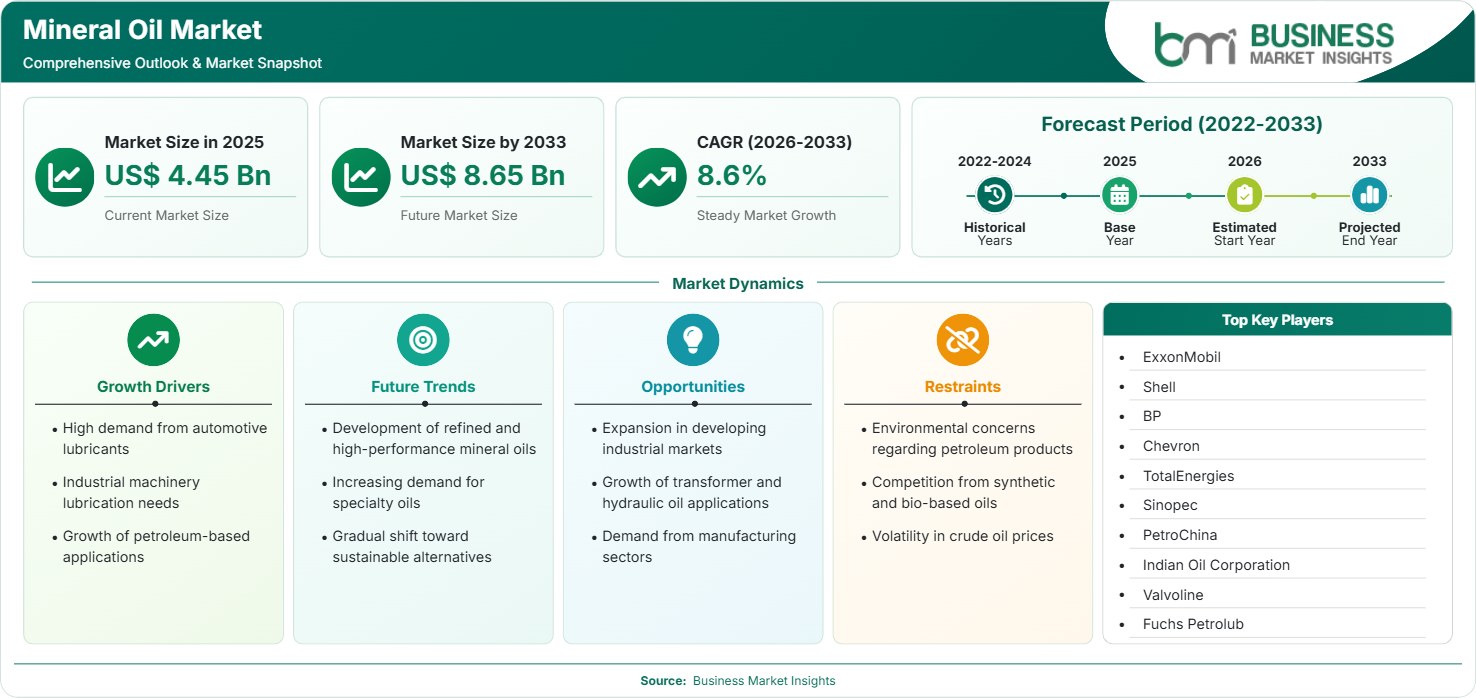
The Mineral Oil Market size was valued at USD 4.45 Billion in 2025 and is projected to reach USD 8.65 Billion by 2033, growing at a CAGR of 8.6% during 2026–2033. Growth is supported by rising industrial manufacturing, expanding automotive production, increasing demand for pharmaceutical-grade white mineral oil, and investments in power transmission infrastructure. Additional opportunities are emerging from industrialization across Asia Pacific and development of advanced lubricant formulations for specialized applications.

Report Coverage
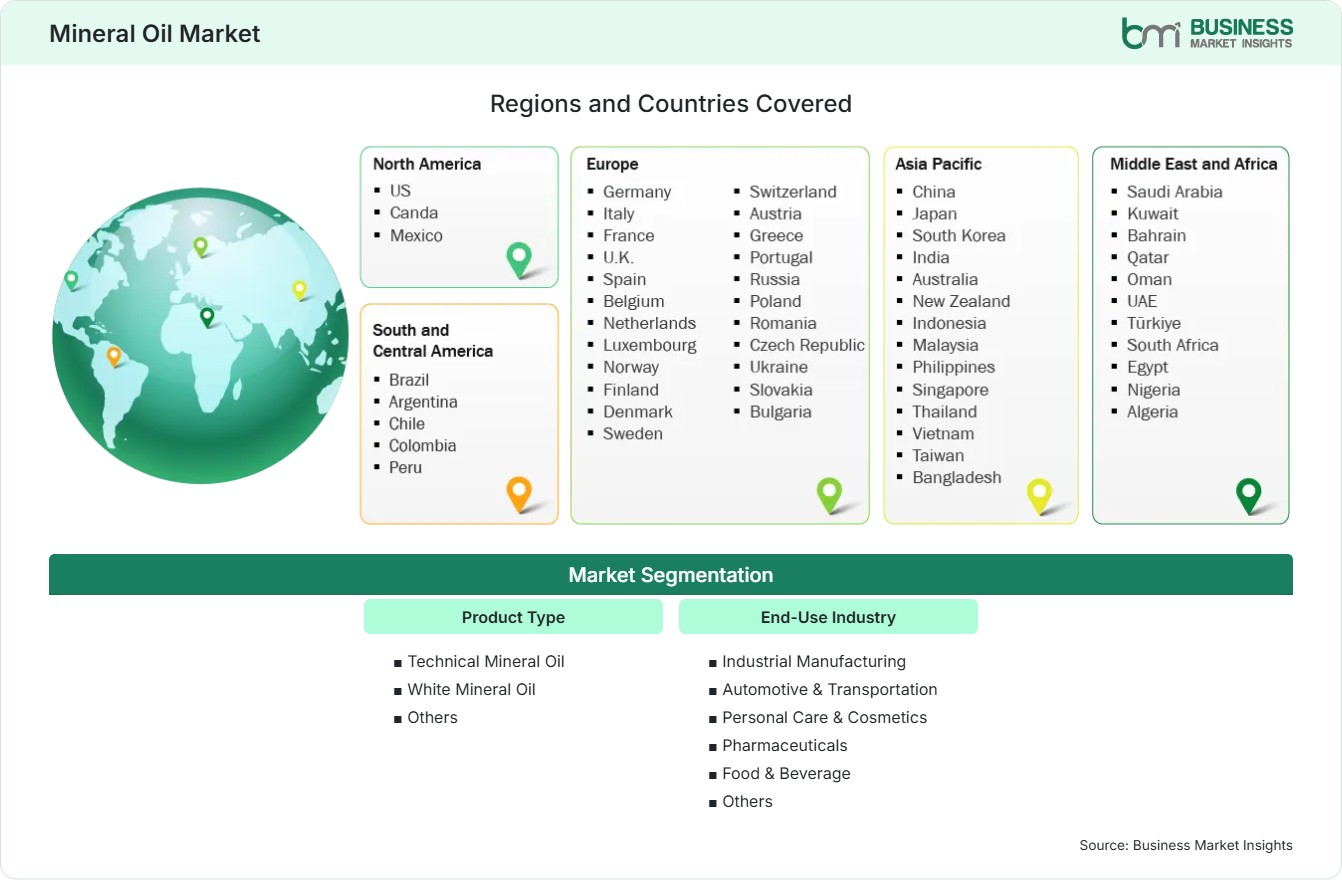
  • Product Type: Technical Mineral Oil, White Mineral Oil, Others
  • End-Use Industry: Industrial Manufacturing, Automotive & Transportation, Personal Care & Cosmetics, Pharmaceuticals, Food & Beverage, Others
US$ 4.45 Bn Market size in 2025
US$ 8.65 Bn Market Size by 2033
8.6% CAGR, 2026 - 2033
2026-2033 Forecast Period

AI Overview

Mineral Oil Market Summary

  • North America Region: North America accounted for 34%–37% market share in 2025 and is projected to grow at a CAGR of 7.4%–7.8% during 2026–2033. Stable industrial output, strong automotive aftermarket demand, expanding pharmaceutical-grade applications, and modernization of industrial assets continue supporting regional growth. The United States is expected to register a CAGR of 7.5%–7.9%.
  • Fastest Growing Region: Asia Pacific held 29%–32% market share in 2025 and is forecast to record the fastest CAGR of 9.8%–10.3% through 2033. Rapid industrialization, manufacturing investments, automotive production, healthcare expansion, and rising industrial lubricant consumption continue driving regional demand.
  • Leading Segment: Industrial Manufacturing accounted for 35%–38% market share in 2025 and is projected to expand at a CAGR of 8.2%–8.7%. Continuous machinery lubrication, factory automation, equipment installations, and preventive maintenance programs continue supporting demand.
  • High Growth Segment: White Mineral Oil represented 24%–27% market share in 2025 and is expected to grow at a CAGR of 9.3%–9.8%. Pharmaceutical manufacturing, cosmetics production, food-grade lubricants, and stringent purity requirements continue accelerating adoption.
  • Key Market Opportunity: Rising investments in pharmaceutical manufacturing, food processing, transformer infrastructure, and premium industrial lubricants are creating long-term opportunities for suppliers of highly refined, regulatory-compliant mineral oil products.
  • Major Market Players: Exxon Mobil Corporation, Shell plc, BP p.l.c., Chevron Corporation, TotalEnergies SE, China Petroleum & Chemical Corporation (Sinopec), PetroChina Company Limited, Indian Oil Corporation Limited, Valvoline Global Operations, FUCHS SE.
Strategic Insights

Mineral Oil Market: Strategic Insights

Mineral Oil Market Strategic Framework
FREE PDF
Request your free sample
Request free sample
Stakeholder View

Key Takeaways

  • The value chain benefits from integration among crude oil refiners, base oil producers, additive manufacturers, lubricant formulators, and distributors. Companies with integrated refining and specialty oil capabilities are better positioned to optimize costs, maintain supply reliability, and meet quality requirements.
  • White mineral oil and pharmaceutical-grade applications represent major long-term revenue opportunities. Expanding pharmaceutical, cosmetics, food processing, and healthcare industries continue increasing demand for highly refined oils meeting strict regulatory standards.
  • Product innovation focuses on improved oxidation stability, lower aromatic content, longer equipment life, and advanced refining technologies that enhance performance across industrial, pharmaceutical, and personal care applications.
  • Asia Pacific offers the strongest investment potential due to rapid industrialization, expanding manufacturing capacity, and growing automotive production. China and India remain key markets, while Vietnam, Indonesia, and Thailand continue attracting industrial investments.
  • Strategic acquisitions, refinery modernization, and capacity expansions are strengthening competition. Leading producers are investing in specialty base oils, wider distribution networks, and partnerships with industrial equipment manufacturers.
  • Sustainability is becoming a major competitive differentiator as companies improve refinery efficiency, reduce emissions, and adopt cleaner production technologies while maintaining product performance.
Geographic Outlook

Mineral Oil Market Regional Highlights

North America Mineral Oil Market

North America accounted for approximately 34%–37% of global revenue in 2025 and is projected to register a CAGR of 7.4%–7.8% during 2026–2033. The region benefits from mature refining infrastructure, strong industrial manufacturing activity, and consistent demand from automotive, pharmaceutical, and food processing industries. The Mineral Oil Market share remains supported by technological advancements in lubricant production, replacement demand from industrial equipment, and stable investments in energy and transportation infrastructure.

  • Strong refining capacity across the United States and Canada ensures reliable production of technical and white mineral oils while supporting diverse industrial, automotive, pharmaceutical, and specialty lubricant applications throughout the regional supply chain.
  • Pharmaceutical and personal care manufacturers continue increasing procurement of highly refined white mineral oils due to stringent product quality standards, expanding healthcare production, and growing consumer demand for premium formulations.
  • Modernization of manufacturing facilities, automation investments, and predictive maintenance practices continue increasing lubricant consumption across industrial machinery, supporting long-term replacement demand despite improvements in equipment efficiency.
  • Investments in power transmission infrastructure and transformer upgrades are generating additional demand for insulating oils, particularly as utilities replace aging electrical assets across North America.
  • Sustainability initiatives encourage refiners to improve processing efficiency, reduce emissions, and manufacture higher-quality specialty mineral oils while maintaining competitive production economics.

US Mineral Oil Market

The United States represents nearly 27%–30% of the global market in 2025 and is forecast to expand at a CAGR of 7.5%–7.9% through 2033. Current Mineral Oil Market trends, such as Extensive refining capacity, strong lubricant manufacturing, and diversified industrial demand, continue supporting market expansion across transportation, pharmaceuticals, manufacturing, and electrical infrastructure applications.

  • The country remains one of the world's largest producers of base oils, supported by integrated refining operations, technological innovation, and established distribution networks serving industrial customers nationwide.
  • Demand for pharmaceutical-grade white mineral oil continues increasing due to expanding domestic drug manufacturing, medical product production, and stricter quality compliance across regulated industries.
  • Automotive maintenance, heavy commercial transportation, and industrial equipment replacement continue supporting stable lubricant consumption despite improvements in vehicle efficiency and machinery durability.
  • Investments in advanced refining technologies enable manufacturers to improve product purity, operational efficiency, and production flexibility while serving higher-value specialty lubricant applications.

Regional Trends and Share Analysis

Europe Mineral Oil Market

Europe represented approximately 24%–27% of global revenue in 2025 and is projected to expand at a CAGR of 7.2%–7.6% during 2026–2033. Demand remains supported by advanced industrial manufacturing, specialty lubricant production, and strong pharmaceutical and cosmetics industries. Environmental regulations continue encouraging higher-quality refining processes and efficient lubricant formulations. Germany remains the leading regional market, while Poland is expected to record the fastest growth due to expanding manufacturing investments and industrial modernization.

  • Germany leads regional consumption through its large automotive, machinery, and chemical manufacturing industries, supported by advanced lubricant technologies and a projected CAGR of 7.1%–7.5%.
  • Poland is anticipated to emerge as the fastest-growing national market with a CAGR of 8.4%–8.8%, driven by industrial expansion, foreign manufacturing investments, and modernization of production facilities.
  • Demand for pharmaceutical-grade white mineral oil continues rising across healthcare and personal care manufacturing, supported by stringent European quality standards and growing exports.
  • Industrial automation and predictive maintenance programs are increasing consumption of premium lubricants capable of extending machinery life and improving operational reliability across manufacturing facilities.
  • Investments in electrical grid upgrades continue supporting demand for transformer oils used in power transmission and distribution infrastructure throughout the region.

Asia Pacific Mineral Oil Market

Asia Pacific accounted for nearly 29%–32% of global revenue in 2025 and is expected to register the highest CAGR of 9.8%–10.3% during 2026–2033. Rapid industrialization, expanding automotive production, and rising pharmaceutical manufacturing continue accelerating regional demand. China remains the largest market, while India is forecast to experience the fastest expansion owing to industrial investment, infrastructure development, and increasing domestic lubricant consumption.

  • China dominates regional demand through its extensive manufacturing base, refining capacity, automotive production, and expanding pharmaceutical industry, with an estimated CAGR of 9.3%–9.7%.
  • India is projected to record the fastest regional expansion with a CAGR of 10.5%–10.9%, supported by industrial development, automotive manufacturing, infrastructure investments, and rising healthcare production.
  • Growing investments in electronics manufacturing, heavy engineering, and machinery production continue increasing consumption of industrial lubricants across Southeast Asian economies.
  • Expanding pharmaceutical and cosmetics manufacturing facilities are driving demand for high-purity white mineral oils meeting international regulatory standards.
  • Government initiatives supporting industrialization, logistics infrastructure, and domestic manufacturing continue strengthening long-term consumption across major emerging economies.

Rest of World Mineral Oil Market

The Rest of World region accounted for approximately 11%–14% of global revenue in 2025 and is projected to grow at a CAGR of 8.1%–8.5% during 2026–2033. South & Central America benefit from expanding mining, agriculture, and industrial production, while the Middle East & Africa continue supporting demand through refinery investments, energy infrastructure, and growing manufacturing activities.

  • Brazil remains the largest regional Mineral Oil Market, supported by automotive manufacturing, mining equipment, industrial production, and a projected CAGR of 8.0%–8.4%.
  • Saudi Arabia is anticipated to record the fastest growth with a CAGR of 8.8%–9.2%, driven by downstream industrial investments, refinery modernization, and expanding manufacturing capabilities.
  • Rising investments in electricity transmission infrastructure are increasing demand for transformer oils across several Middle Eastern and African economies.
  • Industrial diversification initiatives across Gulf countries continue creating new opportunities for specialty lubricants used in manufacturing, petrochemicals, and heavy industrial operations.
  • Expanding food processing, pharmaceuticals, and consumer goods manufacturing across Latin America are supporting gradual adoption of highly refined white mineral oils for regulated applications.
Global Market Geography
FREE PDF
Request your free sample
Request free sample
Segment Analysis

Mineral Oil Market Segmentation

Product Type

The product type segment accounted for a significant portion of industry revenue in 2025, supported by expanding industrial lubrication requirements and increasing consumption across regulated industries. This segment held approximately 41%–44% market share in 2025 and is projected to register a CAGR of 8.8%–9.2% during the forecast period. The Mineral Oil Market scope continues expanding as manufacturers develop higher-purity grades for pharmaceutical, cosmetic, and food-processing applications while maintaining cost-effective solutions for industrial lubrication.

  • Technical Mineral Oil: Widely utilized across industrial machinery, automotive lubricants, hydraulic systems, and transformer oils due to dependable lubrication performance, cost efficiency, oxidation resistance, and extensive compatibility with industrial equipment.
  • White Mineral Oil: Demand continues expanding across pharmaceuticals, cosmetics, food processing, and healthcare applications because of exceptional purity, regulatory compliance, chemical stability, and increasing production of consumer healthcare products.

End-Use Industry

The end-use industry segment remains the primary demand center, accounting for approximately 56%–59% Mineral Oil Market share in 2025 while expanding at a CAGR of 8.4%–8.8% through 2033. Rising industrial output, transportation activities, healthcare manufacturing, and food processing continue supporting sustained consumption. Increasing adoption of premium lubricant formulations and specialized mineral oils further strengthens long-term market expansion across diverse industrial applications.

  • Industrial Manufacturing: Represents the largest application owing to continuous machinery lubrication requirements, preventive maintenance programs, factory automation, and increasing investments in manufacturing capacity across developed and emerging economies.
  • Automotive & Transportation: Sustained vehicle production, commercial fleet expansion, aftermarket servicing, and industrial transportation activities continue generating steady demand for lubricants, hydraulic oils, greases, and related petroleum-based products.
  • Personal Care & Cosmetics: Expanding production of skincare products, haircare formulations, ointments, creams, and cosmetic ingredients continues supporting demand for highly refined white mineral oils meeting stringent safety standards.
  • Pharmaceuticals: Increasing drug manufacturing, medical formulations, topical products, and healthcare investments continue driving consumption of pharmaceutical-grade white mineral oils that comply with strict international quality requirements.
  • Food & Beverage: Food-grade lubricants, processing equipment maintenance, packaging operations, and regulatory compliance requirements continue encouraging broader utilization of purified mineral oil formulations throughout modern food manufacturing facilities.
Market Forces

Mineral Oil Market Dynamics

Key Market Drivers

High demand from automotive lubricants

The automotive industry remains a major consumer of mineral oil-based lubricants due to the expanding global vehicle fleet and growing aftermarket servicing. Increasing production of passenger and commercial vehicles continues supporting demand for engine oils, transmission fluids, and industrial greases. The Mineral Oil Market also benefits from rising vehicle ownership and freight transportation in emerging economies. Although synthetic lubricants are gaining popularity in premium applications, mineral oil-based products remain widely used because of their cost-effectiveness, dependable performance, and broad availability.

Industrial machinery lubrication needs

Industrial manufacturing continues to generate consistent demand for mineral oils as machinery lubrication is essential for minimizing wear, reducing operational downtime, and improving equipment efficiency. Expanding manufacturing investments across Asia Pacific, the Middle East, and Latin America are increasing installations of production equipment requiring hydraulic oils, gear oils, compressor oils, and metalworking fluids. Growing factory automation and predictive maintenance programs further encourage the use of premium lubricant formulations with enhanced oxidation stability and thermal performance.

Growth of petroleum-based applications

Beyond lubrication, mineral oils continue finding extensive applications in pharmaceuticals, cosmetics, food processing, electrical transformers, and specialty industrial products. Pharmaceutical grade white mineral oils complying with strict pharmacopeia specifications find their increasing application in creams, ointments, laxatives, personal care preparations, and food grade processing machinery. Simultaneously, the growing network of power transmission systems in the economies of developing nations is creating an increased need for transformer insulation oils.

Key Market Opportunities

Expansion in developing industrial markets

Rapid industrialization across India, Vietnam, Indonesia, Saudi Arabia, and several African economies continues creating significant opportunities for mineral oil producers. Lubricant demand will increase with government incentives to boost manufacturing and infrastructure development. Mineral oil market forecasts indicate that increased production capacity, improved logistics, and greater investments in manufacturing are likely to contribute to increased consumption. Firms setting up regional blending plants and distribution deals are poised to take advantage of increased demand and reduced costs.

Growth of transformer and hydraulic oil applications

Global investments in power transmission infrastructure, renewable energy integration, and industrial automation continue creating favorable conditions for transformer and hydraulic oil demand. The growth of electricity substations, transmission networks, and hydraulics in industrial settings necessitates the need for insulation and lubrication fluids that can sustain operational stability amid harsh environmental conditions. Refineries that can produce superior quality insulating oil with enhanced oxidation resistance and dielectric properties stand a good chance of taking advantage of such opportunities in the market.

Demand from manufacturing sectors

The continued expansion of advanced manufacturing industries, including automotive, machinery, chemicals, pharmaceuticals, and food processing, offers significant opportunities for specialty mineral oil suppliers. There is increasing demand for lubricants which will help make machinery efficient, reduce the period of maintenance of machinery and at the same time conform to more stringent environmental laws. There has also been an increase in investments in advanced manufacturing plants which have created demand for performance industrial oils.

Market Restraints and Challenges

Environmental concerns regarding petroleum products

Factor: Increasing environmental regulations governing petroleum-derived products and industrial emissions are encouraging manufacturers and end users to evaluate lower-emission alternatives. Regulatory agencies across North America and Europe continue tightening standards related to refinery operations, waste oil disposal, and industrial sustainability.

Impact: Compliance requires refiners to invest in cleaner processing technologies, emission reduction systems, and stronger environmental management practices, increasing operating costs. Corporate sustainability commitments are also influencing procurement decisions while maintaining equipment performance and regulatory compliance.

Competition from synthetic and bio-based oils

Factor: Synthetic and bio-based lubricants continue gaining acceptance in applications requiring extended service intervals, superior thermal stability, and enhanced oxidation resistance. Advancements in lubricant chemistry have improved the performance of alternative base oils, particularly in premium automotive, aerospace, and industrial applications.

Impact: Increasing substitution in high-performance operating environments may limit demand growth for conventional mineral oils in selected applications. To remain competitive, producers are investing in higher-quality base oils, specialty formulations, and refining technologies that improve product performance while maintaining the cost advantages associated with mineral oil-based lubricants.

Company Analysis

Competitive Landscape

The competitive environment is characterized by integrated oil majors, national energy companies, and specialty lubricant manufacturers focusing on capacity expansion, premium refining technologies, and value-added formulations. The mineral oil market analysis highlights sustained investments in high-purity white oils, industrial lubricants, and specialty applications to strengthen competitive positioning across global end-use industries.

Company Name

Overview

Products and Services Relevant to this Market

Exxon Mobil Corporation

Global integrated energy company with extensive refining operations and advanced lubricant manufacturing capabilities across major international markets.

Base oils, industrial lubricants, white mineral oils, process oils, automotive lubricants, and specialty petroleum products.

Shell plc

International energy leader operating large-scale refineries and supplying premium lubricants worldwide through established industrial distribution networks.

Technical mineral oils, industrial lubricants, transformer oils, automotive lubricants, and specialty base oils.

BP p.l.c.

Multinational energy company supplying lubricants and refined petroleum products across automotive and industrial sectors globally.

Lubricants, hydraulic oils, industrial oils, base stocks, and specialty mineral oil solutions.

Chevron Corporation

Major integrated oil producer with strong refining capacity and advanced lubricant technology serving industrial and transportation markets.

Base oils, industrial lubricants, process oils, transformer oils, and specialty petroleum fluids.

TotalEnergies SE

Diversified global energy company producing specialty lubricants and refined petroleum products for industrial and commercial customers.

White mineral oils, industrial lubricants, hydraulic oils, gear oils, and transformer oils.

China Petroleum & Chemical Corporation (Sinopec)

One of the world's largest refining companies supplying petroleum products across domestic and international markets.

Base oils, industrial mineral oils, process oils, lubricants, and specialty refinery products.

PetroChina Company Limited

Integrated petroleum producer with significant refining and lubricant manufacturing capabilities supporting industrial applications.

Technical mineral oils, industrial lubricants, transformer oils, and refinery-derived specialty products.

Indian Oil Corporation Limited

India's leading refining and fuel marketing enterprise serving industrial, automotive, and specialty lubricant markets.

Base oils, lubricants, white oils, transformer oils, and industrial process oils.

Valvoline Global Operations

Global lubricant specialist recognized for premium automotive and industrial lubrication technologies.

Engine oils, hydraulic oils, industrial lubricants, specialty oils, and maintenance products.

FUCHS SE

Independent global lubricant manufacturer specializing in customized industrial and specialty lubrication solutions.

Specialty lubricants, white mineral oils, process oils, industrial oils, and customized lubricant formulations.

Industry Activity

Recent Developments

January 2026

Exxon Mobil Corporation reported progress on its specialty products business, including growth in high-value lubricant-related products and capacity expansion initiatives such as the Singapore Resid Upgrade project, which supports production of higher-value lubricant products.

November 2025

Shell plc announced advancements in Shell EV-Plus Thermal Fluid with PurePlus Technology, a lubricant and thermal management solution designed for electric vehicle powertrain cooling applications. The development reflects Shell’s continued expansion into advanced fluid technologies beyond traditional lubricants.

April 2025

FUCHS SE acquired IRMCO® Advanced Metalforming Lubricant Technologies, a U.S.-based manufacturer of metal-forming lubricants. The acquisition expanded FUCHS’ industrial lubricant portfolio and strengthened its position in providing specialty lubrication solutions for manufacturing applications.

January 2025

FUCHS SE announced the market launch of a hydrogen engine lubricant developed in collaboration with Dumarey Group. The new lubricant solution was designed for hydrogen internal combustion engines and future mobility applications, highlighting FUCHS’ focus on advanced lubricant formulations.

Trust & Transparency

Research Methodology

The market analysis combines proprietary research with secondary data from government agencies, company disclosures, regulatory filings, industry databases and expert interviews. Market estimates are validated through data triangulation, cross-market benchmarking and analyst review.

View Full Research Methodology

Questions Answered

Frequently Asked Questions

What does the Mineral Oil Market Report help stakeholders understand?

The report provides comprehensive insights into market size, competitive landscape, regional performance, segmentation, growth drivers, opportunities, emerging industry trends, and strategic developments, enabling manufacturers, investors, distributors, and policymakers to make informed business and investment decisions.

What factors are supporting long-term market expansion?

Key growth drivers include expanding industrial manufacturing, increasing automotive production, rising pharmaceutical manufacturing, modernization of electrical transmission infrastructure, growing demand for specialty lubricants, and continuous improvements in refining technologies that enhance product quality and operational performance.

Which product segment is expected to witness the fastest growth?

White mineral oil is expected to record the highest growth due to increasing utilization in pharmaceutical formulations, cosmetics, personal care products, food processing equipment, and healthcare applications that require highly refined, regulatory-compliant products.

Which region is expected to dominate the market during the forecast period?

North America is projected to maintain the largest regional revenue share during the forecast period, supported by advanced refining infrastructure, mature lubricant manufacturing capabilities, and consistent demand from industrial, automotive, pharmaceutical, and electrical equipment industries.

What are the primary applications of mineral oil?

Mineral oil is extensively used in industrial machinery lubrication, automotive lubricants, pharmaceuticals, personal care products, food-grade processing, transformer insulation, hydraulic systems, and process industries.

What is driving demand in this Mineral Oil Market?

Rising prevalence of urinary disorders, aging population, and increased surgical procedures are primary demand drivers, alongside growing adoption of home healthcare and advanced catheter technologies.

Access the Full Mineral Oil Market Report

Get segment-level forecasts, regional estimates, competitive benchmarking, company profiles and downloadable Excel datasets.

Access the full Mineral Oil Market Report
350 pages PDF & Excel | 2026-07-31
Similar Research

Related Market Reports