Market Summary
Executive Summary and Global Market Analysis
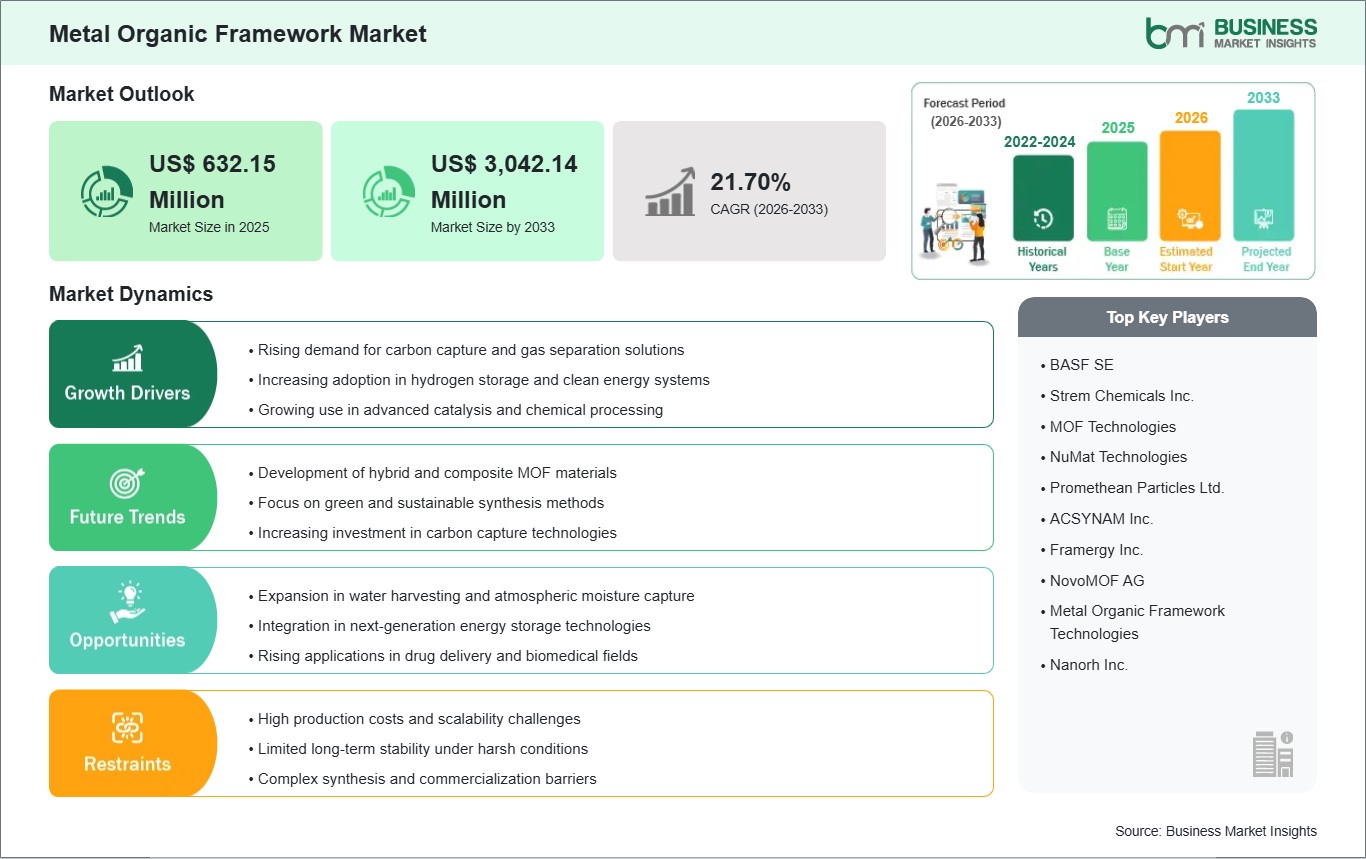
The metal organic framework market is growing significantly due to the special properties of these materials and their expanding application space. Metal organic frameworks have a high surface area and adsorption capacity, which makes them very attractive for gas storage and separation. The increasing demand for energy-efficient and environmentally friendly solutions is also driving the application of these materials. The application space of these materials is expanding due to their versatility.
Apart from conventional industrial applications, there is a growing trend towards exploring high-end applications in water harvesting and energy storage. Ongoing R&D activities are improving material stability and performance, thus opening up avenues for commercialization. Though there are certain limitations in terms of production costs and synthesis difficulties, technological improvements and growing investments are helping in expanding the market. As industries strive towards sustainability and resource efficiency, metal-organic frameworks are poised to play a vital role in enabling future technology in various environmental and energy applications.
Segment Analysis
Metal Organic Framework Market Segmentation
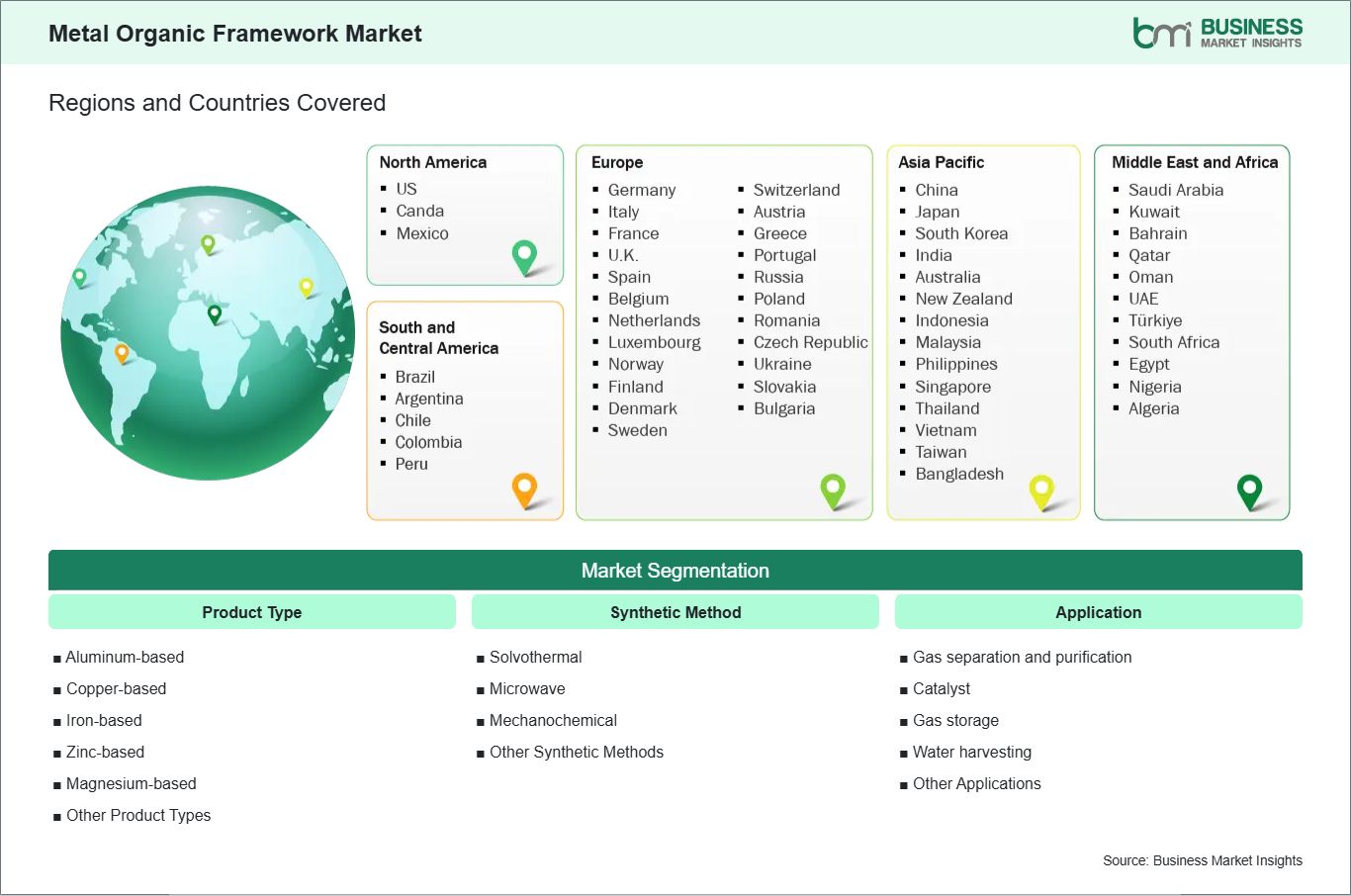
Key segments that contributed to the derivation of the Metal Organic Framework market analysis are product type, synthetic method, and application.
- By product type, the metal organic framework market is segmented into aluminum-based, copper-based, iron-based, zinc-based, magnesium-based, and other product types. The copper-based segment dominated the market in 2025.
- By synthetic method, the metal organic framework market is segmented into solvothermal, microwave, mechanochemical, and other synthetic methods. The solvothermal segment dominated the market in 2025.
- By application, the metal organic framework market is segmented into gas separation and purification, catalyst, gas storage, water harvesting, and other applications. The gas separation and purification segment dominated the market in 2025.
Market Forces
Metal Organic Framework Market Drivers and Opportunities
Rising demand for carbon capture and gas separation solutions
The rise in interest in reducing greenhouse gas emissions has led to a surge in the need for efficient gas separation technologies, and metal-organic frameworks have emerged as a solution to meet such challenges. They have a large surface area and pore structure, making them efficient in adsorbing various gases such as carbon dioxide, methane, and hydrogen. Industries such as power generation, refining, and chemicals are working on metal-organic frameworks to enhance gas separation efficiency. The ability to separate carbon dioxide from flue gas streams with a high level of selectivity makes them a valuable tool in reducing greenhouse gas emissions.
Additionally, the move towards cleaner sources of energy is further propelling the efficient gas purification technologies. Metal-organic frameworks have emerged in the hydrogen purification and natural gas upgrading fields because of their superior adsorption capacity compared to other conventional adsorbents like activated carbon and zeolites. The energy-efficient separation process ensures reduced costs and energy consumption in large-scale industrial processes. The constant improvements in material science, including stability and scalability, have made these frameworks more viable in the market. With industries moving towards sustainable and eco-friendly practices, these frameworks have the potential to revolutionize efficient, cost-effective, and eco-friendly gas separation technologies.
Expansion in water harvesting and atmospheric moisture capture
One of the strong opportunities for the growth of metal-organic frameworks is in water harvesting. This is especially so in cases of water scarcity and lack of access to clean water. The high porosity of these materials allows them to absorb water from the air even when the humidity is low. This is a promising area of application for these materials in arid and semi-arid conditions. The application is also seen for decentralized water harvesting without the need for traditional water infrastructure. With growing global concerns over water availability, these materials are seen as a sustainable and energy-efficient solution for water harvesting directly from the air.
In addition, there are developments in material engineering, which are improving the efficiency, durability, and reusability of these frameworks in water harvesting systems. Researchers are focusing on improving adsorption and release mechanisms in order to ensure their consistency in different climatic conditions. This has enabled their integration in compact, portable devices, which are supporting new applications in residential, military, and emergency response areas, thereby supporting the commercialization of AWGs using advanced materials. Therefore, metal organic frameworks are expected to play a crucial role in supporting water harvesting technologies in different regions, driven by the increased demand for water harvesting technologies in a sustainable manner.
Size and Share Analysis
Metal Organic Framework Market Size and Share Analysis
The global Metal Organic Framework market is experiencing steady growth, with market size and share analysis reflecting evolving treatment preferences and competitive dynamics among key players. The report evaluates important subsegments categorized within product type, synthetic method, and application, highlighting their respective contributions to overall market performance.
By product type, the copper-based subsegment dominated the market due to its superior surface area, structural tunability, and strong adsorption capabilities, making it highly suitable for gas storage and separation applications across industrial and environmental sectors with high efficiency requirements.
By synthetic method, the solvothermal subsegment dominated the market due to its ability to produce highly crystalline and stable frameworks, ensuring consistent pore structure and scalability, which is essential for commercial production and advanced applications in gas adsorption and catalysis processes.
By application, the gas separation and purification subsegment dominated the market due to increasing demand for efficient carbon capture, hydrogen purification, and industrial gas processing technologies, where metal organic frameworks offer exceptional selectivity, adsorption capacity, and energy-efficient separation performance.
Report Coverage
Metal Organic Framework Market Report Coverage and Deliverables
The "Metal Organic Framework Market Size and Forecast (2022 - 2033)" report provides a detailed analysis of the market covering below areas:
- Metal Organic Framework market size and forecast at the regional and country levels for segments covered under the scope
- Metal Organic Framework market trends, as well as drivers, restraints, and opportunities
- Metal Organic Framework market analysis covering key trends, regional framework, major players, regulations, and recent developments
- Industry landscape and competition analysis covering market concentration, heat map analysis, prominent players, and recent developments for the Metal Organic Framework market
- Detailed company profiles, including SWOT analysis
Geographic Insights
Metal Organic Framework Market Geographic Insights
The geographical scope of the Metal Organic Framework market report is divided into: North America, Asia Pacific, Europe, Middle East & Africa, and South & Central America. North America held the largest share in 2025.
North America is the largest market for metal-organic frameworks. It is because the region is the hub for research activities and industrial expertise. Moreover, the region is witnessing high investments in clean technologies. It is home to many research centers and companies working towards the development of innovative materials. Government policies supporting the reduction of emissions and sustainable growth are also propelling the demand for metal-organic frameworks in the region.
Furthermore, the fact that there are already established players in the market, along with the collaboration between academia and industry, also plays a significant role in the constant innovation and commercialization of new products. Moreover, there is a significant increase in the implementation of pilot projects in carbon capture technology and gas purification. In addition, the emphasis on the development of the hydrogen economy, along with the growth of the renewable energy sector, is further boosting the demand for high-performance materials. Thus, it can be concluded that the region will continue to hold its position in the metal-organic framework market.
Industry Activity
Recent Developments
The Metal Organic Framework market is evaluated by gathering qualitative and quantitative data post primary and secondary research, which includes important corporate publications, association data, and databases. A few of the key developments in the Metal Organic Framework market are:
- In October 2023, BASF, announced that it became the first company to produce metal-organic frameworks (MOFs) on a commercial scale of several hundred tons per year, supplying MOF materials for carbon capture applications in partnership with Svante Technologies.
- In October 2023, BASF, further announced that it successfully scaled up production of its CALF-20 MOF sorbent, enabling industrial deployment in carbon capture systems and marking a transition from lab-scale to large-scale manufacturing.
- In 2025, BASF, announced that it is producing MOFs on an industrial scale for carbon capture, highlighting their ability to store large quantities of CO₂ and supporting commercialization of advanced adsorption materials.
Trust & Transparency
Research Methodology
The market analysis combines proprietary research with secondary data from government agencies, company disclosures, regulatory filings, industry databases and expert interviews. Market estimates are validated through data triangulation, cross-market benchmarking and analyst
review.
View Full Research Methodology
Key Sources Referred:
American Chemistry Council (ACC)International Council of Chemical Associations (ICCA)European Chemical Industry Council (Cefic)China National Building Materials Group (CNBM)Indian Minerals & Granite Exporters Association (IMGEA)Japan Mining Industry Association (JMIA)Brazilian Mining Association (IBRAM)Gulf Petrochemicals and Chemicals Association (GPCA)Company WebsitesCompany Annual ReportsCompany Investor Presentations