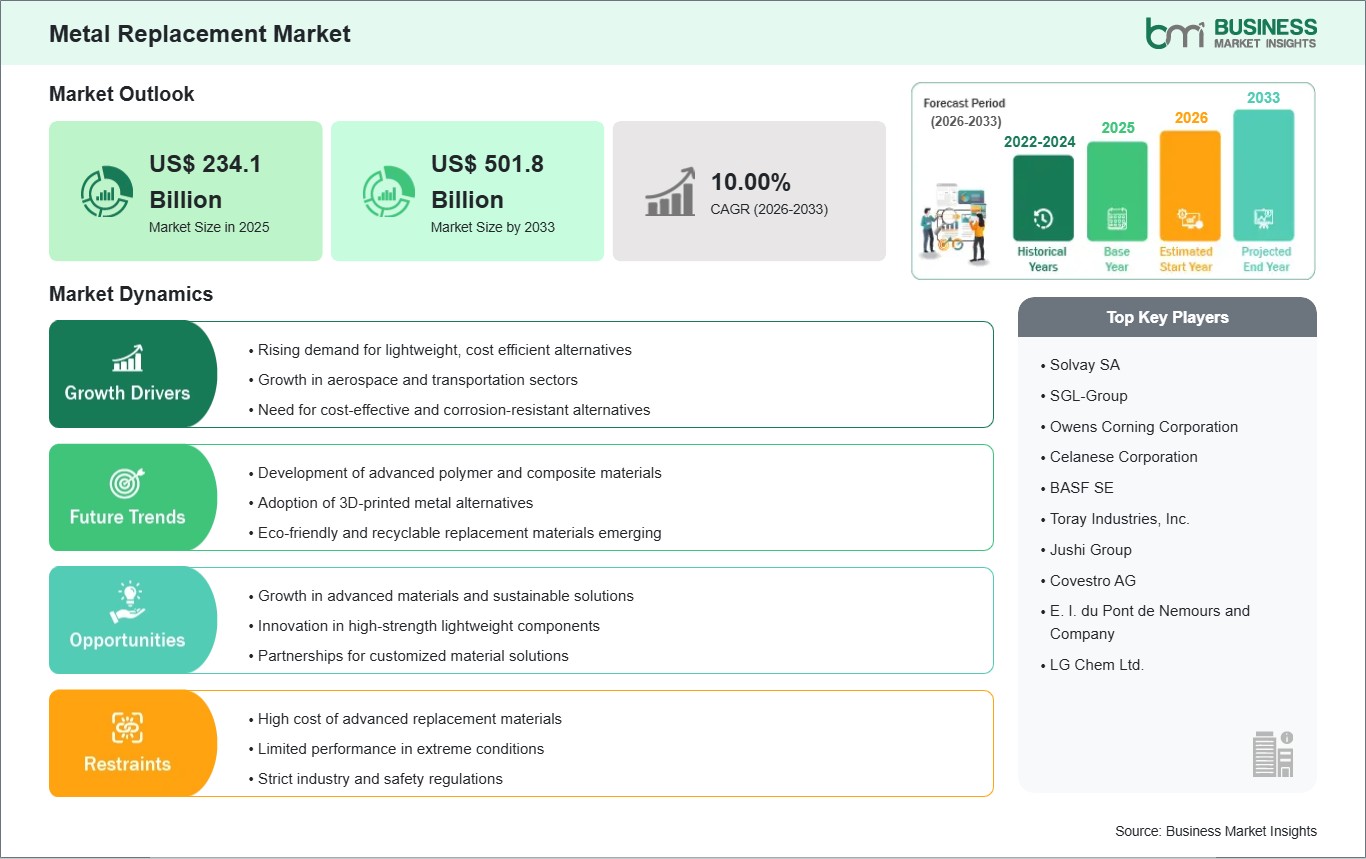
The Metal Replacement Market size is expected to reach US$ 501.8 Billion by 2033 from US$ 234.1 Billion in 2025. The market is estimated to record a CAGR of 10.00% from 2026 to 2033.
The metal replacement market is expanding as industries prioritize lightweighting, cost efficiency, and performance optimization across manufacturing ecosystems. Metal replacement materials including engineered plastics, composites, ceramics, and hybrid materials are increasingly deployed to substitute traditional metals in applications where reduced weight, improved corrosion resistance, and manufacturing flexibility deliver competitive advantages. Automotive, aerospace, electronics, and consumer goods sectors are key adopters, leveraging alternative materials to achieve fuel economy targets, design versatility, and lifecycle cost reduction. Market growth is driven by advances in polymer science, composite reinforcement technologies, and precision manufacturing techniques such as injection molding and additive manufacturing. These capabilities enable complex geometries and functional integration that were previously unattainable with conventional metal fabrication.
Sustainability considerations are also shaping market dynamics, as non‑metallic alternatives often offer lower embodied energy, recyclable pathways, and reduced environmental impact. Strategic partnerships between material suppliers and OEMs are accelerating solution development tailored to performance specifications and regulatory compliance criteria. Competitive differentiation is increasingly linked to material performance validation, reliability in end‑use environments, and integration into automated assembly systems. Regulatory landscapes — particularly in automotive emissions and environmental safety — are further prompting substitution strategies that align with global sustainability mandates. Overall, the metal replacement market reflects a balance between innovative material engineering, operational efficiency, and sector‑specific performance requirements, positioning it as a critical component in future‑ready manufacturing strategies.

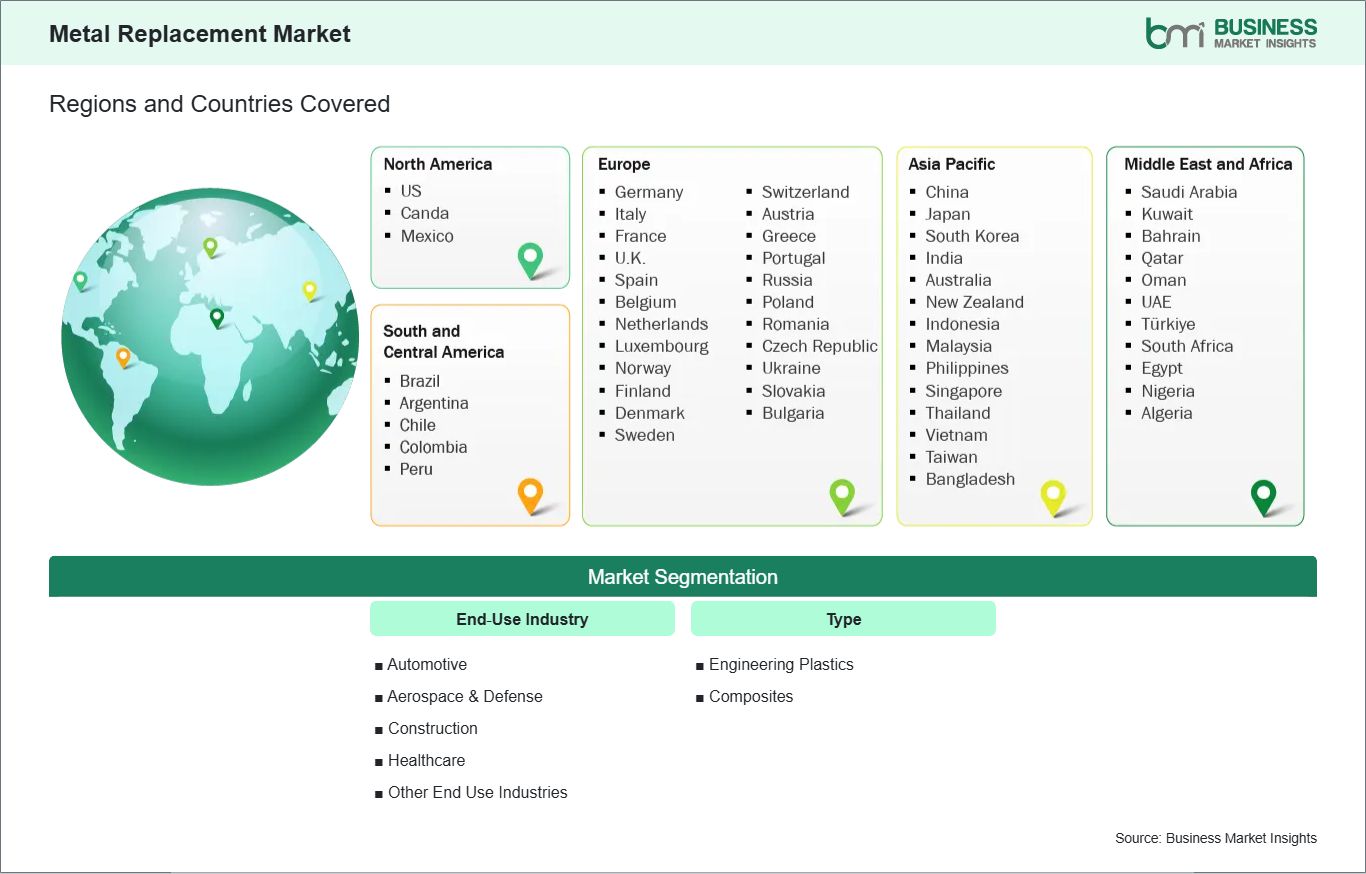
Key segments that contributed to the derivation of the metal replacement market analysis are end‑use industry and type.
The global market for metal replacement is growing with the rising demand for lightweight and cost-effective alternatives to traditional metals. Industries worldwide are increasingly focusing on advanced polymers, composites, and plastics that possess similar strength to traditional metals. This is helping manufacturers optimize the performance of their products without compromising on strength. Industries across various domains are increasingly using metal replacement to optimize the performance and efficiency of their products. By using advanced non-metallic materials in their products, manufacturers are focusing on fuel efficiency and performance in durable goods. This is helping companies stay ahead in the market with performance-based and cost-effective products. Furthermore, metal replacement materials are also being used in products that require high performance. Traditional metals cannot withstand extreme conditions such as corrosion and wear. Advanced materials such as fiber-reinforced plastics and plastics possess specific characteristics that help meet specific demands. This is helping the market grow.
The innovation in technology with regards to new and sustainable materials is offering a number of opportunities in the metal replacement market. New polymer composite materials are being developed with high mechanical properties while maintaining sustainability in the environment. This is in line with global sustainable trends and eco-friendly manufacturing. Research in material sciences is improving the functional properties of metal replacement materials. This is allowing for better thermal stability, increased load-carrying capacity, and resistance to chemicals and wear. This is increasing the number of potential uses in industries that require strong and long-lasting material alternatives. In addition, innovation in manufacturing technologies is allowing for the creation of complex shapes with metal replacement materials. As industries are seeking innovative and sustainable solutions with energy-efficient technology, the global metal replacement market is poised to grow and advance in technology.
The metal replacement market demonstrates steady growth, with size and share analysis highlighting evolving trends and competitive dynamics among key players. The report examines subsegments categorized within end‑use industry and type, offering insights into their contribution to overall market performance.
By End‑Use Industry, the automotive subsegment dominated the market in 2025, driven by increasing adoption of metal-replacing materials in lightweight and high-performance components.
Based on Type, the engineering plastics subsegment dominated the market in 2025, supported by their versatility, cost efficiency, and broad use in automotive and industrial applications.
| Report Attribute | Details |
|---|---|
| Market size in 2025 | US$ 234.1 Billion |
| Market Size by 2033 | US$ 501.8 Billion |
| Global CAGR (2026 - 2033) | 10.00% |
| Historical Data | 2022-2024 |
| Forecast period | 2026-2033 |
| Segments Covered | By End-Use Industry
|
|
Regions and Countries Covered
| |
| North America | US, Canada, Mexico |
| Europe | Belgium, Austria, Finland, Denmark, Greece, Poland, Romania, Russia, Ukraine, Czech Republic, Slovakia, Bulgaria, Italy, Luxembourg, Germany, Switzerland, France, Netherlands, Norway, Portugal, Spain, Sweden, United Kingdom |
| Asia-Pacific | Australia, China, India, Japan, South Korea, Indonesia, Malaysia, Philippines, Singapore, Thailand, Vietnam, Bangladesh, New Zealand, Taiwan |
| South and Central America | Brazil, Argentina, Peru, Chile, Colombia |
| Middle East and Africa | Bahrain, Kuwait, Oman, Qatar, Saudi Arabia, United Arab Emirates, Turkiye, South Africa, Egypt, Algeria, Nigeria |
| Market leaders and key company profiles |
|
The "Metal Replacement Market Size and Forecast (2022 - 2033)" report provides a detailed analysis of the market covering below areas:
The geographical scope of the Metal Replacement Market report is divided into North America, Asia Pacific, Europe, Middle East & Africa, and South & Central America. North America held the largest share in 2025.
Regional dynamics in the metal replacement market show clear adoption trends influenced by industrial needs, innovation networks, and regulations. North America leads the market due to strong manufacturing, strict emissions standards, and high demand for lightweight and high-performance materials in the automotive, aerospace, and electronics industries. Early use of plastic and composite alternatives, along with significant investment in research and development, places this region at the forefront of metal replacement strategies.
Europe has a mature market with a strong focus on sustainability and adherence to regulations. Laws regarding emissions and resource efficiency encourage the use of non-metallic alternatives in transportation systems, industrial equipment, and consumer products. The region`s advanced manufacturing capabilities and commitment to circular economy principles further drive market growth.
In Asia Pacific, rapid growth is happening, driven by industrialization, a growing automotive and electronics manufacturing sector, and cost-effective production systems. Local supply chains are integrating engineered polymers and composites to satisfy regional demand for efficient production and product differentiation.
In the Middle East and Africa, market progress is slow but steady, supported by infrastructure development and diversification of industrial sectors. This leads to a greater use of metal replacement solutions in construction and industrial machinery.
South and Central America is also growing steadily, influenced by better manufacturing capabilities, increased use of alternative materials, and stronger regional compliance frameworks that encourage the adoption of metal substitution technologies.

The Metal Replacement Market is evaluated by gathering qualitative and quantitative data post primary and secondary research, which includes important corporate publications, association data, and databases. A few of the key developments in the metal replacement market are:
The Metal Replacement Market is valued at US$ 234.1 Billion in 2025, it is projected to reach US$ 501.8 Billion by 2033.
As per our report Metal Replacement Market, the market size is valued at US$ 234.1 Billion in 2025, projecting it to reach US$ 501.8 Billion by 2033. This translates to a CAGR of approximately 10.00% during the forecast period.
The Metal Replacement Market report typically cover these key segments-
The historic period, base year, and forecast period can vary slightly depending on the specific market research report. However, for the Metal Replacement Market report:
The Metal Replacement Market is populated by several key players, each contributing to its growth and innovation. Some of the major players include:
The Metal Replacement Market report is valuable for diverse stakeholders, including:
Essentially, anyone involved in or considering involvement in the Metal Replacement Market value chain can benefit from the information contained in a comprehensive market report.
Please tell us your area of interest
(Market Segments/ Regions and Countries/ Companies)