
Laundry Dryer Market Outlook: Size, Share, Trends, Growth Analysis, Competitive Landscape & Forecast, 2026-2033

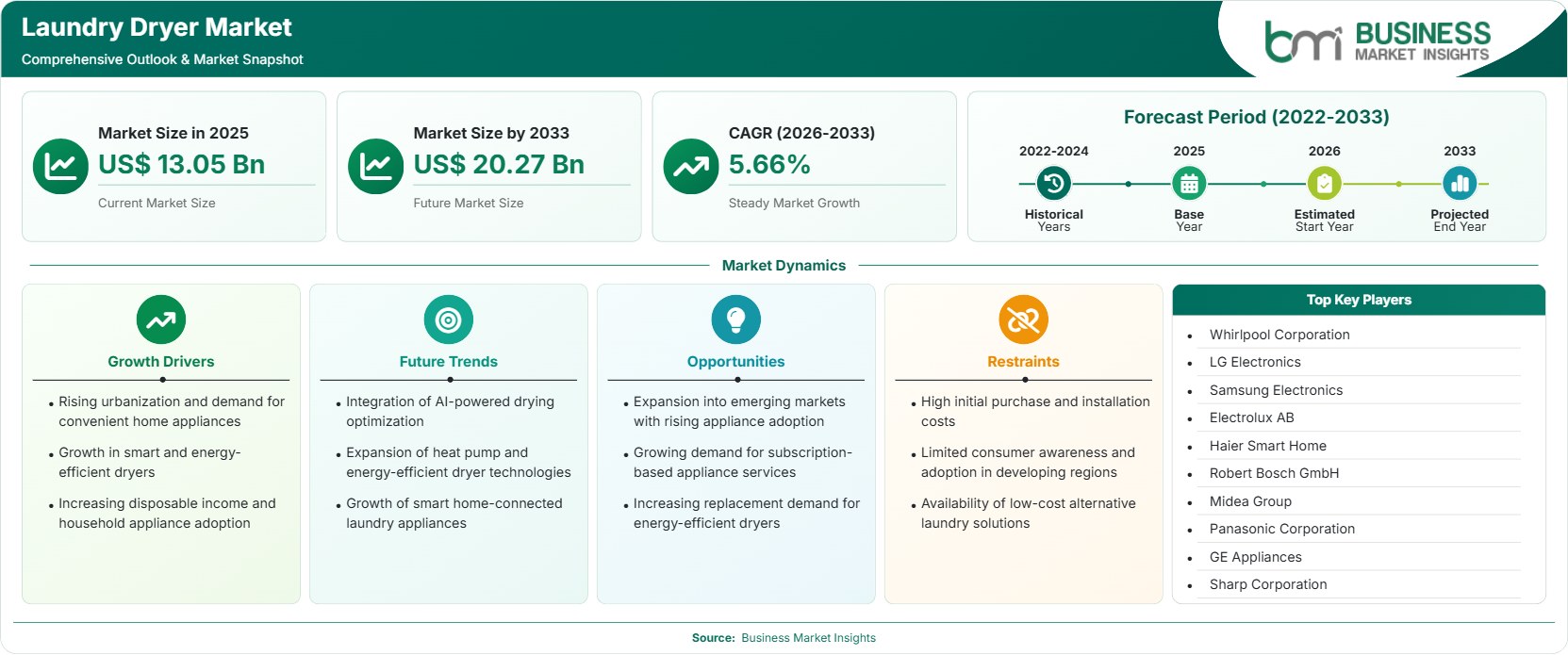
The Laundry Dryer Market size was valued at US$ 13.05 Billion in 2025 and is projected to reach US$ 20.27 Billion by 2033, growing at a CAGR of 5.66% during 2026–2033. Rising urbanization, increasing demand for convenient household appliances, growing adoption of smart and energy-efficient dryers, and replacement demand from aging appliances are supporting market expansion across residential and commercial applications.

Report Coverage
  • Product Type: Gas, Electric
  • Application: Residential, Commercial
  • Distribution Channel: Retail Outlets/Offline, E-commerce/Online
US$ 13.05 Bn Market size in 2025
US$ 20.27 Bn Market Size by 2033
5.66% CAGR, 2026 - 2033
2026-2033 Forecast Period

AI Overview

Laundry Dryer Market Summary

  • North America Region: North America accounts for 35%–38% share in 2025 and is projected to expand at a 5.2%–5.7% CAGR during 2026–2033. Growth is supported by high household appliance penetration, replacement cycles, smart home adoption, and demand for energy-efficient laundry solutions. The U.S. represents the regional leader due to strong appliance ownership, premium product adoption, and advanced retail networks, growing at a 5.3%–5.8% CAGR during the forecast period.
  • Fastest Growing Region: Asia Pacific holds 30%–33% share in 2025 and is expected to grow at a 6.1%–6.7% CAGR through 2033, driven by rising urban populations, increasing disposable income, expanding middle-class households, and growing adoption of modern home appliances.
  • Leading Segment: Electric Dryers account for 72%–75% share in 2025 and are projected to grow at a 5.7%–6.1% CAGR, supported by wider availability, easier installation, smart technology integration, and increasing preference for energy-efficient household appliances.
  • High Growth Segment: Commercial Application accounts for 23%–26% share in 2025 and is projected to grow at a 6.2%–6.8% CAGR, driven by hospitality expansion, laundromat demand, institutional facilities, and professional laundry service requirements.
  • Key Market Opportunity: Expansion in emerging economies, subscription-based appliance models, and replacement demand for advanced energy-efficient dryers are creating new opportunities for manufacturers and service providers.
  • Major Market Players: Whirlpool Corporation, LG Electronics, Samsung Electronics, Electrolux AB, Haier Smart Home, Bosch (BSH Hausgeräte), Midea Group, Panasonic Corporation, GE Appliances, and Sharp Corporation.
Strategic Insights

Laundry Dryer Market: Strategic Insights

Laundry Dryer Market Strategic Framework
FREE PDF
Request your free sample
Request free sample
Stakeholder View

Key Takeaways

  • The value chain is shifting toward integrated appliance ecosystems involving manufacturers, smart technology providers, retailers, and after-sales service networks.
  • Electric dryers and energy-efficient models present strong growth opportunities due to consumer preference for convenience, lower operating costs, and advanced features.
  • Innovation is focused on heat pump technology, artificial intelligence-based drying controls, connected appliances, and improved energy management systems.
  • Asia Pacific provides significant investment potential due to urbanization, expanding middle-class populations, and increasing adoption of modern household appliances.
  • Companies are strengthening competitive positions through product launches, strategic partnerships, digital retail expansion, and smart appliance development.
  • Replacement demand from aging appliances is becoming a key growth contributor as consumers upgrade toward efficient and connected laundry solutions.
Geographic Outlook

Laundry Dryer Market Regional Highlights

North America Laundry Dryer Market

North America accounted for 35%–38% share in 2025 and is projected to grow at a 5.2%–5.7% CAGR during 2026–2033. The region benefits from high household appliance penetration, established retail infrastructure, strong replacement demand, and increasing adoption of connected laundry appliances. The U.S. remains the largest contributor due to widespread dryer ownership, premium appliance demand, and growing interest in energy-efficient models. Canada also supports regional laundry dryer market growth through sustainable appliance adoption.

  • Increasing demand for smart home appliances is encouraging consumers to adopt connected dryers with automated controls, remote monitoring, and improved energy management features.
  • Replacement of older appliances is supporting market expansion as households upgrade toward advanced dryers offering better efficiency, performance, and convenience.
  • Premium appliance adoption is increasing among consumers seeking advanced drying technologies, quieter operation, and enhanced user experience.
  • Retail and e-commerce channels are improving product accessibility through wider availability, financing options, and digital purchasing platforms.

US Laundry Dryer Market

The U.S. represents 84%–87% of the North American market in 2025 and is projected to expand at a 5.3%–5.8% CAGR during 2026–2033. Growth is supported by strong household appliance ownership, replacement cycles, smart appliance adoption, and consumer preference for efficient laundry solutions. Increasing awareness of energy-saving technologies and expanding availability of premium dryer models continue strengthening market demand across residential applications.

  • High household ownership of laundry appliances creates consistent replacement demand for technologically advanced and energy-efficient dryer models.
  • Smart home integration is increasing adoption of connected dryers featuring remote operation, automated cycles, and intelligent maintenance alerts.
  • Consumers are increasingly preferring heat pump dryers due to lower energy consumption and improved long-term operating efficiency.
  • E-commerce platforms are expanding product reach by offering broader selections, competitive pricing, and convenient delivery services.

Europe Laundry Dryer Market

Europe accounted for 26%–29% share in 2025 and is projected to register a 5.5%–6.0% CAGR during 2026–2033. The region benefits from strict energy efficiency standards, sustainability-focused consumers, and increasing adoption of advanced laundry technologies. Germany leads regional demand through strong appliance manufacturing and consumer adoption, while the United Kingdom, France, and Italy represent growing markets supported by replacement demand and smart appliance penetration in laundry dryer market.

  • Germany maintains regional leadership through advanced appliance manufacturing, strong distribution networks, and increasing demand for efficient dryer technologies.
  • The United Kingdom is witnessing growing adoption of smart laundry appliances due to rising consumer interest in connected home solutions.
  • France is expanding through sustainability initiatives encouraging consumers to replace conventional dryers with energy-efficient alternatives.
  • Italy is experiencing increasing demand for compact and advanced dryers suitable for urban households and smaller living spaces.
  • European energy regulations continue encouraging manufacturers to develop appliances with improved efficiency ratings and reduced operating costs.

Asia Pacific Laundry Dryer Market

Asia Pacific accounted for 30%–33% share in 2025 and is projected to grow at a 6.1%–6.7% CAGR during 2026–2033, making it the fastest-growing region. Expansion is supported by rapid urbanization, rising disposable incomes, growing middle-class households, and increasing awareness of modern home appliances. China leads regional demand, while India, Japan, and South Korea are experiencing increased adoption due to changing lifestyles and appliance modernization in laundry dryer market forecasts.

  • China is expanding dryer adoption through urban household growth, increasing appliance penetration, and strong domestic manufacturing capabilities.
  • India represents a high-growth market due to rising incomes, apartment living trends, and increasing consumer preference for convenient laundry solutions.
  • Japan continues adopting advanced dryers through demand for compact designs, energy efficiency, and smart appliance functionality.
  • South Korea benefits from strong consumer electronics integration and increasing demand for connected household appliances.
  • Expanding e-commerce networks across Asia Pacific are improving accessibility to modern laundry equipment.

Rest of World Laundry Dryer Market

The Rest of World accounted for 5%–8% share in 2025 and is projected to grow at a 4.8%–5.4% CAGR during 2026–2033. South America is witnessing gradual adoption through rising urban populations, improving retail networks, and increasing household appliance demand. The Middle East and Africa are expanding through hospitality development, urban modernization, and growing interest in convenient laundry solutions among residential and commercial users in laundry dryer market share.

  • Brazil is increasing dryer adoption through urban household growth and expanding availability of international appliance brands.
  • Mexico benefits from appliance manufacturing capabilities and increasing consumer access to modern laundry equipment.
  • Gulf countries are adopting advanced dryers through hospitality expansion, premium residential projects, and higher consumer purchasing power.
  • South Africa is experiencing gradual market development through urbanization and increasing household appliance modernization.
  • Regional distributors are improving access through expanded retail networks and online appliance purchasing platforms.
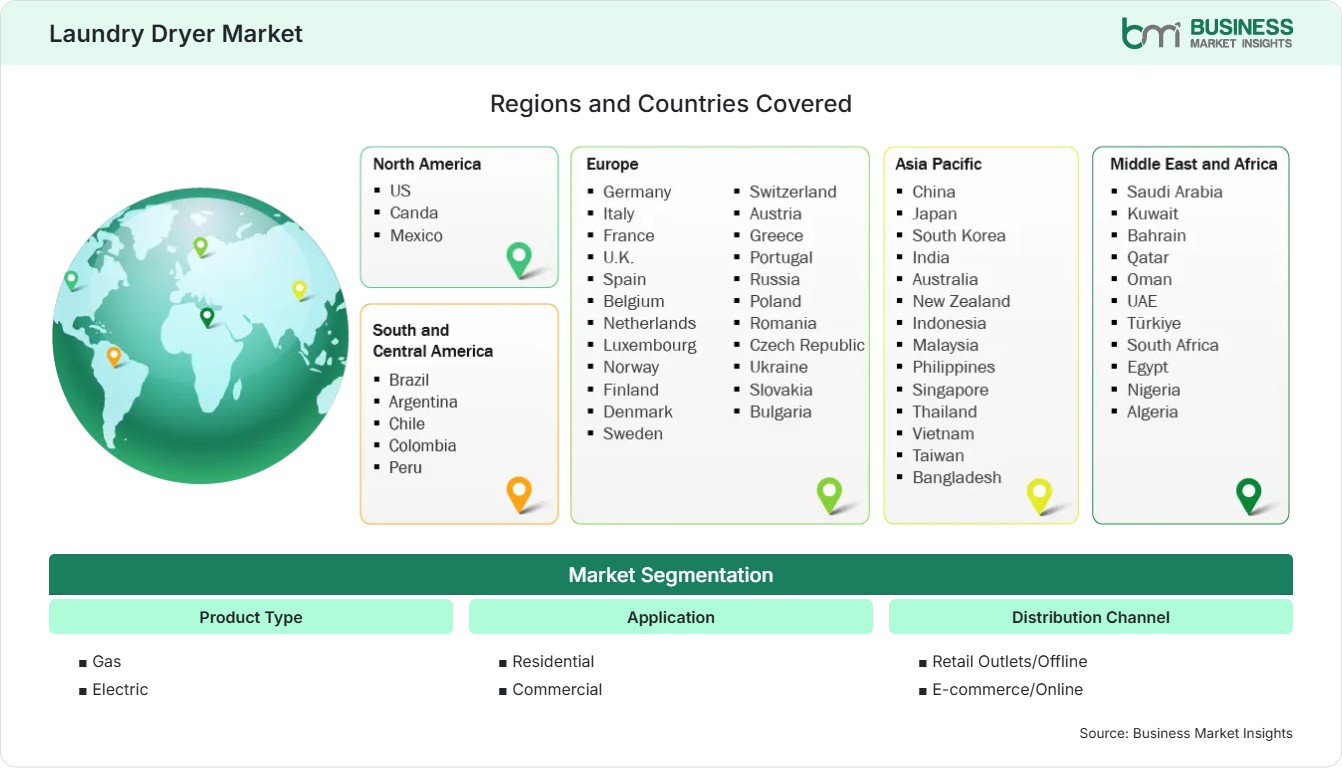
Global Market Geography
FREE PDF
Request your free sample
Request free sample
Segment Analysis

Laundry Dryer Market Segmentation

Product Type

The product type segment is expanding due to increasing consumer preference for convenient, efficient, and technologically advanced laundry appliances. Electric Dryers represent the leading category, accounting for 72%–75% share in 2025 and projected to grow at a 5.7%–6.1% CAGR during 2026–2033. Wider residential adoption, easier installation requirements, smart connectivity features, and improved energy efficiency continue supporting electric dryer demand globally.

  • Gas: Gas dryers maintain demand in regions with established gas infrastructure due to faster drying performance, lower operating costs in some markets, and suitability for high-volume laundry applications.
  • Electric: Electric dryers dominate due to broader availability, simpler installation, increasing heat pump adoption, smart features, and strong consumer preference for energy-efficient household appliances.

Application

The application segment is driven by rising demand from households, hospitality facilities, healthcare institutions, and commercial laundry operators in laundry dryer market. Residential applications account for 74%–77% share in 2025 and are projected to grow at a 5.4%–5.9% CAGR during 2026–2033. Increasing urbanization, smaller living spaces, busy lifestyles, and growing adoption of convenient home appliances are supporting residential dryer penetration across developed and emerging markets.

  • Residential: Residential demand is increasing due to lifestyle changes, rising appliance ownership, urban housing growth, and consumer preference for time-saving laundry solutions.
  • Commercial: Commercial adoption is expanding through hotels, hospitals, laundromats, and institutional facilities requiring durable, high-capacity, and efficient drying equipment.

Distribution Channel

The distribution channel segment is evolving as consumers increasingly combine physical retail experiences with digital purchasing options. Retail Outlets/Offline account for 58%–61% share in 2025 and are projected to grow at a 4.9%–5.4% CAGR during 2026–2033. However, online channels are gaining momentum due to convenience, wider product availability, competitive pricing, and increasing consumer confidence in digital appliance purchases in laundry dryer market.

  • Retail Outlets/Offline: Offline channels remain important due to product demonstrations, installation support, brand trust, and consumer preference for evaluating large appliances before purchase.
  • E-commerce/Online: Online channels are expanding through digital marketplaces, attractive discounts, customer reviews, doorstep delivery, and increasing adoption of online appliance purchasing.
Market Forces

Laundry Dryer Market Dynamics

Key Market Drivers

Rising Urbanization and Demand for Convenient Home Appliances

Urbanization is increasing demand for time-saving household appliances as consumers in metropolitan areas seek efficient solutions for managing daily chores. Smaller living spaces, busy lifestyles, and rising numbers of working households are encouraging adoption of laundry dryers that provide faster and more convenient drying capabilities. The shift toward apartment living and modern residential infrastructure is creating demand for compact and automated appliances. Manufacturers are responding by introducing space-efficient models with improved functionality and connectivity features. These developments are supporting market growth as convenience becomes a major purchasing factor. Emerging Laundry Dryer Market trends indicate increasing adoption of smart controls, automated drying cycles, and energy-efficient designs.

Growth in Smart and Energy-Efficient Dryers

The growing consumer demand for smart and energy-efficient appliances is driving innovations in laundry dryer technology. The use of sensors, intelligent controls powered by artificial intelligence, heat pumps, and connectivity solutions is becoming common among manufacturers seeking to increase efficiency and reduce energy use. As consumers become more aware of the total cost of operations over the appliance's life cycle, alongside its price, there is demand for more energy-efficient models. There is also an increase in sustainability efforts that encourage the manufacture of environmentally friendly appliances.

Increasing Disposable Income and Household Appliance Adoption

The growing disposable incomes and improvements in living standards are leading to an increasing usage of technologically advanced laundry appliances by households, both in developing countries and in developed countries. People are moving from traditional forms of drying clothes to automated systems which provide ease of use and reliability. An expanding middle class is also creating demand opportunities for manufacturers in the premium segment, owing to people’s desire for investing in efficient and durable products. The expansion of retail networks and financing facilities are making modern dryers even more accessible for consumers.

Key Market Opportunities

Expansion into Emerging Markets with Rising Appliance Adoption

Emerging markets present a substantial opportunity due to urbanization, rising household incomes, and lifestyle changes, which are driving higher appliance adoption rates. There is increased demand for laundry solutions across Asia-Pacific, Latin America, and the Middle East due to improved living standards and infrastructure in the residential sector. Companies are working on localized products, price reduction, and more distribution channels to penetrate these markets. With the availability of finance options and online retailing, there has been a positive impact on the availability of household appliances.

Growing Demand for Subscription-Based Appliance Services

The subscription model for appliance service is emerging as a growth path, offering consumers the flexibility to access advanced laundry appliances without substantial upfront costs. The trend toward rental and appliance-as-a-service models has attracted considerable interest from consumers in urban areas, companies, and temporary dwellings. Such models are conducive for boosting the uptake of high-end dryers through low purchase costs at the beginning. Companies are considering offering maintenance services, replacement plans, and monitoring of smart appliances to enhance their customer experience. The increasing acceptability of sharing and subscription models of consumption has opened up new business possibilities.

Increasing Replacement Demand for Energy-Efficient Dryers

The demand for newer machines to replace old appliances is creating new avenues for manufacturers to make energy-efficient laundry dryers with enhanced performance and reduced operational costs. Consumers are upgrading their machines due to higher energy costs, environmental awareness, and the better features available in new dryers. Energy-efficient laundry dryers, including heat pump dryers, are being appreciated for their improved efficiency and reduced environmental impact. Government energy efficiency standards and consumer campaigns are prompting consumers to upgrade in mature markets.

Market Restraints and Challenges

High Initial Purchase and Installation Costs

Factor: High initial purchase and installation costs remain a challenge due to the expense of advanced dryer technologies, specialized installation requirements, and premium smart appliance features. Impact: Higher upfront costs can discourage price-sensitive consumers, particularly in developing regions where traditional drying methods remain common. Modern, advanced units, which are fitted with heat pumps, connectivity capabilities, and are more efficient, usually involve higher expenditure than traditional products. Although energy savings will offset the expenses incurred by such a purchase in the long run, buyers tend to prioritize affordability at the time of purchase.

Limited Consumer Awareness and Adoption in Developing Regions

Factor: Limited consumer awareness affects adoption because many households in developing regions remain unfamiliar with the benefits, convenience, and efficiency advantages of laundry dryers. Impact: Low awareness can slow market penetration and maintain dependence on traditional drying methods, particularly where climate conditions allow outdoor drying. Consumers may also perceive dryers as unnecessary appliances due to limited exposure and affordability concerns. Manufacturers and retailers are increasing educational campaigns, product demonstrations, and digital marketing initiatives to communicate benefits. Expanding urban lifestyles, changing housing patterns, and improving appliance accessibility are expected to gradually increase acceptance in developing markets.

Company Analysis

Competitive Landscape

The Laundry Dryer Market analysis highlights growing competition among global appliance manufacturers focusing on energy efficiency, smart connectivity, product innovation, and expanded distribution networks. Leading companies are investing in advanced drying technologies, connected appliance ecosystems, heat pump solutions, and sustainable product development to strengthen their presence across residential and commercial applications.

Company Name

Overview

Products and Services Relevant to this Market

Whirlpool Corporation

Global home appliance manufacturer offering laundry solutions across residential and commercial markets.

Electric dryers, gas dryers, smart laundry appliances, heat pump technologies, and connected home solutions.

LG Electronics

Technology company providing advanced home appliances with smart connectivity and energy-efficient features.

Smart dryers, AI-powered laundry appliances, heat pump dryers, and connected appliance platforms.

Samsung Electronics

Global electronics company developing innovative smart home and appliance technologies.

Electric dryers, AI-enabled drying systems, connected laundry solutions, and energy-efficient appliance technologies.

Electrolux AB

Appliance manufacturer specializing in premium and sustainable household solutions.

Laundry dryers, heat pump dryers, energy-efficient appliances, and professional laundry equipment.

Haier Smart Home

Global appliance company focused on smart home ecosystems and connected products.

Smart dryers, residential laundry appliances, connected home technologies, and energy-efficient solutions.

Bosch (BSH Hausgeräte)

Appliance manufacturer known for premium engineering and energy-efficient household products.

Heat pump dryers, condenser dryers, smart laundry systems, and advanced drying technologies.

Midea Group

Global appliance manufacturer expanding through innovative household solutions and smart technologies.

Electric dryers, smart laundry appliances, energy-efficient drying systems, and residential solutions.

Panasonic Corporation

Diversified technology company offering consumer electronics and home appliance solutions.

Laundry dryers, smart appliance technologies, energy-efficient household products, and connected solutions.

GE Appliances

Home appliance manufacturer serving residential consumers with advanced laundry solutions.

Electric and gas dryers, smart laundry appliances, connected features, and high-capacity drying systems.

Sharp Corporation

Electronics and appliance company developing consumer-focused home technologies.

Laundry appliances, advanced drying solutions, energy-efficient technologies, and smart home products.

Trust & Transparency

Research Methodology

The market analysis combines proprietary research with secondary data from government agencies, company disclosures, regulatory filings, industry databases and expert interviews. Market estimates are validated through data triangulation, cross-market benchmarking and analyst review.

View Full Research Methodology

Questions Answered

Frequently Asked Questions

What challenges affect laundry dryer adoption?

High purchase costs, installation requirements, limited awareness in developing markets, and competition from traditional drying methods remain major challenges affecting broader adoption.

Which application segment contributes most to laundry dryer market report?

Residential applications contribute the majority of demand due to high household appliance adoption, increasing urban living, and consumer preference for convenient laundry solutions.

Why are smart dryers gaining popularity?

Smart dryers are gaining popularity because they provide automated drying cycles, remote monitoring, improved energy management, and integration with connected home ecosystems.

Which product type dominates the Laundry Dryer Market?

Electric dryers dominate due to easier installation, wider availability, growing smart technology integration, and increasing consumer preference for energy-efficient household appliances.

What is driving demand for laundry dryers globally?

Demand is increasing due to urbanization, changing lifestyles, rising household incomes, smart appliance adoption, and consumer preference for convenient solutions that reduce drying time and improve household efficiency.

Access the Full Laundry Dryer Market Report

Get segment-level forecasts, regional estimates, competitive benchmarking, company profiles and downloadable Excel datasets.

Access the full Laundry Dryer Market Report
350 pages PDF & Excel | 2026-08-06
Similar Research

Related Market Reports