Market Summary
Executive Summary and Global Market Analysis
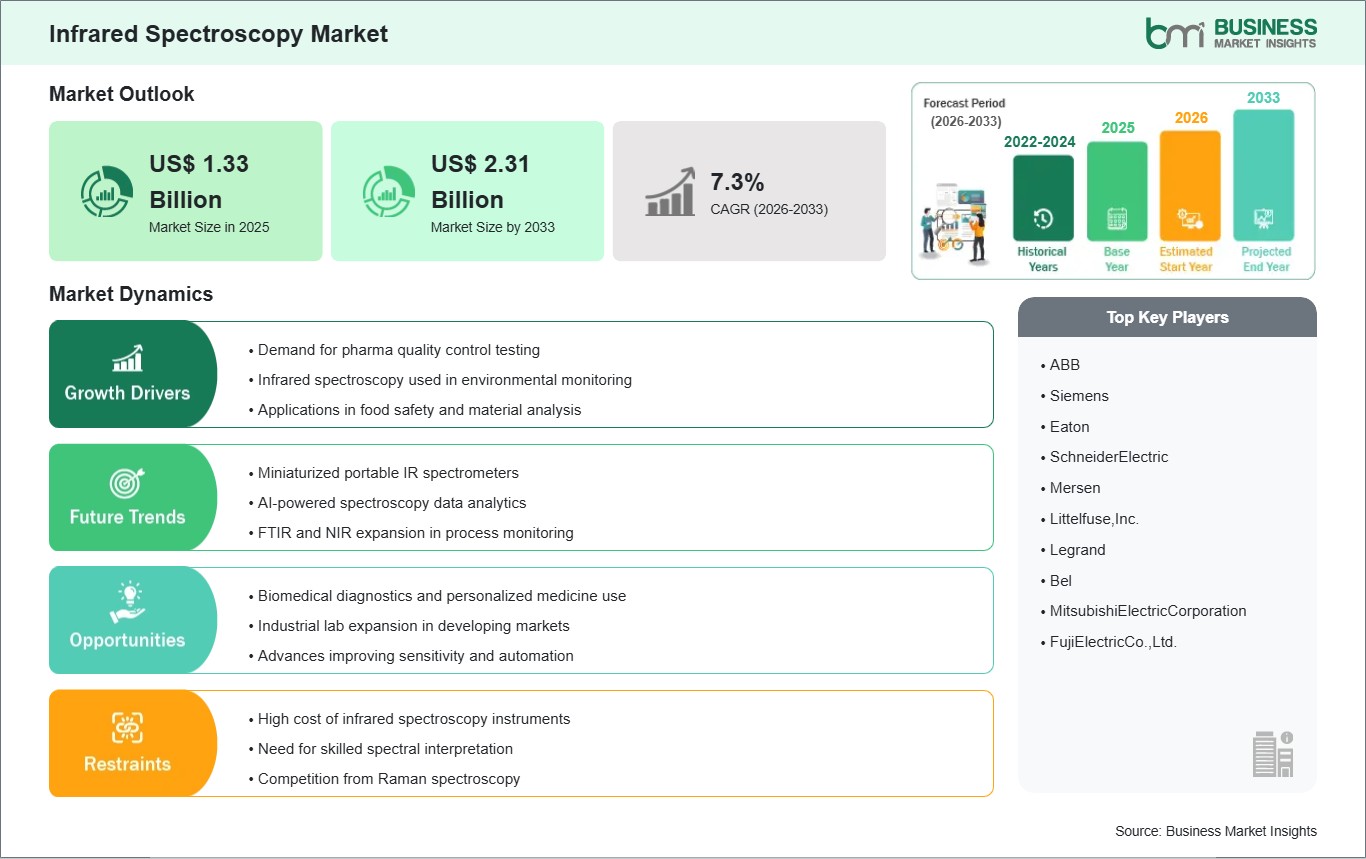
Infrared spectroscopy is an advanced analytical method that measures how infrared radiation interacts with matter through absorption, emission, or reflection. These systems provide significant value by enabling rapid, high-accuracy molecular analysis in key supply chains such as pharmaceuticals, food safety, and environmental monitoring. Market growth is driven by increased biopharmaceutical R&D, stricter food authenticity regulations, and the wider use of compact, field-ready sensors for on-site testing. The adoption of hyphenated techniques that combine spectroscopy with chromatography is also enhancing the detection of complex trace contaminants in material science.
However, several challenges may limit market growth. High acquisition and maintenance costs for advanced FTIR and NIR systems can be prohibitive for academic laboratories and small manufacturers in emerging markets. Technical barriers in data interpretation, often requiring specialized chemometric expertise, may result in underutilization in non-scientific settings. The industry also faces limitations due to wavelength penetration in dense or aqueous samples, which can require complex sample preparation and reduce the technique’s speed advantage.
Despite these challenges, the market offers significant opportunities driven by the global shift toward personalized medicine and the growing use of automated inline process monitoring. Expansion in space exploration and astronomical spectroscopy, along with the development of battery-powered, drone-mounted IR sensors for agricultural health mapping, are expected to support long-term market growth.
Segment Analysis
Infrared Spectroscopy Market Segmentation
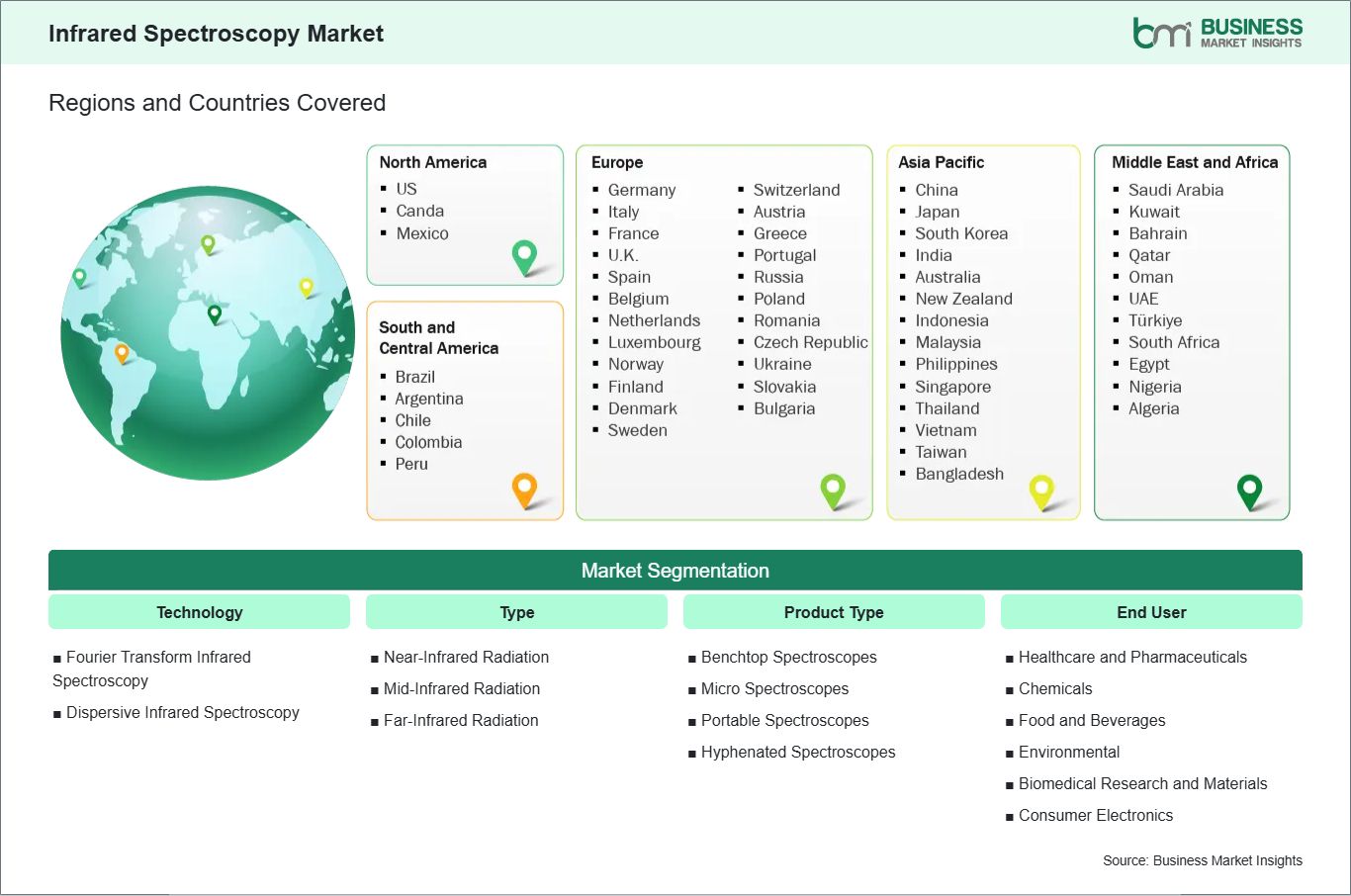
Key segments that contributed to the derivation of the Infrared Spectroscopy market analysis are technology, type, product type, and end user.
- By technology, the market is segmented into Fourier Transform Infrared Spectroscopy and Dispersive Infrared Spectroscopy.
- By type, the market is divided into Near-Infrared Radiation, Mid-Infrared Radiation, and Far-Infrared Radiation.
- By product type, the market is categorized into Benchtop Spectroscopes, Micro Spectroscopes, Portable Spectroscopes, and Hyphenated Spectroscopes.
- By end user, the market is segmented into Healthcare & Pharmaceuticals, Chemicals, Food & Beverages, Environmental, Biomedical Research & Materials, and Consumer Electronics.
Market Forces
Infrared Spectroscopy Market Drivers and Opportunities
Advancing Regulatory Rigor and High-Speed Process Analytical Technology
The Infrared Spectroscopy Market is driven by growing global demand for rapid, non-destructive testing to meet stricter regulatory and quality-by-design (QbD) requirements. Pharmaceutical and biotechnology companies are leading this trend, using FT-IR and NIR spectroscopy for real-time monitoring of key process parameters during drug synthesis and fermentation. These at-line and in-line methods enable manufacturers to quickly identify impurities and verify blend uniformity, reducing batch failures and supporting Real-Time Release Testing (RTRT). Rising concerns about food safety and authenticity have also made infrared systems essential for detecting counterfeit ingredients, pesticide residues, and contaminants in supply chains without damaging samples. Additionally, increased environmental health initiatives, especially in Europe and the Asia-Pacific, have established IR spectroscopy as a vital tool for monitoring air and water pollutants, including microplastics and nitrogen dioxide. These combined factors, regulatory compliance, operational efficiency, and public health, are ensuring continued strong growth for infrared diagnostics in the global analytical market.
Agentic AI Analytics and Miniaturized Pocket-Lab Deployment
A significant high-value opportunity lies in the convergence of Infrared Spectroscopy with Agentic AI and Machine Learning (ML). Modern spectrometers now use autonomous AI agents to analyze complex spectral data in real time, identifying patterns and anomalies that manual methods often miss. Miniaturization and in-field deployment of handheld devices represent another major growth area. These portable tools enable non-specialists to conduct accurate material verification on-site, reducing delays caused by sample transport. The expanding Biopharmaceutical and Cell Therapy sectors also offer strong potential, as specialized MIR systems are increasingly used to characterize protein structures and monitor metabolic byproducts in bioreactors, advancing next-generation therapeutics. Additionally, consumer-integrated wearable spectroscopy is emerging as a long-term opportunity, with affordable multispectral sensors now appearing in smart home devices and personal health trackers to monitor food freshness and biometric data. Manufacturers that prioritize modular, cloud-connected software and develop calibration-free sensors are well-positioned to lead innovation and capture high-margin segments in analytical technology.
Size and Share Analysis
Infrared Spectroscopy Market Size and Share Analysis
The Infrared Spectroscopy market demonstrates steady growth, with size and share analysis revealing evolving trends and competitive positioning among key players. The report further examines subsegments categorized within technology, type, product type, and end user, offering insights into their contribution to overall market performance.
Based on technology, the Fourier Transform Infrared (FTIR) Spectroscopy subsegment holds a significant market share and is the industry standard for high-resolution chemical analysis. FTIR is essential in biomedical research, offering a superior signal-to-noise ratio and rapid scan speeds for detailed studies of protein structures and complex biomolecules. Dispersive Infrared Spectroscopy is also gaining traction, particularly in specialized agricultural and industrial applications. These systems are increasingly used in field testing, offering a durable and cost-effective solution for routine screening of grain quality and soil health, without the environmental limitations of interferometric systems.
Report Coverage
Infrared Spectroscopy Market Report Coverage and Deliverables
The "Infrared Spectroscopy Market Size and Forecast (2022 - 2033)" report provides a detailed analysis of the market covering below areas:
- Infrared Spectroscopy market size and forecast at global, regional, and country levels for all the key market segments covered under the scope
- Infrared Spectroscopy market trends, as well as market dynamics such as drivers, restraints, and key opportunities
- Infrared Spectroscopy market analysis covering key market trends, global and regional framework, major players, regulations, and recent market developments
- Industry landscape and competition analysis covering market concentration, heat map analysis, prominent players, and recent developments for the Infrared Spectroscopy market
- Detailed company profiles, including SWOT analysis
Geographic Insights
Infrared Spectroscopy Market Geographic Insights
The geographical scope of the Infrared Spectroscopy market report is divided into five regions: North America, Asia Pacific, Europe, Middle East & Africa, and South & Central America.
North America leads the market, supported by a strong pharmaceutical research ecosystem and early use of automated analytical platforms. Europe is a key center for innovation, especially in the chemical and environmental sectors, where strict regulations require precise molecular analysis. Asia Pacific is the fastest-growing region, driven by expanding generic drug manufacturing and increased food safety monitoring in emerging economies. The Asia-Pacific Infrared Spectroscopy Market includes China, Japan, South Korea, India, Australia, and the Rest of Asia. The region is experiencing significant industrial transformation. China and India are leading in adopting FTIR and NIR technologies for large-scale quality control. In Japan, growth focuses on advanced R&D in materials science and nanotechnology. India’s growing pharmaceutical sector is increasingly using spectroscopy for real-time process monitoring to meet international export standards.
Industry Activity
Recent Developments
The Infrared Spectroscopy market is evaluated by gathering qualitative and quantitative data post primary and secondary research, which includes important corporate publications, association data, and databases. A few of the key developments in the Infrared Spectroscopy market are:
- In November 2025, Bruker introduced the VERTEX NEO Ultra, a benchtop vacuum FT-IR spectrometer with automated multi-detector flexibility, ultrahigh spectral resolution, and advanced time-resolved capabilities. This launch strengthens the Infrared Spectroscopy market by enabling faster, more accurate, and high-throughput research applications across academic and industrial sectors.
- In July 2025, Photothermal Spectroscopy Corp. launched the mIRage-IR microscope, a submicron IR imaging system using O-PTIR technology. The non-contact, high-resolution system enhances FTIR-class analysis, enabling flexible sample handling and automated particle identification, strengthening capabilities in pharmaceuticals, materials science, and environmental research.
Trust & Transparency
Research Methodology
The market analysis combines proprietary research with secondary data from government agencies, company disclosures, regulatory filings, industry databases and expert interviews. Market estimates are validated through data triangulation, cross-market benchmarking and analyst
review.
View Full Research Methodology
Key Sources Referred:
World Bank - Global Trade Indicators World Trade Organization (WTO) International Monetary Fund (IMF) International Trade Administration (ITA) Company website Company annual reports Company investor presentations