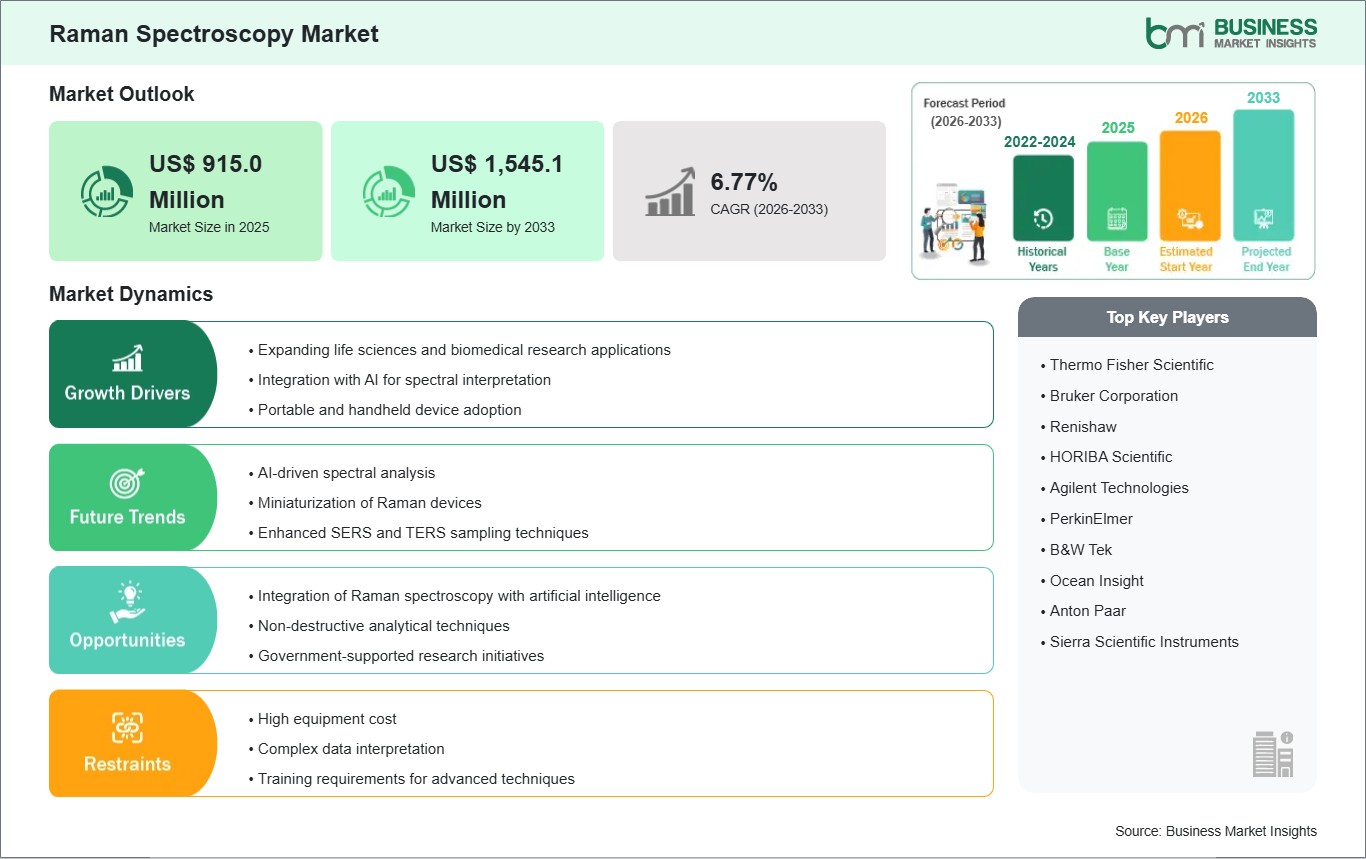
The Raman Spectroscopy Market size is expected to reach US$ 1,545.1 million by 2033 from US$ 915. million in 2025. The market is estimated to record a CAGR of 6.77% from 2026 to 2033.
The global Raman spectroscopy market is expanding steadily due to increasing demand for molecular characterization and non-destructive analytical techniques in life sciences, pharmaceuticals, and materials science. Raman spectroscopy enables vibrational analysis of molecular structures with minimal sample preparation, making it essential in research laboratories, quality control, and industrial analytics.
Technological advancements such as AI-driven spectral interpretation, miniaturized handheld devices, and enhanced sampling techniques (SERS and TERS) are broadening applications and lowering adoption barriers. Portable and handheld systems allow field-based analysis in environmental monitoring, forensic investigations, and industrial quality checks, while microscopy Raman and FT-Raman systems remain critical in laboratory and R&D environments.
North America and Asia Pacific lead growth due to robust research spending, expanding pharmaceutical and semiconductor sectors, and government-supported initiatives.

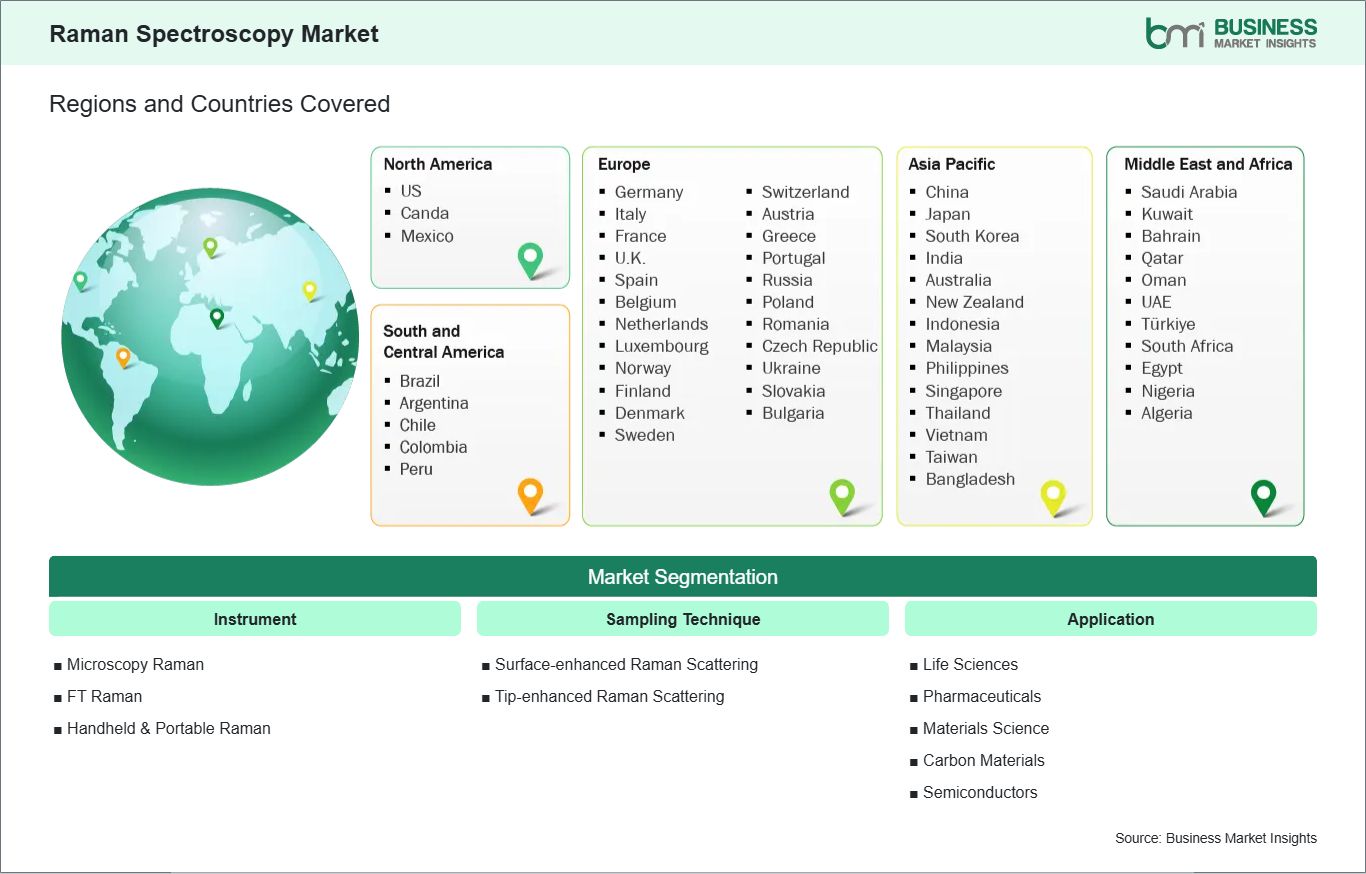
Key segments that contributed to the derivation of the Raman spectroscopy market analysis are instrument, sampling technique, and application.
Raman spectroscopy provides non-destructive, label-free, high-resolution molecular insights. Advanced techniques like SERS and TERS allow detection of trace biomolecules, nanoscale cellular mapping, and drug–cell interaction studies. Universities, clinical research institutions, and pharmaceutical R&D labs adopt Raman for cancer diagnostics, neuroscience, metabolic studies, and personalized medicine development.
AI-driven analysis automates interpretation of complex spectral data, improving speed and accuracy. Applications include pharmaceutical quality control, biomedical diagnostics, and environmental monitoring. AI-based Raman systems can detect counterfeit pharmaceuticals, biomarkers, and pollutants in real-time, enabling use by non-expert operators in the field.
The Raman Spectroscopy Market demonstrates steady growth, with size and share analysis highlighting evolving trends and competitive dynamics among key players. The report examines subsegments categorized within product, usability, and application, offering insights into their contribution to overall market performance.
By instrument, the microscopy Raman systems subsegment dominated the market in 2025, driven by high-resolution imaging and widespread laboratory adoption.
By sampling technique, tip-enhanced Raman scattering subsegment dominated the market in 2025, driven by nanoscale analytical capabilities essential for advanced material and semiconductor research.
In terms of application, the pharmaceuticals subsegment dominated the market in 2025, driven by the extensive quality control, formulation analysis, and regulatory compliance applications.
| Report Attribute | Details |
|---|---|
| Market size in 2025 | US$ 915.0 Million |
| Market Size by 2033 | US$ 1,545.1 Million |
| Global CAGR (2026 - 2033) | 6.77% |
| Historical Data | 2022-2024 |
| Forecast period | 2026-2033 |
| Segments Covered | By Instrument
|
|
Regions and Countries Covered
| |
| North America | US, Canada, Mexico |
| Europe | Belgium, Austria, Finland, Denmark, Greece, Poland, Romania, Russia, Ukraine, Czech Republic, Slovakia, Bulgaria, Italy, Luxembourg, Germany, Switzerland, France, Netherlands, Norway, Portugal, Spain, Sweden, United Kingdom |
| Asia-Pacific | Australia, China, India, Japan, South Korea, Indonesia, Malaysia, Philippines, Singapore, Thailand, Vietnam, Bangladesh, New Zealand, Taiwan |
| South and Central America | Brazil, Argentina, Peru, Chile, Colombia |
| Middle East and Africa | Bahrain, Kuwait, Oman, Qatar, Saudi Arabia, United Arab Emirates, Turkiye, South Africa, Egypt, Algeria, Nigeria |
| Market leaders and key company profiles |
|
The "Raman Spectroscopy Market Size and Forecast (2022 - 2033)" report provides a detailed analysis of the market covering below areas:
The geographical scope of the Raman Spectroscopy Market report is divided into North America, Asia Pacific, Europe, Middle East & Africa, and South & Central America. North America held the largest share in 2025.
North America remains the leading region for Raman spectroscopy adoption, driven by strong investments in biomedical research, pharmaceutical quality control, and advanced materials analysis. The U.S. and Canada benefit from well‑established research ecosystems, regulatory clarity, and early adoption of portable and handheld Raman devices. Universities, clinical labs, and industrial R&D centers are integrating Raman systems for drug authentication, cancer diagnostics, and nanomaterials characterization, supported by government funding and private sector innovation. Europe demonstrates robust uptake, particularly in countries such as Germany, the UK, and France, where centralized health technology assessments and strong public research funding emphasize safety, cost‑effectiveness, and sustainability. Raman spectroscopy is widely used in pharmaceutical manufacturing, food safety testing, and environmental monitoring, with EU regulations encouraging adoption of non‑destructive analytical tools. Public health agencies and industrial labs increasingly incorporate Raman performance indicators into procurement and compliance frameworks.
Asia Pacific is emerging as a high‑growth region, led by Japan, South Korea, China, and India. Japan and South Korea are advancing toward digital‑enabled Raman platforms and integrating spectroscopy into semiconductor and electronics R&D. China’s strong focus on pharmaceutical quality assurance and counterfeit detection is driving demand for handheld Raman devices, while India’s expanding academic and clinical research base is fostering adoption in biomedical and agricultural applications.
Latin America and Middle East & Africa are at earlier stages of adoption but show accelerating interest, particularly in urban centers and industrial hubs. Raman spectroscopy is being deployed in forensic investigations, mining, and environmental monitoring, often supported by public‑private partnerships and donor‑funded programs. Affordability and training remain key considerations, but growing emphasis on drug safety and pollution control is expected to expand uptake.

The Raman Spectroscopy Market is evaluated by gathering qualitative and quantitative data post primary and secondary research, which includes important corporate publications, association data, and databases. A few of the key developments in the raman spectroscopy market are:
The Raman Spectroscopy Market is valued at US$ 915.0 Million in 2025, it is projected to reach US$ 1,545.1 Million by 2033.
As per our report Raman Spectroscopy Market, the market size is valued at US$ 915.0 Million in 2025, projecting it to reach US$ 1,545.1 Million by 2033. This translates to a CAGR of approximately 6.77% during the forecast period.
The Raman Spectroscopy Market report typically cover these key segments-
The historic period, base year, and forecast period can vary slightly depending on the specific market research report. However, for the Raman Spectroscopy Market report:
The Raman Spectroscopy Market is populated by several key players, each contributing to its growth and innovation. Some of the major players include:
The Raman Spectroscopy Market report is valuable for diverse stakeholders, including:
Essentially, anyone involved in or considering involvement in the Raman Spectroscopy Market value chain can benefit from the information contained in a comprehensive market report.
Please tell us your area of interest
(Market Segments/ Regions and Countries/ Companies)