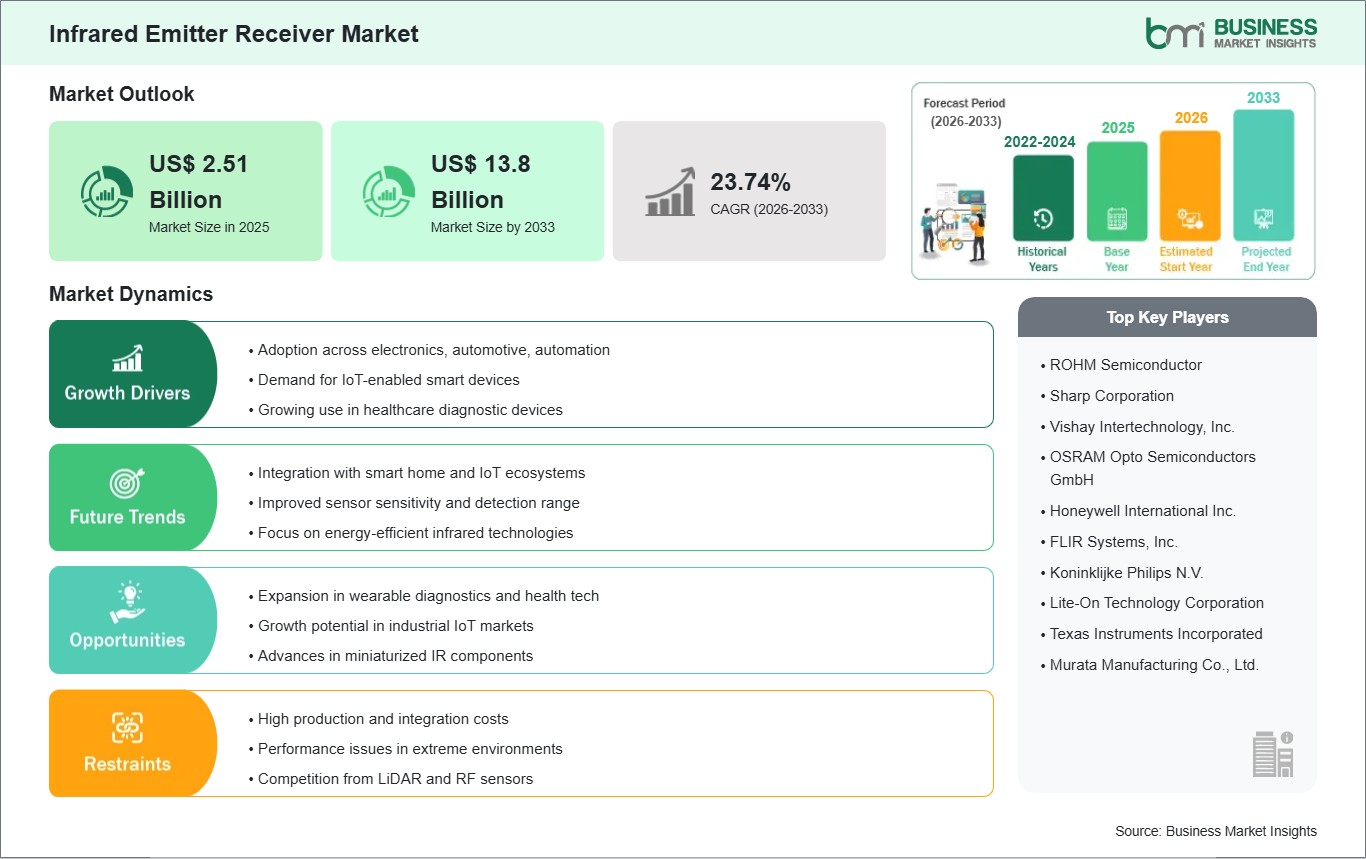
The Infrared Emitter Receiver Market size is expected to reach US$ 13.8 Billion by 2033 from US$ 2.51 Billion in 2025. The market is estimated to record a CAGR of 23.74% from 2026 to 2033.
The global infrared emitter and receiver market is experiencing sustained growth, driven by expanding applications across consumer electronics, automotive safety systems, and industrial automation. The market is growing steadily, reflecting robust demand for infrared components in gesture recognition, proximity sensing, and advanced driver‑assistance systems (ADAS). Near‑infrared (NIR) wavelengths dominate due to cost‑effectiveness and widespread deployment in everyday devices, while short‑wave and laser‑based solutions grow rapidly in precision markets. Consumer electronics retain leadership owing to high unit volumes, but automotive is the fastest‑growing vertical, propelled by regulatory safety mandates and autonomous vehicle trends.
Regionally, Asia‑Pacific leads the infrared emitter and receiver market, accounting for the largest revenue share due to its strong consumer electronics manufacturing base in China, Japan, and South Korea. North America and Europe contribute significant market portions, bolstered by automotive innovation, healthcare diagnostics, and security systems adoption. Technological advancement in VCSEL, LED, and photodiode integrations enhances performance and reduces costs, broadening the technology`s appeal across industries. Consumer electronics applications — especially in smartphones, smart home devices, and wearable tech — remain a major revenue driver, while automotive`s rapid adoption of night vision and occupant sensing systems fuels future growth. Overall, the market demonstrates diversified regional strength and broad industry impact.

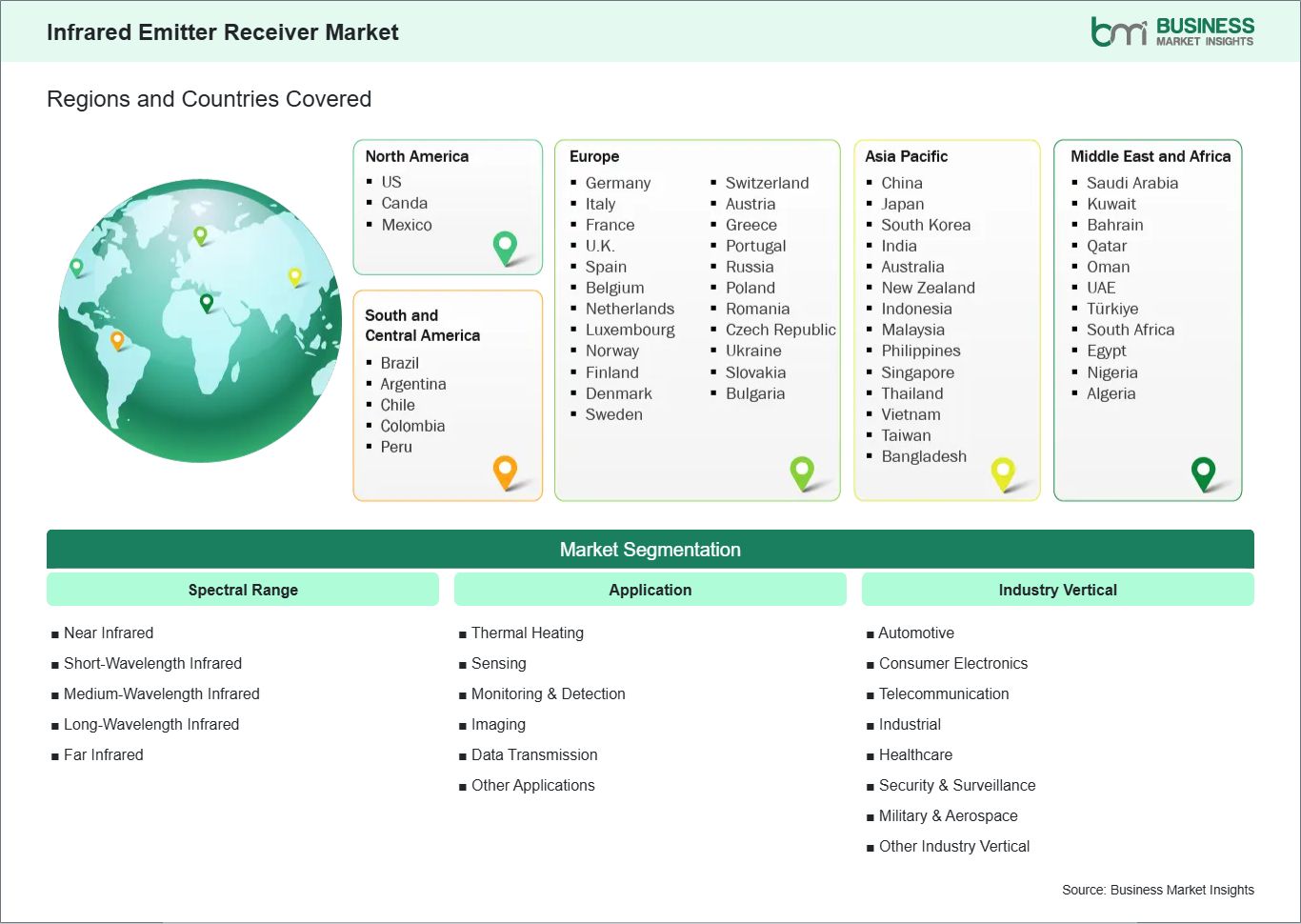
Key segments that contributed to the derivation of the Infrared emitter receiver market analysis are Spectral Range, Application, and Industry Vertical.
The rapid proliferation of consumer electronics, including smartphones, smart TVs, wearables, and home automation devices, is a primary driver for the infrared emitter and receiver market. Infrared technology enables essential functions such as gesture recognition, remote controls, proximity sensing, and facial recognition in smartphones and IoT devices. Increasing consumer demand for convenience, contactless interaction, and seamless device integration has led manufacturers to integrate advanced infrared components. The technology`s cost-effectiveness, reliability, and compact size make it ideal for high-volume electronics production. Consequently, the surge in smart devices worldwide continues to push global infrared component demand, ensuring consistent growth and higher market penetration across the consumer technology segment.
The automotive industry presents a significant growth opportunity for infrared emitters and receivers, driven by increasing adoption of Advanced Driver-Assistance Systems (ADAS) and autonomous vehicles. Infrared sensors are critical for night vision, pedestrian detection, obstacle monitoring, and in-cabin occupancy sensing, enhancing vehicle safety and compliance with regulatory standards. Rising government mandates for collision avoidance and pedestrian protection systems are further accelerating infrared sensor integration. As automotive OEMs focus on smart and autonomous mobility solutions, the demand for highly accurate, reliable, and miniaturized infrared components is expected to surge. This expansion into automotive applications provides manufacturers with substantial revenue potential and opportunities for technology differentiation in a rapidly evolving sector.
By Spectral Range, the market is segmented into Near Infrared (NIR), Short-Wavelength Infrared (SWIR), Medium-Wavelength Infrared (MWIR), Long-Wavelength Infrared (LWIR), and Far Infrared (FIR). The Near Infrared (NIR) segment dominated the market in 2025. Near Infrared (NIR) dominates due to its extensive use in consumer electronics, optical sensors, and short-range data transmission, offering cost-effective, compact, and reliable solutions for detection, sensing, communication, and various industrial and scientific applications.
By Application, the market is segmented into Thermal Heating, Sensing, Monitoring & Detection, Imaging, Data Transmission, and Other Applications. The Sensing, Monitoring & Detection segment held the largest share of the market in 2025. Sensing, monitoring, and detection dominate infrared applications, powering thermal monitoring, motion detection, object recognition, and security systems, forming the backbone for industrial, healthcare, automotive, and consumer electronics solutions globally.
By Industry Vertical, the market is segmented into Automotive, Consumer Electronics, Telecommunication, Industrial, Healthcare, Security & Surveillance, Military & Aerospace, and Other Industry Verticals. The Consumer Electronics segment held the largest share of the market in 2025. Consumer electronics lead demand for IR components, leveraging NIR and SWIR technologies in smartphones, cameras, remote controls, wearables, and smart devices, driving innovation and volume in sensing, communication, imaging, and monitoring applications worldwide.
| Report Attribute | Details |
|---|---|
| Market size in 2025 | US$ 2.51 Billion |
| Market Size by 2033 | US$ 13.8 Billion |
| Global CAGR (2026 - 2033) | 23.74% |
| Historical Data | 2022-2024 |
| Forecast period | 2026-2033 |
| Segments Covered | By Spectral Range
|
|
Regions and Countries Covered
| |
| North America | US, Canada, Mexico |
| Europe | Belgium, Austria, Finland, Denmark, Greece, Poland, Romania, Russia, Ukraine, Czech Republic, Slovakia, Bulgaria, Italy, Luxembourg, Germany, Switzerland, France, Netherlands, Norway, Portugal, Spain, Sweden, United Kingdom |
| Asia-Pacific | Australia, China, India, Japan, South Korea, Indonesia, Malaysia, Philippines, Singapore, Thailand, Vietnam, Bangladesh, New Zealand, Taiwan |
| South and Central America | Brazil, Argentina, Peru, Chile, Colombia |
| Middle East and Africa | Bahrain, Kuwait, Oman, Qatar, Saudi Arabia, United Arab Emirates, Turkiye, South Africa, Egypt, Algeria, Nigeria |
| Market leaders and key company profiles |
|
The " Infrared Emitter Receiver Market Size and Forecast (2022 - 2033)" report provides a detailed analysis of the market covering below areas:
The geographical scope of the Infrared emitter receiver market report is divided into five regions: North America, Asia Pacific, Europe, Middle East & Africa, and South & Central America. The Infrared emitter receiver market in Asia Pacific is expected to grow significantly during the forecast period.
The Asia-Pacific region dominates the global infrared emitter and receiver market, driven by its robust consumer electronics manufacturing hub, particularly in China, Japan, South Korea, and Taiwan. High production volumes of smartphones, smart TVs, wearable devices, and home automation systems have fueled widespread adoption of infrared technology. Additionally, rapid automotive electrification and the integration of Advanced Driver-Assistance Systems (ADAS) are boosting demand for infrared sensors in vehicles for night vision, obstacle detection, and occupant monitoring. Government initiatives promoting smart cities, industrial automation, and security infrastructure further support market expansion. The presence of major component manufacturers and suppliers facilitates cost-effective production and faster technological innovation. Rising disposable incomes, increasing digital penetration, and strong urbanization trends contribute to higher consumer adoption of infrared-enabled devices.

The Infrared emitter receiver market is evaluated by gathering qualitative and quantitative data post primary and secondary research, which includes important corporate publications, association data, and databases. A few of the key developments in the Infrared emitter receiver market are:
The Infrared Emitter Receiver Market is valued at US$ 2.51 Billion in 2025, it is projected to reach US$ 13.8 Billion by 2033.
As per our report Infrared Emitter Receiver Market, the market size is valued at US$ 2.51 Billion in 2025, projecting it to reach US$ 13.8 Billion by 2033. This translates to a CAGR of approximately 23.74% during the forecast period.
The Infrared Emitter Receiver Market report typically cover these key segments-
The historic period, base year, and forecast period can vary slightly depending on the specific market research report. However, for the Infrared Emitter Receiver Market report:
The Infrared Emitter Receiver Market is populated by several key players, each contributing to its growth and innovation. Some of the major players include:
The Infrared Emitter Receiver Market report is valuable for diverse stakeholders, including:
Essentially, anyone involved in or considering involvement in the Infrared Emitter Receiver Market value chain can benefit from the information contained in a comprehensive market report.
Please tell us your area of interest
(Market Segments/ Regions and Countries/ Companies)