
Green Mining Equipment Market Outlook: Size, Share, Trends, Growth Analysis, Competitive Landscape & Forecast, 2026-2033

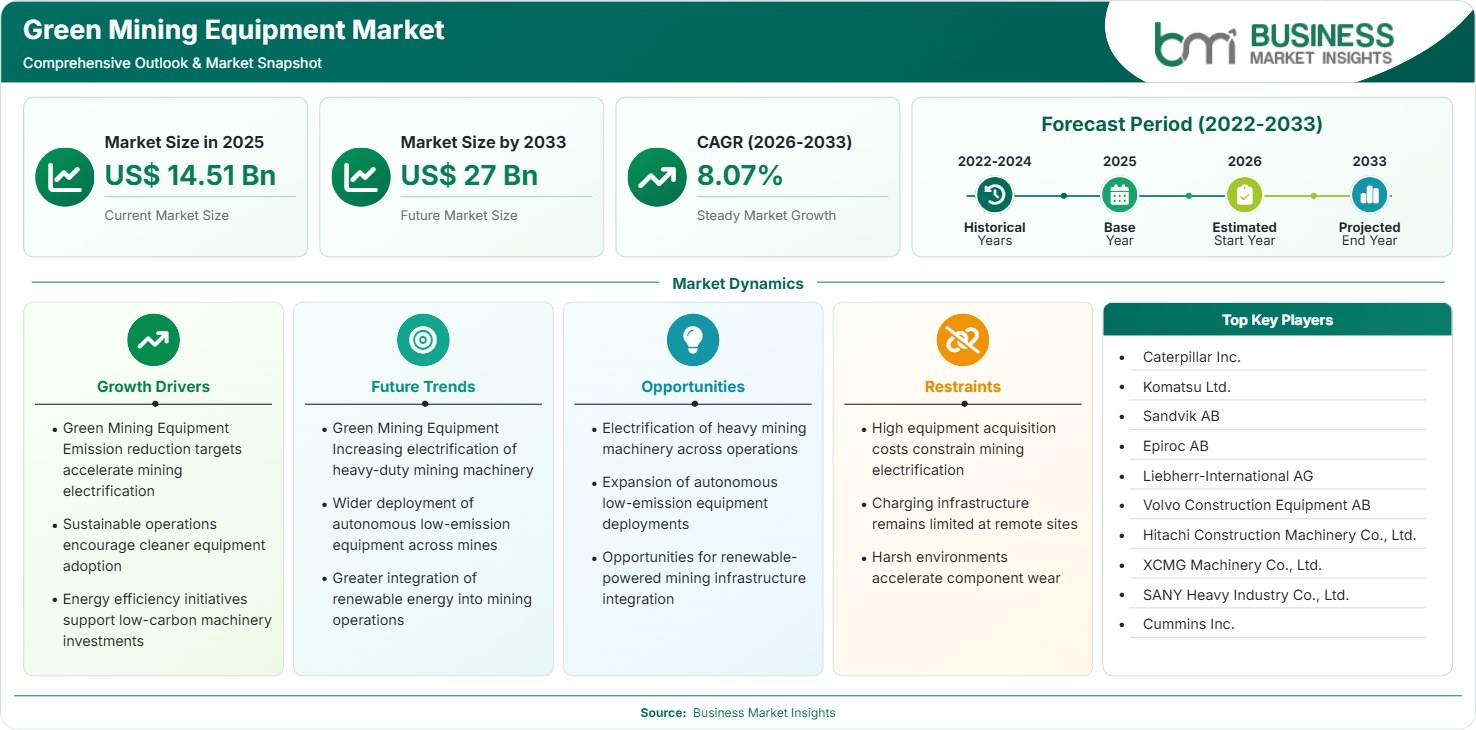
The Green Mining Equipment Market size was valued at US$ 14.51 Billion in 2025 and is projected to reach US$ 27 Billion by 2033, growing at a CAGR of 8.07% during 2026–2033, driven by mine electrification, battery innovation, automation, energy efficiency, decarbonization mandates, and demand for lower operating costs.

Report Coverage
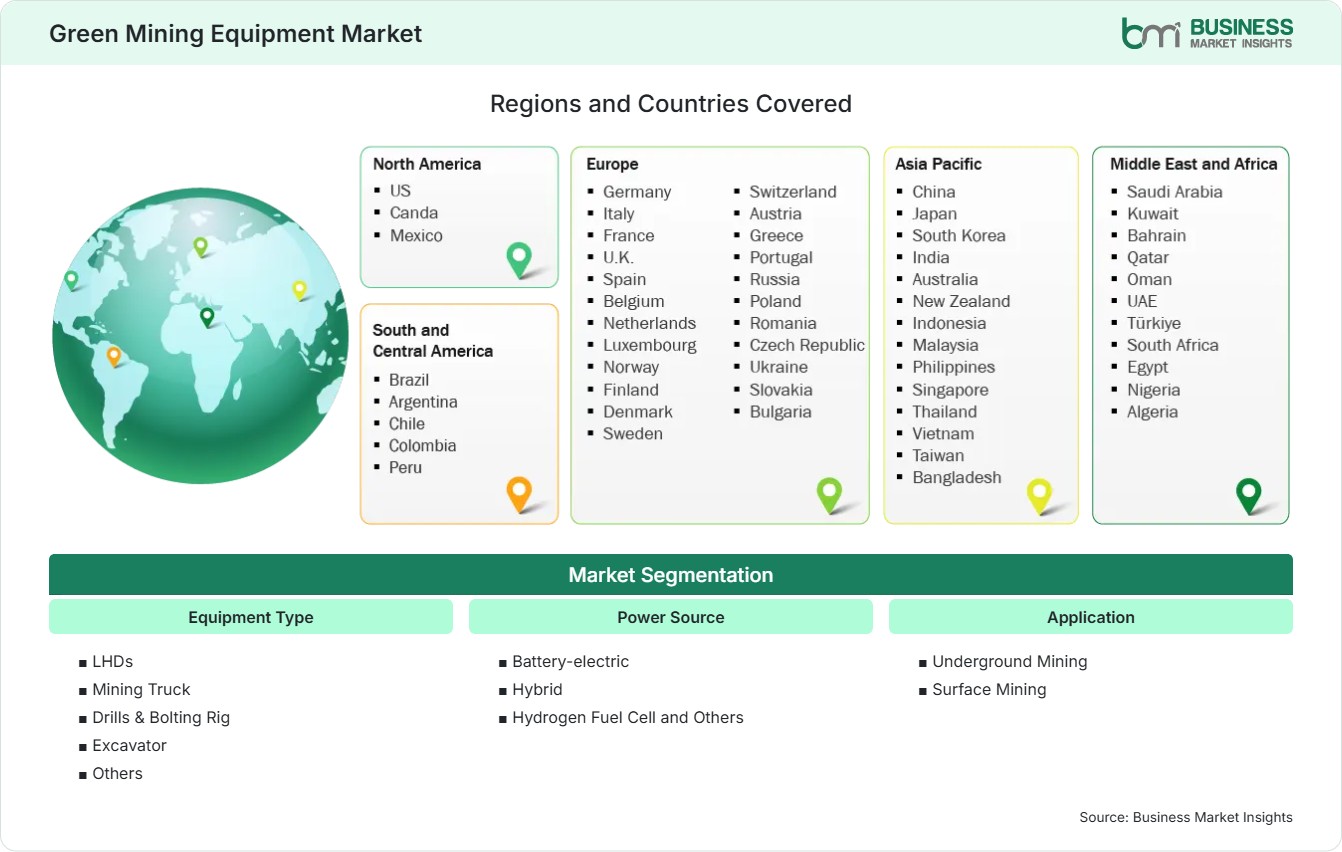
  • Equipment Type: LHDs, Mining Truck, Drills & Bolting Rig, Excavator, Others
  • Power Source: Battery-electric, Hybrid, Hydrogen Fuel Cell and Others
  • Application: Underground Mining, Surface Mining
US$ 14.51 Bn Market size in 2025
US$ 27 Bn Market Size by 2033
8.07% CAGR, 2026 - 2033
2026-2033 Forecast Period

AI Overview

Green Mining Equipment Market Summary

  • North America Region: North America holds a Green Mining Equipment Market share of 29%–32% in 2025, growing at a CAGR of 7.4%–8.0%, influenced by mine electrification, critical-mineral investment, automation, battery-electric haulage, grid modernization, and decarbonization programs.
  • Fastest Growing Region: Asia Pacific holds a market share of 31%–34% in 2025, growing at a CAGR of 9.0%–9.8%, supported by expanding mineral production, Chinese equipment manufacturing, Indian mine modernization, battery supply chains, electrification investment, and stricter environmental performance requirements.
  • Leading Segment: Mining Truck holds a market share of 36%–40% in 2025, growing at a CAGR of 8.2%–8.8%, supported by high diesel consumption, large fleet sizes, autonomous haulage, trolley assistance, battery-electric platforms, and measurable fuel-cost reduction opportunities.
  • High Growth Segment: Battery-electric holds a market share of 11%–15% in 2025, growing at a CAGR of 14%–16%, supported by falling battery costs, improved energy density, swappable systems, regenerative braking, zero tailpipe emissions, and mine-level electrification infrastructure.
  • Key Market Opportunity: Suppliers can capture value by integrating machines, charging, batteries, energy management, automation, fleet software, maintenance, financing, and lifecycle services into scalable decarbonization packages for diverse mining operations.
  • Major Market Players: Caterpillar Inc., Komatsu Ltd., Sandvik AB, Epiroc AB, Liebherr-International AG, Volvo Construction Equipment AB, Hitachi Construction Machinery Co., Ltd., XCMG Machinery Co., Ltd., SANY Heavy Industry Co., Ltd., and Cummins Inc.
Strategic Insights

Green Mining Equipment Market: Strategic Insights

Green Mining Equipment Market Strategic Framework
FREE PDF
Request your free sample
Request free sample
Stakeholder View

Key Takeaways

  • The value chains associated with mining equipment are changing from a focus on the machines themselves to a more integrated approach that includes original equipment manufacturers, battery suppliers, charging providers, automation specialists, utilities, mine developers, and digital-service companies. This shift creates new opportunities for recurring revenue through software, energy management, maintenance, battery lifecycle services, and equipment upgrades.
  • The mining truck still represents the greatest equipment opportunity since haulage fleets work intensively and use a large amount of fuel. Depending on the duty cycle, battery-electric, trolley-assisted, and hybrid types can be used, enabling operators to focus on those applications in which energy savings, regenerative braking, or access to charging bring about tangible economic benefits.
  • There is a growing emphasis on modular batteries, quicker charging, autonomous operation, drivetrains that are independent of power supply, and software-defined energy management. The modular battery design of Epiroc, together with Sandvik's own battery capabilities, shows the direction in which equipment manufacturers are moving towards deeper involvement in energy technology.
  • Because of their mineral production, mine modernization, electrification infrastructure, and policies relating to critical minerals, Australia, Canada, the United States, Chile, Sweden, China, and India provide unique investment opportunities. Companies that localize their service capacity and charging expertise can reduce obstacles to deployment in these markets.
  • Investment activity is now more closely linked to large-scale fleet commitments than to demonstrations based on individual machines, as shown by Sandvik's order for approximately SEK 750 million for Hermosa and Epiroc's contract for approximately SEK 2.2 billion with Fortescue, examples of the shift towards large electrification programs covering several machine categories.
  • The importance of charging facilities and the grid infrastructure is now a key factor in the uptake of green equipment. The ability to scale up electric mining fleets relies not just on the performance of the vehicles but also on the availability of high-capacity charging systems, the mine site's power distribution network, energy storage, and connections to the grid. This situation, therefore, provides equipment suppliers and energy providers with further opportunities to offer combined power and charging solutions together with their mining machinery.
Geographic Outlook

Green Mining Equipment Market Regional Highlights

North America Green Mining Equipment Market

North America represented a 29%–32% share in 2025 and is projected to record a 7.4%–8.0% CAGR through 2033. The Green Mining Equipment Market share is supported by critical mineral development, automation adoption, fleet replacement, and mine electrification. The market growth outlook is reinforced by battery truck demonstrations and trolley-assist systems.

  • US operators are currently testing battery-electric haulage, trolley assistance, autonomous equipment, and electrified excavators, thereby opening up commercial opportunities beyond the stage of pilot projects and prompting suppliers to set up local services relating to charging, training, and the full lifecycle support of their products.
  • The Canadian mines offer the possibility of electrification since the engineering needed for cold weather, the long periods of operation, and the requirement for underground ventilation set clear standards for battery systems, thermal management, remote monitoring, and energy-efficient equipment.
  • The need for equipment suitable to meet investor and permitting requirements concerning emissions, productivity, safety, and operational resilience is growing among critical-mineral projects in the area.
  • The combination of autonomous haulage and electrification is becoming strategically important since digital fleet management is able to coordinate charging, dispatch, route optimization, regenerative energy, and equipment utilization over large mining sites.

US Green Mining Equipment Market

The United States accounted for 70%–74% of North America's 2025 market and is projected to expand at a 7.5%–8.1% CAGR through 2033. The country combines established mining equipment manufacturing, critical mineral development, technology-intensive mines, and substantial investment capacity. The Green Mining Equipment Market is increasingly influenced by demand for lower fuel consumption, autonomous operations, and resilient domestic supply chains.

  • Increasingly, developers in the United States are assessing the use of battery-electric equipment because such equipment can improve the overall operating economics through ventilation savings, fuel displacement, and better energy management, while at the same time helping to achieve their emissions-reduction goals.
  • Because developers are looking for modern equipment configurations from the time the projects begin until they are commissioned, there is a potential demand for electric loaders, trucks, drills, charging systems, and digital fleet platforms within domestic critical-mineral projects.
  • The collaboration between manufacturers of equipment and mining companies is speeding up the validation of technology, decreasing operational uncertainty, and producing data specific to each site, which is needed for its wider commercial use.

Europe Green Mining Equipment Market

Europe Green Mining Equipment Market held a 27%–30% share in 2025 and is projected to record an 8.0%–8.6% CAGR through 2033. Sweden, Finland, Germany, and other industrial economies provide strong technology-development ecosystems for electric mining machinery, automation, batteries, and mine electrification. Sweden represents a leading market, while Finland is a high-growth technology hub.

  • Sweden possesses innovation in the field of mining, expertise in battery technology, experience in automation, and is carrying out active projects relating to the electrification of mines, which makes it an important setting for verifying commercial-scale low-emission equipment and energy-management solutions.
  • Finland has a strong ecosystem for mining technology and a solid base in the manufacture of mining equipment, which enables the development of electric loaders, underground vehicles, drilling systems, automation platforms, and service technologies.
  • Germany still plays an important role in the fields of industrial equipment engineering and the manufacture of components, since the need for electrification is prompting suppliers to enhance the efficiency of their drivetrains, charging systems, digital controls, and machine energy management.
  • When choosing mining machinery, European operators are increasingly taking into account, together with the usual productivity measures, factors such as lifecycle emissions, energy consumption, noise, and worker exposure.

Asia Pacific Green Mining Equipment Market

Asia Pacific held a 31%–34% share in 2025 and is projected to achieve a 9.0%–9.8% CAGR through 2033, making it the fastest-growing regional market. China remains the largest equipment manufacturing base, while India and Australia provide substantial mine modernization opportunities. Japan and South Korea contribute battery, automation, and industrial technology capabilities. The Green Mining Equipment Market in Asia Pacific benefits from expanding mineral demand, manufacturing scale, large mining fleets, and accelerating interest in lower-emission equipment.

  • Because of its vast capacity in the manufacture of equipment and because of the rapid expansion of its range of electric machinery, China is able to carry out competitive development of large loaders, excavators, haulage systems, batteries, and related charging technologies.
  • India presents a strong opportunity for growth since the need to modernize mining operations, develop infrastructure, advance domestic manufacturing, and meet environmental performance requirements is leading companies to look into using more fuel-efficient and electric machinery.
  • Australia is still a major market for testing technology since the large iron ore, copper, lithium, and other mining operations need high-capacity equipment, autonomous systems, and ever more sophisticated decarbonization strategies.
  • Japan and South Korea provide advanced batteries, electronics, automation, and industrial components, which can enhance the technology supply chain for next-generation mining equipment.

Rest of World Green Mining Equipment Market

Rest of World Green Mining Equipment Market accounted for a 7%–10% share in 2025 and is projected to grow at a 7.2%–8.0% CAGR through 2033. South and Central America benefit from copper, lithium, iron ore, and other mineral projects, while the Middle East and Africa offer opportunities linked to mine expansion and modernization.

  • The copper industry in Chile has a need for efficient haulage, electrification, water-conscious technologies, and automation, especially in cases where the grade of the ore is falling, and this makes productivity and energy management all the more important.
  • Because of the extensive iron ore infrastructure in Brazil, there are possibilities for using electric haulage, trolley systems, autonomous fleet management, and for moving materials in an energy-efficient way over large surface operations.
  • Since ventilation, diesel usage, safety, and productivity requirements present strong operational reasons for it, South Africa has the potential to offer battery-electric underground equipment.
  • Saudi Arabia's mining development plan supports the need for modern equipment, digital mine management, efficient energy use, and new mine infrastructure. This happens as mineral production grows.
Global Market Geography
FREE PDF
Request your free sample
Request free sample
Segment Analysis

Green Mining Equipment Market Segmentation

Equipment Type

Equipment Type represented the largest segmentation category, with Mining Truck holding a 36%–40% share in 2025 and a 8.2%–8.8% CAGR through 2033. Haulage electrification is supported by high utilization, fuel consumption, regenerative braking potential, trolley systems, and autonomous fleet management. The Green Mining Equipment Market scope increasingly encompasses equipment lifecycle services alongside machinery.

  • LHDs: Battery-electric LHDs support underground loading and hauling where ventilation costs, confined working environments, and repetitive duty cycles strengthen the economic case for zero-emission equipment.
  • Mining Truck: Large haul trucks offer substantial electrification potential because fuel consumption is high, duty cycles are measurable, and trolley, battery, and hybrid architectures can reduce energy costs.
  • Drills & Bolting Rig: Electric drilling and bolting equipment reduces local emissions and noise while supporting automated drilling, precision control, remote operation, and improved underground working conditions.
  • Excavator: Electric excavators can lower direct emissions and energy consumption in fixed or semi-fixed applications where reliable grid connection or battery storage is available.

Power Source

Power Source is undergoing a rapid technological transition as operators evaluate battery-electric, hybrid, hydrogen fuel cell, and conventional alternatives against duty-cycle economics. Battery-electric equipment represented a 11%–15% Green Mining Equipment Market share in 2025 and is projected to grow at a 14%–16% CAGR through 2033, reflecting accelerating commercialization, improving batteries, and expanding charging ecosystems.

  • Battery-electric: Battery-electric equipment provides zero tailpipe emissions, regenerative energy recovery, lower noise, and potential ventilation savings, with modular battery and fast-charging technologies improving utilization.
  • Hybrid: Hybrid equipment can reduce fuel consumption while retaining conventional refueling flexibility, making it relevant for fleets where full electrification infrastructure remains unavailable or economically premature.
  • Hydrogen Fuel Cell: Hydrogen fuel cells offer longer-duration zero-tailpipe operation and rapid refueling potential, with future relevance for high-utilization applications where battery weight, range, or charging time constrains deployment.

Application

Application demand is divided between underground and surface operations, with site characteristics determining the economic attractiveness of each powertrain. Underground mining benefits strongly from ventilation savings and zero local emissions, while surface mining provides larger opportunities for high-capacity haulage, trolley assistance, autonomous dispatch, and grid-connected equipment. Technology selection, therefore, remains duty-cycle dependent.

  • Underground Mining: Underground operations are strong early adopters of battery-electric loaders, trucks, drills, and bolters because reduced diesel emissions can lower ventilation requirements and improve workplace conditions.
  • Surface Mining: Surface mines offer large-scale opportunities for battery-electric trucks, trolley systems, electric excavators, autonomous haulage, and centralized energy management across extensive production fleets.
Market Forces

Green Mining Equipment Market Dynamics

Key Market Drivers

Electrification of High-Utilization Mining Fleets

The market growth is increasingly tied to the electrification of haul trucks, loaders, drills, and excavators that operate for long hours under demanding conditions. Epiroc reported more than 600 electric machines in its fleet by the end of 2025 and noted that 40 mines had ordered battery-electric equipment. These operational results strengthen the business case beyond emissions reduction. Battery-electric machines also reduce local exhaust emissions, while regenerative braking can recover energy during downhill haulage. The Green Mining Equipment Market trends therefore increasingly emphasize measurable total-cost benefits, not only environmental compliance, particularly where electricity infrastructure can support high equipment utilization.

Critical-Mineral Production Is Raising Equipment Demand

The IEA reported that lithium demand increased nearly 30% in 2024, while demand for nickel, cobalt, graphite, and rare earths rose 6%–8%. This expansion is closely linked to batteries, grids, renewable energy, and electrification. The Green Mining Equipment Market growth opportunity therefore benefits indirectly from the expansion of the mineral supply chain that requires new mines, mine extensions, higher productivity, and modern equipment. New mines increasingly have an opportunity to specify electric machinery and digital systems at the project design stage rather than retrofit existing fleets.

Automation Is Increasing the Value of Electrified Equipment

Automation and electrification are becoming increasingly linked as digitally controlled fleets coordinate their power use, charging, dispatching, maintenance, and production. The use of autonomous equipment leads to less idle time and results in better use of expensive battery assets. Mining customers are increasingly viewing their equipment as integrated operational platforms, which in turn provides opportunities for fleet management, telemetry, artificial intelligence, autonomous control, energy optimization, predictive maintenance, and recurring software revenue.

Key Market Opportunities

Integrated Electrification-as-a-Service Models

Suppliers can develop integrated models combining equipment, batteries, charging infrastructure, energy management, maintenance, software, and financing. These solutions reduce transition complexity and align supplier revenue with equipment availability and performance. Epiroc’s Fortescue contract similarly combines autonomous and electric surface equipment. The Green Mining Equipment Market Forecast opportunity extends beyond machine sales toward service contracts, battery management, infrastructure deployment, and operational optimization.

Battery Innovation and Charging Infrastructure

The development of batteries presents opportunities, as mining equipment requires high energy density, good thermal resilience, fast charging, long cycle life, and reliability in harsh conditions. Epiroc employs modular battery designs, whereas Sandvik creates its own battery systems to enhance the integration with its equipment. The charging infrastructure is likewise developing, with advances being made in static, robotic, trolley, and dynamic systems. Companies that combine batteries with charging can gain an advantage by offering higher uptime and better energy efficiency. As electrified fleets grow, there are also opportunities in the areas of power electronics, charging software, energy storage, grid services, and battery recycling.

Greenfield Mines Can Become Electrification Showcases

By using greenfield mining projects, it is possible to design the electrical infrastructure, equipment fleets, charging stations, automation networks, and renewable energy systems as a single, integrated architecture. This method is illustrated by Liebherr's partnership with Fortescue, and it is also shown in Sandvik's Hermosa order, where battery-electric trucks, loaders, bolters, and drilling equipment are integrated as part of a critical-minerals project. These deployments can create reference sites, accelerate regional adoption, standardize equipment configurations, reduce engineering costs, and enhance implementation efficiency for mining operations across different geographic regions.

Market Restraints and Challenges

High Upfront Costs and Infrastructure Requirements

The cost of using battery-electric mining equipment entails substantial investment in batteries, charging equipment, electrical distribution, energy storage, and site modifications, whereas hydrogen systems require dedicated production, storage, and dispensing infrastructure. As a result, such capital expenses may delay the replacement of a fleet when the mines have unpredictable production schedules, when there is limited available power, or when the assets have a short remaining lifespan. When planning the infrastructure, it is necessary to consider the charging windows, the level of machine usage, peak electrical demand times, and the need for redundancy. Although large mines can distribute these investments over a wide fleet, smaller operators might find the economics less favorable.

Battery Performance, Site Conditions, and Technology Risk

The mining environment subjects batteries, power electronics, motors, and charging systems to vibration, dust, water, extreme temperatures, steep gradients, and heavy operating cycles. If thermal management, charging reliability, battery-swapping capabilities, or component durability do not meet the standards set by conventional diesel equipment, equipment availability may be affected. Epiroc has reported two cases of battery fires by the end of 2025 and has described the specific circumstances for each, highlighting the need for proper battery-system protection and operating procedures. Additionally, the level of technological risk increases when mine operators choose equipment that has a limited record in real-world use.

Company Analysis

Competitive Landscape

The Green Mining Equipment Market analysis shows a competitive structure spanning traditional mining equipment manufacturers, diversified construction machinery groups, drilling specialists, powertrain suppliers, automation providers, and companies developing battery-electric platforms.

Company Name

Overview

Products and Services relevant to this market

Caterpillar Inc.

Global mining equipment manufacturer developing battery-electric and semi-autonomous solutions across surface and underground mining applications.

Battery-electric mining trucks, autonomous haulage, underground equipment, diesel-electric systems, digital fleet management, and machine services.

Komatsu Ltd.

Major mining equipment supplier advancing power-agnostic platforms, trolley assistance, autonomous haulage, and alternative energy technologies.

Mining trucks, electric and trolley systems, autonomous haulage, loaders, excavators, digital mine solutions, and lifecycle services.

Sandvik AB

Mining technology group with extensive underground electrification capabilities and in-house battery development expertise.

Battery-electric trucks, loaders, drilling equipment, bolters, batteries, charging solutions, automation, and digital mining technologies.

Epiroc AB

Mining technology specialist focused strongly on battery-electric equipment, automation, digitalization, and sustainable mine productivity.

Battery-electric loaders, trucks, drills, bolters, battery systems, charging solutions, automation, and collision-avoidance systems.

Liebherr-International AG

Diversified machinery group developing large electric mining trucks, electric excavators, automation, and charging technologies.

Battery-electric haul trucks, electric excavators, trolley systems, autonomous haulage, energy management, and mining services.

Volvo Construction Equipment AB

Construction equipment manufacturer expanding zero-emission machinery into quarrying and mining applications.

Electric excavators, articulated haulers, wheel loaders, charging solutions, digital services, and equipment lifecycle support.

Hitachi Construction Machinery Co., Ltd.

Mining equipment manufacturer developing battery dump trucks, trolley systems, electrification, and digital mine technologies.

Battery dump trucks, trolley-assist systems, mining excavators, autonomous systems, fleet technologies, and electrification solutions.

XCMG Machinery Co., Ltd.

Chinese machinery manufacturer expanding large electric loaders and new-energy equipment for mining environments.

Electric loaders, mining excavators, large machinery, battery systems, intelligent controls, and green mining equipment.

SANY Heavy Industry Co., Ltd.

Major Chinese equipment producer expanding electric mining excavators and intelligent machinery solutions.

Electric mining excavators, mining trucks, digital controls, intelligent monitoring, energy-efficient systems, and service support.

Cummins Inc.

Powertrain and energy technology supplier supporting mining customers through lower-emission engines and alternative power solutions.

Diesel-electric powertrains, hybrid technologies, battery systems, fuel-cell technologies, controls, engines, and lifecycle services.

Trust & Transparency

Research Methodology

The market analysis combines proprietary research with secondary data from government agencies, company disclosures, regulatory filings, industry databases and expert interviews. Market estimates are validated through data triangulation, cross-market benchmarking and analyst review.

View Full Research Methodology

Questions Answered

Frequently Asked Questions

What should buyers evaluate beyond the equipment purchase price?

Buyers should evaluate total lifecycle cost, battery degradation, charging infrastructure, electrical capacity, machine utilization, maintenance requirements, technician training, software compatibility, residual value, safety systems, and equipment availability. A lower acquisition price does not necessarily produce the lowest cost when energy infrastructure and productivity are considered.

How does automation support mining equipment decarbonization?

Automation can coordinate equipment dispatch, charging, route selection, speed, idle time, and maintenance. By improving utilization and reducing unnecessary energy consumption, automated fleet management can increase the productivity of electrified machines while helping operators manage charging constraints across large fleets.

What role will hydrogen fuel cells play in mining equipment?

Hydrogen fuel cells could become relevant for high-utilization applications requiring longer operating periods and rapid refueling. Their adoption will depend on hydrogen availability, production economics, storage requirements, infrastructure investment, safety standards, and the ability to demonstrate competitive lifecycle costs against battery-electric and hybrid alternatives.

What does the Green Mining Equipment Market Report cover?

The Green Mining Equipment Market Report covers market size, regional dynamics, equipment categories, power-source adoption, mining applications, technology trends, competitive developments, investment opportunities, and key factors shaping industry growth through 2033.

Which mining equipment category has the strongest electrification potential?

The strongest near-term potential is concentrated in high-utilization equipment such as mining trucks, LHDs, drills, and bolters. These machines have measurable duty cycles and energy consumption, allowing operators to quantify fuel savings, ventilation benefits, charging requirements, and productivity changes more readily than lower-utilization equipment.

Access the Full Green Mining Equipment Market Report

Get segment-level forecasts, regional estimates, competitive benchmarking, company profiles and downloadable Excel datasets.

Access the full Green Mining Equipment Market Report
350 pages PDF & Excel | 2026-09-30
Similar Research

Related Market Reports