Green Cement Market Regional Highlights
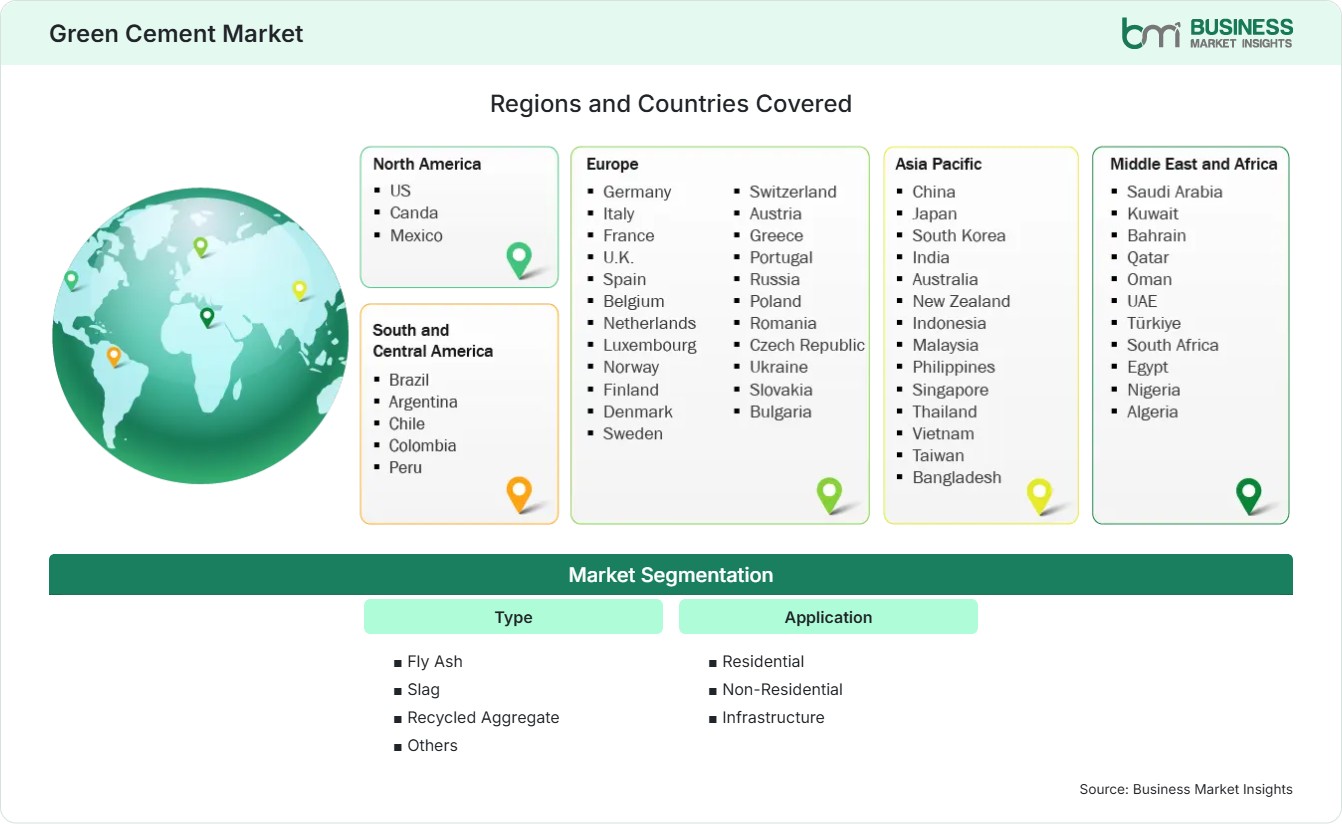
North America Green Cement Market
North America accounted for approximately 32%–35% of global revenue in 2025 and is projected to expand at a CAGR of 7.2%–7.8% through 2033. The region benefits from stringent environmental regulations, advanced construction practices, and widespread adoption of sustainable building standards. Green Cement Market share remains particularly strong among commercial and public infrastructure projects, where lifecycle emissions increasingly influence procurement decisions. Federal infrastructure funding, growing ESG commitments, and expanding circular economy investments continue to support adoption across key construction sectors.
- The federal government's efforts to promote clean construction are leading to greater demand for low-carbon building materials in projects relating to transportation, energy, and public infrastructure, at the same time as they are making it necessary to procure more sustainable alternatives.
- Increasingly, commercial developers are giving priority to measures aimed at reducing embodied carbon to meet investor expectations and the requirements of environmental certifications, which in turn leads to greater demand for cement technologies that are environmentally optimized.
- The availability of industrial by-products promotes the large-scale use of supplementary cementitious materials, which in turn improves sustainability measures and reduces the need for raw materials in various production operations.
- Digital monitoring systems and advanced material science innovations help optimize performance characteristics, enabling broader acceptance among engineers and procurement authorities.
US Green Cement Market
The U.S. represents approximately 78%–82% of the regional Green Cement Market revenue and expands at a CAGR of 7.3%–7.9% through 2033. Demand is driven by the need to rehabilitate infrastructure, sustainable buildings, and green procurement policies. The construction industry is now taking into consideration emissions over the entire life cycle, along with the cost of materials. Demand is still being stimulated due to government investment in areas such as transportation and resilient urban development.
- Environmental impact considerations are now an increasingly common feature of public infrastructure programs, which in turn creates favourable conditions for the adoption of sustainable construction materials in projects funded by the federal and state governments.
- Certifications related to green building prompt developers to choose materials that have better emission profiles and that carry environmental declarations that have been verified in support of sustainability objectives.
- Big cities show strong demand because more companies now let their sustainability plans guide how they choose commercial construction projects.
- By entering into recycling partnerships and carrying out waste utilization schemes, the availability of alternative feedstocks is strengthened and the results of the circular economy are improved.
Europe Green Cement Market
Europe captured approximately 27%–30% of global Green Cement Market revenue in 2025 and is forecast to expand at a CAGR of 7.5%–8.2% through 2033. Policy support through the regions' decarbonization framework continues to motivate the use of low-carbon building materials. Carbon reporting and environmental product declarations continue to affect purchasing decisions. The standard for sustainable buildings is well embedded within both public and private developments. Germany dominates regional demand, whereas the Eastern European nations exhibit faster adoption rates.
- Germany holds on to its regional leadership due to its large industrial capacity, its widespread adoption of green buildings, and its advanced sustainability regulations which support the use of low-carbon construction materials in commercial developments.
- France is continuing to make investments in sustainable infrastructure and is promoting circular construction models which make use of recycled materials and industrial by-products to reduce embodied emissions.
- The United Kingdom's growth rates range from 8.0% to 8.6%, owing to its net-zero building targets, green public procurement policies, and the rising demand for environmentally verified building materials.
- By introducing carbon pricing mechanisms, manufacturers are being encouraged to explore ways of reducing clinker usage and to develop alternative types of cement, which in turn enhances the competitiveness of lower-emission products.
- The various programs aimed at modernizing public infrastructure generate steady long-term demand and, at the same time, promote innovation and commercialization activities.
Asia Pacific Green Cement Market
Asia Pacific accounted for approximately 26%–29% of global Green Cement Market revenue in 2025 and is expected to grow at a CAGR of 8.8%–9.5% through 2033. Urbanization, infrastructure development, and rising environmental consciousness will continue driving the market growth. Sustainability and emissions reductions in construction have become major areas of government emphasis. The demand for the products is especially high within transportation, industry, and residential projects. The Chinese market is the leading one in the region, while India shows fast adoption rates because of growing investments in infrastructure and sustainability initiatives.
- China leads regional consumption through extensive infrastructure development, industrial construction activity, and increasing integration of alternative cement technologies into major projects.
- India is recording compound annual growth rate figures between 9.2% and 9.8% as government-supported infrastructure expansion and efforts to promote sustainable urban development increase the demand for materials that are environmentally responsible.
- The construction policies of economies in Southeast Asia are increasingly including sustainability requirements as they draw in foreign investment for the expansion of their manufacturing capacity.
- Since major contractors are aiming to reduce their lifecycle carbon emissions, there has now developed a greater preference for cement products that have a lower emissions intensity.
- Attempts to make use of industrial waste help to improve resource efficiency and aid in the commercialization of new cement formulations in the various regional markets.
Rest of World Green Cement Market
Rest of World represents approximately 10%–13% of global Green Cement Market revenue in 2025 and is forecast to grow at a CAGR of 7.9%–8.6% through 2033. Infrastructure improvements and heightened environmental consciousness among the developers have worked in favor of South and Central America. Markets for the Middle East and Africa get support through sustainable urban development projects, diversification plans, and green buildings. Brazil plays a prominent role in Latin American activities, while the UAE and Saudi Arabia play key roles in the Middle East and African markets.
- Brazil continues to hold on to its leadership by expanding its construction activities, applying stricter environmental regulations, and increasing the use of supplementary cementitious materials in large-scale projects.
- Chile is showing greater adoption as a result of sustainability-focused mining infrastructure projects and increased investment in low-carbon construction materials.
- Saudi Arabia's compound annual growth rate ranges between 8.4% and 9.0%, owing to the development of mega-projects, its industrial diversification plans, and its investments in infrastructure with a focus on sustainability.
- The United Arab Emirates is still putting money into green building standards, environmentally efficient urban development, and innovative construction technologies.
- The efforts of the international climate financing and ESG investment initiatives are helping to enhance the long-term market potential in developing economies.