
Functional Flour Market Outlook: Size, Share, Trends, Growth Analysis, Competitive Landscape & Forecast, 2026-2033

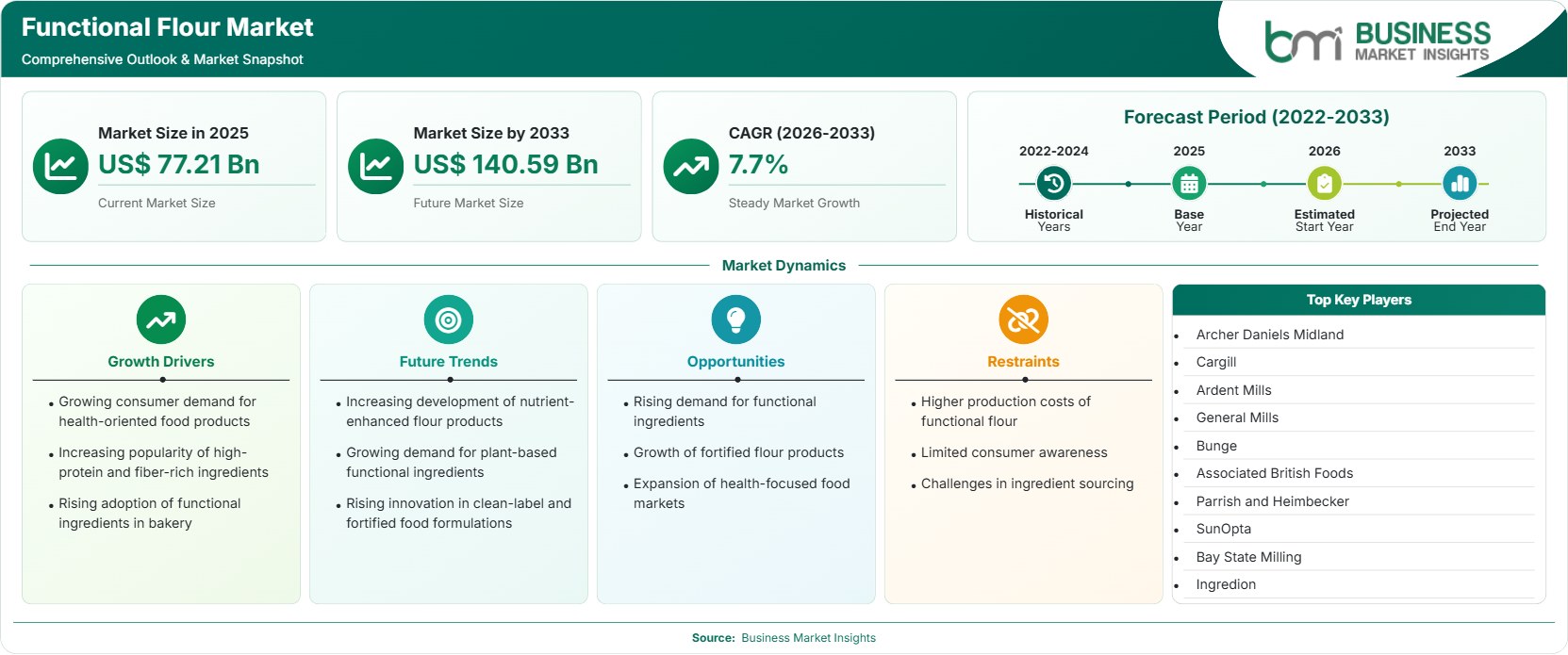
The Functional Flour Market size was valued at US$ 77.21 Billion in 2025 and is projected to reach US$ 140.59 Billion by 2033, growing at a CAGR of 7.7% during 2026–2033, driven by rising health-focused food consumption, increasing demand for protein and fiber-rich ingredients, expansion of fortified products, and adoption of functional ingredients across bakery and processed food applications.

Report Coverage
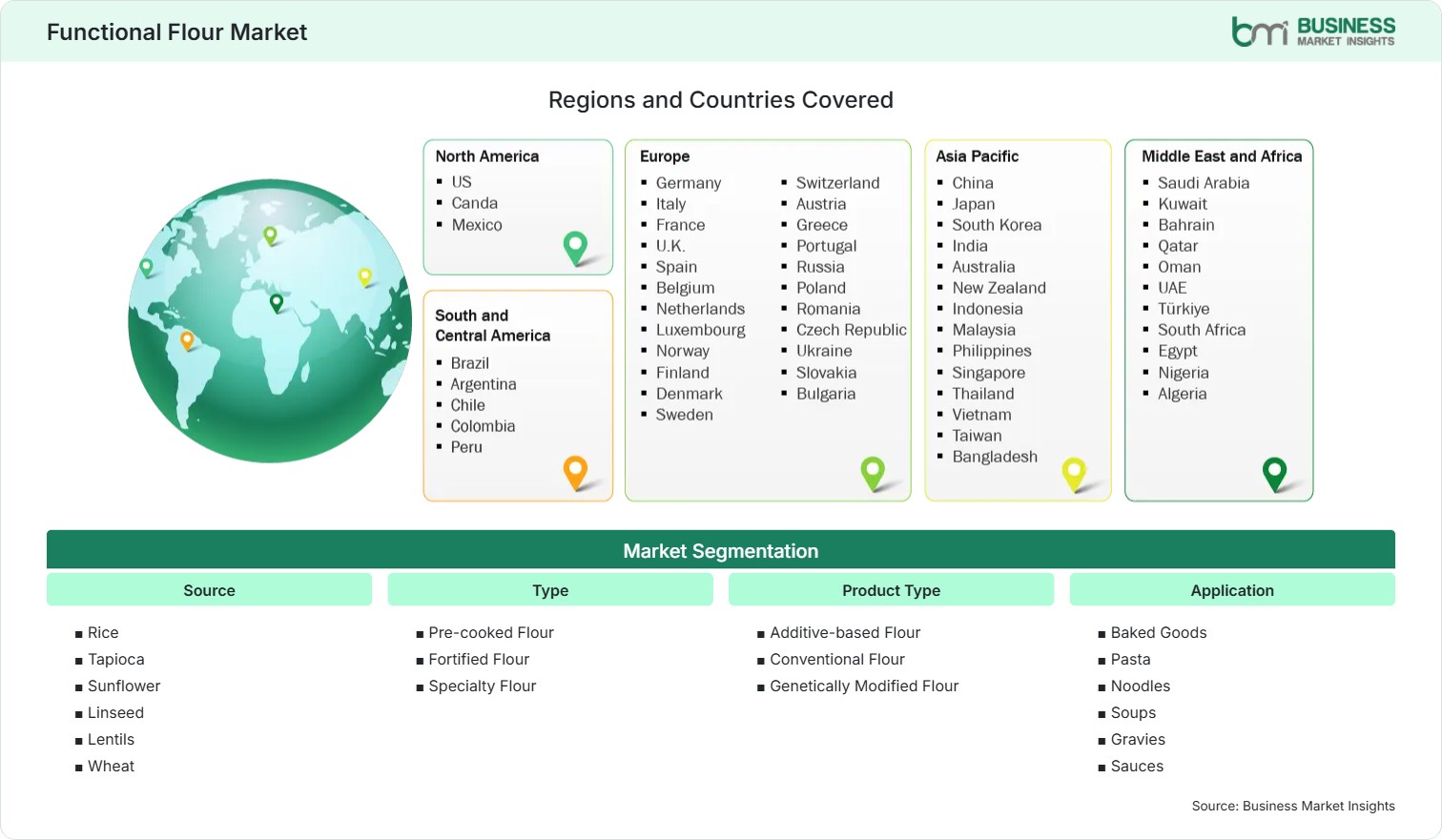
  • Source: Rice, Tapioca, Sunflower, Linseed, Lentils, Wheat
  • Type: Pre-cooked Flour, Fortified Flour, Specialty Flour
  • Product Type: Additive-based Flour, Conventional Flour, Genetically Modified Flour
  • Application: Baked Goods, Pasta, Noodles, Soups, Gravies, Sauces
  • Distribution Channel: B2B, B2C
US$ 77.21 Bn Market size in 2025
US$ 140.59 Bn Market Size by 2033
7.7% CAGR, 2026 - 2033
2026-2033 Forecast Period

01 AI Overview

Functional Flour Market Summary

  • North America Region: North America holds a 31%–34% share in 2025 and is projected to grow at a CAGR of 7.2%–7.8% during 2026–2033, supported by strong demand for functional foods, premium nutrition products, clean-label ingredients, and bakery innovation. The US market is expected to expand at a 7.4%–8.0% CAGR, driven by food technology investments and wellness-focused consumption.
  • Fastest Growing Region: Asia Pacific represents a 28%–31% share in 2025 and is forecast to register the fastest CAGR of 8.2%–8.8%, supported by urbanization, increasing disposable income, processed food expansion, nutritional awareness, and rising demand for fortified flour products.
  • Leading Segment: Wheat-based functional flour accounts for a 34%–37% share in 2025 and is expected to grow at a CAGR of 7.3%–7.8%, supported by established supply chains, bakery applications, consumer acceptance, and widespread food manufacturing compatibility.
  • High Growth Segment: Lentil-based functional flour is projected to grow at a CAGR of 8.5%–9.2%, driven by plant-based protein demand, gluten-free product development, high-fiber nutrition trends, and increasing interest in alternative ingredients.
  • Key Market Opportunity: Fortified flour products, plant-based nutrition, specialty ingredients, and health-focused food categories are creating opportunities for manufacturers developing innovative functional flour solutions.
  • Major Market Players: Archer Daniels Midland, Cargill, Ardent Mills, General Mills, Bunge, Associated British Foods, Parrish and Heimbecker, SunOpta, Bay State Milling, Ingredion.
02 Strategic Insights

Functional Flour Market: Strategic Insights

Functional Flour Market Strategic Framework
FREE PDF
Request your free sample
Request free sample
03 Stakeholder View

Key Takeaways

  • The market ecosystem is shifting toward specialized ingredient solutions that combine nutritional enhancement, functional performance, and application-specific benefits for food manufacturers.
  • Plant-based protein sources, fortified products, and specialty flour categories represent high-potential areas as consumers increasingly seek healthier food alternatives.
  • Product innovation is focused on improving nutritional density, processing stability, ingredient functionality, and sustainability throughout the supply chain.
  • Asia Pacific provides strong investment opportunities due to expanding food processing industries, rising nutrition awareness, and increasing consumption of value-added food products.
  • Partnerships between ingredient suppliers and food manufacturers are increasing to accelerate development of customized functional flour solutions.
  • Companies are strengthening competitive positions through portfolio expansion, sustainable sourcing strategies, and advanced ingredient technologies.
04 Geographic Outlook

Functional Flour Market Regional Highlights

North America Functional Flour Market

North America accounted for a 31%–34% of the Functional Flour Market share in 2025 and is projected to grow at a CAGR of 7.2%–7.8% during 2026–2033. The region benefits from strong consumer awareness regarding nutrition, advanced food processing capabilities, and increasing demand for functional ingredients. The United States remains a major contributor due to innovation in bakery products, fortified foods, and health-oriented nutrition categories.

  • Health-conscious consumers are increasing demand for protein-rich and fiber-enhanced flour products.
  • Food manufacturers are incorporating specialty flour into bakery and convenience food formulations.
  • Clean-label trends are encouraging adoption of naturally sourced functional ingredients.
  • Plant-based nutrition preferences are supporting alternative flour development.

US Functional Flour Market

The US represented a 27%–30% share in 2025 and is forecast to grow at a CAGR of 7.4%–8.0% through 2033. Growth is supported by established food processing infrastructure, increasing demand for healthier products, and strong innovation among ingredient manufacturers. Functional flour adoption is increasing across bakery, pasta, and specialty food applications.

  • Bakery companies are adopting functional flour to improve nutritional profiles.
  • Consumers are increasing purchases of high-protein and fiber-based products.
  • Food brands are introducing fortified and specialty flour products.

Europe Functional Flour Market

Europe held a 24%–27% of the Functional Flour Market share in 2025 and is expected to grow at a CAGR of 7.0%–7.6% during 2026–2033. The region benefits from sustainability-focused consumers, advanced food manufacturing capabilities, and demand for clean-label products. Germany, the United Kingdom, France, and Italy are key markets due to strong bakery industries and functional food innovation.

  • Germany is expanding specialty flour adoption through bakery innovation.
  • The United Kingdom is increasing demand for wellness-oriented food products.
  • France is supporting functional ingredient development.
  • Italy is adopting specialty flour in pasta applications.

Asia Pacific Functional Flour Market

Asia Pacific accounted for 28%–31% in 2025 and is projected to achieve the fastest CAGR of 8.2%–8.8% in the Functional Flour Market forecasts. Growth is driven by increasing urbanization, rising disposable income, expanding processed food consumption, and greater awareness of nutrition. China, India, Japan, and Southeast Asian countries are contributing through food industry expansion and product innovation.

  • China is increasing functional ingredient production and food innovation.
  • India is witnessing demand for fortified and protein-rich products.
  • Japan is adopting specialty ingredients in health-focused foods.
  • Southeast Asia is expanding processed food manufacturing.

Rest of World Functional Flour Market

Rest of World accounted for a 8%–11% share in 2025 and is expected to grow at a CAGR of 7.5%–8.2% between 2026–2033. Latin America, the Middle East, and Africa are adopting functional flour products through increasing nutrition awareness, improving food infrastructure, and rising demand for premium food ingredients.

  • Latin America is expanding functional ingredient adoption in bakery products.
  • Middle Eastern markets are increasing health-focused food consumption.
  • African food manufacturers are exploring fortified ingredient solutions.
  • Regional suppliers are developing locally sourced functional products.
Global Market Geography
FREE PDF
Request your free sample
Request free sample
05 Segment Analysis

Functional Flour Market Segmentation

Source

The source segment is shaped by nutritional characteristics, raw material availability, processing suitability, and application demand. Wheat-based functional flour maintains a leading position with a 34%–37% share in 2025 and a CAGR of 7.3%–7.8% from 2026–2033 due to established supply chains and broad bakery usage. The Functional Flour Market scope is expanding as manufacturers increasingly utilize rice, tapioca, sunflower, linseed, and lentil sources to develop protein-rich, fiber-enhanced, and specialty food ingredients. Rising demand for alternative nutrition sources is encouraging diversification beyond traditional wheat-based formulations.

  • Rice: Rice-based functional flour supports gluten-free applications, infant nutrition, and specialty foods due to neutral flavor, digestibility, and formulation flexibility.
  • Tapioca: Tapioca functional flour is used in gluten-free products, offering binding properties, texture improvement, and compatibility with bakery applications.
  • Sunflower: Sunflower-based functional flour provides nutritional value through protein and fiber content, supporting health-oriented product development.
  • Linseed: Linseed functional flour is gaining adoption due to omega fatty acids, fiber benefits, and applications in functional nutrition products.
  • Lentils: Lentil-based functional flour supports plant-based protein demand and is increasingly used in high-protein and gluten-free food formulations.
  • Wheat: Wheat functional flour remains dominant due to processing familiarity, wide availability, and extensive use in bakery and processed food industries.

Type

The type segment is influenced by increasing demand for nutritional enhancement, improved food functionality, and specialized ingredient performance. Fortified flour and specialty flour categories are gaining importance as manufacturers focus on health-oriented product development. Pre-cooked flour supports convenience food applications through improved preparation efficiency and consistency. Functional flour trends indicate growing investment in customized formulations that provide enhanced nutritional benefits while maintaining taste, texture, and processing quality across multiple food applications.

  • Pre-cooked Flour: Pre-cooked flour improves convenience food production by offering faster preparation, consistent texture, and enhanced processing efficiency.
  • Fortified Flour: Fortified flour adoption is increasing due to nutritional enrichment initiatives and growing demand for enhanced food products.
  • Specialty Flour: Specialty flour supports premium food development through targeted nutritional benefits and application-specific performance characteristics.

Product Type

The product type segment reflects differences in formulation methods, ingredient characteristics, and consumer preferences. Conventional functional flour continues to maintain strong adoption due to established manufacturing practices and widespread usage. Additive-based flour is gaining attention as manufacturers seek improved nutritional performance and enhanced product functionality. Genetically modified flour remains a specialized category influenced by regulatory policies and consumer acceptance. Manufacturers are focusing on transparency, quality improvement, and sustainable ingredient sourcing to strengthen product acceptance.

  • Additive-based Flour: Additive-based flour enhances nutritional and functional properties through incorporation of specialized ingredients for improved food performance.
  • Conventional Flour: Conventional functional flour maintains adoption through established production systems and compatibility with various food applications.
  • Genetically Modified Flour: Genetically modified flour supports specialized agricultural applications but remains influenced by regulatory and consumer considerations.

Application

The application segment continues expanding as food manufacturers integrate functional flour into bakery products, pasta, noodles, soups, gravies, and sauces. Increasing consumer demand for healthier alternatives is encouraging companies to improve nutritional profiles while maintaining product quality. Bakery remains a major application area due to strong demand for protein-enriched and fiber-enhanced products. Manufacturers are also exploring functional flour integration in convenience foods to support healthier formulations and product differentiation.

  • Baked Goods: Functional flour is increasingly used in baked goods to improve nutritional content, texture, and consumer appeal.
  • Pasta: Pasta manufacturers are adopting functional flour to create protein-rich and specialty nutritional product variants.
  • Noodles: Functional flour supports healthier noodle formulations through improved nutritional characteristics and alternative ingredient adoption.
  • Soups: Soup manufacturers use functional flour for texture enhancement, stability improvement, and nutritional enrichment.
  • Gravies: Functional flour improves gravy consistency, thickness, and formulation performance across food processing applications.
  • Sauces: Sauce producers utilize functional flour for viscosity control, texture improvement, and nutritional enhancement.

Distribution Channel

The distribution channel segment is influenced by growing demand from industrial food producers, retailers, and consumers seeking accessible specialty ingredients. Business-to-business channels remain important due to bulk purchasing by bakeries, food processors, and manufacturers. Business-to-consumer channels are expanding through retail availability and online platforms offering specialty flour products. Increasing consumer interest in home baking and healthy cooking is strengthening direct distribution opportunities.

  • B2B: B2B channels support large-volume procurement through partnerships with food manufacturers, bakeries, and industrial users.
  • B2C: B2C channels are expanding through supermarkets, specialty stores, and e-commerce platforms offering functional flour products.
06 Market Forces

Functional Flour Market Dynamics

Key Market Drivers

Growing Consumer Demand for Health-Oriented Food Products

The Functional Flour Market growth is strongly supported by increasing consumer preference for healthier food choices with enhanced nutritional benefits. Consumers are seeking products containing higher protein, dietary fiber, and functional ingredients that support wellness goals. Food manufacturers are responding by incorporating specialty flour into bakery products, snacks, pasta, and convenience foods.

The Functional Flour Market trends show increasing demand for clean-label and nutrient-focused products as consumers evaluate ingredient quality. Companies are investing in research and development to create flour solutions that improve nutritional value while maintaining taste, texture, and production efficiency.

Increasing Popularity of High-Protein and Fiber-Rich Ingredients

Rising interest in protein-rich and fiber-enhanced diets is increasing demand for functional flour derived from legumes, seeds, and specialty grains. Consumers are adopting plant-based nutrition products, creating opportunities for lentil, sunflower, and linseed flour applications. Food manufacturers are using these ingredients to develop products targeting health-conscious consumers and individuals seeking improved nutritional balance.

Advances in processing technologies are improving taste, functionality, and application compatibility of alternative flour solutions. This trend is encouraging companies to expand ingredient portfolios and develop innovative formulations for diverse food categories.

Rising Adoption of Functional Ingredients in Bakery

Bakery manufacturers are increasingly adopting functional ingredients to meet consumer expectations for healthier products without affecting taste and quality. Functional flour enables improved nutritional profiles, enhanced texture, and differentiated product offerings across bread, snacks, and baked goods. Demand for fortified bakery products and clean-label formulations is encouraging companies to introduce innovative flour solutions.

Processing improvements allow manufacturers to maintain product consistency while incorporating higher-value ingredients. The bakery sector remains a major growth area as consumers increasingly seek products combining convenience with nutritional benefits.

Key Market Opportunities

Rising Demand for Functional Ingredients

The increasing demand for functional ingredients provides opportunities for flour manufacturers to develop specialized products with enhanced nutritional properties. Consumers are increasingly selecting foods that offer additional health benefits beyond basic nutrition. Functional flour suppliers can capitalize on this trend through protein enrichment, fiber enhancement, and plant-based ingredient development.

Expansion of wellness foods, sports nutrition products, and alternative dietary solutions is creating new application opportunities. Companies investing in sustainable sourcing, advanced processing, and customized formulations can strengthen their position in this evolving ingredient landscape.

Growth of Fortified Flour Products

consumers and manufacturers concentrate on improving the nutritional value of their products. Manufacturers are creating flour-based solutions fortified with vitamins, minerals, proteins, and other beneficial elements. The increase in the demand for such products has presented a new market opportunity for these manufacturers.

With increased formulation capabilities, producers may capitalize on the growing demand for enriched products. Awareness of the need to prevent nutritional deficiencies is driving the use of fortified flour solutions.

Expansion of Health-Focused Food Markets

The growth of health-conscious food markets is prompting companies to develop innovative flour products for use across various sectors. Consumers are becoming health-conscious and buying products that reflect their interests in health, fitness, and diet.

Companies can capture opportunities by developing diverse product portfolios and application-specific solutions. Expansion of online retail and specialty food channels is improving consumer access and supporting broader adoption of functional flour products.

Market Restraints and Challenges

Higher Production Costs of Functional Flour

Factor: The production process for functional flours uses special raw materials, special processing techniques, additional procedures for nutritional improvement, and quality control, thus making it costlier than regular flour production.

Impact: Higher production costs can limit affordability and reduce adoption among price-sensitive consumers and smaller food manufacturers. Specialty foods like lentils, linseed, and sunflower seeds require extra processing, which adds to the cost of the end product. This is bound to limit market penetration in less-developed areas where traditional flours are preferred for their lower cost. The emphasis now is on making production processes more efficient to keep costs down for producing these nutritious foods.

Limited Consumer Awareness

Factor: Awareness regarding functional flour benefits, nutritional advantages, and application diversity remains limited among consumers in several developing markets.

Impact: Limited awareness can slow adoption despite increasing availability of specialty flour products. Lack of clarity of the consumers on the distinctions between normal and functional flour is expected to decrease purchase interest, restricting further retail development. Improved communication from food producers is necessary in order to make the advantages known, including higher protein content, fiber fortification, and improved nutrition. Digital marketing and healthcare communications, among others, could be used to educate consumers. It will be essential to expand awareness going forward.

07 Company Analysis

Competitive Landscape

The Functional Flour Market analysis highlights competition among ingredient manufacturers, milling companies, and food solution providers focusing on specialty flour development, nutritional enhancement, and sustainable sourcing. Leading companies are expanding product portfolios through innovation, partnerships, and advanced processing capabilities. Market participants are investing in functional ingredient technologies to support applications across bakery, pasta, noodles, and health-focused food categories.

Company Name

Overview

Products and Services relevant to this market

Archer Daniels Midland

Global agricultural processing and food ingredient company.

Functional ingredients, specialty flour, nutritional solutions.

Cargill

Global food and agriculture company serving ingredient markets.

Specialty ingredients, flour solutions, food formulation products.

Ardent Mills

Flour milling company focused on grain innovation.

Specialty flour, bakery ingredients, grain-based solutions.

General Mills

Food company offering consumer and ingredient products.

Grain-based foods, nutrition products, functional formulations.

Bunge

Agricultural company providing food ingredient solutions.

Milling products, specialty grains, ingredient solutions.

Associated British Foods

Diversified food company with ingredient operations.

Flour products, bakery ingredients, food manufacturing solutions.

Parrish and Heimbecker

Canadian agricultural and food processing company.

Specialty flour, grain processing, milling services.

SunOpta

Natural and plant-based ingredient supplier.

Plant-based ingredients, specialty flour solutions.

Bay State Milling

Milling company specializing in innovative flour products.

Functional flour, bakery ingredients, grain solutions.

Ingredion

Ingredient technology company serving food manufacturers.

Functional ingredients, formulation solutions, specialty products.

08 Industry Activity

Recent Developments

January 2026

Cargill announced an expansion of its Beijing plant in China with new production lines and increased functional food solution capabilities. The expansion supports Cargill’s broader functional systems business serving food manufacturers in Asia-Pacific, including applications requiring specialty ingredient solutions.

October 2025

ADM opened its new Central Lab – Milling facility at its Specialty Manufacturing Facility in Decatur, Illinois, to improve flour testing, milling analysis, and product development capabilities. The facility supports ADM’s milling and baking solutions business by helping develop and optimize flour products for bakery and food applications.

March 2025

Cargill showcased its expanded range of functional food solutions at AAHAR 2025 in India, including functional ingredient systems for bakery and food applications. The company highlighted solutions designed to improve texture, performance, and nutritional characteristics in processed foods, supporting demand for functional ingredients including specialty flour-based formulations.

October 2024

ADM introduced new functional nutrition concepts incorporating ingredients such as fiber, plant-based components, and specialty flour replacers to help food manufacturers develop products aligned with health and wellness trends. The initiative supported ADM’s broader functional ingredient innovation strategy.

10 Trust & Transparency

Research Methodology

The market analysis combines proprietary research with secondary data from government agencies, company disclosures, regulatory filings, industry databases and expert interviews. Market estimates are validated through data triangulation, cross-market benchmarking and analyst review.

View Full Research Methodology

11 Questions Answered

Frequently Asked Questions

What challenges affect functional flour adoption?

Key challenges include higher production costs, limited consumer awareness, specialized processing requirements, pricing pressures, and the need for effective consumer education regarding nutritional benefits.

Which applications provide strong opportunities for functional flour suppliers?

Bakery products, pasta, noodles, and convenience foods provide strong opportunities as manufacturers seek healthier formulations with improved nutritional characteristics and functional performance.

How are functional flour products supporting food innovation?

Functional flour enables manufacturers to improve nutritional value, develop plant-based alternatives, create gluten-free products, enhance texture, and introduce differentiated food offerings across multiple categories.

Which source segment dominates the Functional Flour Market?

Wheat-based functional flour dominates due to established supply chains, broad consumer acceptance, extensive bakery applications, and compatibility with existing food manufacturing processes.

What factors are driving the Functional Flour Market Report growth?

The growth is supported by rising demand for healthy food products, increasing adoption of protein and fiber-rich ingredients, functional bakery innovation, fortified product expansion, and growing consumer interest in nutritional food solutions.

Access the Full Functional Flour Market Report

Get segment-level forecasts, regional estimates, competitive benchmarking, company profiles and downloadable Excel datasets.

Access the full Functional Flour Market Report
350 pages PDF & Excel | 2026-07-28