
Fiber Optics Market Outlook: Size, Share, Trends, Growth Analysis, Competitive Landscape & Forecast, 2026-2033

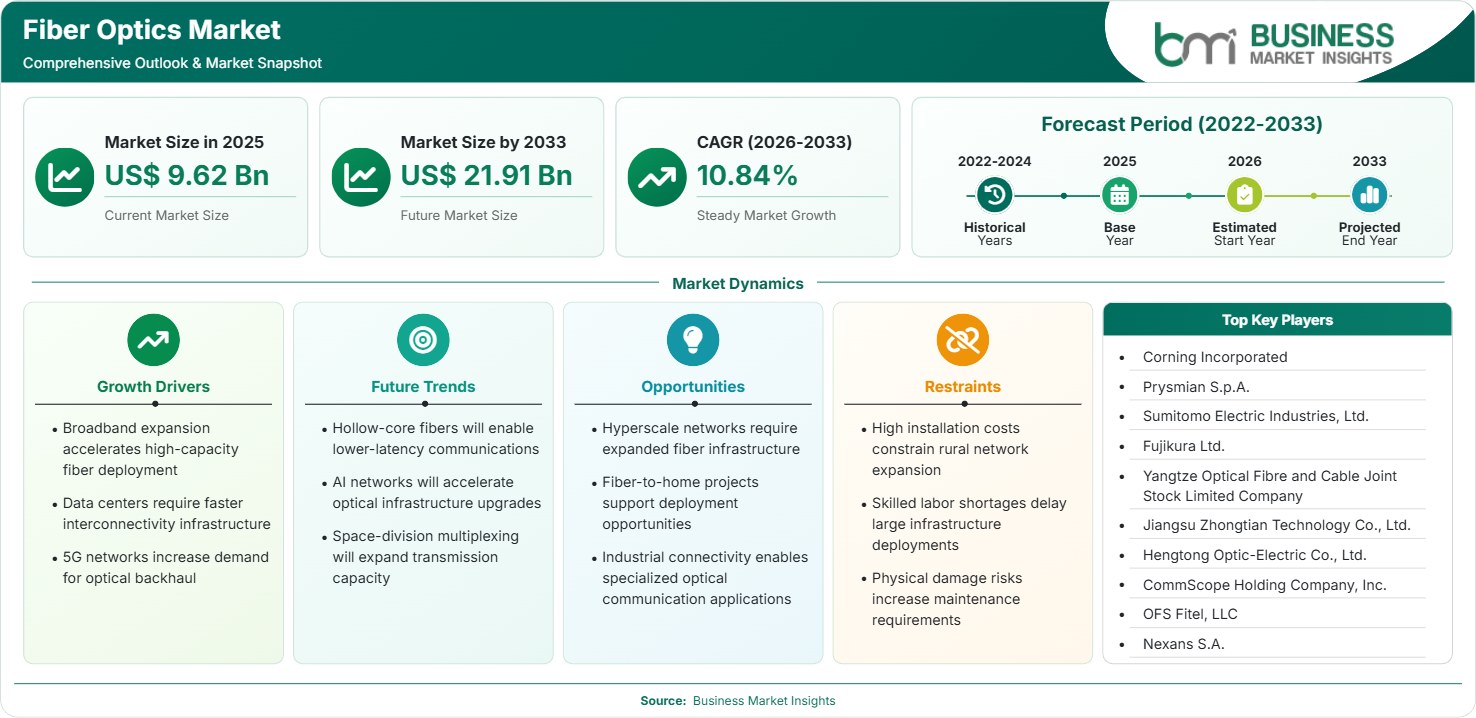
The Fiber Optics Market size was valued at US$ 9.62 Billion in 2025 and is projected to reach US$ 21.91 Billion by 2033, growing at a CAGR of 10.84% during 2026–2033, driven by broadband expansion, AI data centers, 5G densification, industrial digitization, and infrastructure investment.

Report Coverage
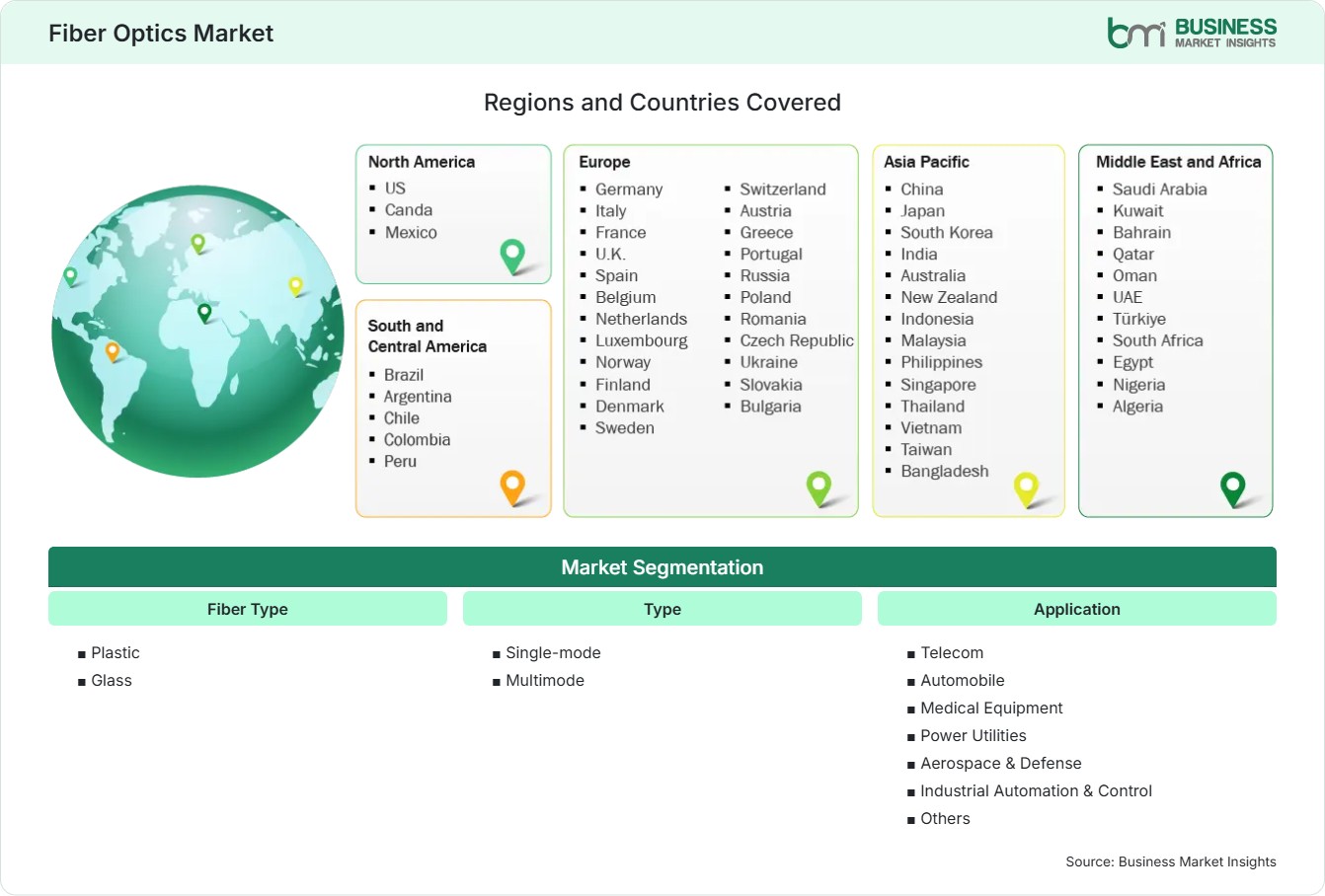
  • Fiber Type: Plastic, Glass
  • Type: Single-mode, Multimode
  • Application: Telecom, Automobile, Medical Equipment, Power Utilities, Aerospace & Defense, Industrial Automation & Control, Others
US$ 9.62 Bn Market size in 2025
US$ 21.91 Bn Market Size by 2033
10.84% CAGR, 2026 - 2033
2026-2033 Forecast Period

AI Overview

Fiber Optics Market Summary

  • North America Region: North America holds a 25%–28% share in 2025, growing at a 10%–12% CAGR during 2026–2033, driven by broadband funding, hyperscale data centers, AI networking, 5G densification, and resilient infrastructure upgrades. The US market advances at a 10%–12% CAGR, supported by broadband deployment, hyperscale data-center construction, enterprise connectivity, and copper replacement.
  • Fastest Growing Region: Asia Pacific holds a 34%–38% share in 2025, growing at an 11%–13% CAGR during 2026–2033, supported by fiber rollout, 5G expansion, data-center investment, manufacturing localization, smart-city programs, and rising bandwidth consumption across major economies.
  • Leading Segment: Glass fiber holds a 56%–60% share in 2025, growing at a 10%–12% CAGR during 2026–2033, supported by superior transmission distance, bandwidth, thermal stability, low attenuation, telecom backbone requirements, hyperscale connectivity, and dense metropolitan network architectures.
  • High Growth Segment: Telecom holds a 52%–57% share in 2025, growing at an 11%–13% CAGR during 2026–2033, driven by FTTH expansion, 5G backhaul, submarine networks, metro connectivity, cloud traffic, network densification, and broadband initiatives.
  • Key Market Opportunity: AI infrastructure is shifting optical demand toward higher fiber counts, tighter connector density, lower-loss transmission, multicore architectures, and specialized data-center connectivity, creating premium opportunities for integrated fiber, cable, and connectivity suppliers.
  • Major Market Players: Corning Incorporated; Prysmian S.p.A.; Sumitomo Electric Industries, Ltd.; Fujikura Ltd.; Yangtze Optical Fibre and Cable Joint Stock Limited Company; Jiangsu Zhongtian Technology Co., Ltd.; Hengtong Optic-Electric Co., Ltd.; CommScope Holding Company, Inc.; OFS Fitel, LLC; Nexans S.A.
Strategic Insights

Fiber Optics Market: Strategic Insights

Fiber Optics Market Strategic Framework
FREE PDF
Request your free sample
Request free sample
Stakeholder View

Key Takeaways

  • Supply-chain economics are shifting toward integrated fiber, cable, connector, and installation capabilities as lead times, material availability, and labor increasingly influence project economics.
  • The strongest upside is concentrated in telecom, hyperscale data centers, AI clusters, and specialized enterprise networks requiring substantially greater optical density.
  • Innovation is moving toward 160-micron bend-insensitive fiber, multicore fiber, expanded-beam connectivity, higher-count cables, and lower-loss architectures.
  • India offers an attractive investment case as BharatNet, FTTH, 5G backhaul, and data-center deployment converge, creating demand across fiber manufacturing and network construction.
  • Investment is favoring capacity expansion and technology partnerships, particularly around multicore fiber, high-density connectivity, and AI-oriented optical infrastructure.
  • Competitive differentiation increasingly depends on specialty fiber, high-count cable, connectors, splicing, monitoring, and application-specific connectivity rather than commodity fiber alone.
Geographic Outlook

Fiber Optics Market Regional Highlights

North America Fiber Optics Market

North America represents a 25%–28% Fiber Optics Market share in 2025 and is projected to grow at a 10%–12% CAGR through 2033. The United States dominates demand, while Canada contributes through rural broadband and enterprise upgrades. Hyperscale data centers, AI infrastructure, 5G transport, and public broadband programs support sustained investment. Suppliers increasingly emphasize domestic production, shorter lead times, high-count cable, and application-specific connectivity. Regional procurement is also becoming more focused on supply resilience as network operators manage construction schedules, material availability, and increasingly complex deployment requirements.

  • AI data-center construction is increasing demand for high-count fiber, compact connectivity, lower insertion loss, and efficient cable routing across hyperscale campuses.
  • Rural broadband programs are creating sustained demand for access fiber, distribution cable, closures, connectors, and installation services outside established metropolitan networks.
  • Domestic manufacturing is gaining importance as customers seek supply resilience, shorter logistics cycles, and greater control over critical communications infrastructure.
  • Data-center interconnection is shifting purchasing toward products where density, thermal management, bend performance, and installation efficiency command greater value.

US Fiber Optics Market

The US Fiber Optics Market accounts for 80%–84% of North American demand in 2025 and is projected to expand at a 10%–12% CAGR through 2033. Hyperscale investment, rural broadband funding, 5G densification, and enterprise modernization support demand. BEAD provides US$42.45 billion for broadband deployment, strengthening the project pipeline, while AI infrastructure increases demand for dense optical connectivity. Public funding and private capital are creating opportunities for domestic fiber manufacturing, cable production, network engineering, and specialized connectivity solutions across underserved and high-growth areas.

  • Hyperscale and colocation campuses require high-density optical architectures as AI clusters increase east-west bandwidth and interconnection requirements.
  • BEAD deployment is expanding opportunities across underserved areas for cable suppliers, integrators, contractors, and network equipment providers.
  • AI infrastructure is encouraging domestic manufacturing expansion focused on higher-count cable and advanced data-center connectivity requirements.

Europe Fiber Optics Market

Europe Fiber Optics Market represents a 20%–23% share in 2025 and is projected to grow at a 9%–11% CAGR through 2033. Germany and France lead through industrial connectivity, broadband modernization, and data-center investment. The United Kingdom maintains strong enterprise and data-center demand. Spain and Italy offer higher growth at 10%–12% as fiber penetration and digital infrastructure investment expand. European connectivity policy continues to support gigabit infrastructure, sustaining demand across households, businesses, public institutions, transport corridors, and industrial networks.

  • Germany benefits from industrial automation, manufacturing digitization, enterprise networks, and expanding data-center capacity.
  • France combines FTTH expansion with digital infrastructure priorities, supporting access-network cable and high-density connectivity demand.
  • Spain offers faster growth as extensive fiber availability, cloud infrastructure, and high-capacity network investment reinforce optical demand.
  • Poland is emerging as a manufacturing and connectivity hub supporting European, Middle Eastern, and African infrastructure requirements.

Asia Pacific Fiber Optics Market

Asia Pacific Fiber Optics Market represents a 34%–38% share in 2025 and is projected to grow at an 11%–13% CAGR through 2033, making it the fastest-growing major region. China leads regional consumption, while Japan and South Korea contribute advanced optical manufacturing. India is a high-growth market at 12%–14%, supported by BharatNet, FTTH, 5G backhaul, and data-center investment. China recorded 74.99 million kilometers of optical cable lines by the end of 2025, demonstrating the region's substantial infrastructure scale and continued deployment potential.

  • China combines extensive installed infrastructure with continued 5G, broadband, and data-center investment, sustaining demand for fiber and cable.
  • India is accelerating deployment through public-private models, while operators expand FTTH and mobile-site fiberization alongside BharatNet.
  • Japan remains important for high-performance optical components and specialty fiber where precision, reliability, and compact architectures matter.
  • South Korea benefits from dense digital infrastructure, semiconductor ecosystems, and data-intensive applications requiring high-bandwidth optical interconnects.

Rest of World Fiber Optics Market

South and Central America are supported by broadband expansion, mobile backhaul, submarine connectivity, and data-center development. Brazil leads demand, while Colombia and Chile provide attractive growth opportunities as operators expand high-capacity networks. Public connectivity programs and private telecom investment are reducing dependence on legacy copper infrastructure, expanding opportunities for optical cable, passive components, and network construction services across emerging connectivity markets.

The Middle East and Africa are developing from smaller bases but offer long-term potential. Saudi Arabia and the United Arab Emirates lead investment, while South Africa anchors African demand. Saudi Arabia and the UAE can achieve 11%–13% growth as cloud, smart-city, subsea, and 5G infrastructure spending expands. Broadband initiatives and mobile-network densification support gradual optical adoption across Africa.

  • Brazil is the principal regional demand center, supported by FTTH deployment, telecom infrastructure expansion, and continued operator investment.
  • Chile and Colombia offer attractive growth as data centers, submarine connectivity, and national broadband programs expand optical backhaul requirements.
  • Saudi Arabia is investing in digital infrastructure alongside smart-city and cloud initiatives, supporting high-density optical networks and subsea connectivity.
  • The United Arab Emirates benefits from hyperscale, cloud, subsea, and smart-city investment requiring resilient, high-capacity fiber infrastructure.
Global Market Geography
FREE PDF
Request your free sample
Request free sample
Segment Analysis

Fiber Optics Market Segmentation

Fiber Type

Glass fiber represents a 56%–60% share in 2025 and is projected to grow at a 10%–12% CAGR through 2033. Low attenuation, high bandwidth, thermal stability, and long-distance performance support telecom backbones, data centers, industrial networks, and utilities. Plastic fiber remains relevant for short-distance applications requiring flexibility and simplified handling. Fiber procurement increasingly considers transmission distance, bend sensitivity, durability, installation conditions, and lifecycle cost alongside material pricing.

  • Plastic: Plastic optical fiber supports short-distance automotive, industrial, consumer, and embedded links, benefiting from flexibility, simple handling, and tight routing capability.
  • Glass: Glass fiber dominates long-distance and high-bandwidth infrastructure because low attenuation and broad transmission capability support telecom, data centers, utilities, and specialized networks.

Type

Single-mode fiber represents a 58%–62% share in 2025 and is projected to grow at a 10%–12% CAGR through 2033. Its long-distance transmission capability supports telecom backbones, FTTH, metro networks, submarine systems, and data-center interconnection. Multimode remains important for shorter links where lower transceiver costs and simpler deployment provide economic advantages. Selection increasingly depends on distance, bandwidth density, optical budget, connector architecture, and upgrade requirements.

  • Single-mode: Single-mode fiber supports long-distance, high-capacity networks and remains central to FTTH, 5G backhaul, metro systems, submarine links, and hyperscale interconnection.
  • Multimode: Multimode fiber remains competitive in enterprise, campus, and shorter data-center links where moderate distances and economical optics support deployment efficiency.

Application

Telecom represents a 52%–57% share in 2025 and is projected to grow at an 11%–13% CAGR through 2033. FTTH, 5G transport, cloud traffic, and backbone modernization underpin demand. Fiber Optics Market scope is broadening as automobile networks, medical equipment, utilities, aerospace systems, and industrial automation increasingly require secure, high-bandwidth, interference-resistant connectivity. Diversification reduces dependence on telecom cycles while supporting demand for ruggedized products, high-count cables, customized assemblies, and specialized connectors.

  • Telecom: Telecom remains the principal application because FTTH, mobile backhaul, metro networks, submarine systems, and backbone modernization require scalable optical infrastructure.
  • Automobile: Automotive adoption is expanding through driver-assistance systems, in-vehicle networking, sensing, and high-bandwidth electronic architectures requiring lightweight, interference-resistant connectivity.
  • Medical Equipment: Medical applications use optical technology for imaging, endoscopy, diagnostics, and specialized equipment requiring compact form factors and strong signal integrity.
  • Power Utilities: Utilities deploy fiber for grid communications, substation automation, protection, monitoring, and operational communications requiring reliability and electrical isolation.
  • Aerospace & Defense: Aerospace and defense applications value fiber for secure, lightweight, high-bandwidth communications and sensing requiring electromagnetic immunity and environmental resilience.
  • Industrial Automation & Control: Industrial systems use fiber for machine communication, process control, robotics, and factory networks where electrical noise limits copper alternatives.
  • Others: Other applications include transportation, security, broadcasting, building networks, and specialized sensing where optical transmission provides bandwidth and electrical isolation.
Market Forces

Fiber Optics Market Dynamics

Key Market Drivers

AI Data Centers and High-Density Connectivity

AI infrastructure is increasing optical requirements as accelerated computing generates larger east-west traffic volumes. The IEA projects global data-center electricity consumption to rise from approximately 415 TWh in 2024 to around 945 TWh by 2030, indicating substantial infrastructure expansion. Higher compute density requires more optical links, tighter routing, and greater connector density. The Fiber Optics Market growth is therefore increasingly tied to data-center architecture alongside broadband. Suppliers are developing higher-count cables, compact connectors, bend-insensitive fibers, and multicore approaches that increase capacity without proportionally expanding physical infrastructure.

Broadband Fiberization and 5G Transport

Fiber remains fundamental to broadband and mobile modernization because 5G requires dense transport connectivity and FTTH requires extensive access infrastructure. China reported 12.1 billion fiber access ports at the end of 2025, representing 96.8% of fixed broadband access ports, while 10G PON-capable ports reached 31.62 million. This deployment scale demonstrates the increasing integration of optical infrastructure into national communications systems. The Fiber Optics Market trends are consequently linked to FTTH penetration, mobile-site fiberization, PON upgrades, and metro densification. Operators are also prioritizing higher fiber counts and installation efficiency.

Industrial Digitalization and Electromagnetic Immunity

Industrial automation is expanding optical use as factories connect controllers, robots, sensors, machine-vision systems, and distributed production assets. Fiber provides electrical isolation and immunity to electromagnetic interference, making it valuable around high-power equipment. Utilities similarly deploy optical links for substation automation, protection, and monitoring. Aerospace applications add requirements for low weight, reliability, and environmental resilience. These requirements encourage differentiated products rather than commodity cable, supporting specialty fibers, ruggedized assemblies, compact connectors, and customized installation solutions for industrial and mission-critical applications.

Key Market Opportunities

AI-Optimized Multicore and High-Count Fiber Architecture

AI clusters drive the need for fiber architectures that can scale capacity without a proportional increase in the number of pathways, racks, or campuses. Major players in optical components are collaborating to define four-core multicore fiber standards for data centers, signaling a shift towards architectural innovation. Value can be created through the use of multicore fibers, high-count cables, small connectors, and transceivers. There is also potential to develop new standards for interconnectivity, connectivity, deployment, and network management, creating a broader value chain around next-generation optical infrastructure.

Domestic Manufacturing and Supply-Chain Localization

Governments and hyperscalers are increasing their focus on optical supply-chain resilience. Manufacturing expansion in the United States and Europe is targeting fiber and cable requirements associated with AI data centers and broadband infrastructure. Regional production can improve delivery times, qualification responsiveness, and supply security for large infrastructure projects. The strongest investment cases are likely to involve differentiated fiber, high-count cable, connectivity assemblies, and application-specific systems rather than undifferentiated commodity output. Localization also creates opportunities for regional partnerships and integrated network deployment capabilities.

Emerging-Market Broadband and Data-Center Infrastructure

Emerging economies create openings for broadband access and the building of digital infrastructure. This is evident in India, where BharatNet has laid 694,711 km of optical fiber as of October 2025 and has made 209,809 Gram Panchayats ready for optical fiber. Similar cases have been observed in the Middle East, where cloud, submarine, smart city, and 5G are combined. Providers can get value added by providing solutions that include the whole package from cable, closure, connector, testing, and installation services. Fiber Optics Market Forecasts increasingly need to account for execution capabilities, as project delivery depends on permitting, contractors, financing, and local technical expertise.

Market Restraints and Challenges

Raw Material, Capacity, and Pricing Volatility

Factor: The ability to source fiber preforms, power expenses, costs of specialty glass, cable materials, and regional shortages can cause procurement risk. Impact: Companies involved in optical fiber production can face margin pressure, qualification delays, and slower deployment when demand exceeds local capacity. The fiber price was expected to rise in 2025 due to strong demand from data centers and supply chain constraints. Big volume projects are highly vulnerable to price fluctuations. Companies with a broader manufacturing presence and long-term material commitments have an advantage over spot-market sellers.

Deployment Complexity and Skilled-Labor Constraints

Factor: The installation of the fiber itself involves special needs for splicing, testing, routing, permissions, and management of civil work, none of which are easily available in qualified technicians. Impact: This could lead to increased construction time, higher labor costs, and higher total deployment costs even if the cost of fiber remains constant. Urban deployments would need to cope with congested ducts and constrained right-of-way, whereas rural deployments would face longer distances and fewer subscribers per mile.

Company Analysis

Competitive Landscape

The Fiber Optics Market analysis indicates competition among vertically integrated fiber manufacturers, cable specialists, optical component suppliers, and connectivity providers. Differentiation increasingly depends on manufacturing scale, specialty fiber performance, high-density connectivity, regional production, qualification capabilities, and access to hyperscale, telecom, utility, and industrial customers.

Company Name

Overview

Products and Services relevant to this market

Corning Incorporated

Global materials-science and optical communications leader with extensive fiber manufacturing and strong telecom and data-center exposure.

Optical fiber, fiber-optic cable, connectivity systems, data-center solutions, specialty optical technologies, and high-density interconnect products.

Prysmian S.p.A.

Global cable manufacturer with broad telecommunications infrastructure capabilities and strong European manufacturing presence.

Optical fiber, telecom cables, high-density cable systems, specialty fibers, connectivity, and network infrastructure solutions.

Sumitomo Electric Industries, Ltd.

Diversified technology company with substantial optical communications expertise and advanced fiber manufacturing capabilities.

Optical fiber, fiber-optic cable, fusion splicing equipment, connectivity products, optical components, and multicore technologies.

Fujikura Ltd.

Japanese specialist with deep expertise in optical fiber, cable, splicing, and telecommunications infrastructure equipment.

Optical fiber, high-count cable, closures, fusion splicers, air-blown cable systems, and installation technologies.

Yangtze Optical Fibre and Cable Joint Stock Limited Company

Major Chinese optical-fiber producer serving domestic and international telecommunications infrastructure requirements.

Optical fiber, fiber-optic cable, specialty fibers, preforms, and integrated optical communications products.

Jiangsu Zhongtian Technology Co., Ltd.

Diversified Chinese infrastructure technology provider with substantial optical communications manufacturing capabilities.

Fiber-optic cable, submarine cable, specialty cable, optical components, and communications infrastructure solutions.

Hengtong Optic-Electric Co., Ltd.

Large Chinese communications infrastructure supplier with extensive optical-fiber manufacturing and international exposure.

Optical fiber, telecom cable, submarine systems, connectivity products, and integrated communications infrastructure.

CommScope Holding Company, Inc.

Connectivity infrastructure provider serving broadband, enterprise, data-center, and communications network customers.

Fiber-optic cable, fiber connectivity, enclosures, distribution systems, data-center infrastructure, and network solutions.

OFS Fitel, LLC

Specialty optical fiber and cable provider serving communications, sensing, industrial, and defense applications.

Optical fiber, fiber-optic cable, specialty fiber, sensing solutions, industrial products, and advanced optical technologies.

Nexans S.A.

Global cable manufacturer with telecommunications and infrastructure capabilities across multiple regional markets.

Optical fiber cable, telecom infrastructure products, connectivity solutions, and specialized network cable systems.

Trust & Transparency

Research Methodology

The market analysis combines proprietary research with secondary data from government agencies, company disclosures, regulatory filings, industry databases and expert interviews. Market estimates are validated through data triangulation, cross-market benchmarking and analyst review.

View Full Research Methodology

Questions Answered

Frequently Asked Questions

How should investors evaluate optical-fiber manufacturers?

Investors should assess specialty-fiber exposure, manufacturing utilization, geographic capacity, hyperscale relationships, product mix, technology differentiation, raw-material resilience, and high-density connectivity exposure. Companies spanning fiber, cable, connectors, and installation technologies can capture more infrastructure value.

How should investors evaluate optical-fiber manufacturers?

Automotive, medical equipment, power utilities, industrial automation, aerospace, and defense provide diversification because their optical requirements emphasize reliability, electrical isolation, environmental resilience, or specialized form factors rather than lowest-cost transmission.”

How are manufacturers responding to higher fiber density requirements?

Manufacturers are developing smaller-diameter bend-insensitive fibers, higher-count cables, compact connectors, expanded-beam technologies, and installation systems that reduce pathway occupancy. These improvements allow operators to increase capacity without proportionally expanding ducts, cabinets, or data-center floor space.

What makes multicore fiber strategically important?

According to a Fiber Optics Market report, multicore fiber can increase transmission capacity within a constrained physical footprint by placing multiple optical cores inside one fiber structure. Its importance is rising as AI clusters require greater connectivity density and operators face space and pathway constraints.

What is driving demand beyond traditional telecommunications?

AI data centers, industrial automation, utilities, automotive networking, medical equipment, and aerospace systems are broadening optical demand. These applications value bandwidth, electromagnetic immunity, low weight, signal integrity, or long-distance transmission, allowing suppliers to diversify beyond conventional broadband infrastructure.

Access the Full Fiber Optics Market Report

Get segment-level forecasts, regional estimates, competitive benchmarking, company profiles and downloadable Excel datasets.

Access the full Fiber Optics Market Report
350 pages PDF & Excel | 2026-10-05
Similar Research

Related Market Reports