
Esters Market Outlook: Size, Share, Trends, Growth Analysis, Competitive Landscape & Forecast, 2026-2033

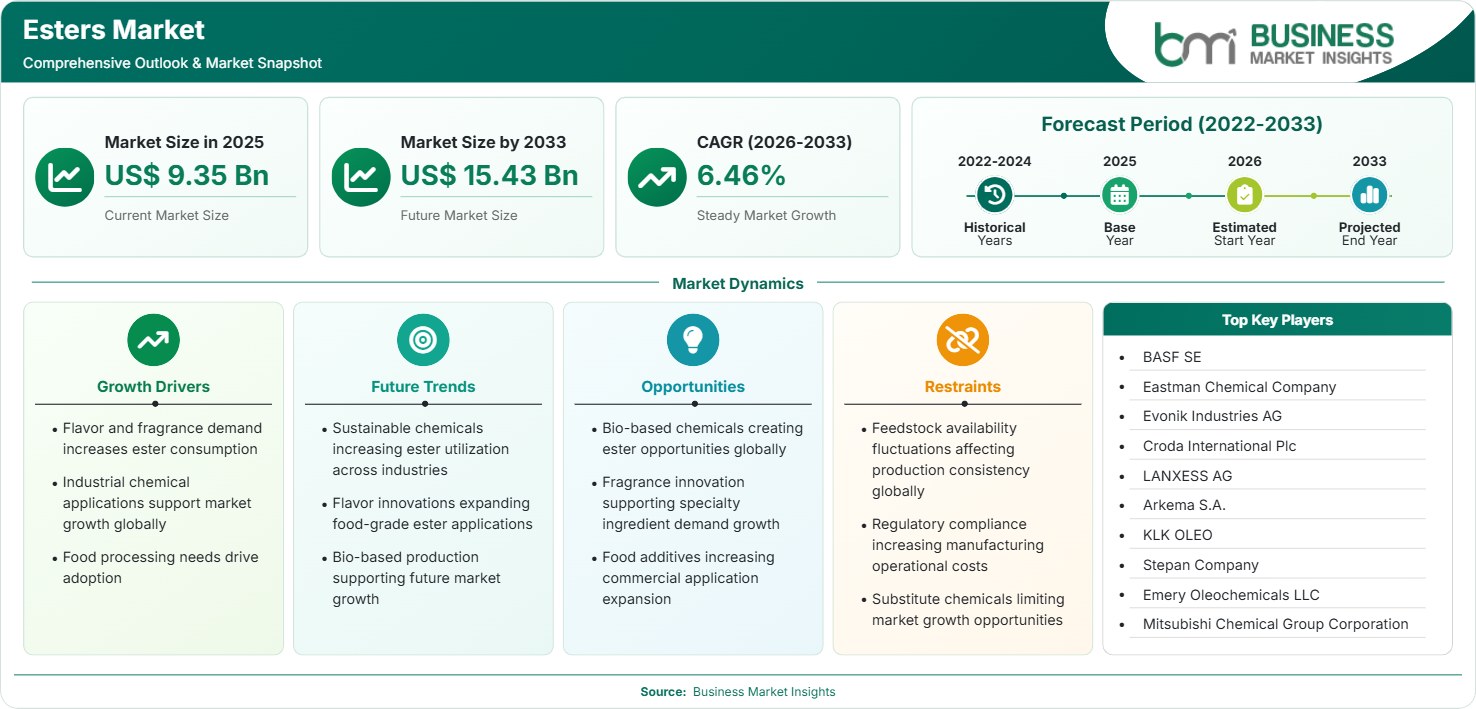
The Esters Market size was valued at US$ 9.35 Billion in 2025 and is projected to reach US$ 15.43 Billion by 2033, growing at a CAGR of 6.46% during 2026–2033. Rising demand for bio-based chemicals, synthetic lubricants, specialty solvents, personal care ingredients, and environmentally compliant formulations is accelerating adoption, while sustainable feedstocks and industrial modernization create new opportunities.

Report Coverage
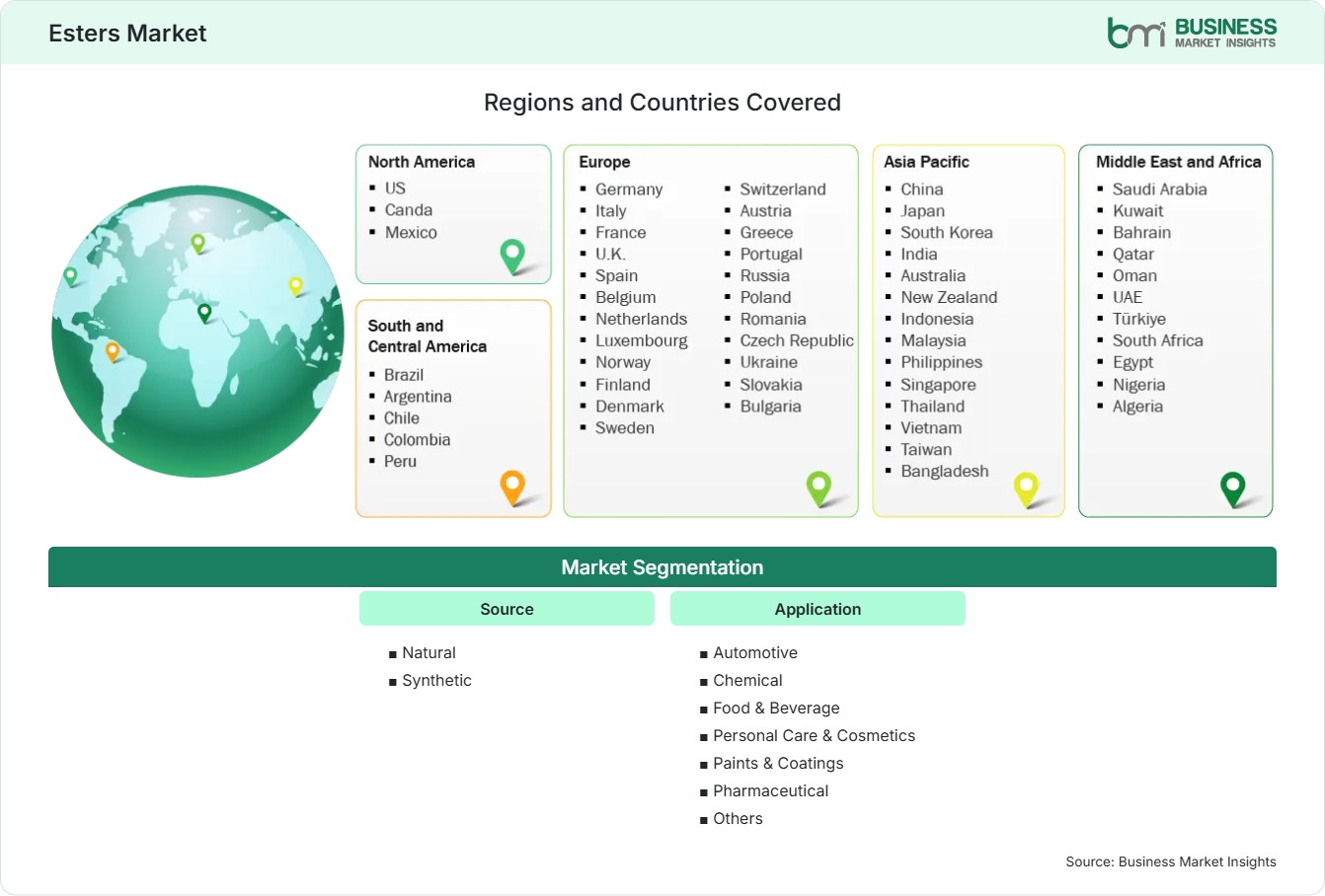
  • Source: Natural, Synthetic
  • Application: Automotive, Chemical, Food & Beverage, Personal Care & Cosmetics, Paints & Coatings, Pharmaceutical, Others
US$ 9.35 Bn Market size in 2025
US$ 15.43 Bn Market Size by 2033
6.46% CAGR, 2026 - 2033
2026-2033 Forecast Period

AI Overview

Esters Market Summary

  • North America Region: North America holds a market share of 32%–35% in 2025, growing at a CAGR of 5.8%–6.2% during 2026–2033, supported by synthetic lubricant innovation, advanced chemical manufacturing, and increasing demand for sustainable industrial fluids. Strong regulatory support and investment in specialty chemicals sustain expansion across end-use industries. The US maintains leading regional demand through automotive, coatings, and specialty formulation applications, with CAGR estimated at 5.9%–6.3%.
  • Fastest Growing Region: Asia Pacific holds a market share of 29%–32% in 2025, expanding at a CAGR of 7.2%–7.8% during 2026–2033, driven by manufacturing growth, chemical investments, biodiesel production, rising personal care consumption, export-oriented industrial capacity additions, urbanization, and increasing demand for specialty ingredients throughout developing economies.
  • Leading Segment: Synthetic source accounts for a 62%–66% share in 2025 and advances at a CAGR of 6.1%–6.5%, supported by large-scale availability, performance consistency, industrial versatility, cost efficiency, broad application compatibility, expanding lubricant demand, and growing consumption in coatings, chemicals, pharmaceuticals, and manufacturing operations.
  • High Growth Segment: Personal Care & Cosmetics represents an 11%–14% Esters Market share in 2025 and grows at a CAGR of 7.6%–8.2%, supported by premium beauty products, bio-based ingredient demand, clean-label formulations, superior emollient functionality, sustainability targets, and increasing penetration across emerging consumer markets globally.
  • Key Market Opportunity: Development of renewable feedstock-derived esters for lubricants, cosmetics, food processing, and industrial solvents creates opportunities as industries seek lower-carbon materials, regulatory compliance, improved biodegradability, and enhanced lifecycle sustainability performance.
  • Major Market Players: BASF SE, Eastman Chemical Company, Evonik Industries AG, Croda International Plc, LANXESS AG, Arkema S.A., KLK OLEO, Stepan Company, Emery Oleochemicals LLC, Mitsubishi Chemical Group Corporation.
Strategic Insights

Esters Market: Strategic Insights

Esters Market Strategic Framework
FREE PDF
Request your free sample
Request free sample
Stakeholder View

Key Takeaways

  • The value chain increasingly integrates feedstock suppliers, esterification facilities, specialty formulators, distributors, and end-use manufacturers, creating opportunities for vertical integration and margin optimization.
  • Personal care, pharmaceuticals, and specialty lubricants provide the strongest upside due to premium pricing structures and expanding demand for performance-enhancing formulations.
  • R&D investment is shifting toward bio-based esters, high-purity grades, and multifunctional ingredients that improve sustainability profiles while maintaining application performance.
  • Asia Pacific offers the strongest investment case as rapid industrialization, expanding chemical production, and consumer market growth continue to increase consumption.
  • Merger and acquisition activity remains focused on specialty chemical portfolios, renewable feedstocks, and regional manufacturing assets that enhance market access.
  • Regulatory preference for environmentally responsible products is encouraging innovations that combine biodegradability, thermal stability, and formulation flexibility.
Geographic Outlook

Esters Market Regional Highlights

North America Esters Market

North America accounted for approximately 32%–35% of the Esters Market share in 2025 and is projected to grow at a CAGR of 5.8%–6.2% through 2033. The region benefits from advanced specialty chemical manufacturing, strong automotive production, and continuous innovation in synthetic lubricants. Demand from pharmaceuticals, coatings, and personal care applications supports stable expansion. Regulatory emphasis on sustainability and biodegradable industrial chemicals is accelerating adoption of renewable feedstocks and high-performance formulations across multiple industrial sectors.

  • Strong demand for synthetic lubricants supports premium product adoption across transportation, aerospace, and industrial machinery applications.
  • Regulatory focus on sustainable chemicals encourages investment in bio-based production technologies and environmentally compliant formulations.
  • Increasing pharmaceutical manufacturing supports consumption of specialty intermediates and high-purity grades.
  • Advanced coatings industry continues driving demand for performance-oriented esters with improved durability and application characteristics.

US Esters Market

The United States represents 74%–78% of regional demand and is expected to expand at a CAGR of 5.9%–6.3%. Large-scale chemical manufacturing infrastructure, strong innovation capabilities, and high demand from industrial users strengthen domestic consumption. Continued investment in specialty chemicals and renewable materials supports long-term competitiveness. Growth is further reinforced by expanding personal care, pharmaceutical, and advanced lubricant markets requiring high-value formulations.

  • Specialty chemical producers continue increasing capacity for performance-oriented industrial and consumer applications.
  • Growth in electric vehicle fluids and advanced lubricants supports premium ester demand.
  • Cosmetic ingredient innovation encourages adoption of sustainable and multifunctional formulations.
  • Pharmaceutical production expansion increases consumption of highly refined chemical intermediates.

Europe Esters Market

Europe captured a 25%–28% share in 2025 and is anticipated to register a CAGR of 5.7%–6.1% through 2033. Sustainability regulations, circular economy initiatives, and strong personal care industries underpin regional demand. Germany remains the leading market, while Eastern European manufacturing hubs exhibit faster expansion. Bio-based products and environmentally compliant formulations are increasingly preferred across industrial, automotive, and consumer applications, encouraging innovation among regional manufacturers.

  • Germany leads regional consumption with broad industrial usage and strong specialty chemical production.
  • Poland and Romania demonstrate higher expansion rates through manufacturing investments and export growth.
  • Demand for biodegradable lubricants continues increasing due to environmental compliance requirements.
  • Premium cosmetics and personal care sectors support consumption of high-value specialty ingredients.

Asia Pacific Esters Market

The Asia Pacific region accounted for 29%–32% of the global Esters Market share in 2025, with a growth rate of 7.2%–7.8% CAGR, making it the fastest-growing region. Growth in industrialization, investments in chemical manufacturing, and export activities have boosted the region’s demand. China accounts for the maximum consumption of esters, whereas India holds the highest growth potential. Expanding automotive production, paints and coatings demand, and rising personal care expenditure continue supporting regional development and capacity additions.

  • China remains the dominant producer and consumer due to extensive manufacturing ecosystems.
  • India records the strongest regional growth supported by chemicals investment and industrial expansion.
  • Biodiesel-related demand supports increased use of ester intermediates across energy value chains.
  • Rising middle-class consumption boosts cosmetics and personal care ingredient requirements.
  • Coatings and construction activities continue supporting industrial chemical demand.

Rest of World Esters Market

Rest of World holds a 10%-13% share in 2025 and is expected to grow at a CAGR of 6.4%-6.9% between 2023 and 2033. South & Central America have an advantage in agriculture-based feedstocks and biodiesel production, while the Middle East & Africa leverage their petrochemical infrastructure and manufacturing facilities. Brazil dominates consumption in the region, while Saudi Arabia shows remarkable growth due to diversification efforts and investments in the chemical industry.

  • Brazil benefits from established biofuel industries and abundant agricultural feedstock availability.
  • Saudi Arabia increases investments in downstream chemical manufacturing and specialty materials.
  • Industrial diversification initiatives support new demand channels across emerging economies.
  • Growing food processing sectors stimulate use of flavoring and formulation ingredients.
  • Infrastructure investments reinforce coatings, construction chemicals, and specialty material demand.
Global Market Geography
FREE PDF
Request your free sample
Request free sample
Segment Analysis

Esters Market Segmentation

Source

The synthetic variants accounted for 62%-66% of the market in 2025 and are expected to grow at a 6.1%-6.5% CAGR owing to their scalability, consistent quality, and broad applicability across industries. The Esters Market's scope is expanding as producers seek to align their product performance with their sustainability goals. Natural products are gaining popularity due to consumers' environmental policies.

  • Natural: Derived from renewable feedstocks including vegetable oils and natural fats, these products gain traction through sustainability initiatives, biodegradable properties, and increased demand across food, cosmetics, and environmentally sensitive applications.
  • Synthetic: Industrially manufactured grades maintain strong adoption due to reliable performance, cost competitiveness, processing efficiency, and suitability for demanding automotive, coatings, chemical, and pharmaceutical applications.

Application

The Chemicals application segment accounted for 24%–27% of the market in 2025 and is forecast to register a CAGR of 6.3%–6.7%. Esters Market trends suggest rising demand for esters in industrial formulations, solvents, intermediates, and specialized processing aids. The rising demand has been driven by shifting manufacturing needs and industrial sectors globally.

  • Automotive: Widely utilized in synthetic lubricants, fluids, and specialty additives, benefiting from growing vehicle production, electrification trends, and performance requirements demanding thermal stability and oxidation resistance.
  • Chemical: Serves as a versatile intermediate and formulation component across industrial manufacturing, supporting broad adoption through compatibility, functional flexibility, and expanding specialty chemical production.
  • Food & Beverage: Demand is supported by flavoring applications, emulsification functions, shelf-life enhancement requirements, and increasing consumer preference for high-quality processed food products.
  • Personal Care & Cosmetics: Premium beauty formulations increasingly utilize ester ingredients for texture enhancement, sensory performance, emollient characteristics, and clean-label product development.
  • Paints & Coatings: Consumed as solvents and formulation ingredients that improve performance, drying characteristics, durability, and application efficiency across industrial and architectural products.
  • Pharmaceutical: Utilized in drug formulation, excipient development, and specialty manufacturing processes where purity, stability, and regulatory compliance remain critical requirements.
Market Forces

Esters Market Dynamics

Key Market Drivers

Rising Demand for Biodegradable Industrial Lubricants

International environmental policies and sustainable practices have prompted the use of environmentally friendly lubricants over petroleum-based ones. Various bodies, such as the International Energy Agency, still emphasize the efficiency and emission-reduction concerns of industries. Natural and synthetic ester-based lubricants offer advantages over other lubricant types in biodegradability, stability, and effectiveness. Development in the transportation, marine, industrial machinery, and renewable energy industries will increase demand for these technologies. The Esters Market growth is also aided by users' need to comply with environmental requirements without compromising equipment safety. Ongoing investments in low-carbon industrial solutions create durable demand foundations across developed and emerging economies.

Expansion of Personal Care and Cosmetic Manufacturing

The beauty and personal care industry continues to increase consumption of functional ingredients that improve texture, spreadability, and formulation stability. Esters serve as key emollients and sensory modifiers in skincare, haircare, and cosmetics. Increased disposable income, premiumization, and the preference for natural products are driving demand growth. Esters Market trends can be attributed to the increasing use of biodegradable raw materials, resulting from companies' commitment to sustainability. Innovation that focuses on creating multifunctional products helps meet regulatory requirements while improving the consumer experience.

Increasing Specialty Chemical Production Worldwide

Growth in specialty chemical manufacturing across Asia Pacific, North America, and the Middle East continues to drive significant demand. The ester is an important intermediate in the production of paints, solvents, plastics, drugs, and industrial chemicals. Development in downstream chemical manufacturing boosts demand for esters while contributing to regional production ecosystems. Chemical manufacturers are focusing on developing high-quality formulations that require high-performance ingredients. Growth in advanced manufacturing industries and industrialization initiatives drive market growth and encourage ongoing capacity additions throughout the value chain.

Key Market Opportunities

Renewable Feedstock Integration Across End-Use Industries

The increasing availability of vegetable oils, waste fats, and biologically derived raw materials creates opportunities to develop environmentally friendly alternatives to petroleum-based products. The industry is developing technologies that will lower greenhouse gas emissions while improving product properties. Market demand for such products from the food processing, cosmetics, lubricant, and industrial sectors encourages business models. The need for more transparent and sustainable practices provides further reason to consider the problem. Firms that can produce renewable materials economically can generate high value and strengthen long-term competitiveness across multiple industries.

Advanced Fluids for Electric Mobility and Industrial Systems

Fluids that exhibit enhanced thermal and reliability performance are needed for electric cars, energy storage devices, and other advanced industrial machinery. Specialty esters are highly beneficial for their ability to withstand oxidation and transfer heat effectively. Growing trends in electrification present avenues for innovation and development of products for new applications. Esters Market Forecasts now consider the commercial viability of future industrial and mobility systems. Suppliers that work hand in hand with machinery manufacturers can capitalize on these segments.

High-Purity Pharmaceutical and Food-Grade Applications

The growing importance of safety, traceability, and quality results in higher demand for high-quality products. Manufacturers of drugs and foods need raw materials that will exhibit uniform performance and comply with the changing requirements. Specialty suppliers may capitalize on sophisticated purification methods to meet these stringent requirements. The growth of health care spending, expansion of processed food industries, and the need for premium products are conducive to future market growth. These applications generally provide attractive margins and reinforce opportunities for value-added product differentiation.

Market Restraints and Challenges

Feedstock Price Volatility and Margin Pressure

Factor: The prices of vegetable oil, petroleum derivatives, and alcohol-based products are influenced by climate change, geopolitics, and issues in the energy industry. Impact: Uncertainty about production costs adds pressure to profit margins. It becomes increasingly challenging for manufacturers to maintain their prices and still operate profitably. Small manufacturers are particularly vulnerable to such factors because they are less able to negotiate than integrated manufacturers. Continued volatility may influence investment decisions, capacity utilization rates, and competitive positioning across the value chain.

Regulatory Complexity Across Global Markets

Factor: Compliance regulations vary widely across regions for chemical registration, environmental standards, food additives, and pharmaceutical use. Impact: Development and commercialization timescales may be extended and costly. It will be necessary to dedicate significant effort to testing and documentation. In addition, various regulatory systems pose obstacles to firms' expansion into other markets around the globe. These challenges can slow innovation cycles and increase operating costs, particularly for smaller organizations managing diverse product portfolios and multiple end-use markets.

Company Analysis

Competitive Landscape

The competitive environment is characterized by product innovation, sustainability investments, and regional expansion strategies. Esters Market analysis indicates increasing focus on bio-based feedstocks, specialty formulations, and high-value end-use applications.

Company Name

Overview

Products and Services relevant to this market

BASF SE

Global chemical leader with extensive specialty chemical and performance materials portfolio.

Fatty acid esters, plasticizers, lubricant components, specialty intermediates, performance chemicals.

Eastman Chemical Company

Major specialty materials producer serving industrial and consumer applications worldwide.

Cellulose esters, specialty esters, solvents, additives, formulation ingredients.

Evonik Industries AG

Advanced specialty chemicals company emphasizing innovation and high-performance solutions.

Specialty esters, additives, intermediates, lubricant technologies.

Croda International Plc

Focused on sustainable specialty ingredients for consumer and industrial markets.

Cosmetic esters, bio-based ingredients, performance additives.

LANXESS AG

Specialty chemicals manufacturer with a diversified industrial product portfolio.

Industrial intermediates, specialty additives, performance chemicals.

Arkema S.A.

Global producer of specialty materials and advanced chemical solutions.

Acrylic esters, coatings ingredients, specialty materials.

KLK OLEO

Leading oleochemical company utilizing renewable feedstocks.

Natural esters, oleochemicals, personal care ingredients.

Stepan Company

Producer of surfactants and specialty chemical ingredients globally.

Ester derivatives, formulation chemicals, specialty ingredients.

Emery Oleochemicals LLC

Oleochemical specialist serving industrial and consumer industries.

Natural esters, lubricant base stocks, specialty chemicals.

Mitsubishi Chemical Group Corporation

Diversified chemicals group focused on advanced materials and innovation.

Specialty esters, intermediates, industrial chemical solutions.

Trust & Transparency

Research Methodology

The market analysis combines proprietary research with secondary data from government agencies, company disclosures, regulatory filings, industry databases and expert interviews. Market estimates are validated through data triangulation, cross-market benchmarking and analyst review.

View Full Research Methodology

Questions Answered

Frequently Asked Questions

How are electric vehicles influencing industry demand?

Electric mobility platforms require advanced thermal management and lubrication solutions, creating opportunities for high-performance specialty formulations with improved oxidation stability and efficiency.

What does the Esters Market Report examine?

The Market Report evaluates market size, regional dynamics, competitive positioning, segment performance, emerging technologies, regulatory influences, and strategic opportunities across key end-use industries.

Why are natural-source esters gaining importance?

Natural-source products align with sustainability initiatives, offer biodegradability benefits, and help manufacturers meet evolving environmental regulations and consumer preferences.

Which region offers the strongest growth potential?

Asia Pacific presents the highest growth potential due to industrialization, expanding chemical production, rising consumer spending, and continued investments in manufacturing infrastructure.

What factors are driving demand for ester-based products?

Demand is supported by growth in specialty chemicals, biodegradable lubricants, cosmetics, food processing, coatings, and pharmaceutical applications requiring high-performance and environmentally compliant ingredients.

Access the Full Esters Market Report

Get segment-level forecasts, regional estimates, competitive benchmarking, company profiles and downloadable Excel datasets.

Access the full Esters Market Report
350 pages PDF & Excel | 2026-11-10
Similar Research

Related Market Reports