
Digital Banking Market Size, Share, Trends & Forecast Report, 2026–2033

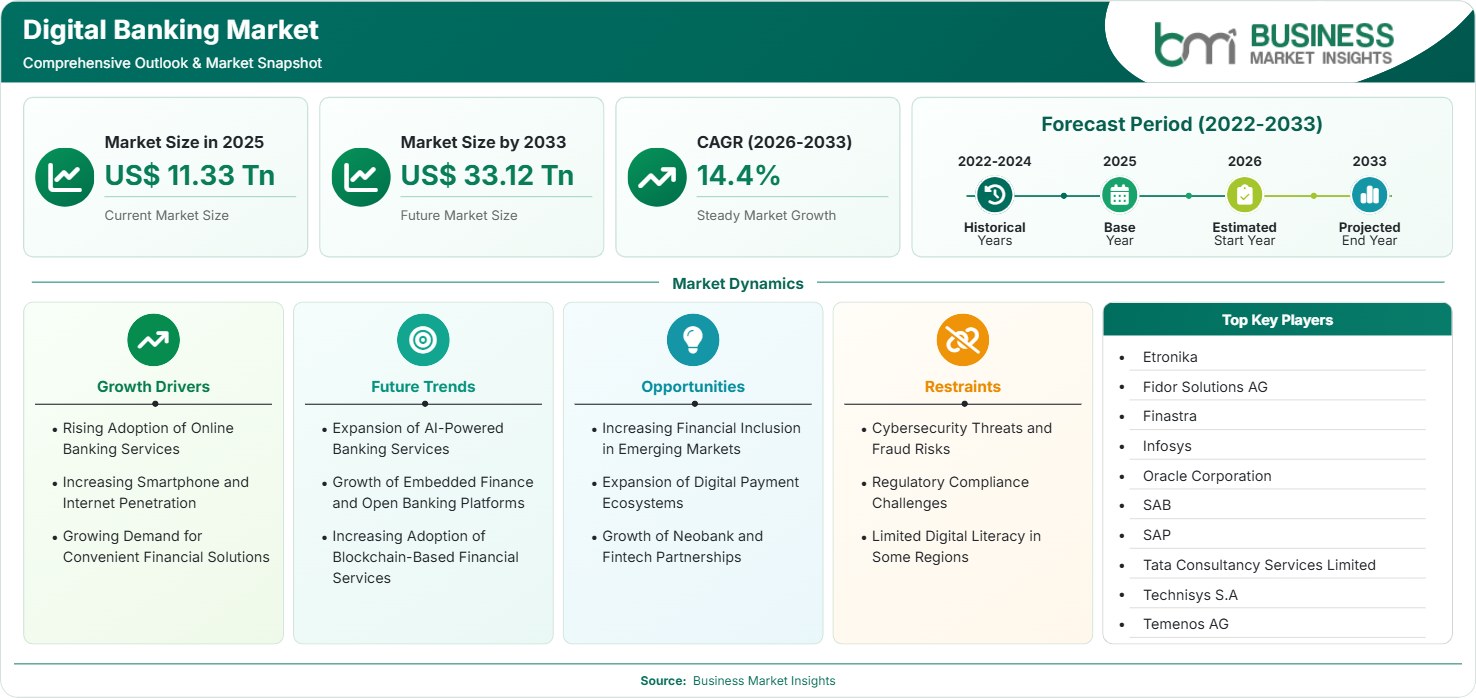
The Digital Banking Market size was valued at US$ 11.33 Trillion in 2025 and is projected to reach US$ 33.12 Trillion by 2033, growing at a CAGR of US$ 14.4% during 2026–2033, driven by mobile-first banking adoption, financial inclusion initiatives, cloud-based banking platforms, and expanding digital payment ecosystems across global economies.

Report Coverage
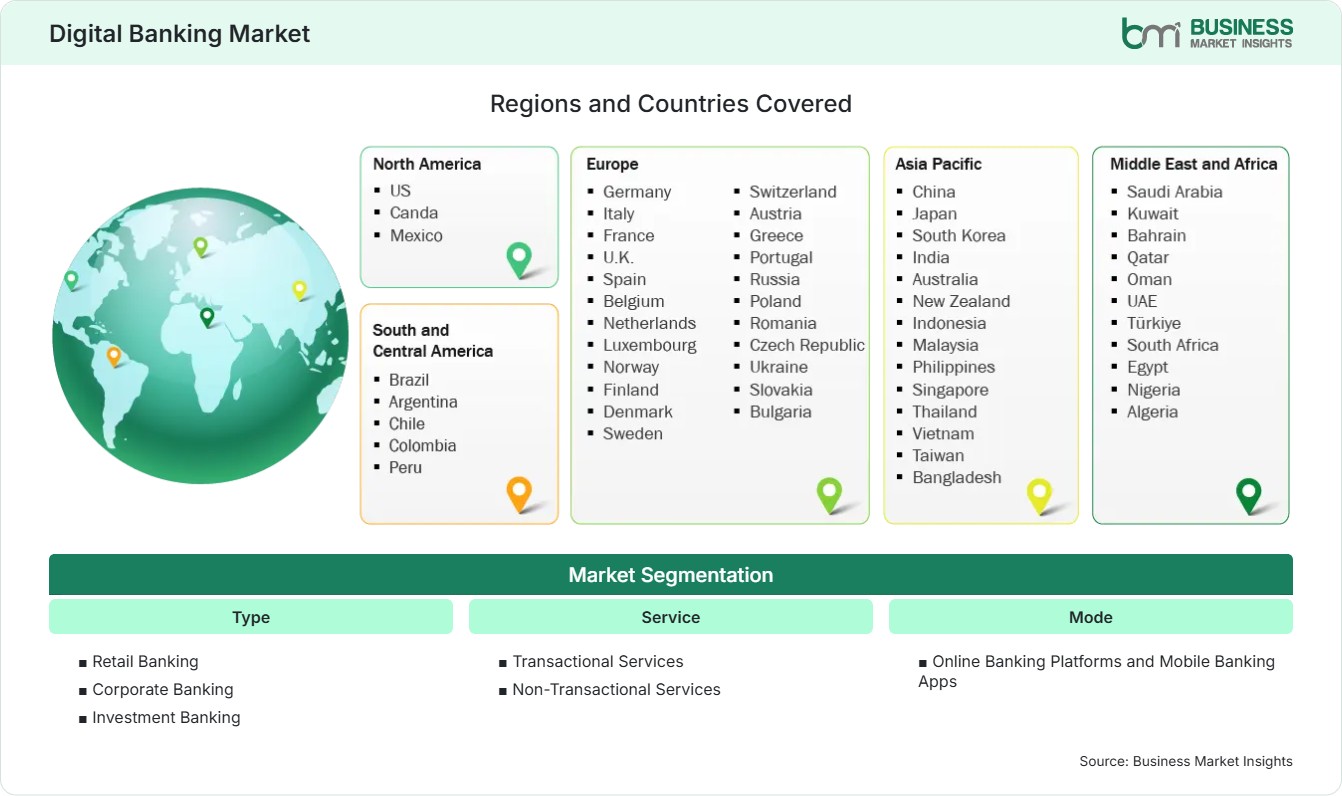
  • Type: Retail Banking, Corporate Banking, Investment Banking
  • Service: Transactional Services, Non-Transactional Services
  • Mode: Online Banking Platforms and Mobile Banking Apps
US$ 11.33 Tn Market size in 2025
US$ 33.12 Tn Market Size by 2033
14.4% CAGR, 2026 - 2033
2026-2033 Forecast Period

01 AI Overview

Digital Banking Market Summary

  • North America Region: North America holds a Digital Banking market share of 28%–31% in 2025, growing with a CAGR of 13.8%–14.8% influenced by fintech innovation, cloud banking investments, cybersecurity upgrades, and open banking adoption. The US market demonstrates strong expansion through digital financial services transformation, with a CAGR of 14.0%–15.0% during 2026–2033.
  • Fastest Growing Region: Asia Pacific holds market share of 34%–37% in 2025, growing with a CAGR of 15.0%–16.0% supported by smartphone adoption, financial inclusion programs, digital payment expansion, and rapid banking technology modernization across emerging economies.
  • Leading Segment: Retail Banking holds a market share of 45%–48% in 2025, growing with a CAGR of 14.2%–15.2% driven by consumer demand for mobile banking, personalized financial services, automated transactions, and customer-centric digital experiences.
  • High Growth Segment: Mobile Banking Apps represent a high-growth segment with increasing adoption supported by smartphone penetration, instant payment capabilities, biometric authentication, and growing preference for convenient digital financial interactions.
  • Key Market Opportunity: Expansion of embedded finance, digital payment infrastructure, artificial intelligence-based banking services, and underserved market penetration creates opportunities for technology providers supporting scalable and secure financial platforms.
  • Major Market Players: Etronika, Fidor Solutions AG, Finastra, Infosys, Oracle Corporation, SAB, SAP, Tata Consultancy Services Limited, Technisys S.A., Temenos AG.
02 Strategic Insights

Digital Banking Market: Strategic Insights

Digital Banking Market Strategic Framework
FREE PDF
Request your free sample
Request free sample
03 Stakeholder View

Key Takeaways

  • Digital banking ecosystems are evolving from transaction-focused platforms into integrated financial service environments combining payments, lending, investment solutions, and personalized customer engagement capabilities.
  • Consumer banking applications and mobile financial services provide significant growth opportunities as users increasingly prefer instant access, automated services, and personalized digital experiences over conventional banking channels.
  • Artificial intelligence, machine learning, biometric authentication, and cloud computing are reshaping banking technology strategies by improving fraud detection, operational efficiency, and customer experience management.
  • Asia Pacific presents a strong investment opportunity due to expanding digital payment adoption, rising smartphone penetration, and government-supported financial inclusion programs across developing economies.
  • Strategic partnerships between banks, fintech companies, and technology providers are increasing as financial institutions seek faster innovation cycles, improved platform scalability, and specialized digital capabilities.
  • Regulatory technology and cybersecurity investments are becoming critical priorities as financial institutions expand digital services while maintaining compliance, customer trust, and operational resilience.
04 Geographic Outlook

Digital Banking Market Regional Highlights

North America Digital Banking Market

North America accounted for a market share of 28%–31% in 2025 and is projected to expand at a CAGR of 13.8%–14.8% during 2026–2033. Market share in the region is supported by fintech development, advanced banking infrastructure, cloud adoption, and strong consumer preference for digital financial services. The US remains the primary contributor due to technology innovation and widespread online banking adoption.

  • Open banking initiatives are encouraging financial institutions to develop interconnected platforms that improve customer access, personalization, and third-party service integration capabilities.
  • Banks are investing in artificial intelligence solutions to enhance customer support, automate operations, and strengthen fraud prevention mechanisms.
  • Cloud-based banking infrastructure adoption is increasing as financial institutions seek flexible, scalable, and cost-efficient technology environments.
  • Digital payment innovation continues expanding through contactless transactions, mobile wallets, and integrated financial applications.

US Digital Banking Market

The US accounted for a market share of 24%–27% in 2025 and is expected to register a CAGR of 14.0%–15.0% between 2026–2033. Digital Banking Market expansion in the country is influenced by fintech innovation, customer demand for seamless services, and financial institutions adopting advanced digital platforms. Strong technology infrastructure supports continuous banking transformation.

  • Neobank adoption is increasing as consumers seek simplified account management, lower service barriers, and digitally optimized banking experiences.
  • Financial institutions are integrating artificial intelligence and automation technologies to improve operational efficiency and customer engagement.
  • Regulatory developments supporting digital financial innovation are encouraging partnerships between banks and technology providers.

Europe Digital Banking Market

Europe represented a market share of 20%–23% in 2025 and is projected to grow at a CAGR of 12.8%–13.8% during 2026–2033. Digital Banking Market share in Europe is influenced by open banking regulations, fintech ecosystems, and increasing demand for digital payment solutions. Germany, the United Kingdom, and France remain important contributors, while Nordic countries demonstrate strong digital banking adoption.

  • The United Kingdom maintains leadership through advanced fintech ecosystems, digital banking platforms, and strong consumer adoption of online financial services.
  • Germany is expanding digital banking capabilities through technology modernization and increasing collaboration between banks and fintech providers.
  • France is supporting digital financial innovation through investment in secure payment systems and banking technology infrastructure.
  • Nordic countries continue demonstrating high digital adoption through advanced online banking services and cashless payment environments.

Asia Pacific Digital Banking Market

Asia Pacific held a market share of 34%–37% in 2025 and is anticipated to expand at a CAGR of 15.0%–16.0% through 2033. Market share in the region is driven by mobile connectivity, digital payment ecosystems, government inclusion programs, and technology investments. China, India, Singapore, and Southeast Asian economies are accelerating digital financial transformation.

  • China continues expanding digital banking through mobile payment ecosystems, technology platforms, and financial technology innovation.
  • India is advancing digital financial access through government-supported payment infrastructure and increasing smartphone-based banking adoption.
  • Singapore strengthens regional digital banking development through fintech innovation, regulatory support, and technology partnerships.
  • Southeast Asian markets are adopting digital banking solutions to improve financial access and customer service delivery.
  • Regional banks are investing in cloud platforms and artificial intelligence to improve operational capabilities.

Rest of World Digital Banking Market

Rest of World accounted for a market share of 8%–11% in 2025 and is projected to grow at a CAGR of 12.0%–13.0% during 2026–2033. Market share across Latin America, Middle East, and Africa is expanding through mobile financial services, digital payment adoption, and increasing financial inclusion efforts. Emerging markets are creating opportunities for technology providers.

  • Latin American countries are expanding digital banking adoption through fintech innovation, mobile payment platforms, and consumer-focused financial solutions.
  • Brazil demonstrates strong digital banking momentum through technology-driven financial services and increasing customer migration toward online platforms.
  • Middle Eastern economies are investing in digital banking infrastructure as part of broader financial modernization strategies.
  • African markets are leveraging mobile banking solutions to improve access to financial services among underserved populations.
  • Government initiatives across emerging economies are supporting digital payment ecosystems and banking technology adoption.
Global Market Geography
FREE PDF
Request your free sample
Request free sample
05 Segment Analysis

Digital Banking Market Segmentation

Type

Type represents one of the most important segments that holds a market share of 100% within the banking domain, growing at a CAGR of 14.4% during 2026-2034. The type segment is a reflection of the wide range of adoption that occurs within consumer, enterprise, and investment-oriented financial services. Digital transformation policies and technology upgrades are leading to increased adoption by banks worldwide. The digital banking market scope continues to expand as organizations develop specialized platforms for different financial service requirements.

  • Retail Banking: Digital retail banking platforms enable consumers to access accounts, payments, loans, and financial services through online channels, supported by mobile adoption, personalization, and automated service delivery.
  • Corporate Banking: Corporate digital banking solutions support business transactions, cash management, treasury operations, and enterprise financial services through secure platforms designed for institutional requirements.
  • Investment Banking: Digital investment banking platforms improve advisory services, market analysis, portfolio management, and automated financial operations through advanced technology integration.

Service

Service is represented as an important area of segmentation, constituting 55%–58% of the segment by 2025, and registering a CAGR of 14.0%–15.0% over the period of 2026-2034. There is an evolution of service-oriented platforms through automation, artificial intelligence, and digital customer experience. There is a trend towards technological solutions to improve transaction efficiency and enhance customer interaction among banks.

  • Transactional Services: Transactional digital services support payments, transfers, deposits, and account activities through secure online platforms, improving speed, accessibility, and customer convenience.
  • Non-Transactional Services: Non-transactional services include financial advice, account management, analytics, and customer engagement solutions that enhance digital banking relationships.

Mode

Mode represents a highly dynamic category, comprising 42%-45% of market value in 2025 and expected to grow at a CAGR of 14.8%-15.8% from 2026 to 2034. High adoption is fueled by the growing use of smartphones, Internet access, and consumer preference for conducting business online. Technology vendors are creating robust digital solutions to facilitate banking transactions.

  • Online Banking Platforms: Online banking platforms provide web-based financial services, account management, payments, and digital transactions through secure browser-based banking environments.
  • Mobile Banking Apps: Mobile banking applications enable convenient financial access through smartphones, supporting instant payments, biometric authentication, personalized services, and customer engagement.
06 Market Forces

Digital Banking Market Dynamics

Key Market Drivers

Rising Adoption of Online Banking Services

The growing popularity of remote financial services among consumers is leading to increased adoption of online banking platforms in both developed and emerging economies. The Digital Banking Market growth can be attributed to greater internet availability, improved banking applications, and the need for immediate financial transactions. According to the World Bank, billions of people have been able to access financial accounts via digital channels in recent years, helping build strong ecosystems for digital finance. Some market trends include cloud architecture, automation, and consumer-oriented platforms.

Increasing Smartphone and Internet Penetration

Increased smartphone use and improved internet connectivity are helping to create favorable conditions for digital banking worldwide. Mobile devices are becoming the primary channels for making payments, managing accounts, and accessing financial services, especially in developing nations. Internet connectivity has been growing globally, according to the International Telecommunication Union. Growth in the market is being driven by the mobile-first approach of banks and fintech organizations. Trends in the Digital Banking Market include increased development of mobile apps that have features such as biometric authentication, quick payments, and custom-tailored financial services.

Growing Demand for Convenient Financial Solutions

Rising expectations for speed, convenience, and customization are prompting banks to invest in new and innovative technologies. More and more people want financial services that provide immediate access to their accounts and enable other financial transactions without visiting branches in person. The growth pattern of the market is based on the rising use of artificial intelligence and automatic advice, and other digital financial services. The Digital Banking Market trends are being driven by the need for operational efficiency and increased customer engagement.

Key Market Opportunities

Increasing Financial Inclusion in Emerging Markets

The opportunities for digital banking firms remain considerable within emerging markets due to efforts by the government and the financial institutions themselves to expand access to financial services. The use of mobile banking is an opportunity to alleviate infrastructure issues and extend financial access to underprivileged areas. Digital technologies enable low-cost access to financial accounts and transactions in places where the existing banking network is sparse. The Digital Banking Market Forecast indicates that opportunities will remain due to financial inclusion projects, particularly in the Asia Pacific, Africa, and Latin America.

Expansion of Digital Payment Ecosystems

Growing digital payment systems are creating chances for banks, fintech firms, and technology firms to create interconnected financial ecosystems. The rise in the use of instant payments, digital wallets, and contactless payments is changing customer interaction with financial services providers. Businesses are looking for integrated payment options that are efficient and offer a great customer experience. Support for digital payment infrastructure from regulatory agencies is driving innovations in the global market. Financial technology firms can capitalize on these innovations by creating secure payment platforms.

Growth of Neobank and Fintech Partnerships

The collaboration between banks and fintech firms creates opportunities for accelerated digital transformation and service innovation. Neobanks are launching technology-based banking services focused on customer convenience, and existing banks are partnering to modernize their platforms. The collaboration enables rapid digital product launches, greater flexibility, and access to unique technological expertise. Increasing investments in the fintech ecosystems are spurring partnership strategies aimed at payments, lending, analytics, and customer engagement services.

Market Restraints and Challenges

Cybersecurity Threats and Fraud Risks

Factor: Increasing cyber threats, identity fraud, and digital financial attacks create security challenges for banking platforms expanding online services. Impact: Security incidents can reduce customer confidence, increase compliance costs, and require continuous investment in advanced protection technologies. Digital banking providers must implement multi-factor authentication, encryption, artificial intelligence-based monitoring, and fraud prevention systems to maintain secure operations. As transaction volumes increase, financial institutions face greater exposure to sophisticated cyber risks. Managing cybersecurity requirements remains a critical operational priority for banks and technology providers developing digital financial ecosystems.

Regulatory Compliance Challenges

Factor: Complex and evolving financial regulations across different regions create challenges for digital banking providers operating globally. Impact: Compliance requirements can increase operational complexity, implementation timelines, and technology investment needs. Banks must continuously adapt platforms to meet data protection, consumer security, anti-money laundering, and financial reporting requirements. Differences between regulatory frameworks can limit scalability across international markets. Technology providers are developing compliance-focused solutions to help financial institutions manage regulatory obligations while maintaining efficient digital service delivery.

07 Company Analysis

Competitive Landscape

The Digital Banking Market analysis reflects a competitive ecosystem driven by technology innovation, platform scalability, cybersecurity capabilities, and strategic collaborations between financial institutions and technology providers. Market participants are focusing on cloud-native banking platforms, artificial intelligence-enabled solutions, payment modernization, and customer experience enhancement. Leading companies are strengthening their positions through product expansion, partnerships, and digital transformation services that support banks, fintech organizations, and enterprises worldwide.

Company Name

Overview

Products and Services relevant to this market

Etronika

Financial technology provider delivering digital banking and payment solutions for modern financial institutions.

Digital banking platforms, payment solutions, electronic transaction systems, and financial technology services.

Fidor Solutions AG

Digital banking technology company specializing in innovative online banking platforms and services.

Digital banking infrastructure, API-based banking solutions, fintech integration, and customer engagement platforms.

Finastra

Global financial software provider supporting banking institutions with digital transformation technologies.

Digital banking platforms, payment processing, core banking software, lending solutions, and financial services technology.

Infosys

Technology services company providing digital transformation solutions for financial institutions worldwide.

Banking platforms, cloud solutions, artificial intelligence services, digital transformation consulting, and financial technology solutions.

Oracle Corporation

Enterprise technology company providing cloud-based financial and banking technology solutions.

Cloud banking applications, database technologies, analytics platforms, and financial services software.

SAB

Banking software provider offering digital banking solutions for financial institutions and financial markets.

Core banking systems, digital channels, payment solutions, and banking technology platforms.

SAP

Enterprise software company supporting financial institutions through technology modernization solutions.

Banking applications, enterprise resource planning, analytics, cloud solutions, and financial management technologies.

Tata Consultancy Services Limited

Technology services company delivering banking transformation and digital financial solutions globally.

Digital banking platforms, cloud migration, automation, cybersecurity, and financial technology consulting services.

Technisys S.A.

Digital banking software company focused on cloud-native banking platforms and financial innovation.

Digital banking systems, customer experience platforms, API-based solutions, and banking-as-a-service technologies.

Temenos AG

Banking technology provider specializing in software platforms for financial institutions.

Core banking software, digital banking platforms, payments technology, and financial service applications.

08 Industry Activity

Recent Developments

February 2026

Backbase announced a partnership with Plaid to integrate open finance capabilities into AI-powered banking experiences, supporting financial institutions in improving digital customer engagement and data connectivity.

February 2026

Grasshopper Bank reported strategic growth initiatives including AI-driven banking innovation and announced a merger agreement with Enova, strengthening its position as a digital-first bank focused on small businesses, startups, and fintech companies.

December 2025

10x Banking partnered with Audax Financial Technology to help banks across Asia-Pacific, Europe, and the Middle East modernize core banking infrastructure and launch scalable digital banking services using cloud-native technology.

May 2025

Infosys Finacle announced that Bank of Sydney selected the Infosys Finacle Digital Banking Suite on AWS Cloud to support technology-led growth, automation, digital customer experiences, and modernization of banking operations.

10 Trust & Transparency

Research Methodology

The market analysis combines proprietary research with secondary data from government agencies, company disclosures, regulatory filings, industry databases and expert interviews. Market estimates are validated through data triangulation, cross-market benchmarking and analyst review.

View Full Research Methodology

11 Questions Answered

Frequently Asked Questions

Why are mobile banking applications gaining importance?

Mobile banking applications are gaining importance because smartphones provide convenient access to payments, account management, financial products, and personalized services, particularly among digitally connected consumers.

What does the Digital Banking Market Report identify as major future opportunities?

The report identifies opportunities from financial inclusion initiatives, digital payment expansion, embedded finance adoption, neobank growth, and increasing demand for scalable cloud-based banking platforms.

Which technologies are shaping the future of digital banking services?

Artificial intelligence, cloud computing, application programming interfaces, biometric authentication, blockchain-based solutions, and advanced analytics are shaping digital banking services by improving security, personalization, and operational efficiency.

How are fintech partnerships influencing banking transformation?

Fintech partnerships enable banks to accelerate innovation by accessing specialized technologies, improving customer experiences, launching new digital products, and integrating advanced capabilities such as artificial intelligence and automated financial services.

What is driving adoption of digital banking platforms among financial institutions?

Financial institutions are adopting digital banking platforms due to customer demand for convenient services, operational efficiency improvements, cloud technology adoption, automation capabilities, and increasing preference for mobile and online financial interactions.

Access the Full Digital Banking Market Report

Get segment-level forecasts, regional estimates, competitive benchmarking, company profiles and downloadable Excel datasets.

Access the full Digital Banking Market Report
350 pages PDF & Excel | 2026-07-30