Market Summary
Executive Summary and Global Market Analysis
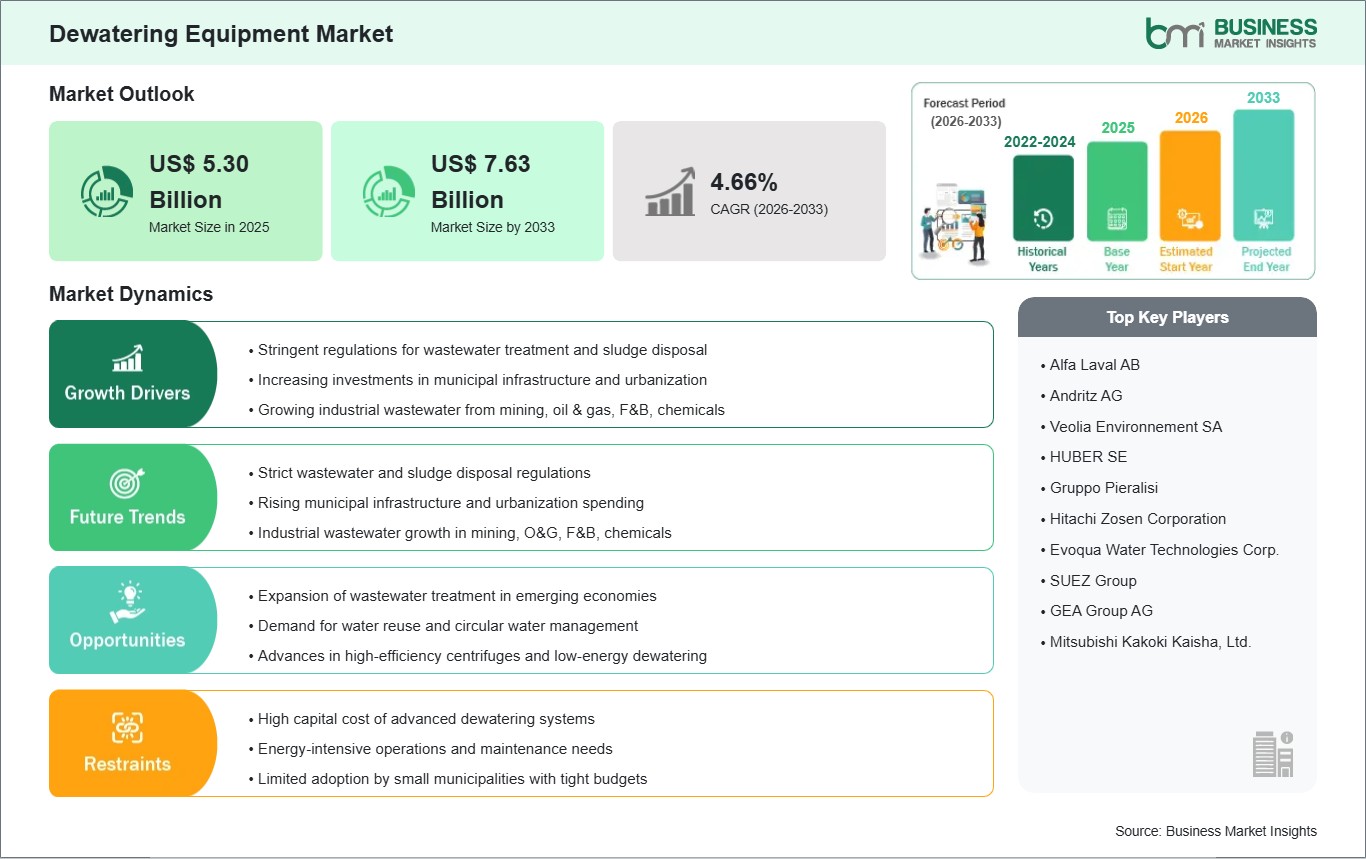
The global dewatering equipment market is witnessing steady growth driven by increasing wastewater generation, rapid urbanization, and stringent environmental regulations governing sludge disposal and water treatment. Dewatering equipment plays a critical role in reducing sludge volume, minimizing disposal costs, and improving operational efficiency in municipal and industrial treatment facilities. Rising investments in wastewater infrastructure upgrades, particularly in emerging economies, are further supporting market expansion. Technological advancements such as high-efficiency centrifuges, automated belt filter presses, and energy-optimized systems are enhancing performance while lowering operational costs. The municipal segment continues to account for a significant share due to expanding urban populations and regulatory compliance requirements, while industrial applications are growing steadily across sectors such as mining, oil & gas, chemicals, and food processing. Additionally, increasing focus on sustainability, water reuse, and resource recovery is shaping long-term market opportunities, positioning advanced and automated dewatering technologies as key growth enablers globally.
Segment Analysis
Dewatering Equipment Market Segmentation
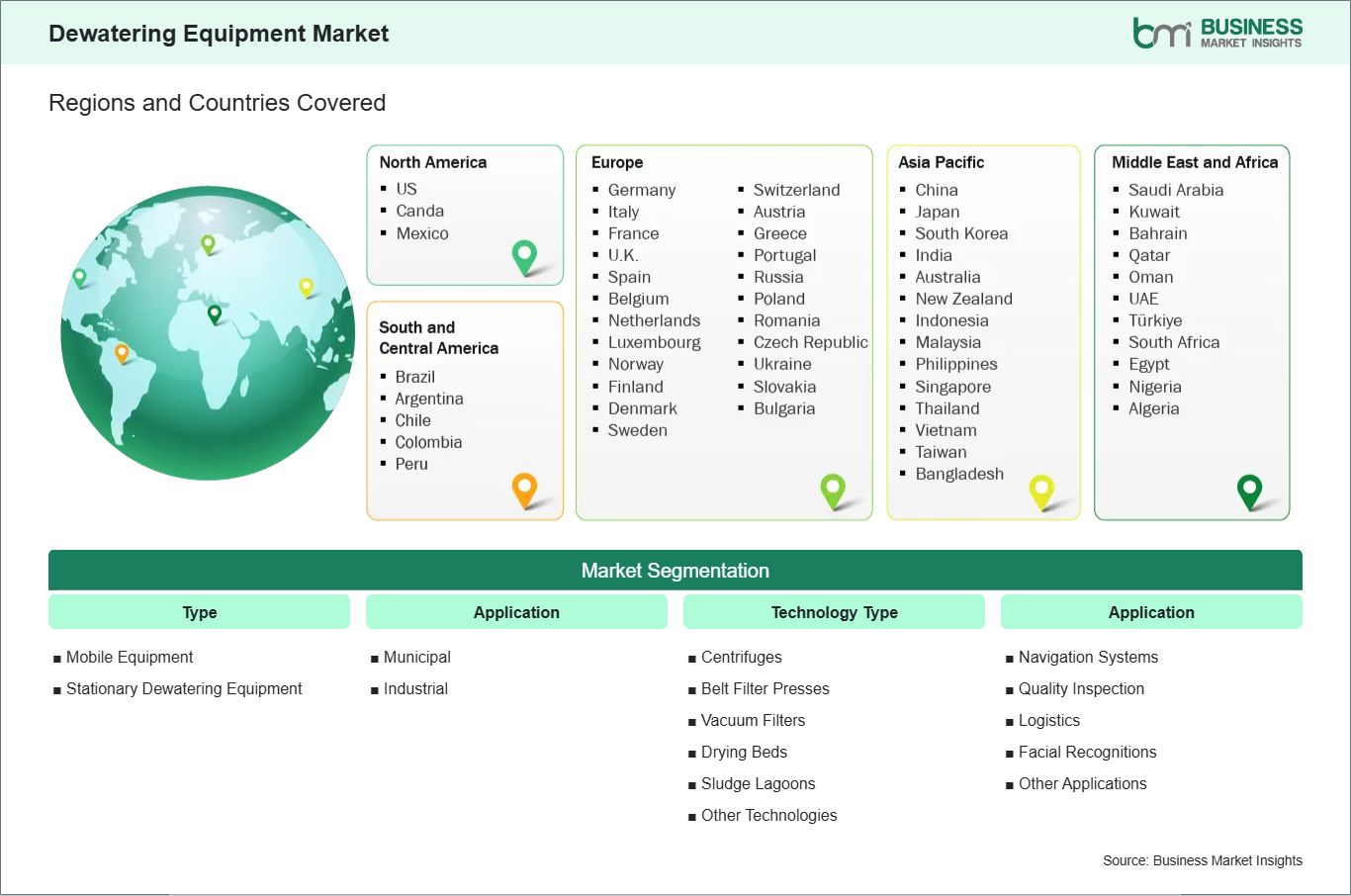
Key segments that contributed to the derivation of the Dewatering Equipment market analysis are type, application, and technology.
- Based on type, the Dewatering Equipment market is segmented into Mobile Dewatering Equipment and Stationary Dewatering Equipment. Among these, the mobile dewatering equipment segment accounted for the largest share of the market in 2025.
- Based on application, the Dewatering Equipment market is segmented into Municipal and Industrial. Among these, the Municipal segment accounted for the largest share of the market in 2025.
- Based on technology type, the Dewatering Equipment market is segmented into Centrifuges, Belt Filter Presses, Vacuum Filters, Drying Beds, Sludge Lagoons, and Other Technologies. Among these, the Centrifuges segment accounted for the largest share of the market in 2025.
Market Forces
Dewatering Equipment Market Drivers and Opportunities
Stringent Environmental Regulations and Wastewater Treatment Mandates
The growing enforcement of stringent environmental regulations regarding wastewater discharge, sludge management, and water reuse is a major driver for the dewatering equipment market. Governments and environmental agencies across the globe are implementing strict standards to limit contaminants in discharged water and reduce the environmental impact of sludge disposal. Municipal authorities are under increasing pressure to upgrade aging wastewater treatment infrastructure to meet compliance requirements. Similarly, industries such as oil & gas, mining, chemicals, and food processing must treat effluents effectively before discharge or reuse. Dewatering equipment plays a critical role in minimizing sludge volume, lowering transportation and disposal costs, and improving overall treatment efficiency. As urbanization and industrialization continue to rise, wastewater generation is increasing significantly, further accelerating the need for reliable and high-performance dewatering solutions to meet regulatory standards and sustainability goals.
Growing Investments in Sustainable and Advanced Treatment Technologies
The rising global focus on sustainability, resource recovery, and energy efficiency presents significant growth opportunities for the dewatering equipment market. Governments and private stakeholders are investing heavily in advanced wastewater treatment technologies to promote water reuse, reduce carbon footprints, and recover valuable resources from sludge. Modern dewatering systems, such as high-efficiency centrifuges and automated filtration technologies, are increasingly integrated with digital monitoring and smart control systems to optimize performance and reduce operational costs. Emerging economies are also expanding their wastewater treatment capacity through infrastructure development projects, creating strong demand for advanced dewatering solutions. Additionally, the shift toward circular economy practices—such as converting sludge into biogas or agricultural fertilizers—further boosts the adoption of efficient dewatering technologies. These trends are expected to create long-term opportunities for manufacturers offering energy-efficient, automated, and environmentally sustainable equipment solutions.
Size and Share Analysis
Dewatering Equipment Market Size and Share Analysis
Based on type, the Dewatering Equipment market is segmented into Mobile Dewatering Equipment and Stationary Dewatering Equipment. Among these, the Sludge Dewatering Equipment segment accounted for the largest share of the market in 2025 due to its widespread use in wastewater treatment plants to reduce sludge volume and disposal costs efficiently.
Based on application, the Dewatering Equipment market is segmented into Municipal and Industrial. Among these, the Municipal segment accounted for the largest share of the market in 2025 wing to increasing investments in urban wastewater treatment infrastructure and stringent environmental regulations.
Based on technology type, the Dewatering Equipment market is segmented into Centrifuges, Belt Filter Presses, Vacuum Filters, Drying Beds, Sludge Lagoons, and Other Technologies. Among these, the Centrifuges segment accounted for the largest share of the market in 2025 because of their high efficiency, continuous operation capability, and ability to handle large volumes of sludge with lower operational time.
Report Coverage
Dewatering Equipment Market Report Coverage and Deliverables
The "Dewatering Equipment Market Size and Forecast (2022 - 2033)" report provides a detailed analysis of the market covering below areas:
- Dewatering Equipment market size and forecast at global, regional, and country levels for all the key market segments covered under the scope
- Dewatering Equipment market trends, as well as market dynamics such as drivers, restraints, and key opportunities
- Dewatering Equipment market analysis covering key market trends, global and regional framework, major players, regulations, and recent market developments
- Industry landscape and competition analysis covering market concentration, heat map analysis, prominent players, and recent developments for the Dewatering Equipment market
- Detailed company profiles, including SWOT analysis
Geographic Insights
Dewatering Equipment Market Geographic Insights
The geographical scope of the Dewatering Equipment market report is divided into five regions: North America, Asia Pacific, Europe, Middle East & Africa, and South & Central America. The Dewatering Equipment market in Asia Pacific is expected to grow significantly during the forecast period.
The Dewatering Equipment market exhibits diverse regional dynamics shaped by varying regulatory environments, infrastructure investments, and industrial development levels. North America remains a prominent regional market, driven by stringent environmental regulations, advanced wastewater treatment infrastructure, and robust industrial operations. The United States and Canada are investing in modernizing aging municipal wastewater systems and incorporating automated, energy-efficient dewatering solutions. Europe also holds a substantial share, supported by the European Union’s water quality standards and sustainability initiatives that emphasize sludge reduction and resource recovery. Countries such as Germany, France, and the UK are key contributors to regional growth.
In Asia Pacific, rapid urbanization, population growth, and escalating industrial activities in China, India, and Southeast Asian nations are significantly increasing demand for dewatering equipment. Governments across the region are prioritizing investments in wastewater treatment facilities to address pollution concerns, providing fertile ground for both standard and advanced dewatering technologies. South & Central America and the Middle East & Africa are emerging markets, witnessing gradual uptake of dewatering solutions as infrastructure development gains momentum and environmental regulations become more defined. Overall, regional trends indicate strong growth prospects across both developed and developing economies, with technology adoption and regulatory frameworks shaping market expansion globally.
Industry Activity
Recent Developments
The Dewatering Equipment market is evaluated by gathering qualitative and quantitative data post primary and secondary research, which includes important corporate publications, association data, and databases. A few of the key developments in the Dewatering Equipment market are:
- In February 2024, Cosmos Pumps unveiled its latest engineering innovation, the Giant Dewatering Pump, designed to transform dewatering operations in deep mining and heavy industrial applications. The new pump delivers 650 HP of power, a high head of 130 meters, and can dewater up to 1,000,000 litres per hour, addressing significant challenges related to water ingress in deep excavation and mining projects. Developed over six months by Cosmos’s R&D team, the Giant Dewatering Pump incorporates globally sourced components and was rigorously tested for real‑world mining conditions. Company leaders state that this product highlights India’s advanced manufacturing capabilities and aligns with the "Make in India" The pump is positioned as a robust global solution and is expected to compete with international dewatering technologies while underscoring Cosmos Pumps’ commitment to innovation and high‑performance industrial equipment.
- In October 2025, Xylem Inc. introduced its new Godwin HL300M Dri-Prime® automatic self-priming pump, engineered for large-scale construction, mining, and municipal dewatering applications. The pump features improved fuel efficiency, advanced telemetry for remote monitoring, and enhanced solids-handling capability to manage challenging site conditions. Designed for high-flow, high-head performance, the HL300M delivers reliable operation in flood control and infrastructure projects while reducing maintenance downtime. The launch reinforces Xylem’s focus on sustainable, digitally enabled water management solutions and strengthens its competitive position in the global dewatering equipment market.
Trust & Transparency
Research Methodology
The market analysis combines proprietary research with secondary data from government agencies, company disclosures, regulatory filings, industry databases and expert interviews. Market estimates are validated through data triangulation, cross-market benchmarking and analyst
review.
View Full Research Methodology
Key Sources Referred:
World Bank - Global Trade IndicatorsWorld Trade Organization (WTO)International Monetary Fund (IMF)International Trade Administration (ITA)Company websiteCompany annual reportsCompany investor presentations