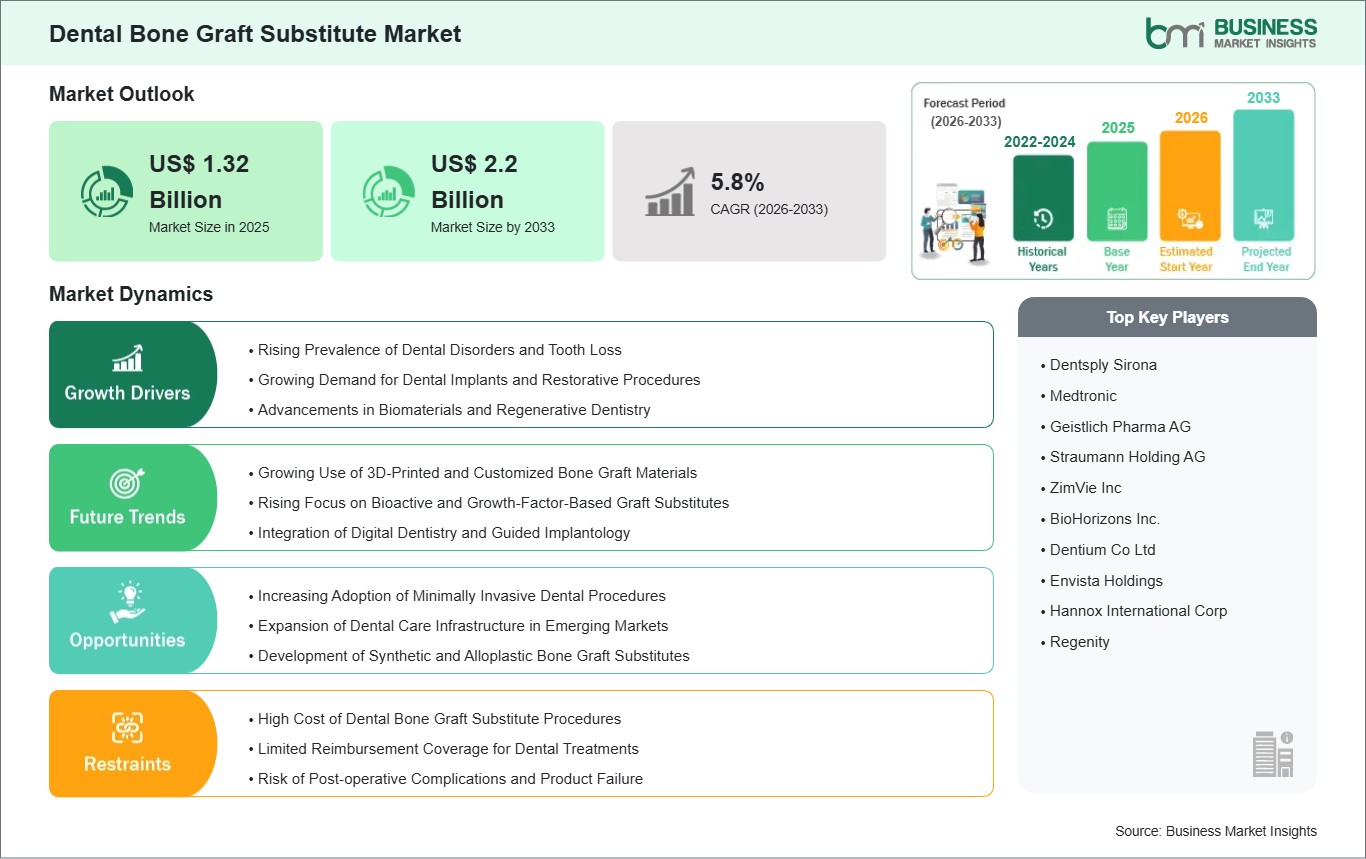
The Dental Bone Graft Substitute Market size is expected to reach US$ 2.2 Billion in 2033 from US$ 1.32 Billion in 2025. The market is estimated to record a CAGR of 5.8% from 2026 to 2033.
Dental bone graft substitutes are biocompatible materials that are used to replace or regenerate the jawbone's missing structure caused by various factors such as loss of teeth, accident, periodontal disease, and infection. These substitutes act as a scaffold for new bone to grow and are commonly used in dental implant surgeries, ridge augmentation, sinus lifts, and periodontal regeneration. The main types are synthetic (alloplastic), xenograft, allograft, and bioactive materials, all of which are aimed at enhancing osteoconduction and even in the case of some, osteoinduction.
The global dental bone graft substitute market is steadily growing and it is mainly fueled by the increasing number of tooth loss cases, the growing number of aged persons, and the increasing demand for dental implants and restorative dentistry. Along with that, new biomaterials such as bioactive ceramics and composite grafts are making the clinical outcomes better and the healing times shorter, thus encouraging more and more dental professionals to adopt them. Moreover, the market expansion is being aided by the rise in oral health awareness, the trend towards cosmetic dentistry, and the increase in the number of private dental practitioners. In the less developed countries, the demand is on the rise due to the better healthcare infrastructure, dental tourism, and easier access to advanced dental treatments. But on the other hand, the high cost of procedures, the limited reimbursement policies in place, and the possibility of complications after surgery still act as barriers to market growth. Overall, the market is expected to pass through the stages of innovation, increased usage of synthetic grafts, and digital dentistry technologies rather than being restricted to the conventional methods, thus supporting the long-term acceptance in dental care settings globally.

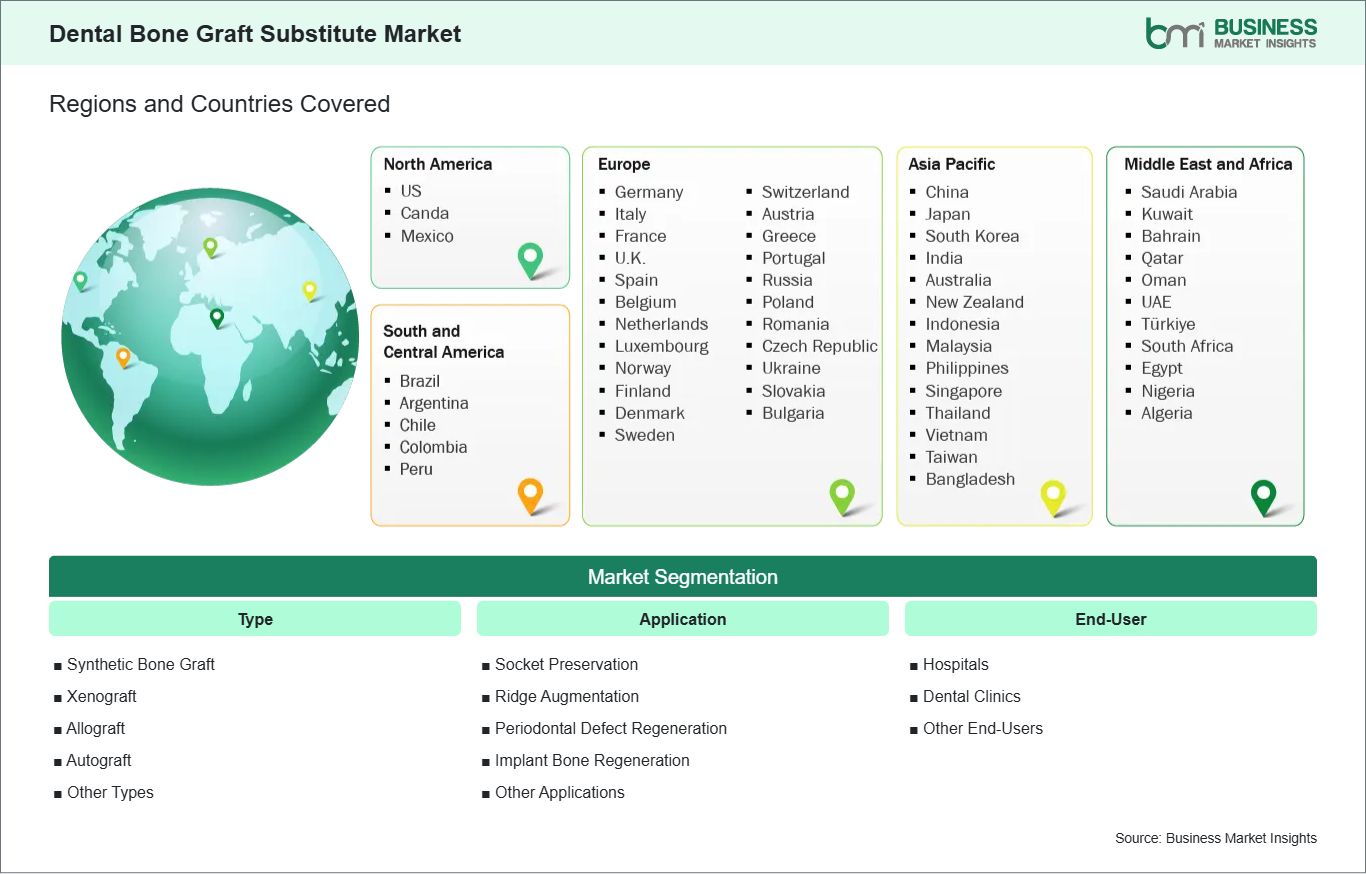
Key segments that contributed to the derivation of the dental bone graft substitute market analysis are type, application, and end-user.
The increasing global inclination towards dental procedures, especially dental implants, is one of the major reasons for the growth of the dental bone graft substitute market. This drift is associated with a fast-growing elderly population and is also influenced by people's general awareness of oral health. Recent industry reports suggest that dental implant procedures are the main reason for the majority of the bone grafts used, with about 68% of the grafts being implanted-related applications because clinicians look for effective regeneration solutions to support the success of the implants. Moreover, the WHO reports reveal that a considerable amount of the world's population has dental problems—about 2 billion adults suffer from caries and over 1 billion from periodontal diseases—which usually leads to the need for bone regeneration. The elderly population is another group demanding this greatly; they forecast that by 2030, the number of adults aged 60 years and above will reach 1.4 billion which means more cases of edentulism and bone loss that will need the dentist to perform a graft procedure. Taking all these factors into account, the clinical need for bone graft substitutes that are both reliable and biocompatible is growing across the whole world.
A solid technological innovation and product development are the best opportunities in the dental bone graft substitute market. Major companies are launching sophisticated graft materials that are designed for better clinical outcomes of the entire process. In the past few years, there have been a number of important developments: the Straumann Group came out with "NeoCera," a synthetic ceramic that has properties conducive to the adhesion of osteoblasts; Geistlich Biomaterials introduced "Bio-Oss Flex" that is malleable and easy to work with, and Zimmer Biomet Dental got the FDA’s green light for "RegenerOss Plus," a biphasic calcium phosphate graft embedding growth factor. Other strides include patient-specific bone scaffold solutions made via 3D printing—thanks to collaborations like Nobel Biocare and Desktop Health—which cut the time for surgeries and give better anatomical fit. Moreover, the launch of AI-assisted particle distribution products (e.g., MinerOss AI) and the emergence of injectable putty-form xenografts for niche procedures are further proof that the industry is going in the right direction, i.e., towards the development of more effective and user-friendly materials. This advancement in technology has the power not only to elevate the quality of treatment but also to open up new avenues for differentiation, and the expansion of the market and clinician acceptance on a global scale.
By type, the dental bone graft substitute market is categorized into synthetic bone graft, xenograft, allograft, autograft, other types. The synthetic bone graft segment held the largest share of the market in 2025. Synthetic bone grafts lead the market due to their consistent quality, unlimited availability, and lower risk of disease transmission compared to biological grafts. These materials offer predictable clinical outcomes, good osteoconductive properties, and eliminate ethical or donor-site concerns associated with autografts and allografts. Continuous advancements in biomaterials, such as bioactive ceramics and composite grafts, have improved integration and healing efficiency, making synthetic grafts the preferred choice among dental professionals globally.
By application, the market is segmented into socket preservation, ridge augmentation, periodontal defect regeneration, implant bone regeneration, other applications. The implant bone regeneration segment held the largest share of the market in 2025. Implant bone regeneration dominates because of the rapid global increase in dental implant procedures. Successful implant placement requires sufficient bone volume and density, making graft substitutes essential. Growing patient preference for permanent tooth replacement, combined with advancements in implantology and guided bone regeneration techniques, has increased graft usage. Additionally, the rise in edentulism and cosmetic dentistry demand further strengthens this segment’s leadership worldwide.
By end-user, the dental bone graft substitute market is segmented into hospitals, dental clinics, other end-users. The dental clinics segment dominated the market in 2025. Dental clinics are the leading as most dental implant and bone grafting procedures are performed in outpatient clinical settings rather than hospitals. Clinics offer specialized implantology services, advanced imaging, and faster treatment turnaround. The growing number of private dental clinics, especially in urban areas, along with increasing patient preference for specialized and cost-effective care, continues to drive higher adoption of bone graft substitutes in this segment.
| Report Attribute | Details |
|---|---|
| Market size in 2025 | US$ 1.32 Billion |
| Market Size by 2033 | US$ 2.2 Billion |
| Global CAGR (2026 - 2033) | 5.8% |
| Historical Data | 2022-2024 |
| Forecast period | 2026-2033 |
| Segments Covered | By Type
|
|
Regions and Countries Covered
| |
| North America | US, Canada, Mexico |
| Europe | Belgium, Austria, Finland, Denmark, Greece, Poland, Romania, Russia, Ukraine, Czech Republic, Slovakia, Bulgaria, Italy, Luxembourg, Germany, Switzerland, France, Netherlands, Norway, Portugal, Spain, Sweden, United Kingdom |
| Asia-Pacific | Australia, China, India, Japan, South Korea, Indonesia, Malaysia, Philippines, Singapore, Thailand, Vietnam, Bangladesh, New Zealand, Taiwan |
| South and Central America | Brazil, Argentina, Peru, Chile, Colombia |
| Middle East and Africa | Bahrain, Kuwait, Oman, Qatar, Saudi Arabia, United Arab Emirates, Turkiye, South Africa, Egypt, Algeria, Nigeria |
| Market leaders and key company profiles |
|
The " Dental Bone Graft Substitute Market Size and Forecast (2022 - 2033)" report provides a detailed analysis of the market covering below areas:
The geographical scope of the dental bone graft substitute market report is divided into five regions: North America, Asia Pacific, Europe, Middle East and Africa, and South and Central America. The dental bone graft substitute market in Asia Pacific is expected to grow significantly during the forecast period.
The Asia-Pacific dental bone graft substitute market is segmented into China, Japan, South Korea, India, Australia, New Zealand, Indonesia, Malaysia, the Philippines, Singapore, Thailand, Vietnam, Taiwan, Bangladesh, and the Rest of Asia. The Asia-Pacific dental bone graft substitute market is experiencing robust growth, due to a mixture of demographic, economic, and healthcare system factors. The large and rapidly aging population in countries like China, Japan, and South Korea leads to a higher incidence of tooth loss, periodontal disease, and jawbone degeneration. Hence, there is growth in the demand for bone regeneration procedures. The rising disposable incomes and empires of the middle-class population are the main reasons behind the high investments in advanced dental treatments including the implants which require bone graft substitutes.
Besides, the whole Asia-Pacific region is receiving enormous dental tourists every year due to the massive difference in the cost of good quality implant and grafting procedures between countries like India, Thailand, and Malaysia and the Western countries. Urbanization and the upgrading of the healthcare infrastructure have brought about the setting up of dental clinics with state-of-the-art implantology and regenerative technologies. Also, people's awareness of dental health and cosmetic dentistry supported by the government oral healthcare programs and the private sector's investments are leading to the promotion of treatment at an early stage and preventive care. Local companies are producing affordable and region-specific synthetic and xenograft products, thus, making them accessible and acceptable. In addition, a higher number of dental professionals who are trained and the use of digital dentistry and guided bone regeneration techniques are together resulting in the success of the procedures, thus, accelerating market growth in the whole Asia-Pacific region.

The dental bone graft substitute market is evaluated by gathering qualitative and quantitative data post primary and secondary research, which includes important corporate publications, association data, and databases. A few of the key developments in the dental bone graft substitute market are:
The Dental Bone Graft Substitute Market is valued at US$ 1.32 Billion in 2025, it is projected to reach US$ 2.2 Billion by 2033.
As per our report Dental Bone Graft Substitute Market, the market size is valued at US$ 1.32 Billion in 2025, projecting it to reach US$ 2.2 Billion by 2033. This translates to a CAGR of approximately 5.8% during the forecast period.
The Dental Bone Graft Substitute Market report typically cover these key segments-
The historic period, base year, and forecast period can vary slightly depending on the specific market research report. However, for the Dental Bone Graft Substitute Market report:
The Dental Bone Graft Substitute Market is populated by several key players, each contributing to its growth and innovation. Some of the major players include:
The Dental Bone Graft Substitute Market report is valuable for diverse stakeholders, including:
Essentially, anyone involved in or considering involvement in the Dental Bone Graft Substitute Market value chain can benefit from the information contained in a comprehensive market report.
Please tell us your area of interest
(Market Segments/ Regions and Countries/ Companies)