Market Summary
Executive Summary and Global Market Analysis
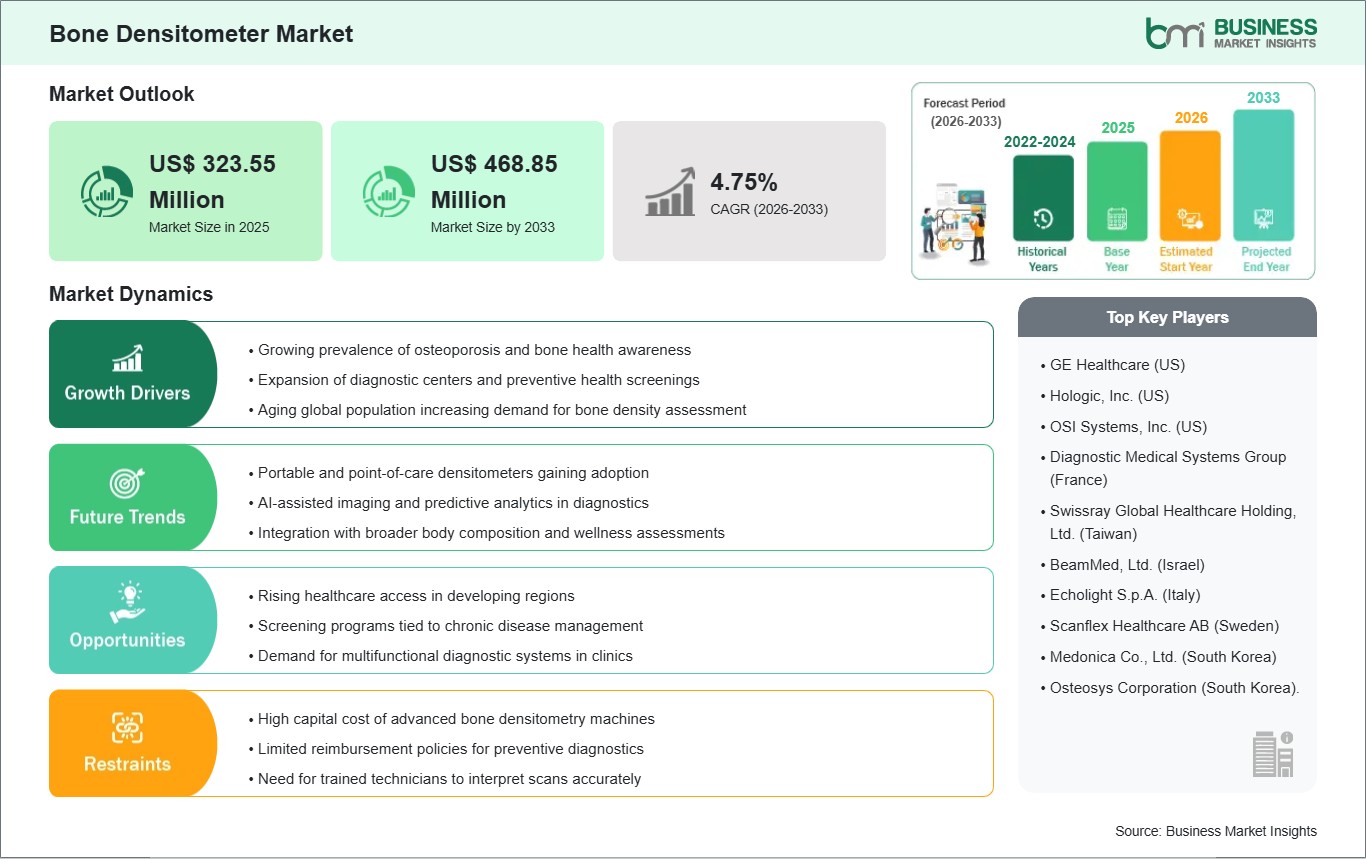
Bone Densitometers serve as essential tools which enable global healthcare professionals to diagnose and track bone health conditions through their ability to deliver instant and dependable bone mineral density and fracture risk evaluations. The system serves multiple medical purposes which include diagnosing osteoporosis and osteopenia and cystic fibrosis and chronic kidney disease (CKD) and measuring body composition and diagnosing rheumatoid arthritis. The benefits of bone densitometers include their capacity to deliver immediate test outcomes and conduct tests without harming patients and enable medical professionals to begin treatment before symptoms appear. The market experiences growth because more people develop osteoporosis while society becomes more informed about bone health and the population of senior citizens continues to increase. Diagnostic precision improves through innovations in imaging technologies and software analytics and portable densitometer systems which achieve better operational performance.
The market experiences growth constraints which arise from three main factors: expensive device prices and insufficient reimbursement policies that apply to particular areas and the requirement for specialized equipment operators. The industry experiences economic volatility which leads to operational challenges during periods when hospitals postpone noncritical medical procedures and when they need to cut their funding. The market presents substantial growth opportunities which arise from governmental bone health initiatives and the establishment of diagnostic facilities in emerging markets and the increasing adoption of user-friendly portable densitometer systems. The market will expand through research and development investments combined with developments in multi-functional diagnostic tools which include artificial intelligence capabilities.
Segment Analysis
Bone Densitometer Market Segmentation
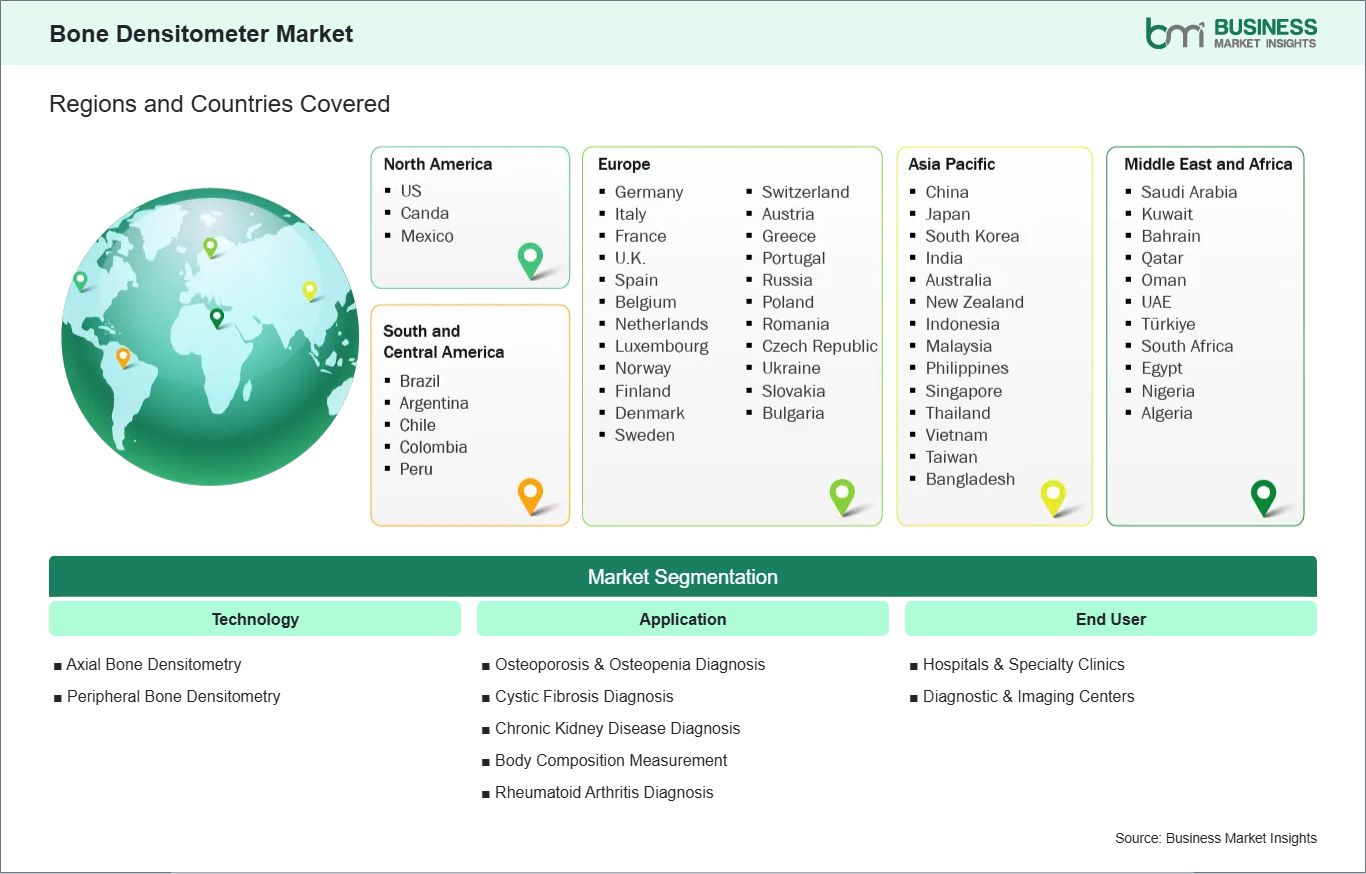
Key segments that contributed to the derivation of the Bone Densitometer market analysis are Technology, Application, End User.
- By Technology, the Bone Densitometer market is bifurcated into Axial Bone Densitometry, Peripheral Bone Densitometry. The Axial Bone Densitometry segment dominated the market in 2025.
- By Application, the market is segmented into Osteoporosis & Osteopenia Diagnosis, Cystic Fibrosis Diagnosis, Chronic Kidney Disease (CKD) Diagnosis, Body Composition Measurement, Rheumatoid Arthritis Diagnosis. The Osteoporosis & Osteopenia Diagnosis segment held the largest share of the market in 2025.
- By end user, the market is bifurcated into Hospitals & Specialty Clinics, Diagnostic & Imaging Centers. The Hospitals & Specialty Clinics segment held the largest share of the market in 2025.
Market Forces
Bone Densitometer Market Drivers and Opportunities
Rising Prevalence of Bone Disorders
The increasing rate of osteoporosis and osteopenia and other bone disorders has become the main factor that drives growth in the bone densitometer market. The healthcare industry now requires bone densitometers for early diagnosis and monitoring because people understand bone health better and the elderly population increases. The International Osteoporosis Foundation IOF projects that osteoporosis will affect more than 500 million people worldwide by 2030 which will lead to a major increase in fractures from low bone density according to their 2025 projections. The increase occurs because chronic kidney disease and rheumatoid arthritis and cystic fibrosis and sedentary behavior and poor nutrition become more common among people. The rising demand for bone health assessment solutions drives bone densitometer market expansion because diagnostic solutions need to provide accurate and fast results which healthcare providers require for patient care throughout the world.
Major hospitals and diagnostic centers and specialty clinics have expanded their screening programs and adopted advanced densitometry technologies which have resulted in major changes to their clinical protocols. Bone densitometers deliver precise measurements through non-invasive methods which produce interpretable results that help clinicians make medical decisions about existing clinical needs. The devices provide a better solution because they allow for early detection and monitoring of bone density changes which requires prompt treatment for specific patient groups.
Expansion of Diagnostic Services and Healthcare Infrastructure
The bone densitometer market experiences strong growth because healthcare facilities expand their diagnostic services and build new healthcare facilities. Healthcare providers depend on bone densitometry results because medical facilities purchase new imaging equipment and develop their preventive healthcare programs. Bone densitometers function as essential tools for contemporary bone health management because they deliver exact measurements which enable clinicians to monitor patient progress throughout treatment.
The adoption of bone densitometers has increased because government programs improve reimbursement systems and specialized osteoporosis clinics create new opportunities for both developed and developing countries. High-risk populations such as postmenopausal women, elderly individuals, and patients with chronic illnesses benefit significantly from these devices, as they allow early intervention and improved patient outcomes.
The medical device industry needs to develop new products because its diagnostic methods keep transforming. The new development involves creating portable bone densitometers which operate through artificial intelligence and function as multiple medical tools to assist in complete patient examination. The healthcare system will see growing demand for advanced bone densitometer technology because healthcare providers need to manage rising patient numbers while patients become more aware of their bone health requirements.
Size and Share Analysis
Bone Densitometer Market Size and Share Analysis
By Technology, the Bone Densitometer market is bifurcated into Axial Bone Densitometry, Peripheral Bone Densitometry. The Axial Bone Densitometry segment dominated the market in 2025. Axial bone densitometry dominates due to its high accuracy, widespread adoption in clinical settings, ability to assess major fracture-prone sites, strong physician preference, and proven reliability for monitoring bone mineral density effectively.
By Application, the market is segmented into Osteoporosis & Osteopenia Diagnosis, Cystic Fibrosis Diagnosis, Chronic Kidney Disease (CKD) Diagnosis, Body Composition Measurement, Rheumatoid Arthritis Diagnosis. The Osteoporosis & Osteopenia Diagnosis segment held the largest share of the market in 2025. Osteoporosis & osteopenia diagnosis leads the market as these conditions are highly prevalent, especially among aging populations, requiring regular monitoring, early detection, and preventive care, making bone densitometers essential in clinical practice.
By end user, the market is bifurcated into Hospitals & Specialty Clinics, Diagnostic & Imaging Centers. The Hospitals & Specialty Clinics segment held the largest share of the market in 2025. Hospitals and specialty clinics dominate because they perform the highest volume of bone density assessments, have access to advanced densitometry equipment, skilled technicians, and offer comprehensive patient management programs for bone health.
Report Coverage
Bone Densitometer Market Report Coverage and Deliverables
The "Bone Densitometer Market Size and Forecast (2022-2033)" report provides a detailed analysis of the market covering below areas:
- Bone Densitometer market size and forecast at global, regional, and country levels for all the key market segments covered under the scope
- Bone Densitometer market trends, as well as market dynamics such as drivers, restraints, and key opportunities
- Bone Densitometer market analysis covering key market trends, global and regional framework, major players, regulations, and recent market developments
- Industry landscape and competition analysis covering market concentration, heat map analysis, prominent players, and recent developments for the Bone Densitometer market
- Detailed company profiles, including SWOT analysis
Geographic Insights
Bone Densitometer Market Geographic Insights
The geographical scope of the Bone Densitometer market report is divided into five regions: North America, Asia Pacific, Europe, Middle East & Africa, and South & Central America. The Bone Densitometer market in Asia Pacific is expected to grow significantly during the forecast period.
The Asia-Pacific Bone Densitometer market is segmented into China, Japan, South Korea, India, Australia, New Zealand, Indonesia, Malaysia, the Philippines, Singapore, Thailand, Vietnam, Taiwan, Bangladesh, and the Rest of Asia. The Asia-Pacific bone densitometer market is experiencing robust growth, driven by the rapid rise in osteoporosis and osteopenia cases, increasing prevalence of chronic diseases such as CKD and rheumatoid arthritis, and the growing demand for preventive healthcare and body composition assessment. Major economies like China and India are leading the way, fueled by increasing healthcare infrastructure investments, expansion of hospitals and specialty clinics, and the development of advanced diagnostic centers.
The region is also witnessing increased adoption of advanced diagnostic technologies, including axial and peripheral bone densitometers, AI-based analysis software, and portable densitometer systems particularly relevant for osteoporosis screening and body composition measurement. Expansion of hospital capacities, alongside training of skilled technicians and enhanced healthcare accessibility, is improving operational efficiency and diagnostic accuracy. Additionally, the surge in aging populations, rising awareness of bone health, and increasing medical tourism, coupled with the growth of preventive healthcare programs, is positioning Asia-Pacific as a key hub in the global bone densitometer market. The rise of government initiatives and strong infrastructure development across major healthcare corridors further solidifies the region’s dominant market position
Industry Activity
Recent Developments
The Bone Densitometer market is evaluated by gathering qualitative and quantitative data post primary and secondary research, which includes important corporate publications, association data, and databases. A few of the key developments in the Bone Densitometer market are:
- In October 2025, Echolight, a global innovator in bone densitometry, will be exhibiting at the Radiological Society of North America (RSNA) 2025 Congress to demonstrate bone density scanning capabilities.
- In November 2024, Echolight, a global innovator in bone densitometry, announced that it has signed an agreement enabling Siemens Healthineers to be a reseller of Echolight bone densitometers in support of their Women's Health solutions.
- In February 2024, Supporting the Diagnosis of Bone-related Diseases, FUJIFILM India Installs an Advanced DEXA Machine in Delhi. FUJIFILM India aspires to give hope to millions of patients suffering from bone-related diseases in India, by upgrading the diagnostic capabilities in healthcare facilities
Trust & Transparency
Research Methodology
The market analysis combines proprietary research with secondary data from government agencies, company disclosures, regulatory filings, industry databases and expert interviews. Market estimates are validated through data triangulation, cross-market benchmarking and analyst
review.
View Full Research Methodology
Key Sources Referred:
World Bank - Global Trade IndicatorsAmerican Medical Association (AMA)National Center for Biotechnology Information (NCBI)National Library of Medicine (NLM)Centers for Disease Control and Prevention (CDC)Company websiteNational Institutes of Health (NIH)International Hospital Federation (IHF)Company annual reportsCompany investor presentations