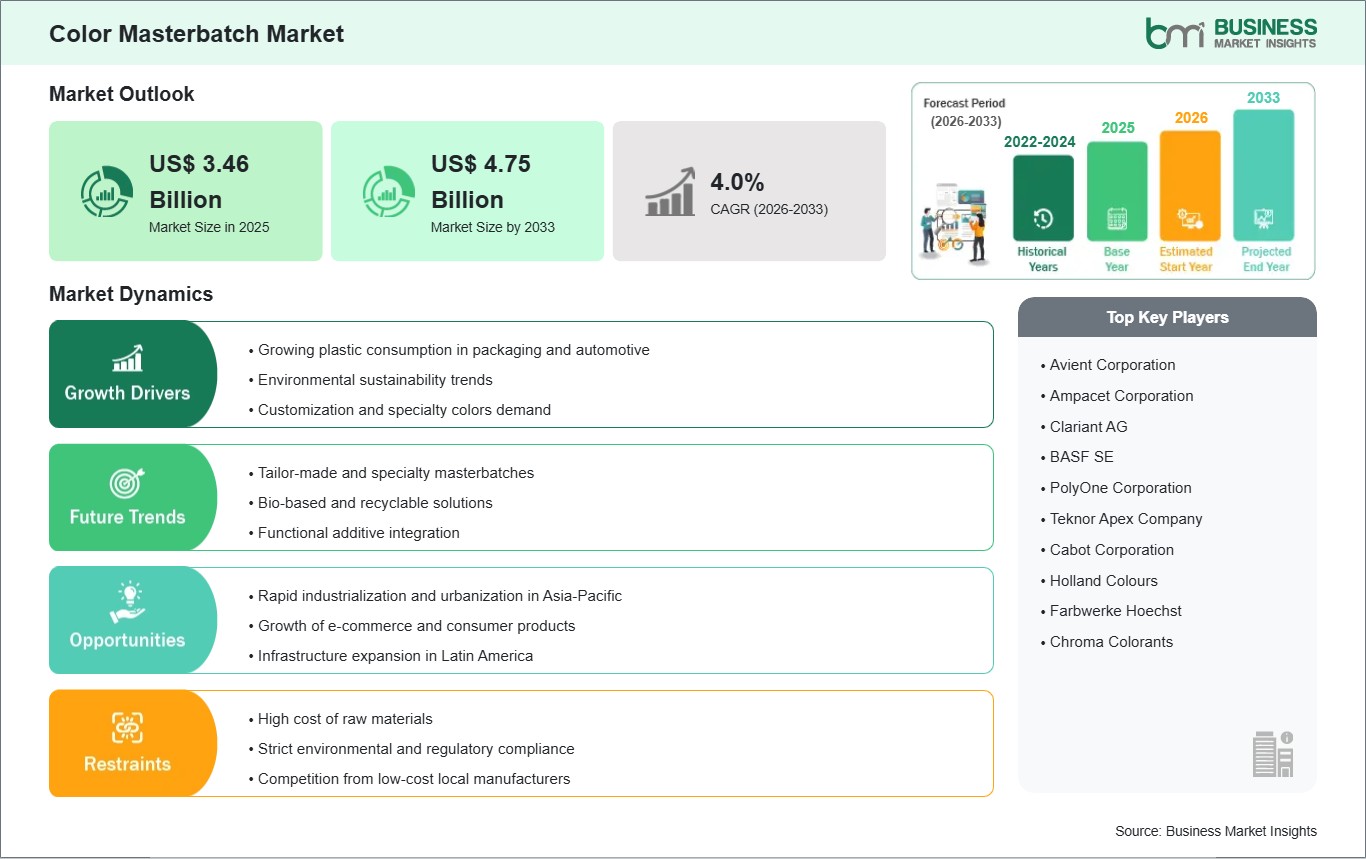
The Color Masterbatch Market size is expected to reach US$ 4.75 billion by 2033 from US$ 3.46 billion in 2025. The market is estimated to record a CAGR of 4.0% from 2026 to 2033.
The global color masterbatch market is driven by its crucial role in imparting consistent, high-quality coloration and performance-enhancing additives across plastic products used in diverse industries. Color masterbatches combine pigments and additives with carrier resins to deliver precise and durable color solutions during plastic processing.
Demand is propelled by growth in plastic consumption within packaging, automotive, consumer goods, and construction sectors. Increasing product customization and demand for specialty and tailor-made colors support innovation and market expansion. Environmental regulations and consumer preference for sustainable, eco-friendly materials are encouraging development of bio-based and recyclable masterbatches.
Innovation in carrier resin technologies, pigment formulation, and additive functionalities is shaping competitive dynamics. Manufacturers focus on product differentiation, regulatory compliance, and sustainability to meet evolving market demands globally.

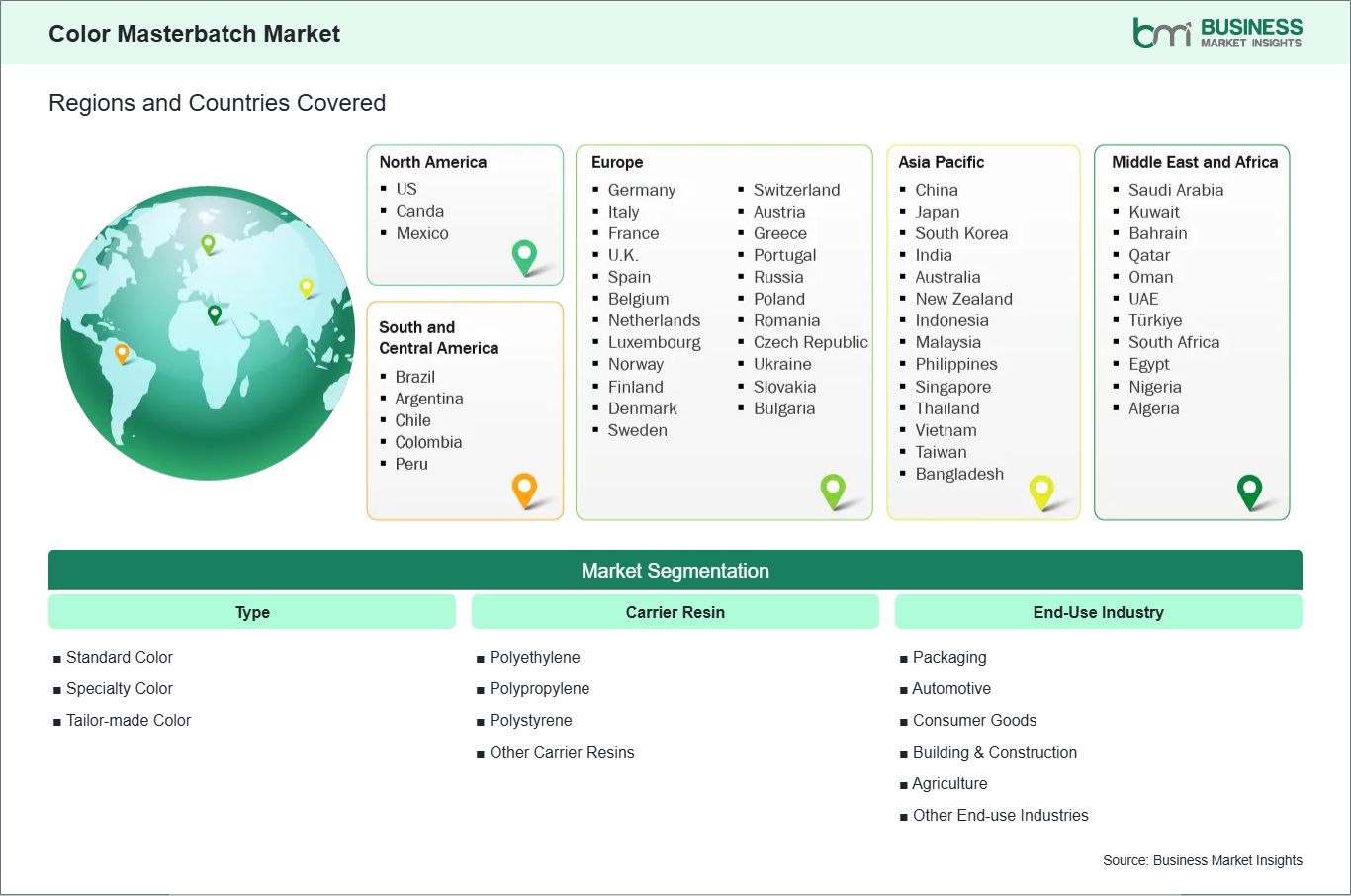
Key segments that contributed to the derivation of the color masterbatch market analysis are type, carrier resin, and end-use industry.
The worldwide load of colored plastic additives ("compound colored") is directly affected by the growing use of plastics in both the packaging and automobile industries. Color additives have become an integral part of the packaging industry due to their adaptability, resiliency, and economical nature; they can also provide substantial amounts of color enhancement to create attractive and easily recognizable products, which are very important in a highly competitive retail environment because the packaging will be the first contact consumers make with a company/brand.
In addition to adding visual appeal, color additives may also contain functional components such as ultraviolet absorbers, anti-clog substances, anti-bacterial agents, etc., in order to enhance packaging performance, extend shelf life, and provide safety within the packaging.
With the growth of electronic commerce, the demand for attractive, long-lasting, and functional packaging is also growing. Simultaneously, the growth of environmental sustainability has led to an increase in biodegradability and recyclability of colored plastics, promoting innovation within this industry.
In the automotive industry, plastic materials are being adopted at a rapid pace to replace traditional materials to decrease vehicle weight, improve vehicle gas mileage, and reduce vehicle manufacturing costs using colored plastic compounds and colorants. Color additive compounds (masterbatches), therefore, play a large and important part in the manufacture of durable, lightweight, and visually pleasing automobile parts, such as dashboards, interior trim, bumpers, lighting fixtures, etc., as a result of the consistent color throughout the automobile's life and the UV resistance/long-term performance of these colored component.
Customised colour masterbatches allow users to select specific colours or additives for different plastics, resulting in innovation and enhanced efficiency of products and production. This segment will experience growth due to an increase in demand for unique decoration and improved functionality for the end user.
Trends toward sustainability generate interest in the creation of biodegradable or recyclable, and/or low-impact masterbatch products that comply with globally accepted environmental standards such as REACH and RoHS. These eco-friendly products are developed to meet the expectations of consumers, as well as the requirements established by regulations, especially in Europe and North America.
The development of electronic, agricultural, and construction markets is creating the need for specialty masterbatches that perform beyond providing colour, such as providing UV protection, anti-static and flame-retardant properties. Furthermore, the growth of e-commerce and consumer products is driving the demand for visually attractive and high-functioning packaging.
Asia Pacific and Latin America are both experiencing growth from urbanization and industrialization, with manufacturers investing in R&D to improve the dispersion, colour permanence, and plastic compatibility of masterbatches, thereby continuing to create a dynamic marketplace that is innovative.

The Color Masterbatch Market demonstrates steady growth, with size and share analysis highlighting evolving trends and competitive dynamics among key players. The report examines subsegments categorized within type, carrier resin, and end-use industry, offering insights into their contribution to overall market performance.
By type, the standard color subsegment dominated in 2025 due to broad mass-production use.
By carrier resin, the polypropylene subsegment led in 2025, reflecting its dominance in packaging and automotive applications.
By end-use industry, the packaging subsegment dominated in 2025, driven by extensive use of colored plastics for branding and protection.
| Report Attribute | Details |
|---|---|
| Market size in 2025 | US$ 3.46 Billion |
| Market Size by 2033 | US$ 4.75 Billion |
| Global CAGR (2026 - 2033) | 4.0% |
| Historical Data | 2022-2024 |
| Forecast period | 2026-2033 |
| Segments Covered | By Type
|
|
Regions and Countries Covered
| |
| North America | US, Canada, Mexico |
| Europe | Belgium, Austria, Finland, Denmark, Greece, Poland, Romania, Russia, Ukraine, Czech Republic, Slovakia, Bulgaria, Italy, Luxembourg, Germany, Switzerland, France, Netherlands, Norway, Portugal, Spain, Sweden, United Kingdom |
| Asia-Pacific | Australia, China, India, Japan, South Korea, Indonesia, Malaysia, Philippines, Singapore, Thailand, Vietnam, Bangladesh, New Zealand, Taiwan |
| South and Central America | Brazil, Argentina, Peru, Chile, Colombia |
| Middle East and Africa | Bahrain, Kuwait, Oman, Qatar, Saudi Arabia, United Arab Emirates, Turkiye, South Africa, Egypt, Algeria, Nigeria |
| Market leaders and key company profiles |
|
The "Color Masterbatch Market Size and Forecast (2022 - 2033)" report provides a detailed analysis of the market covering below areas:
The geographical scope of the Color Masterbatch Market report is divided into North America, Asia Pacific, Europe, Middle East & Africa, and South & Central America. North America held the largest share in 2025.
North America holds the largest share in the global color masterbatch market as of 2025, driven by a mature industrial base, advanced manufacturing capabilities, and high demand from key end-use industries such as packaging, automotive, consumer goods, and building & construction. The United States and Canada are at the forefront, supported by a well-established plastics industry that continually seeks innovative and sustainable color masterbatch solutions to meet stringent regulatory standards and evolving consumer preferences.
In North America, the increasing emphasis on sustainability and environmental compliance is encouraging manufacturers to develop bio-based and recyclable color masterbatches, enhancing product appeal among eco-conscious consumers and brands. The robust automotive sector, including electric vehicle production, demands high-performance color masterbatches that provide durability, UV resistance, and flame retardancy, further strengthening market growth.
Europe follows closely, characterized by strong regulatory frameworks such as REACH and RoHS that drive the adoption of eco-friendly and high-quality masterbatches. Countries like Germany, France, and the UK lead in specialty and tailor-made color masterbatch consumption, fueled by demand from automotive and packaging industries emphasizing both aesthetics and sustainability.
Asia Pacific is the fastest-growing region due to rapid industrialization, urbanization, and expanding plastic consumption in countries like China, India, and Southeast Asia. The rising middle class, growing e-commerce, and increasing infrastructure development propel demand for color masterbatches, particularly in packaging and automotive sectors.
Emerging markets in Latin America and the Middle East & Africa are witnessing steady growth, supported by expanding consumer goods production and infrastructure projects. However, market penetration remains moderate due to pricing sensitivity and developing regulatory environments.
Across all regions, innovation in sustainable solutions and tailored products will be pivotal in shaping the competitive landscape and driving future growth.

The Color Masterbatch Market is evaluated by gathering qualitative and quantitative data post primary and secondary research, which includes important corporate publications, association data, and databases. A few of the key developments in the color masterbatch market are:
The Color Masterbatch Market is valued at US$ 3.46 Billion in 2025, it is projected to reach US$ 4.75 Billion by 2033.
As per our report Color Masterbatch Market, the market size is valued at US$ 3.46 Billion in 2025, projecting it to reach US$ 4.75 Billion by 2033. This translates to a CAGR of approximately 4.0% during the forecast period.
The Color Masterbatch Market report typically cover these key segments-
The historic period, base year, and forecast period can vary slightly depending on the specific market research report. However, for the Color Masterbatch Market report:
The Color Masterbatch Market is populated by several key players, each contributing to its growth and innovation. Some of the major players include:
The Color Masterbatch Market report is valuable for diverse stakeholders, including:
Essentially, anyone involved in or considering involvement in the Color Masterbatch Market value chain can benefit from the information contained in a comprehensive market report.
Please tell us your area of interest
(Market Segments/ Regions and Countries/ Companies)