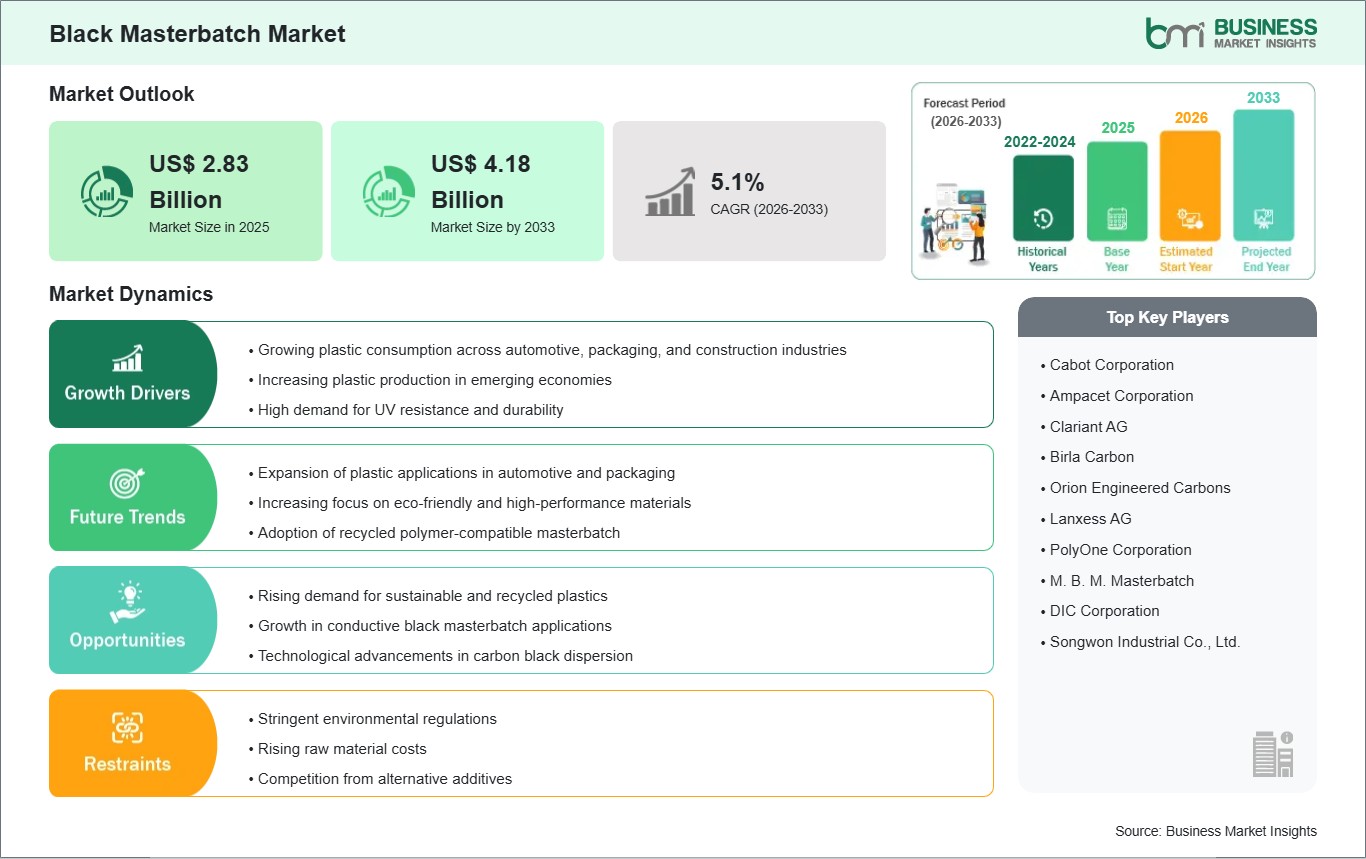
The Black Masterbatch Market size is expected to reach US$ 4.18 billion by 2033 from US$ 2.83 billion in 2025. The market is estimated to record a CAGR of 5.1% from 2026 to 2033.
The global black masterbatch market is expanding steadily due to the rising demand for functional and aesthetic enhancements in plastic products across multiple industries. Black masterbatch, composed of carbon black dispersed in a polymer carrier, is widely used to impart color, UV resistance, conductivity, and durability to plastic components. It plays a crucial role in enhancing the performance and lifespan of products in packaging, automotive, infrastructure, and electronics sectors.
Market growth is supported by increasing plastic consumption globally, particularly in emerging economies where industrialization and urbanization are accelerating. The demand for high-quality, uniform coloration and protection against environmental degradation has driven widespread adoption of black masterbatch solutions. Additionally, the growing use of plastics in outdoor applications has increased the need for UV-resistant formulations.
Competitive dynamics focus on improving dispersion quality, enhancing jetness, and developing specialty masterbatch formulations tailored to specific applications. Companies are also emphasizing sustainability by introducing products compatible with recycled polymers. Technological advancements and strategic collaborations with plastic processors and end-use industries are further shaping the competitive landscape.

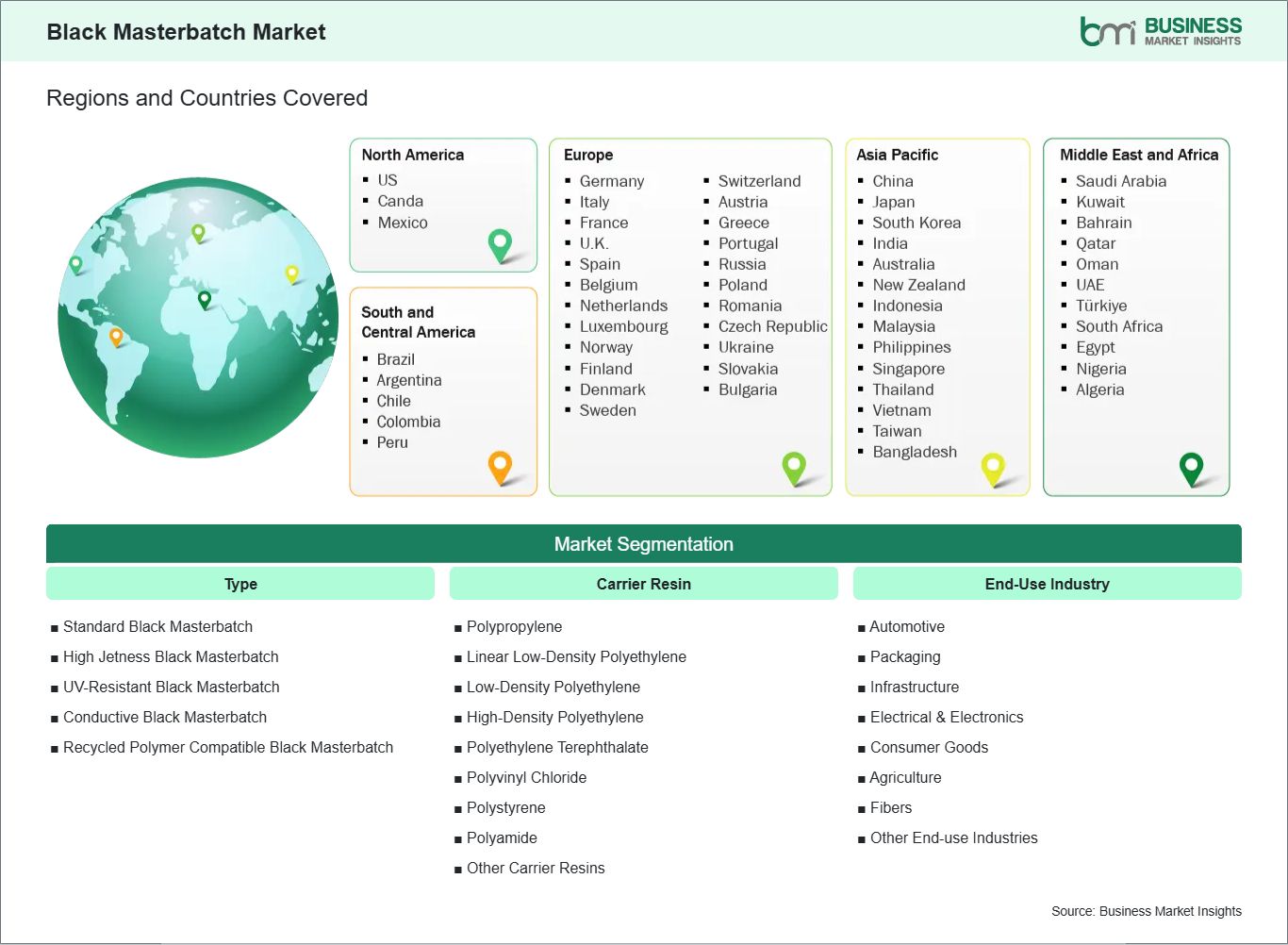
Key segments that contributed to the derivation of the black masterbatch market analysis are type, carrier resin, and end-use industry.
Black masterbatch is used in various industries such as automotive packaging and construction. Its increasing use is due to the rise in plastic production and consumption in these industries. Black masterbatch provides significantly greater durability UV stability and appearance to the end product. The use of black masterbatch in films containers and pipes in the packaging industry is to provide both opacity and protection from light making sure that products are safe and have a longer shelf experience. The automotive industry is also a major user of black masterbatch, utilizing it on both the interior and exterior of vehicles. It improves aesthetics resists environmental factors such as heat and UV light and aids the shift to lightweight materials.
As automobile manufacturers are using more plastics instead of metals to reduce the weight and fuel economy of their automobiles, the demand for black masterbatch is expected to continue to grow. In the construction industry, black masterbatch is an important component used to manufacture pipes cables and fittings, all of which require durable materials in harsh environments. The increase in processing technology and the demand for high-performance plastics are leading manufacturers to further expand the market for black masterbatch. As manufacturers are innovating and expanding their operations globally, the demand for black masterbatch is expected to continue to grow, reinforcing black masterbatch as a crucial additive for the plastic manufacturing industry.
As there is more attention being paid to sustainable practices and methods in relation to circular economies, a number of new growth opportunities will emerge as a result of developing solutions that work with recycled plastics by black masterbatch manufacturers. This allows them to produce high-quality recycled materials, while maintaining their initially intended functionality and appearance. In the general market (including packaging and consumer goods), using a recycled polymer-compatible black masterbatch is steadily increasing due to the fact that sustainability has become an increasingly significant part of how consumers evaluate businesses. These types of solutions increase the visual appearance and continuity of recycled plastics, thus making them usable for commercial purposes.
Furthermore, developments in conductive black masterbatches have created new opportunities for developing other types of electronic and electrical components, such as cables, housings and connectors. The advancement of carbon black dispersion and formulations have improved product performance, efficiency, and durability. Both industries are being pressured to adopt more eco-friendly materials as regulations become more stringent and consumers are becoming more aware of these issues. There has been a surge of interest in sustainable black masterbatch solutions due to regulatory support, new innovative technologies and a growing preference from consumers for "green" types of products, resulting in new growth opportunities for black masterbatch towards creating a sustainable plastic manufacturing future.
The Black Masterbatch Market demonstrates steady growth, with size and share analysis highlighting evolving trends and competitive dynamics among key players. The report examines subsegments categorized within type, carrier resin, and end-use industry, offering insights into their contribution to overall market performance.
By type, the standard black masterbatch subsegment dominated the market in 2025, driven by its widespread applicability and cost-effectiveness.
Based on carrier resin, the polypropylene subsegment dominated the market in 2025 due to high consumption of polypropylene in packaging and automotive applications.
In terms of end-use industry, the packaging subsegment dominated in 2025, supported by rising demand for durable and UV-protected plastic packaging solutions.
| Report Attribute | Details |
|---|---|
| Market size in 2025 | US$ 2.83 Billion |
| Market Size by 2033 | US$ 4.18 Billion |
| Global CAGR (2026 - 2033) | 5.1% |
| Historical Data | 2022-2024 |
| Forecast period | 2026-2033 |
| Segments Covered | By Type
|
|
Regions and Countries Covered
| |
| North America | US, Canada, Mexico |
| Europe | Belgium, Austria, Finland, Denmark, Greece, Poland, Romania, Russia, Ukraine, Czech Republic, Slovakia, Bulgaria, Italy, Luxembourg, Germany, Switzerland, France, Netherlands, Norway, Portugal, Spain, Sweden, United Kingdom |
| Asia-Pacific | Australia, China, India, Japan, South Korea, Indonesia, Malaysia, Philippines, Singapore, Thailand, Vietnam, Bangladesh, New Zealand, Taiwan |
| South and Central America | Brazil, Argentina, Peru, Chile, Colombia |
| Middle East and Africa | Bahrain, Kuwait, Oman, Qatar, Saudi Arabia, United Arab Emirates, Turkiye, South Africa, Egypt, Algeria, Nigeria |
| Market leaders and key company profiles |
|
The "Black Masterbatch Market Size and Forecast (2022 - 2033)" report provides a detailed analysis of the market covering below areas:
The geographical scope of the Black Masterbatch Market report is divided into North America, Asia Pacific, Europe, Middle East & Africa, and South & Central America. North America held the largest share in 2025.
Regional market dynamics for black masterbatch are shaped by industrial growth, plastic consumption, and regulatory frameworks, with North America emerging as the largest regional market. The region benefits from advanced manufacturing capabilities, strong demand for high-performance plastics, and a growing emphasis on sustainability. In the U.S. and Canada, black masterbatch is widely used across packaging, automotive, and construction industries, where durability, UV stability, and aesthetics are critical. The presence of leading polymer manufacturers and continuous investment in research and development further strengthens North America’s dominance.
Asia Pacific, however, remains a powerhouse in terms of production and consumption, driven by strong manufacturing activity, an expanding packaging industry, and rising demand for consumer goods in countries such as China and India. Rapid industrialization and urbanization are fueling the use of plastics, while cost-effective production capabilities make the region highly competitive. Although Asia Pacific leads in volume, North America maintains its position as the largest market due to higher adoption of advanced and sustainable solutions.
Europe represents a mature market, characterized by strict regulatory frameworks and a strong focus on eco-friendly materials. The region’s emphasis on reducing carbon footprints and promoting circular economy practices has accelerated the adoption of sustainable black masterbatch solutions.
Emerging regions such as the Middle East & Africa and South & Central America are witnessing steady growth, supported by infrastructure development and industrial expansion. As sustainability trends and advancements in polymer processing technologies continue to evolve, all regions are expected to contribute to the steady expansion of the global black masterbatch market, with North America retaining its leadership role.

The Black Masterbatch Market is evaluated by gathering qualitative and quantitative data post primary and secondary research, which includes important corporate publications, association data, and databases. A few of the key developments in the black masterbatch market are:
The Black Masterbatch Market is valued at US$ 2.83 Billion in 2025, it is projected to reach US$ 4.18 Billion by 2033.
As per our report Black Masterbatch Market, the market size is valued at US$ 2.83 Billion in 2025, projecting it to reach US$ 4.18 Billion by 2033. This translates to a CAGR of approximately 5.1% during the forecast period.
The Black Masterbatch Market report typically cover these key segments-
The historic period, base year, and forecast period can vary slightly depending on the specific market research report. However, for the Black Masterbatch Market report:
The Black Masterbatch Market is populated by several key players, each contributing to its growth and innovation. Some of the major players include:
The Black Masterbatch Market report is valuable for diverse stakeholders, including:
Essentially, anyone involved in or considering involvement in the Black Masterbatch Market value chain can benefit from the information contained in a comprehensive market report.
Please tell us your area of interest
(Market Segments/ Regions and Countries/ Companies)