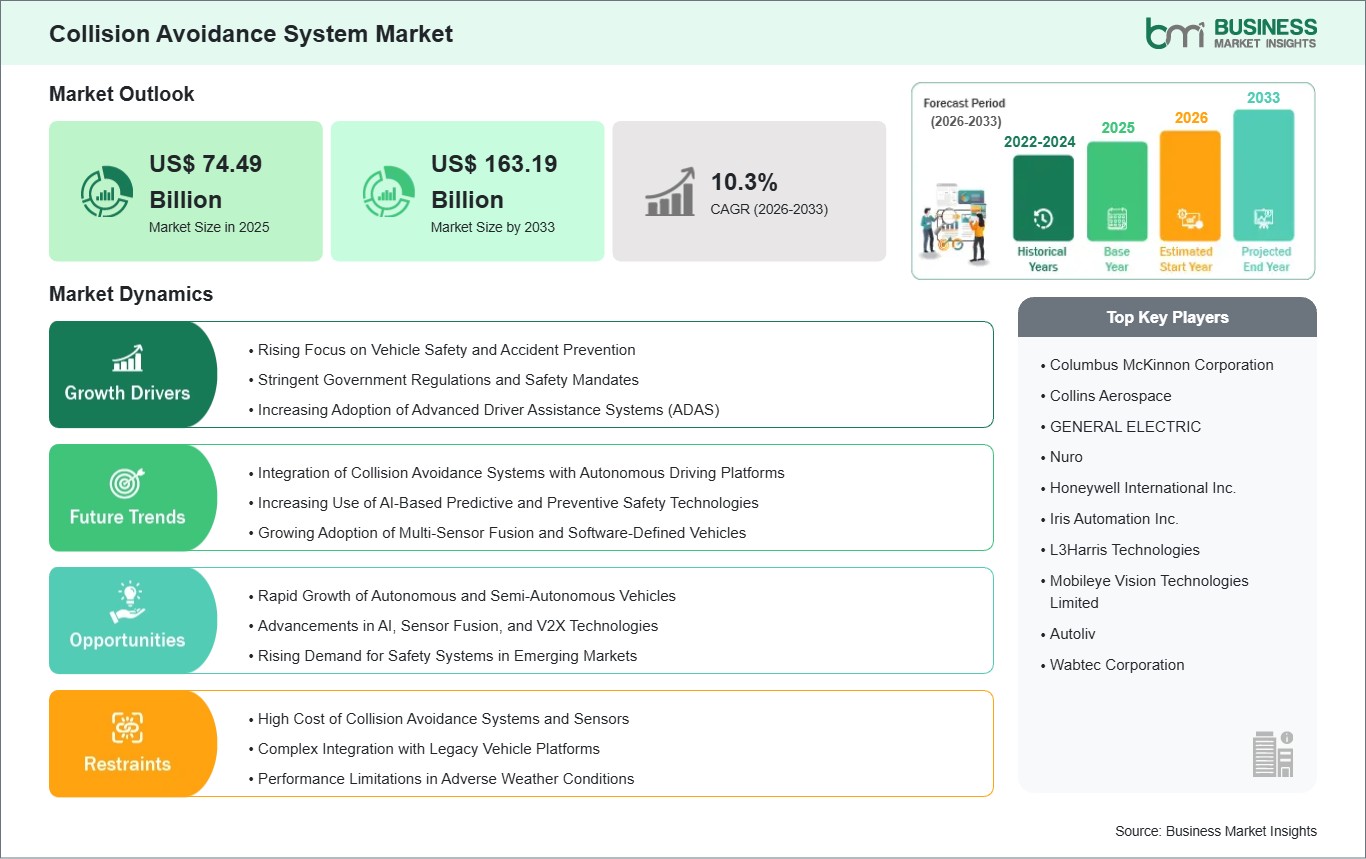
The collision avoidance system market size is expected to reach US$ 163.19 billion by 2033 from US$ 74.49 billion in 2025. The market is estimated to record a CAGR of 10.3% from 2025 to 2033.
Collision avoidance systems have emerged as an essential element across multiple industries, particularly in the automotive and transportation sectors, for ensuring safety and operational continuity. Collision avoidance systems, including radar-based systems, camera-based systems, LiDAR sensors, ultrasonic sensors, and sensor fusion solutions, are increasingly used in passenger vehicles, commercial vehicles, autonomous vehicles, and industrial mobility applications. These systems have also gained significant adoption in aviation, marine, and industrial automation environments. Collision avoidance solutions help organizations and vehicle operators achieve several advantages, including accident prevention, real-time hazard detection, improved situational awareness, reduced human error, and enhanced compliance with safety regulations. The growth of advanced driver assistance systems (ADAS), autonomous vehicle development, rising road safety concerns, and stringent government safety regulations have generated strong focus on the implementation of collision avoidance systems.
However, the collision avoidance system market faces several challenges that may restrain its growth. These include the high cost of system development and deployment, the complexity of integrating multiple sensor technologies, interoperability issues with legacy vehicle platforms, and the need for continuous calibration and software updates. Capital investment requirements, along with varying safety and regulatory standards across regions, also influence market adoption. Despite these challenges, the collision avoidance system market presents strong growth opportunities, driven by increasing adoption of autonomous and semi-autonomous vehicles, advancements in AI-based perception technologies, growing demand for vehicle safety features, and the rising need for intelligent and automated safety systems.

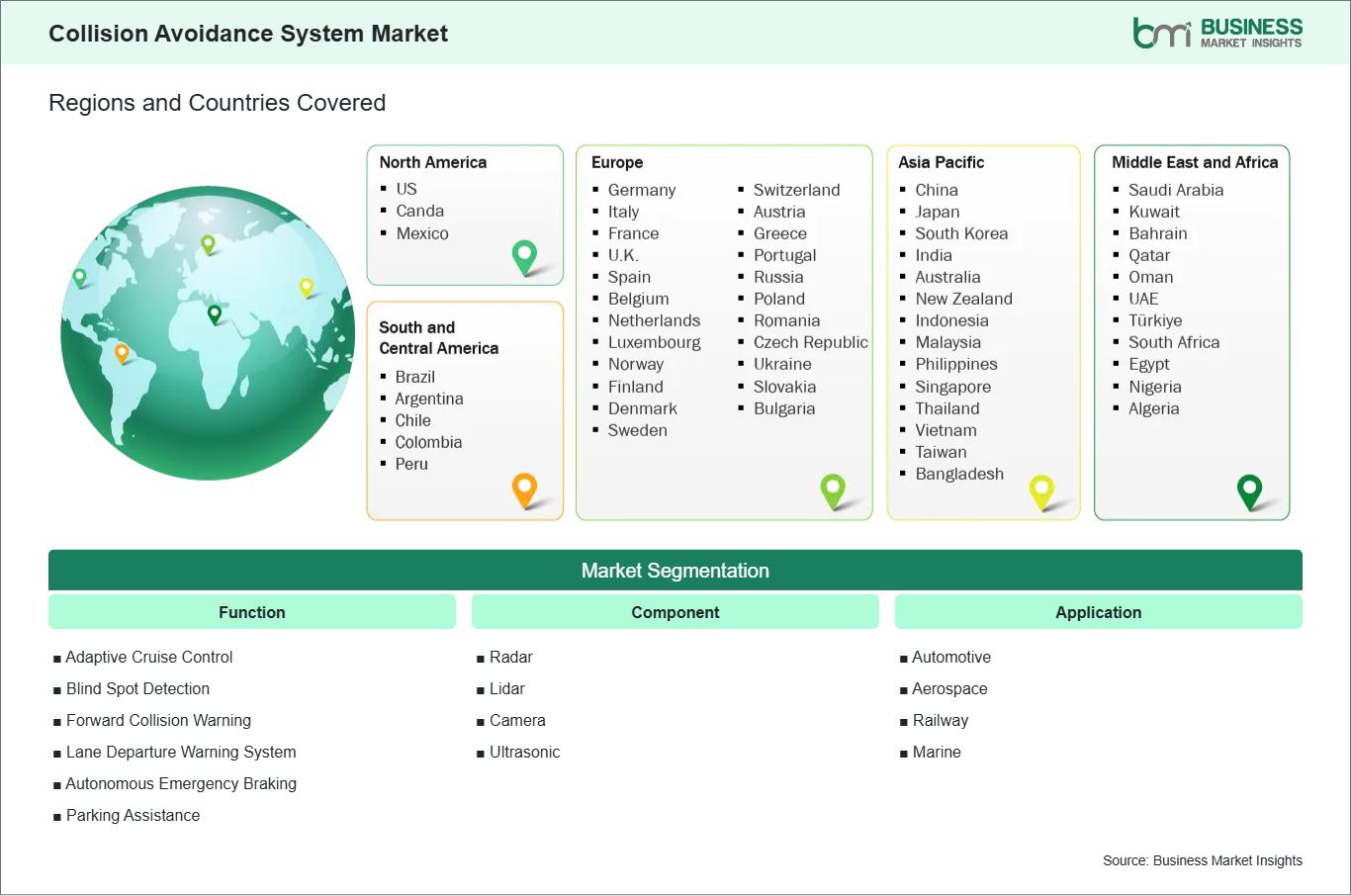
Key segments that contributed to the derivation of the collision avoidance system market analysis are function, component, and application.
The collision avoidance system market is primarily driven by the growing emphasis on vehicle safety and the implementation of stringent government regulations across major economies. Regulatory authorities in regions such as North America, Europe, and Asia Pacific are mandating the inclusion of advanced safety features like automatic emergency braking, forward collision warning, and lane departure warning systems in new vehicles. Increasing road accidents, fatalities, and insurance costs have further accelerated the demand for collision avoidance technologies. Additionally, rising consumer awareness regarding vehicle safety ratings and standards has encouraged automakers to integrate collision avoidance systems as standard or optional features, thereby driving market growth.
The rapid development of autonomous and connected vehicle technologies presents a significant growth opportunity for the collision avoidance system market. As vehicles move toward higher levels of automation, the demand for advanced perception, sensing, and real-time decision-making systems continues to increase. Collision avoidance systems play a critical role in enabling safe autonomous operations by detecting obstacles, pedestrians, and other vehicles. Moreover, the integration of artificial intelligence, sensor fusion, and vehicle-to-everything (V2X) communication is expected to enhance system accuracy and reliability. This evolution is creating strong opportunities for technology providers and automotive manufacturers worldwide.
By function, the collision avoidance system market is segmented into Adaptive Cruise Control, Blind Spot Detection, Forward Collision Warning, Lane Departure Warning System, Autonomous Emergency Braking, and Parking Assistance. The Autonomous Emergency Braking segment dominated the market in 2025 due to its widespread adoption in passenger and commercial vehicles and increasing regulatory mandates focused on vehicle safety.
By component, the collision avoidance system market is categorized into radar, LiDAR, camera, and ultrasonic sensors. The radar segment dominated the market in 2025, supported by its reliability in adverse weather conditions, long-range detection capability, and extensive integration in advanced driver assistance systems.
By application, the collision avoidance system market is divided into automotive, aerospace, railway, and marine applications. The automotive segment dominated the market in 2025, driven by rising vehicle production, increasing consumer demand for safety features, and the growing adoption of advanced driver assistance and autonomous driving technologies.
| Report Attribute | Details |
|---|---|
| Market size in 2025 | US$ 74.49 Billion |
| Market Size by 2033 | US$ 163.19 Billion |
| Global CAGR (2026 - 2033) | 10.3% |
| Historical Data | 2022-2024 |
| Forecast period | 2026-2033 |
| Segments Covered | By Function
|
|
Regions and Countries Covered
| |
| North America | US, Canada, Mexico |
| Europe | Belgium, Austria, Finland, Denmark, Greece, Poland, Romania, Russia, Ukraine, Czech Republic, Slovakia, Bulgaria, Italy, Luxembourg, Germany, Switzerland, France, Netherlands, Norway, Portugal, Spain, Sweden, United Kingdom |
| Asia-Pacific | Australia, China, India, Japan, South Korea, Indonesia, Malaysia, Philippines, Singapore, Thailand, Vietnam, Bangladesh, New Zealand, Taiwan |
| South and Central America | Brazil, Argentina, Peru, Chile, Colombia |
| Middle East and Africa | Bahrain, Kuwait, Oman, Qatar, Saudi Arabia, United Arab Emirates, Turkiye, South Africa, Egypt, Algeria, Nigeria |
| Market leaders and key company profiles |
|
The "Collision Avoidance System Market Size and Forecast (2022–2033)" report provides a detailed analysis of the market covering below areas:
The geographical scope of the collision avoidance system market report is divided into five regions: North America, Asia Pacific, Europe, Middle East & Africa, and South & Central America. The collision avoidance system market in Asia Pacific is expected to grow significantly during the forecast period.
The Asia-Pacific collision avoidance system market is segmented into China, Japan, South Korea, India, Australia, New Zealand, Indonesia, Malaysia, the Philippines, Singapore, Thailand, Vietnam, Taiwan, Bangladesh, and the Rest of Asia. The region is witnessing strong growth, driven by rapid urbanization, expanding transportation infrastructure, and rising vehicle production across developing and developed economies. Major countries such as China, Japan, and India are leading market growth due to increasing demand for vehicle safety technologies across passenger vehicles, commercial fleets, railways, and marine transportation.
The region is also experiencing growing adoption of advanced collision avoidance technologies, including radar-based systems, camera-based solutions, LiDAR, and sensor fusion technologies. Increasing road safety awareness, stricter vehicle safety regulations, and government initiatives aimed at reducing traffic accidents are further supporting market growth. Additionally, rising investments in intelligent transportation systems, the expansion of electric and autonomous vehicles, and continuous technological advancements are positioning Asia-Pacific as a key growth region in the global collision avoidance system market.

The collision avoidance system market is evaluated by gathering qualitative and quantitative data post primary and secondary research, which includes important corporate publications, association data, and databases. A few of the key developments in the collision avoidance system market are:
The Collision Avoidance System Market is valued at US$ 74.49 Billion in 2025, it is projected to reach US$ 163.19 Billion by 2033.
As per our report Collision Avoidance System Market, the market size is valued at US$ 74.49 Billion in 2025, projecting it to reach US$ 163.19 Billion by 2033. This translates to a CAGR of approximately 10.3% during the forecast period.
The Collision Avoidance System Market report typically cover these key segments-
The historic period, base year, and forecast period can vary slightly depending on the specific market research report. However, for the Collision Avoidance System Market report:
The Collision Avoidance System Market is populated by several key players, each contributing to its growth and innovation. Some of the major players include:
The Collision Avoidance System Market report is valuable for diverse stakeholders, including:
Essentially, anyone involved in or considering involvement in the Collision Avoidance System Market value chain can benefit from the information contained in a comprehensive market report.
Please tell us your area of interest
(Market Segments/ Regions and Countries/ Companies)